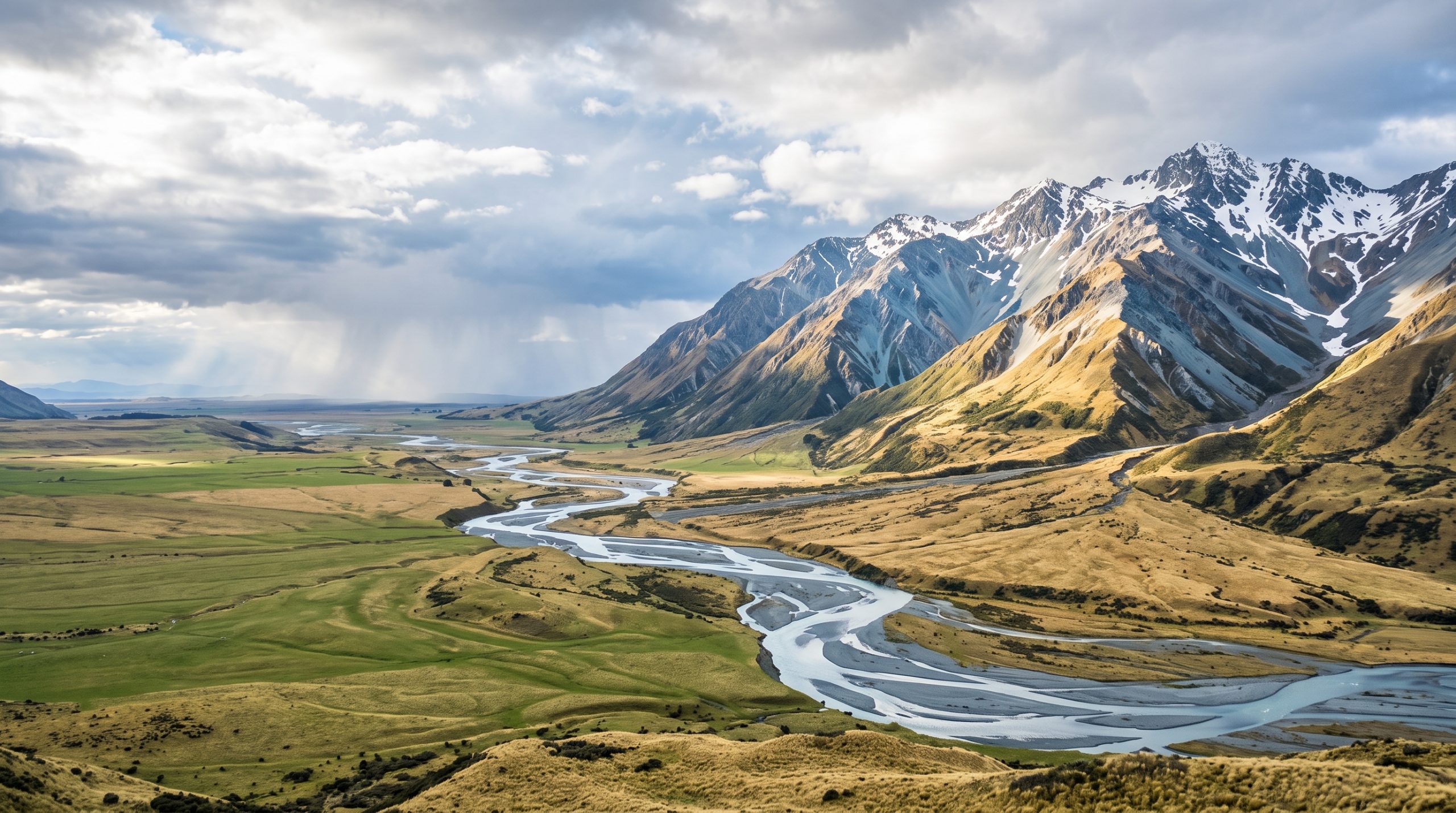
New Zealand runs your calendar backwards, and that one fact undoes most American elopement planning before it starts. December is high summer. July is deep winter. At Queenstown’s latitude the December solstice puts the sun up a few minutes before six in the morning and down at half past nine at night. Six months later the same valley gets sunrise at twenty past eight and loses the light by ten past five.
Queenstown sits at 45 degrees south, the mirror image of Portland, Oregon. The swing in daylight across the year is enormous, and it changes far more than what time you eat dinner. It decides how many locations fit inside one day, how long the warm light holds at either end, and whether a mountain road or a lake track is open at all.
We plan days here in all four seasons, from Fiordland to the Mackenzie Basin to the Bay of Islands. This is the calendar we work from, with the windows that open and shut inside three weeks and the ones that hold for months.
The three weeks we would book first
April, and specifically the first three weeks. Autumn brings the most settled air of the year to the Southern Alps, the midday sun sits low enough to be kind at any hour, the alpine roads are still on their summer pattern, and the summer crowd has gone home. The colour peaks in the second half of the month.
The month-by-month table we plan from
Daylight figures below are for Queenstown. Mountains push real sunrise later and real sunset earlier than any almanac says, sometimes by an hour or more in a deep valley, which is why we time a ceremony to a ridge rather than to a printed time.
| Month | Conditions | Light | Crowds | Our verdict |
|---|---|---|---|---|
| January | Warmest month. Westerly fronts arrive fast and clear fast | Sunset near 9:30pm, about 15 hours of daylight | The year’s busiest | Worth it only for the 9pm hour |
| February | Often the most settled stretch of summer | Sunset just before 9pm mid-month | Busy to the last week | Strong, if you accept company |
| March | Warm afternoons, cold mornings, air beginning to settle | 12 hours 27 minutes mid-month, sunset 8:10pm | Thinning weekly | Our second choice |
| April | The most settled air of the year, frost inland | Clocks go back the first Sunday, sunset 6:10pm mid-month | Quiet outside Easter week | First choice |
| May | Cold and often very clear, first snow on the tops | 9 hours 31 minutes mid-month | Almost nobody | Underrated |
| June | Winter proper, valley fog and inversion cloud inland | 8 hours 45 minutes at the solstice, noon sun only 21 degrees high | Ski traffic builds late in the month | Short day, extraordinary light |
| July | Coldest month, hoar frost on the Central Otago flats | Sunrise 8:19am mid-month | Southern school holidays peak | Works with one location, not four |
| August | Deepest snow cover, days lengthening quickly | 10 hours 13 minutes mid-month | Easing after the holidays | The best winter month |
| September | Changeable. Snow high, green low | 11 hours 44 minutes mid-month | Low | Good snow-and-daylight balance |
| October | Spring wind. Roys Peak closed for lambing until 10 November | 13 hours 18 minutes mid-month, sunset 8:10pm | Rising | Wait for November |
| November | Warming, snow still high, lupins from the last week | 14 hours 47 minutes mid-month | Building, still manageable | Excellent, especially the final ten days |
| December | High summer. The crowd lands around the 26th | 15 hours 37 minutes at the solstice, noon sun 68 degrees high | Calm to mid-month, then peak | Yes to the first half |
Windows that open and shut inside three weeks
Four things people fly here for are not seasons at all. They are short events, and two of them move.
- Mackenzie Basin lupins. Colour along the Tekapo and Pukaki shorelines runs from roughly the last week of November into mid-December. A cold spring pushes it later by a week, a warm one pulls it forward by about the same, so we hold the location decision until the fortnight before.
- Autumn colour. The poplars and larches around Arrowtown, Wanaka and the Cardrona valley hold their peak for something like two weeks in the second half of April. Willows on the lake edges turn first, larch last, which gives us a slightly wider working window than the guidebooks suggest.
- Aurora australis. The southern lights are a probability, not a plan, and the sky is only dark early enough to use them from about March to September. We shoot for the Milky Way instead. The Aoraki Mackenzie International Dark Sky Reserve delivers the galaxy on any clear moonless night, which is a far better bet than a solar storm landing on your date.
- Great Walks season. The serviced season on tracks like the Routeburn and the Milford runs from late October to late April. Outside it the huts drop to basic standard, so your date decides which valleys we can reasonably walk into.
The weeks we would move you off, and where we would move you instead
Boxing Day to about 20 January is the one stretch we push back on. Every lodge, road and lake edge in Queenstown and Wanaka is full, and the light you came for is shared with a lot of other people. The last ten days of November give you nearly the same daylight with a fraction of the traffic, and early March gives you warm water and settled evenings.
October is the other one. Spring here is genuinely unsettled, and the famous Wanaka ridgeline at Roys Peak is closed for lambing until 10 November, which removes the shot most couples have saved to a folder. Mid-November solves both problems at once.
If you want high alpine access, June and July are hard work. Eight and three-quarter hours of daylight at the solstice is not much of a day when the drive to Milford alone is two hours each way. Late August into September is the fix: full snow cover on the peaks, three or four more hours of usable light, and a country that has emptied out again.
None of that makes a July date a bad date. If your week is fixed by work or family, tell us that first and we will build around it instead of around the ideal. A Central Otago winter morning at 9am, hoar frost on the fence lines and a sun that never climbs past 23 degrees, is one of the most beautiful things we photograph anywhere, and it does not need a long day to work.
Sun angle, and why April light beats January light
At the December solstice the noon sun climbs to 68 degrees above the horizon here. That is close to overhead, and between about eleven and five it is unkind to faces, water and snow alike. What summer gives you instead is length: 15 hours 37 minutes from rim to rim, two long warm windows, and a blue hour that lingers past ten o’clock. There is room to drive somewhere else between them.
At the June solstice the noon sun tops out at 21 degrees. It never climbs high enough to go hard, so the entire 8 hours 45 minutes behaves like one continuous evening. The trade is obvious. You get beautiful light all day and very little day.
April sits between the two, with the midday sun around 35 degrees and just under eleven hours of daylight. That is the reason we name it. You can start on a lake at first light, drive an hour, and still be shooting in raking light at four in the afternoon. The one thing to watch is the clock change: New Zealand moves off daylight saving on the first Sunday in April, so an evening ceremony that would have finished at half past seven on the Saturday finishes at half past six on the Sunday. We rebuild the timeline around it rather than around a habit.
What any of this looks like once it is photographed is easier shown than described. Our published stories and films are the quickest way to see how these valleys hold up in summer green, autumn ochre and midwinter frost, and to work out which of those you actually want to marry in.
What the calendar locks: roads, tracks and tunnels
Fiordland is the big one. It is 119 kilometres from Te Anau to Milford Sound, about two hours of driving without stopping, and the last stretch climbs to the single-lane Homer Tunnel, which runs on traffic signals through the busy months. From roughly June to November the transport agency runs a snow and avalanche control programme on that road, and it can be held closed for planned control work at short notice. We treat every Milford date in those months as a two-plan day, with the ceremony hour set late enough that a hold at the tunnel costs us nothing.
Aoraki is simpler. State Highway 80 runs 55 sealed kilometres from Lake Pukaki to Mount Cook Village and stays open year round, and the Hooker Valley Track is 10 kilometres return over three swing bridges, walkable in most conditions with the right footwear. That reliability is why we lean on the Mackenzie for winter and shoulder dates.
Two more dates worth writing down. The commercial ski fields above Queenstown and Wanaka typically run from mid-June to early October, which is what fills the town in July and what puts snow within a short drive of a ceremony. And helicopter access to the glaciers and high tops is always a probability rather than a booking, so we design the day to be complete on the ground first, then add the flight if the morning gives it to us.
Rain shadow planning: the second and third locations
The Southern Alps do something very useful. The Main Divide takes almost everything out of the westerly airstream, which is why Milford Sound collects roughly six metres of rain a year while Central Otago, ninety minutes east, is one of the driest places in the country. So when a nor’wester is loading up on the west side, we do not sit and hope. We move east into Bannockburn, the Nevis or the Lindis, where the same weather system arrives as wind and high cloud instead of water.
That is what a weather plan means in practice. Named alternatives for each wind direction, chosen for the drive time from where you are sleeping, and a ceremony hour that can slide two or three hours inside the same day. All of it goes into your timeline before anyone gets on a plane, so the decision on the morning is a short message rather than a negotiation.
Season is also where having a photographer and filmmaker from the same team stops being a nicety. In June you have 8 hours 45 minutes and a two-hour drive inside it, so both cameras have to be working the same moment at once rather than taking turns. In February the 9pm sunset gives everyone room to work slowly, one at a distance and one close in, and nobody is rushing the vows to beat the dark. Our coverage is built around whole days rather than hours, and the shapes are all set out on the pricing page.
If you already have a month in mind, or a fixed week you cannot move, that is the most useful thing you can tell us. Send Us a Message with the dates and the kind of country you are drawn to, and we will tell you honestly what that week does and does not give you.
Common questions
Is December or April better for a New Zealand elopement?
April, for most couples. December gives you 15 hours 37 minutes of daylight and warm evenings, which is real. April gives you settled air, a midday sun around 35 degrees instead of 68, autumn colour from mid-month, and roads and lodges that are not full. If you want long swimming-warm evenings, take the first half of December instead.
Can we elope in Queenstown in July and still get a full day of filming?
Yes, with a different shape. Mid-July gives sunrise around 8:19am and dark by half past five, so we plan one or two locations rather than four and put the ceremony in the middle of the day. Winter light never goes harsh here, so the whole nine hours is workable. Frost, inversion cloud and snow make up for the hours you lose.
When do the lupins flower at Lake Tekapo?
Roughly the last week of November into mid-December, with the peak moving about a week either side depending on the spring. We would not book a whole trip around them. We would book late November or early December for the daylight and the snow line, then choose the exact shoreline in the fortnight before you fly.
How much rain should we expect in Fiordland?
A lot, in any month. Milford Sound takes something like six metres of rain a year, and that is what makes the walls run with waterfalls and the cloud sit in the valleys. Rain days here are not lost days, they are a different film. What we plan against is not the rain, it is the wind direction.
Will the Milford Road be closed on our date?
Most likely not, but between June and November it can close for avalanche control with little notice, so we plan as though it might. That means a Te Anau or Eglinton Valley alternative already chosen, a ceremony hour set late enough to absorb a hold at the Homer Tunnel, and a second full day option if you are with us for more than one.
What time would our ceremony start in each season?
In midwinter, late morning to early afternoon, so the drive and the vows both sit inside 8 hours 45 minutes of light. In April, mid to late afternoon. In December, we often put the ceremony at seven or eight in the evening and use the two hours after it, because that is when the mountains finally go warm.
How far ahead should we choose our date?
We are currently taking elopement bookings for 2027 through 2029, and the narrow windows go first. The legal side comes much later, since a New Zealand marriage licence is issued after three clear working days and stays valid for three months, so it is one of the last things you organise rather than one of the first. Our planning fundamentals set out the order.
Choosing your three weeks
If you take one thing from this page, take April. If April will not work, take the last ten days of November or the second half of August, in that order. And if your week is already fixed, we would rather shape a day around it than talk you into someone else’s ideal month.
Send us the dates you are holding and the country you keep coming back to, whether that is Fiordland’s walls, the Mackenzie’s space or Northland’s coast. Everything on our side happens in writing, so you can read and reply on your own time, and a first response with our brochure reaches you inside 24 hours. Our destination guides are a good place to wander in the meantime, and when you are ready, Start Your Story.