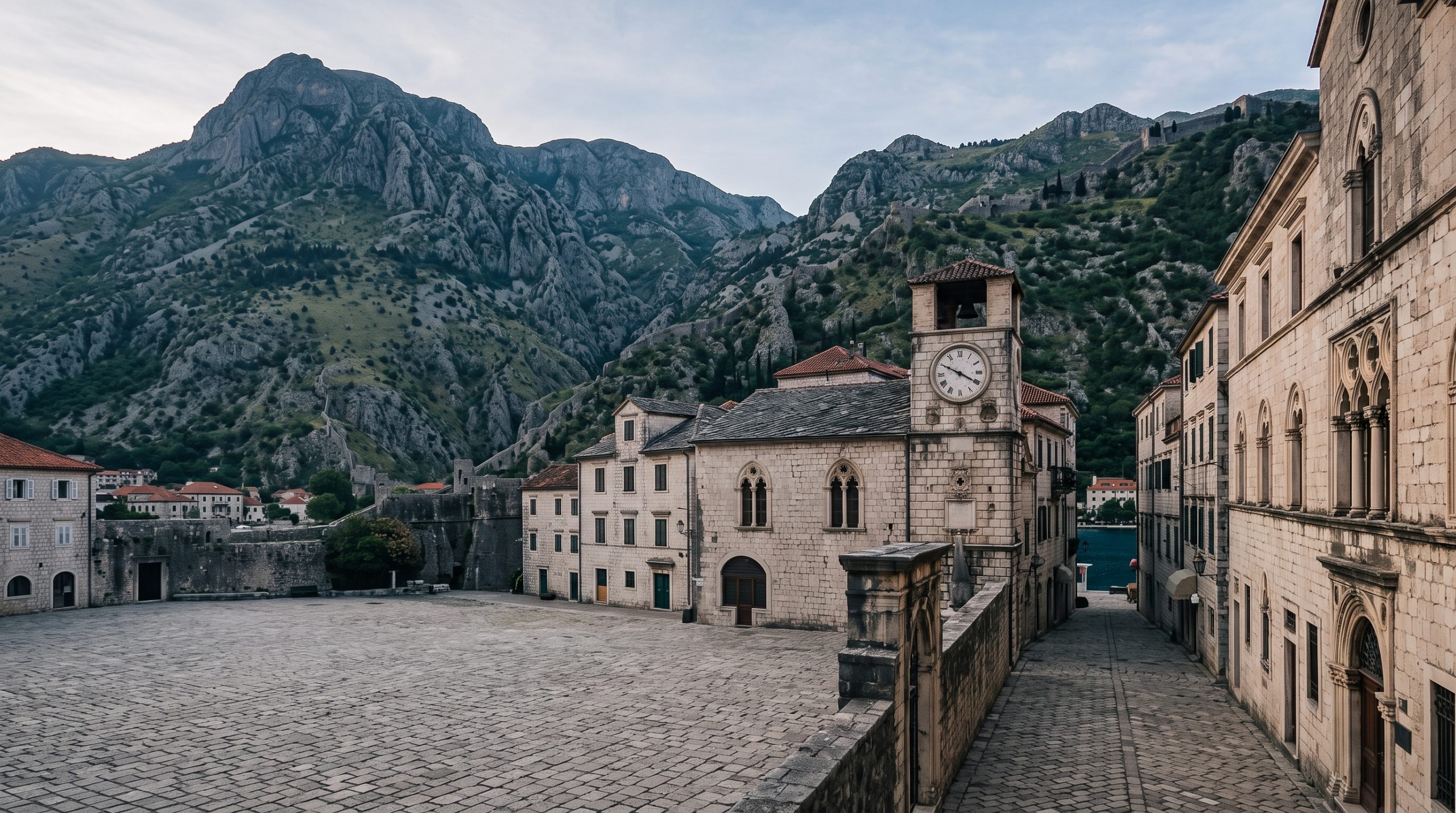
The first surprise for most couples is that a slip of paper from their hotel ends up inside their marriage file. Visitors register their stay with the police in Montenegro, and a licensed hotel or apartment normally does it on your behalf within hours of check-in. The municipality wants proof of that registration before it will marry you.
The second surprise is how short the legal runway actually is. The application goes in at least seven days before the ceremony, with both of you at the counter in person. Everything genuinely slow happens months earlier and at home, in the order you request, apostille and translate your documents. Get that order right and the week in Montenegro is mostly light, driving time and deciding where to stand.
We work across the Bay of Kotor, the Lovćen road and the Durmitor plateau, and we treat the legal hour and the good hour as one problem rather than two. What follows is the chain as we plan around it, written for couples travelling from the United States.
Seven days of notice and one trip to the municipal office
Foreign couples can marry legally in Montenegro. The application goes to the registrar in the municipality where you plan to marry, at least seven days ahead, with both partners present. Documents issued abroad need an apostille and a certified Montenegrin translation. The municipal fee is 20 euros inside the registry office and 100 euros outside it.
Where the Montenegro file needs the most attention
Montenegro sits in the middle of the paperwork scale. Nothing in the chain is exotic, there is no long residency clock to run down, and the notice period is a week rather than a month. What makes it fiddly is that the list is set locally. The U.S. Embassy in Podgorica is direct about this in its own guidance for American citizens: requirements can vary slightly from town to town, so it is essential to check with the local registrar in the town where you plan to get married. The list Kotor hands you is not automatically the list Tivat hands you.
The second complication is American rather than Montenegrin, and we come back to it below. Civil law countries want a government document proving you are free to marry, and the United States does not produce one.
One condition sets the route for some couples. Marriage in Montenegro is between a man and a woman. The country has recognised same-sex life partnerships since 15 July 2020, but the law requires at least one of the partners to be a citizen of Montenegro for a partnership to be registered. Two visiting Americans therefore marry at home and hold the ceremony here, which is a genuinely good way to do this and gets its own section further down.
We are photographers and filmmakers, not lawyers. Rules change and circumstances differ, so confirm the detail with the relevant registry office or your own consulate before you book flights. If you are still deciding how the whole thing hangs together, our guide to planning an elopement covers the shape of the day rather than the file.
The documents, in the order you actually need them
The sequence matters more than the list, because two of these steps cannot happen until the previous one is physically in your hands.
- Both passports. Valid, with clear photocopies for the file. You show the originals when you file.
- A recent certified copy of each birth certificate. Order it from the state that holds the record, not from a drawer at home. Older copies are frequently turned away.
- An apostille on each birth certificate. Montenegro succeeded to the 1961 Hague Convention abolishing legalisation, so an apostille replaces consular legalisation. The apostille is issued by the designated authority of the state that issued the document, which for a U.S. birth record means the authenticating office in the issuing state, not the embassy in Podgorica.
- Proof that you are free to marry. The State Department’s own manual is unusually blunt here: no such document, and no governmental authority to issue such a document, exists in the United States, and in consular districts with that requirement a notarized statement from the U.S. citizen affirming that they are free to marry often is accepted instead. Ask the municipality which form it accepts before you have anything notarized.
- Documentation closing any earlier marriage. A final divorce decree, or the corresponding certificate if you were widowed. Same treatment as the birth certificate: apostille, then translation.
- Proof of your registered stay in Montenegro. The U.S. Embassy lists this as proof of registered residence from the Montenegrin Ministry of Interior, and in practice it comes from the registration your accommodation files for you.
- Passport copies for two adult witnesses. These go in with the application rather than turning up on the morning.
- The municipality’s application form. Collected from the marriage registrar in the town where you plan to marry. There is no national online portal for this.
- Proof of payment of the administrative fee. Paid into the municipality’s bank account, not handed across the desk.
Certified Montenegrin translation is the last thing to arrange, and it is worth understanding why. The apostille is part of the document once it is attached, so it gets translated along with everything else. Translate first and you pay twice. There is also a strong argument for having the translation done in Montenegro rather than at home, because a certified translation carries weight in the country whose courts swore the translator in, and translations are best made in the state where the document will actually be used.
Build the Montenegro document calendar from the ceremony hour
There are two clocks. The legal one is short. The practical one is long, and it is the one we build the plan on.
| Step | Legal requirement | What we schedule |
|---|---|---|
| Choosing the municipality | None, but it decides your document list | Settled as soon as the date is signed, because the list and the off-site rules follow from it |
| Birth certificates and apostilles | Must be complete before translation | Started first, so a slow state office never sets the pace of your year |
| Certified Montenegrin translation | Must be with the application | Arranged once the apostilles are physically in hand |
| Free-to-marry statement | Must satisfy the registrar on the day | Produced late in the sequence, so it is fresh when it is read |
| Filing the application | At least seven days before the ceremony, both partners present | Both of you in the country a clear working week ahead, with a spare day on each side |
| Administrative fee | Proof of payment with the application | Handled as a bank errand on a working day, not on the ceremony morning |
So the real minimum is seven days of notice with both of you in Montenegro. The comfortable minimum, and the one we work to, is a clear ten days on the ground before the ceremony with every apostilled and translated document already filed, which turns the legal week into a formality and leaves the interesting decisions where they belong. We are currently booking 2027, 2028 and 2029, which is far more notice than any registry office needs. The constraint is never our calendar. It is the municipal calendar and the hour the sun leaves the bay.
Registry charges and response windows are moving parts. Re-check the current amount and deadline with the issuing office before you lock in flights or appointments for montenegro marriage documents, apostille and timing.
Your hotel registration slip is a marriage document
This is the section we would want if we were the ones filing. None of it is dramatic. All of it is the difference between a calm Tuesday at the municipality and a scramble.
The registration of stay
Visitors intending to stay longer than three days register with the police within 24 hours of arrival. A licensed hotel or registered apartment does this for its guests automatically, and quickly. A private rental that is not registered as accommodation does not, and then it is on you. Ask for the confirmation, photograph it, and keep the paper. It is a marriage document.
Both of you, in person, at the counter
The application is not something a planner files on your behalf while you are still in Denver. Both partners attend. That single rule is what sets the shape of the trip, and it is why we build Montenegro weeks that start with a working day in town rather than a dawn on a ridge.
The fee is a bank transaction
The administrative fee goes into the municipality’s account. That means a transfer or a counter visit and a receipt, on a working day, in a bank with its own hours. It is 20 euros for a ceremony in the registry office. Outside official premises the figure the Embassy publishes is 100 euros, and because the tariff is set municipality by municipality, published guidance varies and the office that will marry you is the one whose number counts.
Apostille first, translation second
Documents get apostilled in the country that issued them, and translated after. Reverse the order and the translation is incomplete, because it will not contain the apostille the registrar is reading.
Carry the originals
Scans go ahead by email so the office can check the file. The originals travel with you, in a folder in your hand luggage, including the apostilled copies. Municipalities want to see them, and a document sitting in a delayed suitcase in Belgrade is a document you do not have.
Off-site is a category, not a favour
A ceremony outside official premises is provided for. The registrar approves the place, the higher fee applies, and it is requested in advance with a reason rather than raised on the day. Which locations a given registrar will travel to is the single most useful question you can ask early, and it is worth asking before you fall in love with a specific terrace. Our destination guides are where we work through how regions differ in practice.
Legal at home, ceremony above the Bay of Kotor
A large share of the couples we work with in Montenegro are legally married before they land. They sign at a courthouse near home, quietly, sometimes months earlier, and then travel here for the ceremony that actually means something to them. It is not a downgrade and we would never present it as one.
What changes practically: no municipal application, no apostilles, no certified translation, no seven-day window, no need to be in the country a clear week early, and no registrar deciding whether your location is acceptable. That last one is bigger than it sounds. It opens up ground a registrar would not travel to, which in Montenegro means the high stone terraces above Perast, the Lovćen switchbacks in the last hour of light, the karst above Skadar Lake, the Durmitor tarns in early summer.
What does not change at all: the vows, the hour, the two of you, the walk, the weather plan, the film. Highlights reach you in five days and the full gallery or film in three weeks either way. If you want to see how the coast and the mountains actually read on camera before you commit to one or the other, our published stories and films are the honest version, including the days when the light did something we did not plan for.
Same-sex couples take this route by default, and it works exactly as well. So do couples who simply do not want their wedding week to contain a bank errand.
Tell us which of the two routes you are leaning toward and we will build the timeline around it. Check Your Date and we will tell you what the week would look like.
What we can coordinate and what only the two of you can sign
We do the planning that sits around the paperwork. Destination and location design, a timeline built on light and real travel time rather than optimism, permit research and logistics guidance, weather alternatives held in reserve, and the date protected against registrar and office availability so the ceremony hour and the good hour are the same hour. Where drone footage is legal, safe and appropriate, it runs on that same schedule.
We do not file your documents, notarize anything, or sign on your behalf. Nobody but the two of you can make the counter visit, and that is the one part of the week nobody can take off your hands.
One practical thing about how we are set up. Because the photographer and the filmmaker come from the same eight-person team rather than being hired separately and meeting on the morning, the register signing inside the municipal room and the vows outside can both be covered properly, without one of us stuck waiting on a stairwell. It matters most on a legal day, when the official hour is fixed by the office and the beautiful hour is fixed by the sun.
What each experience includes, from a single dedicated photographer or filmmaker through to a photographer and filmmaker working together, is set out on our pricing page, and the figure does not move with the number of people standing there.
Common questions
Do we have to be in Montenegro before the wedding day?
Yes. The application is filed at least seven days before the ceremony and both partners have to be present for it. That is the rule that shapes the trip, and it is why we plan Montenegro weeks with a working day in town near the start rather than treating the arrival day as a rest day.
Does a US birth certificate need an apostille for Montenegro?
Yes. Montenegro succeeded to the 1961 Hague Convention, so an apostille replaces consular legalisation. The apostille is issued by the authenticating authority in the state that issued the certificate, so a certificate from Ohio is apostilled in Ohio. The embassy in Podgorica does not do it.
Who is allowed to translate our documents into Montenegrin?
A certified translation is required, and a translator sworn before the courts in Montenegro is the version local offices are used to reading. Have it done after the apostille is attached, because the apostille has to be translated too, and ask the municipality whether it wants the translation from a translator on its own list.
How do we prove we are free to marry if the US does not issue a certificate of no impediment?
With a notarized statement affirming that you are free to marry, which the State Department’s guidance confirms is often accepted where no government certificate exists. Because the exact form varies between municipalities, ask the registrar what wording they need before you sign anything in front of a notary.
Can we legally marry outdoors in Montenegro, or does it have to be the registry office?
Outdoors is possible. Ceremonies outside official premises are a recognised category with their own fee, currently 100 euros against 20 euros inside the office. The registrar has to approve the location in advance, so ask which places that particular office will travel to before you settle on one.
Will our Montenegrin marriage certificate be accepted back home?
The certificate is issued in Montenegrin, so request an apostille on it in Montenegro before you fly out, since an apostille is always issued by the country that issued the document. The State Department’s position is that a marriage performed in line with local law is valid where it took place, and it points couples to the attorney general’s office in their own state for questions about recognition at home.
Can our photographer and filmmaker be our witnesses?
You need two adults, and their passport copies go in with the application days beforehand, so this is a decision to make early rather than on the morning. If you are travelling without guests, tell us at the inquiry stage and we will build the day around the arrangement your municipality accepts.
Can same-sex couples marry legally in Montenegro?
Not as visiting foreigners. Same-sex life partnerships have been recognised since 15 July 2020, but registering one requires at least one partner to be a Montenegrin citizen. Couples marry at home and hold the ceremony here, which also removes the apostille chain entirely.
Start with the date, then the file
Pick the ceremony hour first, in the month that gives you the light you want, and let the file arrange itself behind it. That order works. The reverse, where a slow apostille decides your anniversary, is the one to avoid.
Everything with us runs in writing and on your schedule. Send the inquiry form and you will have a reply and our initial brochure within 24 hours, then a tailored proposal, and planning begins once the contract is signed and the 30 percent retainer is paid. Team travel is included wherever we go, so Montenegro costs you nothing in flights for us.
Tell us the month, the region and whether you are marrying here or at home, and we will send back the week as we would actually run it. Tell Us Your Story.