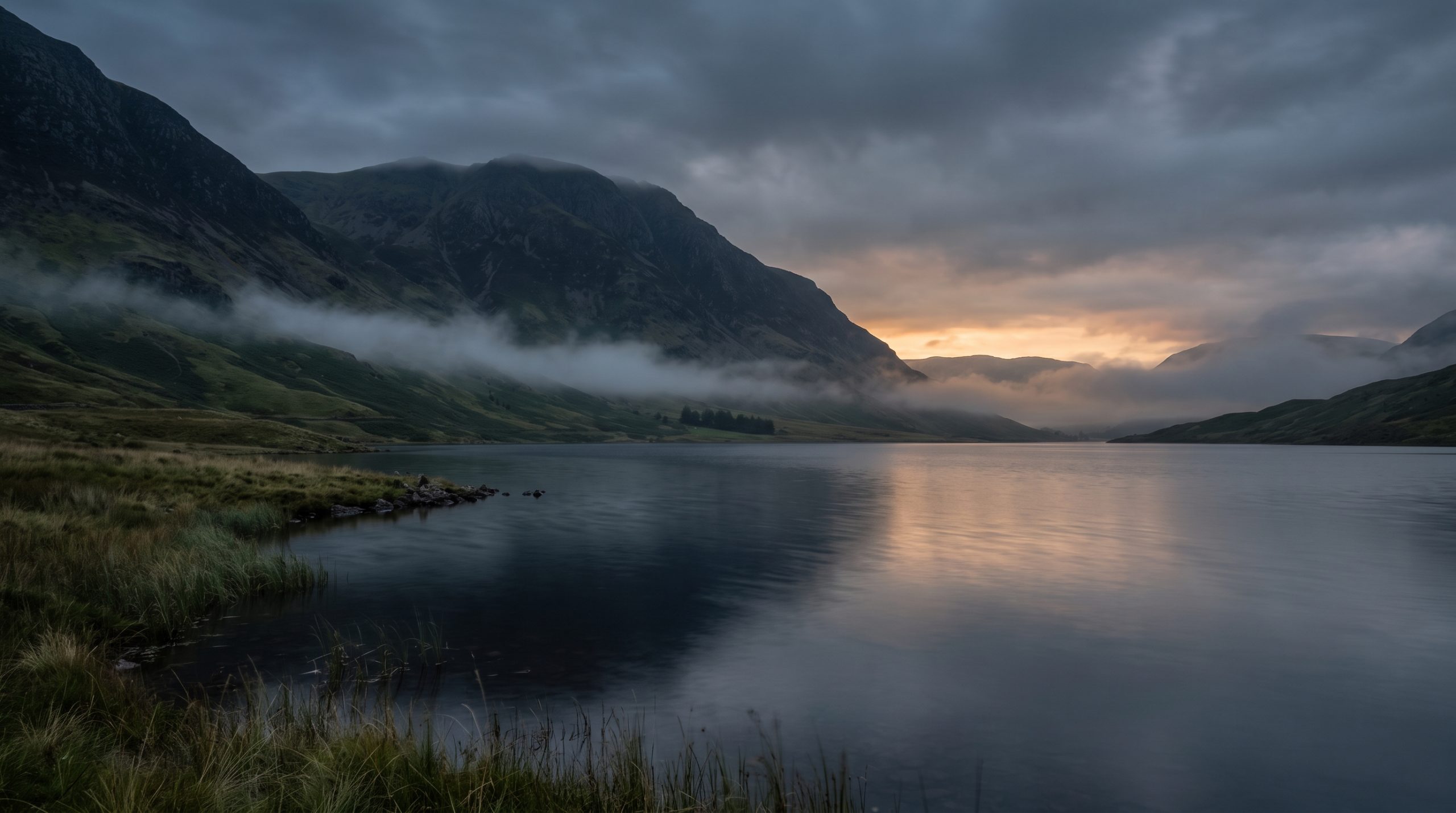
In the third week of June the sun clears the fells above Keswick at 4:36am and does not set until 9:52pm. Seventeen hours and sixteen minutes of daylight, and at this latitude it never goes properly dark in between. Six months later the same valley gets seven hours and fourteen minutes, and the year’s latest sunrise lands at 8:36am on 29 December.
Those two numbers decide almost everything about a Lake District wedding film. They decide whether you are standing on a fell at four in the morning or eating a slow breakfast and still catching gold at nine. They also decide how many valleys you can honestly reach between them, because the Lakes are small on a map and slow on the ground. Sty Head is the shortest crossing between Borrowdale and Wasdale, two miles and 1,200 feet above the farm at Seathwaite. By car, those same two valleys sit more than an hour apart.
So this page does two things. It answers the cost question properly, and it shows what the money actually buys in this corner of England: the light research, the permission work, the timeline that survives a wet morning, and a photographer and filmmaker who come from the same team of eight and plan your day together long before either of them lifts a camera.
What a Lake District wedding film costs with us
A full day of Lake District coverage starts at $4,900 with one dedicated photographer or one dedicated filmmaker. A photographer and filmmaker working the same day together starts at $7,900. Both include location design, a timeline built around Cumbrian light, permit research, weather alternatives, and travel for the team assigned to you.
A June day, 4:36am to 9:52pm
We leave the cottage at about 3:45am. In mid-June the sky is already pale grey-blue by then, which is a gift and a trap: it looks like you have time, and you do not. The council car parks around Windermere charge from 8am to 8pm, so a pre-dawn start costs nothing at the machine, and the upland ones are worth having coins for because a few of them sit outside phone signal.
Catbells is 451 metres and takes most couples about an hour from Hawes End, which is why we use it so often for a first-light ceremony or first-light vows. You are on the ridge before 4:36am with the whole of Derwentwater below you and, on a still morning, cloud lying in the valley like spilled milk. By 6:30am we are usually walking down into a valley that has not woken up. Those two hours between sunrise and the first other walker are the quietest hours you will get here in summer, and they are the reason we ask for the early alarm.
Late morning is where the legal part of the day usually sits. A civil ceremony in England has to happen at a register office or at approved premises, and since 2022 that includes the licensed outdoor grounds of those premises. Westmorland and Furness runs register offices at Kendal, Penrith and Barrow-in-Furness, open Monday to Friday, 9am to 4:30pm, by appointment only. The Georgian Room at Kendal Town Hall holds up to 23 guests plus the two of you; the Chairman’s Room downstairs holds eight. Cumberland Council covers the north and west of the park with its own offices and its own fee scale. We build the day around whichever office or approved venue you choose, then take the outdoor vows wherever the light is best.
Afternoons here are worth being honest about. Between roughly 1pm and 4pm in high summer the light goes flat and white, every viewpoint with a road to it is busy, and the handful of parking spaces above Ashness Bridge have been full for hours. We do not fight that window. We use it for the drive, for food, for the change of clothes, and for exactly one mountain pass rather than three, because Hardknott climbs at gradients of one in three and nothing about it is quick.
Then the day gives it all back. From about 8pm the fells start to warm up, the day visitors have gone, and you have nearly two hours of the best light of the whole twenty-four. By 9pm the sun has swung well round to the northwest, so we work looking east across the water rather than into the glare, and the last frames come somewhere around 9:52pm. One small piece of local truth: still water on a warm June evening means midges, and thirty metres of height on a breezy shoulder solves it completely.
When the day is seven hours long, not seventeen
A December day in the same valley runs seven hours and fourteen minutes, with sunrise as late as 8:36am at the end of the month. That sounds like a loss and mostly is not. The sun never climbs high enough to go harsh, so the light is usable from breakfast to mid-afternoon, and a 7:45am start is a civilised morning by anyone’s measure. What changes is ambition: winter days stay in one valley, on lakeshores, in oak woodland and on low ground, and we save the high passes for a spring-onwards plan. If you want a fell summit, we will tell you which months make that realistic for your fitness and your dates.
Send us the month you are looking at and we will come back with the real sunrise time for your date, a first shape for the day and the two or three valleys that fit it. Check Your Date.
The rain question, and what we actually do about it
Seathwaite in Borrowdale is the wettest inhabited place in England, averaging somewhere around 3,300 millimetres of rain a year. We are not going to pretend otherwise, and the couples who write to us have already read that number. What matters is the planning that sits on top of it.
Every day we design has two shapes. There is the high plan, which needs cloud base above the ridge line, and the valley plan, which works in anything: woodland, water, walls, slate, bracken. Both are scouted, both have a timeline, and both have a sheltered alternative within about fifteen minutes’ drive. We watch the forecast from four days out, talk it through with you the night before, and make the final call at 5am. Because your notice of marriage names the ceremony venue, the legal part of the day cannot move. Everything with our name on it can, and we build it that way on purpose.
The other half of the answer is that wet Lakeland mornings photograph beautifully. Low cloud tearing across a crag, dark water, wet slate holding the light, a valley that looks like nobody has ever been there. Flat blue skies are the harder day to make interesting. If you would still rather stack the odds, March through June is generally the drier stretch and October through January the wettest, and our destination guides go month by month.
Wind on the ridge, and why two of us are up there
There are eight of us: Serg, Alex, Alex and Viktoria on photography, Lara, Mike, Anthony and Stas on film. On the Expedition, one dedicated photographer and one dedicated filmmaker work your day together, from the same plan, briefed weeks in advance. That is not the same animal as booking a photographer in one place and a videographer in another and hoping they get along in the car park at dawn.
In the Lake District the difference shows up first as wind. A westerly on a 450-metre ridge will erase spoken vows for any microphone, and the Expedition includes professional audio for vows and meaningful moments where conditions allow, so we choose where the words happen based on shelter as much as on view. A sheepfold wall, the lee of a crag, birch woodland at the water’s edge. The ridge then carries what it is good for: the wide frames, the walking, the moment you turn round and see how far up you are. None of that needs sound.
The seventeen-hour day also splits well between two people. While the photographer works close on the summit, the filmmaker is 200 metres down the path with a long lens on the approach, so the film has the shot of two people arriving in a landscape and the gallery has the frame from an arm’s length away. With one camera on the ground, one of those does not exist. On a wet morning the same maths applies in a duller way: one of us keeps working while the other dries a front element.
Aerials get planned the same careful way. Drone footage is included where it is legal, safe and appropriate, and in this park that depends on whose ground you are standing on. A great deal of the valley floor and lakeshore belongs to the National Trust, which does not grant permission for private drone flights to launch from its land. Filming on land the National Park Authority owns, including woodlands, islands, lakeshores and fells, runs under its licence, with the charge set by the application. Public highways sit with Westmorland and Furness or Cumberland Council, and private land sits with the farmer. We settle all of that before an aerial goes into the plan, which is why the plan holds.
If you want to see how this landscape behaves in finished work, our published galleries and films are the honest version: how a grey morning renders, what rain on slate does to a stills frame, how a highlights film still cuts together cleanly when the day moved twice before lunch.
From location design to a film in three weeks
Every experience, whichever tier you choose, includes the whole planning side rather than just the day itself:
- Destination and location design for your actual dates, built from real sunrise, sunset and twilight times
- A custom timeline that respects valley-to-valley travel, not map distance
- Permit research and logistics guidance across the registration service, the National Park Authority, the National Trust and private landowners
- Weather alternatives and backup planning for every location on the timeline
- Drone footage where it is legal, safe and appropriate
- Professional audio for vows and meaningful moments on the Expedition, where conditions allow
- Travel for the team assigned to you, including flights, accommodation and ordinary transport
- Highlights delivered in 5 days, and the full gallery or film in 3 weeks
Guest count does not change the fee. Two of you on Catbells at 4:36am and eighteen people in the Georgian Room at Kendal cost the same from us. Guests change access, permits, transport and the shape of the timeline, and we plan for that, but they are not a line on the invoice. If you have never mapped out an elopement day before, our guide to planning one covers the fundamentals we will not repeat here.
Where coverage starts, and what Cumbria charges on top
The Adventure is one full day with a dedicated photographer or a dedicated filmmaker. The Expedition is one full day with both, working together. The Odyssey runs two to seven days across one or several destinations, photography and film, quoted as a custom proposal. There is no half day. Both day rates and what sits inside them are laid out on our pricing page.
Team travel is included worldwide, with no European or long-haul distinction, and the Lake District is no exception. Getting our people to Cumbria, housing them and moving them around the park is our cost and never appears on your invoice.
What you pay locally, in pounds, is everything that belongs to somebody else:
- Registration service fees. Notice fees per person and the registrar’s attendance are set by the council, not by us, and reviewed each April.
- Your venue’s own charge, if you marry at approved premises. That is separate from the registration team’s attendance fee.
- A celebrant, if you want a ceremony outdoors on ground that is not licensed for the legal words.
- Parking. Rates differ by operator across the park: an all-day ticket at Lake Road in Windermere currently runs about £10.60, while arriving before 9am on the early-bird tariff is around £1.40.
- Any fee the National Park Authority sets for filming on land it owns, which depends on the application.
- Accommodation, and unusual transport if we plan it in: a boat, a 4×4 up a farm track, a mountain guide.
How a Lake District film enquiry becomes a held date
- Send the inquiry form with your dates, or the month if the date is still loose, and the part of the park you keep coming back to.
- We reply within 24 hours with our initial brochure and our first questions about the shape of your day.
- We write a tailored proposal: which of us would be assigned, the coverage that fits, locations, and the permissions your plan needs.
- You sign the contract when the proposal is right.
- You pay a 30% retainer to hold the date. The rest of the payment schedule is set out in the proposal.
- Planning starts: location design, the timeline around light and travel, permit research, and the wet-morning alternatives.
Our current Lake District availability runs across 2027–2029, which means most couples writing to us now are choosing their month by the light rather than by what is left on a calendar.
Common questions
Can we legally get married on a fell top in the Lake District?
Not the legal part. In England a civil ceremony takes place at a register office or at approved premises, including the licensed outdoor grounds of those premises since 2022. Vows on a summit or a lakeshore are celebrant-led or private, and they are often the emotional centre of the day. We plan both halves so they sit an easy drive apart.
How far ahead do we have to give notice to marry in Cumbria?
Notice must be given at least 29 days before the ceremony, in person at the register office for the district where you live, and it sits on public display for 28 days. Depending on immigration status that period can extend to 71 days. Your notice names the venue, so choose that before you go.
Do you need a permit to film a wedding in the Lake District National Park?
It depends entirely on the landowner. Filming on land the National Park Authority owns needs its permission under a licence, with the charge set by the application. Public highways go through Westmorland and Furness or Cumberland Council, and private land goes through the landowner. The research and the paperwork are ours; the fee itself is yours.
Can you fly a drone for our Lake District film?
Where it is legal, safe and appropriate, yes, and it is one of the things this landscape most rewards. The constraint is ground ownership rather than scenery: the National Trust does not permit private drone flights to launch from its land, so we confirm the launch point and the permission before we design an aerial into your film.
Which month gives the best light for a Lake District elopement film?
June buys you the most room, with seventeen hours and sixteen minutes of daylight and a 4:36am sunrise. Late September is the connoisseur’s month: sunrise arrives a little after seven, so you sleep, the bracken has turned, and the fells hold colour all evening. Spring is generally the drier stretch of the year.
Does the price change if our parents and a few friends come?
No. The fee is the same for two of you as for a small group. Guest numbers change access, transport, permits and the pace of the timeline, and the ceremony room sets its own limit, which at Kendal is 23 guests in the Georgian Room and eight in the Chairman’s Room.
How soon do we see the photos and the film?
Highlights land 5 days after the day itself, which is usually while you are still travelling. The full gallery or the finished film follows within 3 weeks.
Can we book film only, without photography?
Yes. The Adventure covers one full day with one dedicated filmmaker, or one dedicated photographer, whichever you choose. The Expedition puts both on the same day, working from the same plan. For anything longer or spread across more than one place, the Odyssey is quoted for you.
Choosing your month, then choosing your morning
The Lakes reward couples who are willing to be out before it is light, who do not mind wet ground and uneven paths, and who can hear at 5am that the ridge is in cloud and cheerfully take the valley plan instead. If a 3:45am alarm is genuinely not your idea of a good morning, say so in your first message: late September gives you a sunrise after seven, and a winter day in one valley can be gentler and just as strong. Tell us what you actually want and we will either build the day around it or tell you honestly which month suits it better.
All of our planning happens in writing, by email, so you can read a proposal and reply at midnight in Denver if that is when your week goes quiet. Nothing to attend, nothing to arrange around a time zone. Tell Us Your Story.