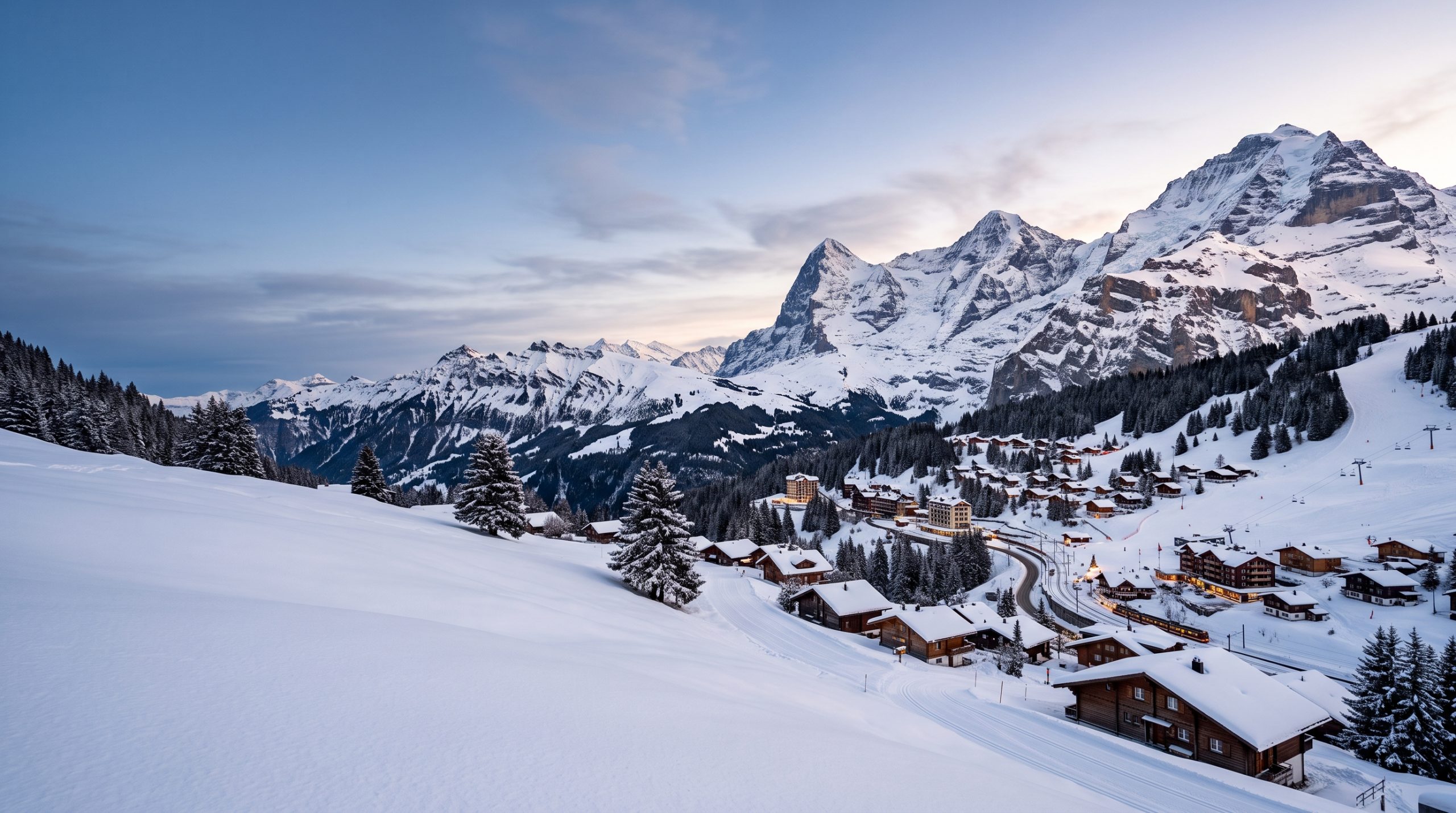
Piz Gloria turns slowly at 2,970 metres above Mürren, with the Eiger, Mönch and Jungfrau lined up across the valley. It played a Bond villain’s mountain lair in 1969 and now serves brunch to skiers with a lift pass. As places to stand in a wool coat and say something you mean, it is hard to beat.
What it cannot do is marry you. In Switzerland, no restaurant, hotel, cable car company or ski resort has the power to make a marriage legal. A civil registrar does that, in a room the canton has formally designated for marriages, and that list belongs to the commune rather than to the mountain. So the useful question is not which resorts allow ski weddings. It is which communes will send a registrar to a designated venue, what a mountain restaurant charges to hold a private day in high season, and how much of the budget goes on moving your people uphill.
We work winter days in Valais and the Bernese Oberland, and the pattern repeats. Couples arrive expecting the resort to be the gatekeeper. In practice the gatekeepers are a registry office, a lift timetable, and the wind on one exposed cable stage.
The commune decides, not the ski resort
No Swiss ski resort can marry you. Only a civil registrar can, in a room the canton has designated for marriages, which in most ski communes sits in the village rather than at the top station. The civil ceremony itself costs a few hundred francs by cantonal tariff. Venue hire and lift transport are separate.
Two ceremonies, and only one of them needs a registrar
The legal file is opened with the registry office of the commune where you intend to marry, not with the hotel and not with us. Documents come from home, translated and legalised where the office asks for it, and the office’s clearance has a limited life. That is why the paperwork sits in the last months of planning rather than two years out, and why our timeline works backwards from it instead of pretending it does not exist.
Two adult witnesses have to be present, and the ceremony is a public act. A registrar cannot marry the two of you alone on a glacier with nobody else in the picture. A religious blessing, if you want one, follows the civil marriage rather than replacing it.
Most couples flying in from the United States settle the legal side at home and treat the mountain as the ceremony that carries the vows, led by a celebrant or by someone who knows them. Others take a morning slot in the village office, sign, then go up. Both shapes work. The difference matters to your timeline more than to your day, and it is the first thing we pin down in the planning fundamentals before any location talk starts.
Four mountains that work, and how you actually reach each one
These four come up again and again in our winter planning, and the reason is transport rather than views. How you get up decides how much the weather can push you around.
| Mountain | Top station | How you get up | What moves the plan |
|---|---|---|---|
| Gornergrat, Zermatt | 3,089 m | Cog railway from the village, around 33 minutes | Timetable and cloud base. A rack railway on the ground shrugs off wind that an exposed cable stage will sit out |
| Piz Gloria, above Mürren | 2,970 m | Aerial cableway in stages, through Birg at 2,677 m | Wind on the top stage. Birg, and Mürren itself at 1,638 m, are the fallbacks on the same ticket |
| Mittelallalin, Saas-Fee | 3,500 m | Alpin Express, then the Metro Alpin funicular inside the mountain | Glacier weather at the top. The underground section is indifferent to wind |
| Muottas Muragl, Engadin | 2,456 m | Funicular from Punt Muragl, ten minutes from St. Moritz | Cloud base rather than wind. The lowest of the four and the least dependent on a good morning |
Zermatt, Saas-Fee and Mürren are all car-free, which sounds like a complication and usually is not. You park at Täsch and take the shuttle train into Zermatt. You reach Mürren either through Lauterbrunnen or from Stechelberg on the cableway that climbs at a gradient of 159.4 percent, the steepest aerial cableway in the world, which takes about as long as reading this paragraph. What car-free does change is luggage and shoes, and both are solvable if someone has thought about them before the morning.
If a summit feels like more expedition than you want, Allmendhubel at 1,907 m above Mürren and Riffelberg at 2,582 m above Zermatt both sit on the same lift systems with restaurants, indoor space and the same mountains on the horizon. Neither asks anything of you physically.
Light in a valley that spends winter in its own shadow
Zermatt sits at 1,620 m at the bottom of a deep north-south trench. In late December there are under nine hours between sunrise and sunset, and the village floor gets less than that, because the ridges take the first and last of it. The Matterhorn’s east face is lit long before anything in town is. If you want a ceremony facing that peak with light on its face, you want the morning.
From Gornergrat the Matterhorn stands to the west. Front-lit and clean before midday, then it flips: late afternoon gives you a silhouette with rim light down one edge and no detail in the rock at all. Both are good pictures. They are completely different pictures, and choosing between them sets your ceremony hour before anything else does.
Mürren works the opposite way. The village sits on a shelf on the west side of the Lauterbrunnen valley, so in winter the sun drops behind the Schilthorn ridge above town while the Eiger, Mönch and Jungfrau across the valley are still burning. For a while you have couples in blue shade with a lit wall behind them, which is a strange and lovely combination if you place them where the snow bounces light back into their faces, and a mess if you do not. Going up to Birg or Allmendhubel buys back some of the sun you lose in the village.
Two honest notes. The Riffelsee reflection saved on every mood board is a summer photograph; in February it is a snowfield and we plan ridgelines and shadow edges instead. And arriving early does not empty a ski mountain the way it empties a summer trail, because the first cabins carry everyone chasing fresh snow. The quiet windows in winter are midweek days in January, and the last hour of lift service when the mountain drains downhill and the light finally goes warm.
Room to work matters more up here than most people expect. The terrace and the ridge below Gornergrat station give a photographer and a filmmaker genuinely separate ground, so one can work wide from the platform while the other takes the line of the ridge, and neither collects the other in frame. A small summit platform gives you less, so we split by time rather than space and stack sequences instead of spreading out. Wind takes voices apart above 2,500 m, which is why we choose a lee corner for vows and put the audio there; on the Expedition our filmmaker runs proper sound for that. You can see how these winter days look finished in our films and galleries.
What a mountain venue is actually charging for
The civil ceremony is the small number. Cantonal tariffs put it in the low hundreds of francs, with a surcharge where the registrar travels to a designated venue away from the office or works outside normal hours. Nothing about the legal act is expensive in Switzerland.
The mountain is where money goes. Restaurants at these altitudes usually quote a minimum spend rather than a flat hire fee, and a private booking outside service hours costs more than the same room at lunchtime, because staff, supplies and one more lift run all have to go up for you. Then there is transport: every guest needs a return ticket at winter fares, and any cabin or train moving outside the published timetable is billed as a private trip. That line scales with your guest list rather than with the ceremony, so it is worth pricing early.
On our side, the coverage structure is fixed and public. The Adventure starts at $4,900 for one full day with a dedicated photographer or a dedicated filmmaker. The Expedition starts at $7,900 with both working together, which on a summit day means one of them can stay with you while the other is already positioned at the next spot. The Odyssey covers two to seven days across one or several destinations as a custom proposal. Team travel is included worldwide, so a Swiss winter carries no travel surcharge from us, and the fee does not move with guest count. Government, venue and landowner permit fees are yours; the research, the timeline and the logistics guidance are ours.
Wedding clothes, ski boots and minus ten
This is the part almost nobody writes down, and it decides how the day feels. You go up in boots with your shoes in a bag. Mountain restaurants at Gornergrat, Mürren and Saas-Fee have boot rooms and warm interiors, and staff are used to people changing at the top rather than arriving finished, so the dress comes out of the bag at altitude.
Dry powder brushes off a hem and leaves nothing behind. Wet spring snow at plus four does not, so on March and April dates we put the dress work earlier and let the afternoon go slushy without you in it. Wind at 2,970 m will do one of two things to a veil: hand us the frame of the day, or cost twenty minutes of untangling. Hair that survives a hood is worth more up there than hair that photographs beautifully in a hotel room.
Ten to twenty minutes outside is realistic in a dress at minus ten, and it is enough for vows and for the frames that matter. A wool coat, gloves that come off cleanly for the rings, and hand warmers in a pocket stretch it considerably. Tell your guests to bring real footwear; they will be standing on packed snow, not on a lawn. And if you both ski confidently, a few hundred metres of easy piste in the dress is a genuinely good sequence, while if one of you started last season, keep the skis for the frames and ride the lift down. Our destination guides go further into how each region’s seasons behave.
The morning the top stage waits for the wind
Exposed cable stages open when the wind allows, sometimes an hour or two later than the timetable suggests. So every winter day we plan has a second ceremony spot lower on the same ticket, chosen in advance rather than improvised: Birg at 2,677 m, Riffelberg at 2,582 m, Allmendhubel at 1,907 m. We check the mountain report before you leave your room and tell you which version of the day is running, so nobody is standing in a lobby in a dress waiting for a decision.
Common questions
Can we legally get married at the top of a Swiss mountain, or only in the village?
Only in a venue the canton has designated for marriages, with a registrar present. Some communes have added rooms beyond the office and some have not, and only that commune’s registry office can confirm its own list. We research this for your specific date and location as part of planning.
Do our guests need to buy a lift ticket to come to the ceremony?
Yes. A return ticket per guest is the honest headline cost of a mountain ceremony in Switzerland, and it is charged by the railway or cableway company rather than by the venue. Guests with a valid ski pass are often already covered for the same lifts.
What if the cable car to the summit is not running at the hour we planned?
We move to the fallback spot we chose with you at the planning stage, lower on the same lift system, and slide the timeline rather than cancel anything. Cog railways and funiculars keep running in conditions that make an exposed top cable stage wait, which is why they feature heavily in our winter plans.
Is there anywhere to change out of ski boots before the ceremony?
At the mountain restaurants we work with, yes: boot rooms, heated interiors and staff who have seen this before. You travel up in boots, change at altitude, and leave the bag with the venue rather than carrying it into the frames.
Do we have to be strong skiers to have a ski wedding?
No. Every location in the table above is reached by train, funicular or cableway, and you can spend the whole day on foot in a few square metres of packed snow. Skis are a choice, not a requirement, and one of you skiing while the other rides down is completely normal.
Does bringing a photographer and a filmmaker to Switzerland cost extra?
No. Flights, accommodation and ordinary travel for the assigned team are included worldwide, with no long-haul distinction. Highlights reach you five days after the day itself, and the full gallery or film within three weeks.
Working backwards from one hour on the mountain
Every Swiss winter day we build starts from the same decision: the hour when the light, the lift and the registry office all agree. Everything else, the village slot or the paperwork at home, the boot room, the second location, the run down the piste, is assembled around that hour. Tell us the mountain you keep coming back to, or just the feeling you want at eight in the morning, and we will tell you honestly which resort, month and altitude deliver it.
We handle the planning in writing so nothing depends on matching time zones, on your schedule and across time zones. Send the inquiry form and you get a reply and our first brochure inside 24 hours, then a tailored proposal, then a contract and a 30 percent retainer, and planning begins. We are currently taking Swiss Alps bookings across the 2027–2029 seasons. Tell Us Your Story.