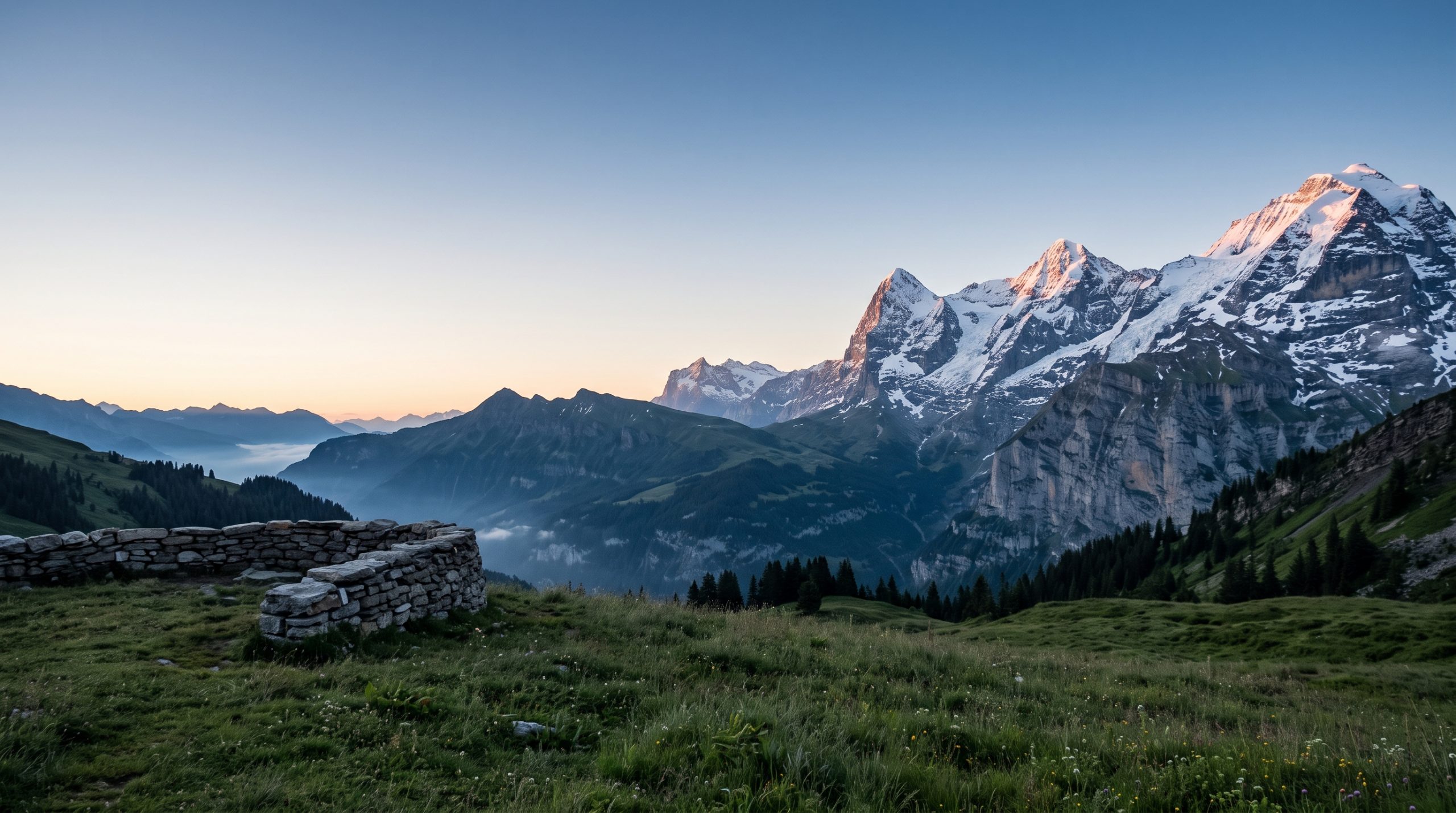
The legal half of a Swiss wedding happens indoors, at a desk. Swiss law puts marriage in front of a civil registrar, in a room the canton recognizes for the purpose, and in the Visp civil status district that means the Gemeindesaal in Zermatt or the Gletscherstube in the Saas-Fee community building, on a weekday, in office hours.
Nothing on that list is a ridge above the Matterhorn at six in the morning. So the mountain ceremonies you have seen from Switzerland are almost all symbolic ones. The couple signed at home before flying, or signed in the valley, and then went up to say the words that actually mattered to them.
That is not a workaround, and it is not second best. It is the cleanest shape a Swiss elopement takes, and it carries far less paperwork than couples expect. Below is what the symbolic route involves, what the local line items run in francs, and what changes if you want the Swiss civil marriage as well.
Where the legal marriage happens, and where the ceremony happens
A symbolic ceremony in the Swiss Alps has no legal effect and needs no Swiss paperwork at all. You marry legally at home, then hold the ceremony wherever the light and the last cable car allow. The costs that remain are local: a celebrant, mountain transport, any landowner fee. The date, the hour and the altitude are yours.
Why symbolic is simple while the Swiss civil route is not
If you arrive already married, the difficulty rating is close to zero. There is no notice period to serve, no registry office diary to work around, no document that has to be translated into German by a date. You choose an hour based on where the sun hits the rock, and that is the only calendar that governs the day.
If you want the legal marriage itself performed in Switzerland as visiting foreigners, the rating moves to fiddly. It is genuinely possible, and Swiss offices are precise and pleasant to deal with. It is also a chain of steps with real deadlines at both ends: documents that cannot be older than six months when they go in, a preparatory procedure that both of you must attend in person, and a ceremony that may take place no earlier than ten days and no later than three months after that procedure is declared complete.
Swiss law also provides that a religious wedding ceremony may not be held before the civil one. Couples who marry at home first sit clearly on the right side of that provision, and a symbolic ceremony led by a celebrant, a friend, or nobody but the two of you is not a marriage in law and creates no entry in any register. The vows are the vows. What the mountain morning does not do is generate a certificate, because you already have one.
What changes on the ceremony-only route is administrative and nothing else. No registrar means no witnesses are required, no ten-day wait, no translations, no office hours. What does not change is everything a reader of this page actually cares about: the readings, the rings, the people you brought, the walk up, the hour you picked. Planning fundamentals are the same as anywhere else, and our guide to planning an elopement covers the parts that have nothing to do with Switzerland.
What a symbolic ceremony in the Alps actually costs
The honest answer is that the symbolic ceremony itself is one of the cheaper parts of the trip. Nobody charges you for the words. What you pay for is getting the two of you and your celebrant to a place worth standing in, at an hour worth standing there.
| Line item | Who sets the price | What to plan for |
|---|---|---|
| Celebrant for a symbolic ceremony | The celebrant | Priced per ceremony and unregulated, because no legal act is taking place. A friend can do it. So can one of you, reading to the other. |
| Mountain transport | The railway or cable car operator | Tickets per person on the cog railways and lifts, plus whatever an early or off-hours run costs when you want the viewpoint before the day-trippers reach it. |
| Location permission | The municipality, the landowner, or the transport company | Often nothing on open ground. A fee where a hotel terrace, a chapel or a private alp is involved. The research is ours, the fee is yours. |
| Registry office fees, only if you marry legally in Switzerland | The canton and the municipality | The preparatory procedure and the ceremony together commonly run into the low hundreds of francs, with supplements for a Saturday or for an approved external venue. |
| Certified copies and translations, only if you marry legally in Switzerland | Your home records office and the translator | One certified birth certificate copy each, issued inside the six-month window, plus translation into German, French or Italian. |
Quote everything to yourself in francs first. The franc has been worth a little more than the dollar for several years now, so read a Swiss figure as slightly higher once it lands on your card, and do not build a budget on a conversion you did yesterday. Fees and deadlines quoted here were correct at the time of writing and are worth re-checking with the office that issues them.
Our own side of it is one page: The Adventure covers a full day with a dedicated photographer or a dedicated filmmaker from $4,900, The Expedition puts a photographer and a filmmaker on the ground together from $7,900, and the multi-day Odyssey is built as a proposal, with the full list of what each experience includes set out in one place.
The document chain if you want the Swiss civil marriage too
We are photographers and filmmakers, not lawyers. Rules change and circumstances differ, so confirm the detail with the relevant registry office or your own consulate before you book flights. With that said, this is the order the documents arrive in, and the order matters more than the list does.
- A certified copy of each birth certificate, issued within the last six months. For US citizens the Swiss requirement is a certified copy rather than the original document you keep at home, showing your full name, date and place of birth and both parents’ full names, including your mother’s maiden name.
- Valid passports. Straightforward, and the one item on this list nobody forgets.
- Proof of your current address. A residence certificate or the equivalent from where you live now.
- Paperwork showing that any earlier marriage has ended. A divorce decree, or the document your own jurisdiction issues in its place.
- A declaration of your civil status. This is the step that changed for Americans on 1 January 2028: the US Embassy and its consular agencies in Switzerland no longer notarize Civil Status Declarations, because US civil registries are held at state, county and municipal level with no central federal register to check them against. The Embassy publishes a letter explaining that policy, which you can hand to a Swiss office that asks for the old document. Ask the registry office running your procedure what it accepts in place of it before you plan anything else around this step.
- Certified translation into German, French or Italian. Into the language of the office that will hold your file, which in Valais depends on where in the canton you are: the upper Rhone valley around Zermatt and Saas-Fee works in German, the lower valley in French. Offices set their own standard for who may translate, so confirm that before commissioning the work.
- The preparatory procedure itself. Both of you attend in person. You do not have to attend together, or in the same place, but neither of you can send someone else. If you live abroad, this is usually run through the Swiss representation in your own country rather than at the Swiss counter.
- Notification that the procedure is complete. This starts the clock that governs everything: the ceremony may happen no earlier than ten days after that notification, and no later than three months after it.
- Two witnesses of legal age on the day. They sign the register with you.
Two structural points worth holding on to. Documents you submit are not returned, and photocopies are not accepted, so order certified copies you are content to part with. And the six-month rule runs to the day the documents go in, not to your ceremony date, which means ordering them the week you got engaged is the wrong move.
Build the symbolic day from the date backwards
Work from the ceremony date, not from today.
- Between ten days and three months before: the window in which the preparatory procedure must have been declared complete. Miss the far edge of it and the authorization lapses.
- Roughly two months before that: certified copies ordered, translated and filed, with the six-month clock still comfortably alive.
- Six months out: the minimum we would actually work to for a Swiss civil marriage plus a mountain ceremony. Technically the Swiss side can move faster once your documents are in hand, but nothing about it rewards haste.
- Twelve months and more: where most of these plans really sit, which is why we are currently booking 2027, 2028 and 2029.
On the symbolic route, all of that collapses. The only clock is your marriage license at home, the season on the mountain you have chosen, and the first and last departures of whatever carries you up.
The details that catch couples out in Switzerland
None of these are hard. They are simply the points where a plan built on a blog post meets an office that works to a rule.
- The six-month window is measured at the wrong end by almost everyone. Documents must not be older than six months when they reach the Swiss authority. A birth certificate copy ordered fourteen months before a July date is scrap paper by the time it is needed.
- What you send in, you do not get back. Submitted originals stay with the civil status authority and photocopies are refused. This is why the American requirement is a fresh certified copy rather than the certificate in your file at home.
- The language follows the office, not the country. Switzerland has four national languages and your translation has to match the office holding your file. In the German-speaking upper Valais that is German, even though the canton also runs in French an hour down the valley.
- The civil status declaration route for Americans changed on 1 January 2028. If you read guidance written before that date, it will tell you to have an affidavit notarized at the Embassy in Bern. Start with what the registry office accepts today instead.
- Ceremony rooms keep working hours. In the Visp civil status district, weekday ceremonies are held in named rooms, the Gemeindesaal in Zermatt and the Gletscherstube in Saas-Fee among them, and a Saturday has to be arranged directly with the office. A Saturday on the mountain can easily mean a Friday at the desk.
- Foreign nationals must show lawful stay. If neither of you is Swiss, you need to be lawfully present in Switzerland for the period of the preparatory procedure and up to the ceremony, which is a question of timing more than of law.
Permits, aerials, and the hour we build the vows around
A symbolic ceremony frees the calendar, and then the mountain sets its own conditions. Access is the real constraint in the Alps: which lift runs, when it starts, when the last one comes down, and whether the ground you want is open meadow, hotel property, railway land or a private alp. Permit research and logistics guidance are part of every experience we run, along with location design, a timeline built around light and honest travel time, and weather alternatives held in reserve. Government, venue and landowner permit fees themselves stay on your side of the line, along with the celebrant, accommodation and anything unusual that moves you, from a private 4×4 to a mountain guide.
Aerials follow the European framework, which Switzerland adopted on 1 January 2023. Registration and the online remote pilot test cover most drones, flights stay within visual line of sight and below 120 metres above ground, and open-category flying over gatherings of people is out. Where a site sits inside a restricted zone we plan the film without a drone and lean on the ridge itself, which usually gives more than the aerial would have.
The hour is where having a photographer and a filmmaker from the same team stops being a nice idea and starts being practical. Vows happen once, in the fifteen minutes when the light is doing what we came for, and two people who plan together get them from two angles without asking you to repeat a single word of it. Highlights reach you five days later, the full gallery or film three weeks after the day, and you can see how mountain mornings resolve in our published films and galleries.
What we do not do is file paperwork or give legal advice. We hold your date against the registrar’s availability if you are marrying here, coordinate the ceremony hour with the light, and tell you plainly when the shape you have described works better in a different month or a different valley. Team travel to Switzerland, flights and accommodation for the assigned team, is included. Tell us the version of the morning you want and we will build the day backwards from it, or say honestly which season fits it better. Send Us a Message with the date you have in mind.
Common questions
Is a symbolic ceremony in Switzerland legally binding?
No, and that is the point of it. Only a civil marriage before a registrar has legal effect in Switzerland, so a symbolic ceremony creates no register entry and no certificate. Couples arrive already married at home, which also keeps them clear of the Swiss provision that no religious wedding ceremony may be held before the civil one.
Can we legally get married on a mountain in Switzerland?
The legal act happens in front of a civil registrar, in a venue the canton recognizes for weddings. Cantons can approve locations beyond the registry office’s own room, and Bern’s civil status service charges a supplement for an external venue plus the venue’s rental. A summit at sunrise is a symbolic ceremony, not a civil one.
What paperwork do we need for a symbolic ceremony in the Swiss Alps?
None on the Swiss side. Your legal marriage happens at home under your own state’s rules, and the document you carry home from Switzerland is a gallery and a film rather than a certificate. Some venues and landowners want permission arranged in advance, which is a booking matter rather than a legal one.
How far ahead do we need to start if we want the Swiss civil marriage as well?
Six months is the comfortable minimum and the one we work to. The hard edges are the ten-day minimum wait after the preparatory procedure closes, the three-month expiry on the far side of it, and the rule that documents must be under six months old when submitted. Our calendar currently covers 2027–2029.
Do we need witnesses, and how many guests can come?
A Swiss civil marriage needs two witnesses of legal age. A symbolic ceremony needs nobody but the two of you, so bring whoever you want and no one you do not. Guest numbers change access, transport and permits rather than our fee, which does not move with the size of the group.
Can a same-sex couple have a ceremony in the Swiss Alps?
Yes. Marriage in Switzerland has been open to same-sex couples since 1 July 2022, after 64 percent of voters and every one of the 26 cantons approved the change. Symbolic ceremonies were never restricted, and the civil route now runs on identical rules.
Does a winter ceremony change the paperwork or the permits?
The paperwork is identical in February and August. What changes is access: high passes and some lifts run seasonally, snow closes certain approaches and opens others, and daylight is short enough that the ceremony hour and the light are the same decision. We build winter days around what is actually running.
Choosing the valley, then choosing the hour
Zermatt and the Bernese Oberland are the two obvious starting points, and they photograph nothing alike; Valais gives you the Matterhorn and a cog railway to 3,089 metres, while Grindelwald and Lauterbrunnen give you north faces, waterfalls and meadows within twenty minutes of each other. Our destination guides go region by region if you are still narrowing it down.
Everything with us happens in writing. Send the inquiry form and you get a reply and our first brochure inside 24 hours, then a tailored proposal, then a contract and a 30 percent retainer, and planning starts from there. Start Your Story and tell us which valley you keep coming back to.