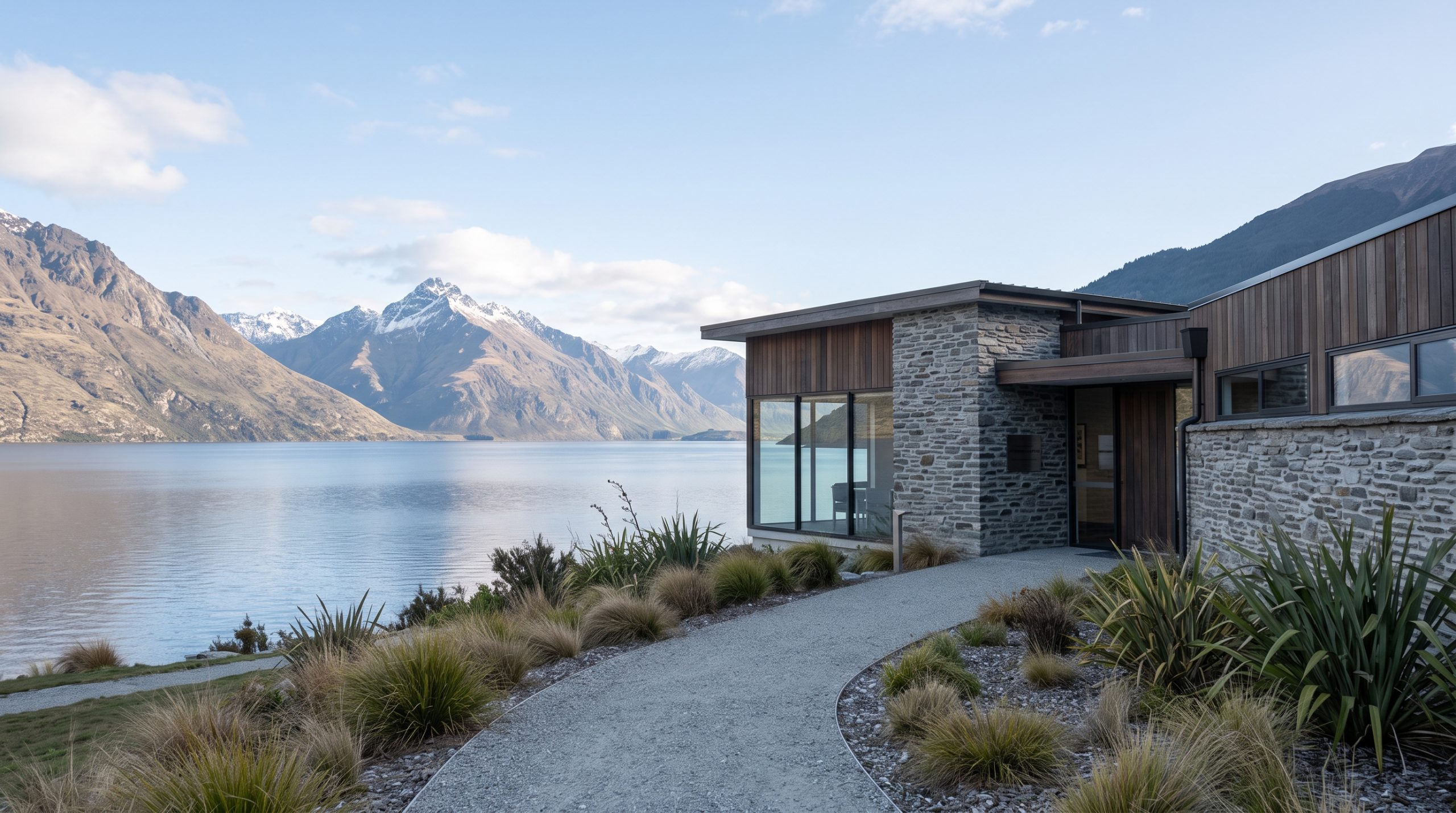
There is a field on the New Zealand marriage licence application for a second location. Not a second date. A second place, for the morning the weather closes in on the first one. A government form that quietly assumes the mountain might not cooperate tells you a great deal about what marrying in this country is actually like.
For a couple flying in from Denver or Charleston, New Zealand is close to the least demanding country in the world to marry in legally. There is no residency test. No apostille. No sworn translation, no certificate of no impediment to chase down at a county clerk’s office, no folder of certified copies carried through customs in a plastic wallet. One licence, one registered celebrant, two witnesses, and a clock that runs three working days.
What follows is the chain as it actually runs, the handful of places couples lose a week without noticing, and what we take off your hands while we are photographing and filming the morning.
What New Zealand asks of a foreign couple
Any two people aged 18 or over can marry in New Zealand, with no residency or citizenship requirement. You apply for one marriage licence, which costs NZD 150 through a celebrant, takes at least three working days to issue and stays valid for three months. You need a registered celebrant, two witnesses, and a place named on the licence.
No apostille, no translation, no residency test
Most countries make you prove you are free to marry before they will let you. Italy wants a declaration sworn at a consulate and a translated, legalised set of documents. France wants residence. New Zealand asks you to declare it on the licence application itself, under statutory declaration, and then takes you at your word.
That single difference removes an entire pre-trip project. You are not ordering long-form birth certificates, paying for apostilles at a Secretary of State’s office, or booking a sworn translator three months out. Neither of you needs to have lived in New Zealand for a single day. You arrive as visitors, you marry, you fly home. American passport holders travel on an NZeTA rather than a visa, with a visitor levy paid alongside it, both handled online before departure.
Marriage has been open to same-sex couples in New Zealand since 19 August 2013, and because there is no residency requirement attached to it, two women from Austin go through precisely the same one-page process as anyone else. Same form, same fee, same three working days.
This is practical planning guidance rather than legal advice. Confirm the final requirements for your circumstances with the relevant registry office or consulate before travel is fixed.
The licence, step by step, in the order it happens
Six steps, and only one of them has a deadline attached. The order matters more than most couples expect, because step two locks step three.
- Fix the date, the place and the alternative place. Both locations go on the application. This is a design decision before it is a paperwork one, and it is the step we are usually involved in first.
- Book your celebrant. Their full name goes on the licence application, so the celebrant is confirmed before you apply, not after. New Zealand maintains a public list of registered celebrants, and only a celebrant on that list, or a Registrar of Marriages, can legally marry you.
- Complete the Notice of Intended Marriage. One of you fills it in, with details for both. It carries a statutory declaration that there is no legal reason the two of you cannot marry. If either of you has been married before, the notice asks for the dates.
- Pay the fee. Currently NZD 150 if a celebrant marries you, or NZD 240 if you marry at a registry office, which includes the ceremony itself. Add the marriage certificate at the same time, currently NZD 33, and it is produced once the marriage is registered rather than requiring a second application later.
- Wait for the licence to issue. At least three working days. It goes to your celebrant, along with two copies of the particulars of marriage that get signed on the day.
- Marry, speak the required line, sign. New Zealand law asks each of you to say one sentence naming the other as your legal spouse, in front of the celebrant and both witnesses. Your celebrant supplies the exact form of words. Everything on either side of that sentence is yours to write. Then you sign, the witnesses sign, and the celebrant files the particulars with Internal Affairs for registration.
At the rates of the past couple of years, roughly sixty US cents to the New Zealand dollar, the licence lands under a hundred dollars. It is a small number on a long trip, and it is the one part of the morning where a government office sets the price. Fees and deadlines quoted here were correct at the time of writing and are worth re-checking with the office that issues them.
Build the New Zealand licence calendar around the ceremony
Three working days is the legal floor. It is not the number to plan on, because it assumes nothing between you and the Registrar goes sideways, and it takes no account of a flight that crosses the equator or a country running sixteen to eighteen hours ahead of the US East Coast depending on the season. Region and season choices belong further back still, and those sit in our destination elopement guides.
| Counting back from the ceremony | What happens | Who moves it |
|---|---|---|
| 6 to 12 months | Island, region, month and ceremony hour chosen around light and season; celebrant approached | You and us |
| 10 to 12 weeks | Exact ceremony location agreed, plus the named alternative; access and any landowner consent confirmed | Us, with your celebrant |
| 6 to 8 weeks | Notice of Intended Marriage submitted and fee paid, comfortably inside the three-month validity window | You |
| 3 working days, minimum | The licence is issued and reaches your celebrant | Internal Affairs |
| 4 to 6 days | You land, sleep off the time zone, and we walk the ground in whatever weather is genuinely happening that week | You and us |
| Ceremony morning | Licence with the celebrant, two witnesses present, alternative location live if the cloud sits low on the tops | Everyone |
The comfortable minimum we work to is a licence applied for six to eight weeks out, and both of you in the country four to six days before the ceremony morning. That buffer is not paperwork insurance. It is what allows us to move a sunrise ceremony from Tuesday to Wednesday when Tuesday is going to be flat grey nothing, without anyone’s arrangements unravelling.
Working days, anniversary days and the three-month clock
This is where the days go. None of it is difficult once you can see it, and almost all of it is invisible from the outside.
- Working days are not days. The three-day count skips weekends and public holidays, and New Zealand has a generous supply. The Christmas and New Year block removes 25 and 26 December and 1 and 2 January, which is exactly when the southern summer light is longest and when most couples want to be standing on a ridge. Waitangi Day on 6 February and ANZAC Day on 25 April sit in the shoulder months. Matariki moves each year. On top of the national list, every region observes its own anniversary day: Auckland’s falls in late January, Otago’s in March, which is the one Queenstown and Wanaka run on, and Canterbury’s in November.
- The three-month window closes at both ends. Apply too late and the licence is not ready in time. Apply too early, in the flush of enthusiasm eleven months out, and it expires before you land. Six to eight weeks ahead is the honest sweet spot.
- The licence is tied to a place, not to a single date. Inside those three months you can move the ceremony day for weather without touching the paperwork, provided you marry where the licence says you will. For an elopement built around a sunrise on an exposed ridge, this is the single most useful thing to understand about New Zealand.
- Name the alternative location, and name it properly. The second location field is not decoration. It is the difference between rescheduling and simply driving twenty minutes down the valley. We work out the wording of both locations with your celebrant so that the description on the licence matches the ground you will actually be standing on.
- The celebrant comes before the form. Couples routinely try to file the notice first and find the celebrant afterwards, then discover the application wants a name they do not have yet. In peak season on the South Island, good celebrants are spoken for months ahead.
- Order the certificate with the licence. Ticking the box at application time costs the same as doing it later and saves you chasing a New Zealand government office from a different hemisphere in a fortnight’s time.
- The apostille is a separate errand, and it comes afterwards. New Zealand is a party to the Hague Apostille Convention, and the Department of Internal Affairs is the office that issues them on New Zealand documents. If a bank, a consulate or an employer at home wants your marriage certificate authenticated, that application happens once the marriage is registered, not before you travel.
Seven things. None of them expensive, none of them hard, all of them capable of eating a week if they surface in the wrong order.
Sign at home and keep New Zealand for the ceremony
A good number of the couples we work with sign at a courthouse at home on a quiet Thursday afternoon and fly to New Zealand for the ceremony that actually means something to them. It is not a compromise and it is not a lesser version of anything. It is a different sequence, and it comes with real advantages.
With no licence in play, the three-working-day clock disappears, so does the three-month window, and so does the location field. You can marry at 5.50am on a ridge you chose the night before because the forecast turned. A friend can lead the words instead of a registered celebrant. Nobody has to be on any list, and nothing has to be filed in a New Zealand office afterwards.
What does not change is everything you will remember. The vows are the vows. The light is the light. The two of you standing in wet tussock at first light with a valley opening below you looks and sounds identical either way, and so does the film. If you are weighing the two routes, our notes on how to plan an elopement walk through the practical differences without the legal freight.
What we can carry into the day and what remains yours
We design the destination and the locations, build a timeline around light and honest travel times, research permits and hand you the logistics in plain language, and hold weather alternatives ready before you need them. On a New Zealand day that means we are looking at the ceremony hour and the licence in the same conversation, holding your date against celebrant availability, and making sure the place written on the licence is the place where the sun will actually be doing something at the hour you want it.
Aerials run on landowner consent, and on public conservation land they run on a Department of Conservation authorisation as well, so we confirm both before we build any part of the film around them. Team travel is included worldwide with no long-haul distinction, which matters more for New Zealand than almost anywhere we work.
Two witnesses have to be present, watching, and they sign afterwards. Couples travelling as two often assume this means recruiting strangers off a walking track at dawn. On The Expedition there is a dedicated photographer and a dedicated filmmaker on the ground with you, which is two adults already standing at the edge of the frame, and your celebrant confirms who is able to sign on the day. With eight of us on the team there is always a second camera and a colleague in reserve.
What stays with you: the licence fee, your celebrant, accommodation, any government or landowner permit fees, and unusual transport if the day calls for it, whether that is a helicopter onto a glacier, a boat across a sound or a 4×4 up a farm track. We do not file your paperwork. The licence is yours to apply for; the day built around it is ours.
Highlights reach you within five days of the ceremony, and the full gallery or film at three weeks. Our published stories and films are the quickest way to see what a South Island morning looks like when the licence, the celebrant and the sunrise all land inside the same hour, and what three weeks later actually gets delivered.
Coverage starts at $4,900 for a full day with one dedicated photographer or one dedicated filmmaker, and at $7,900 for a full day with both working together, with everything else set out on our pricing page.
Send us the region you are drawn to and the week you could travel, and we will come back with the ceremony hour we would aim for and the licence timeline sitting behind it. Check Your Date.
Common questions
Do we need to live in New Zealand to get married there?
No. There is no residency or citizenship requirement for either of you, and no minimum stay before the ceremony. Nothing in the licence application depends on having a New Zealand address. The only timing rule is the licence itself, which takes at least three working days to issue and stays valid for three months.
How far ahead can we apply for a New Zealand marriage licence?
Up to three months before the ceremony, because the licence expires three months after it is issued. The floor at the other end is three working days. We plan around six to eight weeks, which is far enough out to absorb a public holiday and close enough in that the licence will not run out.
How much does a New Zealand marriage licence cost?
Currently NZD 150 when a registered celebrant marries you. If you marry at a registry office instead, it is NZD 240 and the ceremony itself is included in that. A marriage certificate is a separate NZD 33 and is worth ordering at the same time as the licence rather than later.
Do we need birth certificates, an apostille or translations?
No. New Zealand runs the application on a statutory declaration rather than a submitted folder of documents, so there is no apostille to obtain before you travel and no sworn translation to commission. If you later need your New Zealand marriage certificate authenticated at home, the Department of Internal Affairs issues apostilles on New Zealand documents.
Can we get married on a mountain or a beach in New Zealand?
Yes. New Zealand places no restriction on the type of location or the hour of the day, so a 5.50am summit ceremony in late December is exactly as legal as a registry office at eleven in the morning. The location has to be named on the licence, and you can name a second one for weather.
Who can be our two witnesses if we are travelling alone?
Two witnesses must be present at the ceremony and sign the particulars afterwards. Couples who fly in as a pair usually use the people already standing there with them, and your celebrant confirms who is able to sign on the day. On a two-person team day, that is a photographer and a filmmaker on the ground with you.
Can same-sex couples from overseas marry in New Zealand?
Yes. Marriage has been open to same-sex couples in New Zealand since 19 August 2013, and because there is no residency requirement, couples from overseas go through exactly the same licence process as anyone else. The form, the fee and the three working days are identical.
Do we need a special visa to get married in New Zealand?
There is no marriage visa and none is needed. Couples marrying while visiting travel on ordinary visitor entry, and American passport holders use an NZeTA applied for online before departure, with a visitor levy paid at the same time. Marrying in New Zealand does not alter your entry conditions.
Start with the light, then fit the licence around it
The order that works is light first. Choose the month and the hour you want to be standing somewhere, then let the paperwork arrange itself around that, because the licence is flexible and the sun is not. In late December a Queenstown sunrise arrives close to six in the morning and the evening light holds past nine. In June you wait until after eight for first light and lose it before five, which makes a winter day short, cold and better lit than most people expect.
Everything with us happens in writing. Send the inquiry form and you will have a reply and our initial brochure within 24 hours, then a tailored proposal built around your dates. A signed contract and a 30% retainer start the planning properly. Our calendar currently covers 2027–2029.
Tell us the island, the month and what you want the morning to feel like, and we will tell you where the licence timeline has to sit to make it happen. Start Your Story.