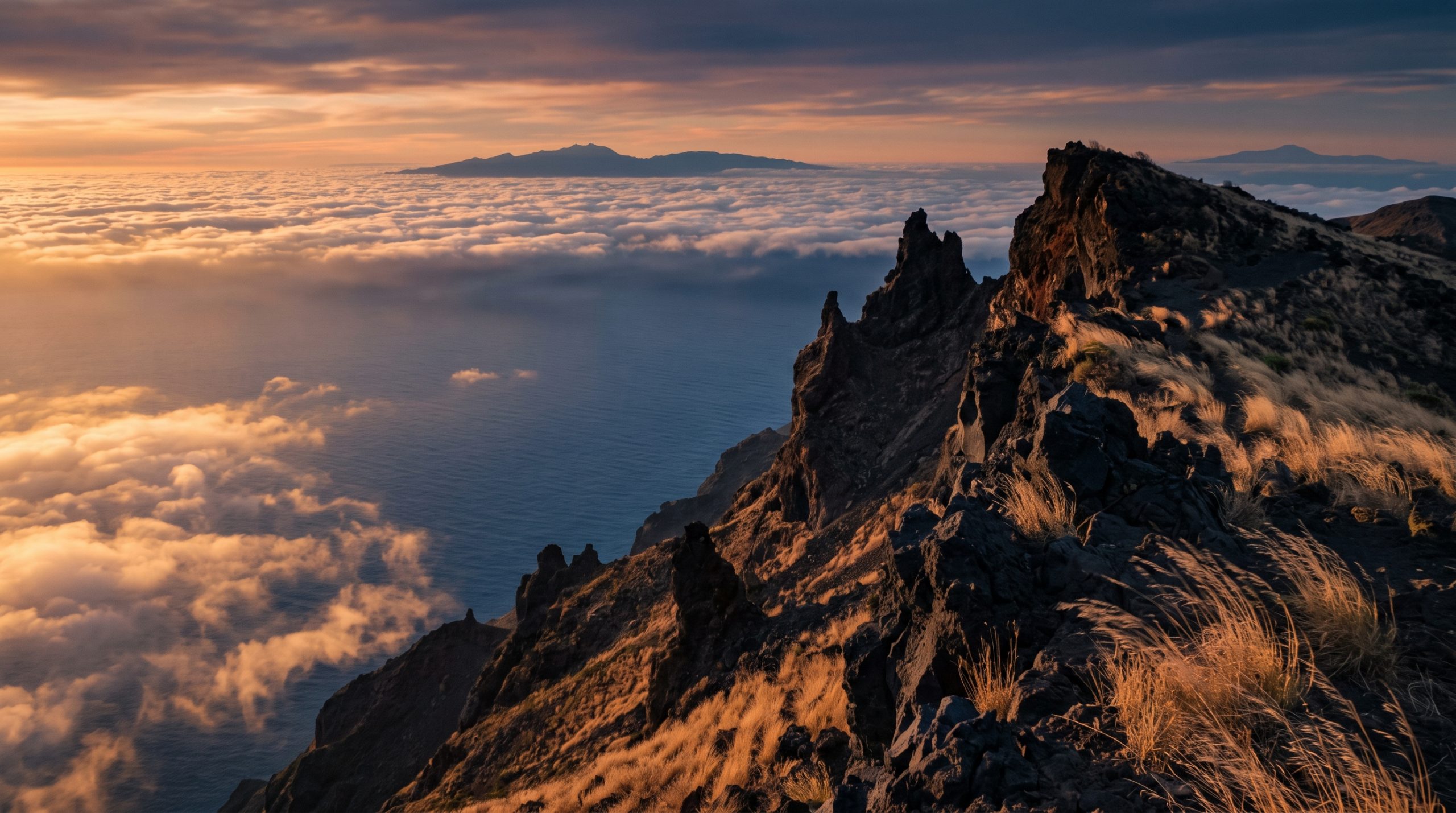
The first cabin up the Teide cable car leaves at nine in the morning. In June, sunrise on the crater floor lands a little after 7:10. Those two numbers shape a Canary Islands wedding film more than any camera decision does, because the best light of the day happens more than a thousand meters below the top station, on foot, long before the mountain opens for business.
The second thing that shapes it is paperwork with a rhythm to it. Teide National Park authorizes professional photography and filming in writing, and the application goes in at least a month before the date. For a group the size of ours, the park’s own ceiling is one authorized shoot per calendar month. A date here is not simply free or taken; it is claimed early or it is claimed by someone else.
Then there is the cloud. Most mornings the trade wind stacks a gray deck against the north coast and stops well below Las Cañadas, so the town you wake up in can be flat and colorless while the park at 2,000 meters sits in clean, hard sun. It cuts the other way too. The Roques de García viewpoint at eleven in the morning is a car park with a view and forty strangers in your frame. At 6:40 it belongs to you.
The figure, and the two things that move it
We are eight people, photographers and filmmakers, with planning built into the work rather than sold beside it. A full day in the Canaries with a dedicated filmmaker starts at $4,900. A full day with a dedicated photographer and filmmaker working together starts at $7,900. Team travel to the islands is included in both.
From a 5:20 alarm to a dusk that lasts 26 minutes
An island day is built backward from two edges: the moment the sun clears the eastern ridge and the moment the color drains out of the sky. In the Canaries the second edge arrives fast. At this latitude civil twilight runs roughly 26 minutes, so the soft blue window after sunset is a quarter of an hour of usable film and then it is gone. Everything else in the timeline exists to put you in the right place for those two edges.
Before light
In June that means leaving the coast around 5:20. It is about an hour of climbing road from either shoreline up into the park, and the last twenty minutes of it are worth doing in the dark rather than at speed. By 6:40 we want you standing on the pumice with your shoes already sorted, because first light strikes the cone well before it reaches the floor and the difference between those two events is about fifteen minutes of the best frames of the morning. Sunrise is near 7:10 in June and near 7:54 in late December, which is the whole argument for a winter date if early alarms are not your idea of romance.
The nine o’clock decision
If the summit is part of your picture, the cable car is the gate. First cabin at nine, upper station at 3,555 meters, and the final stretch of trail to the 3,715 meter peak needs a separate free permit from the national park, capped at a couple of hundred people a day across timed slots and released long enough in advance that it is worth booking the moment your date is held. Cable car tickets do not include that permit, and a non-resident adult fare currently runs around 23.50 euros one way. The base station car park has 220 spaces and it tightens through the morning, so we go early or we go late.
The dead hours, used properly
Between roughly ten and four the park light goes hard and directionless, the coaches arrive, and honestly there is very little worth filming up there. We treat that as part of the plan rather than a failure of it: descend into the Corona Forestal pines where the shade holds, or drop to sea level, eat something, change, sleep for an hour. Couples who fight this window arrive at sunset with nothing left. Couples who use it get a second full act.
The second edge
Late afternoon we choose by wind direction, not by preference. West coast basalt and black sand if the trades are pushing from the northeast; the laurel forest of Anaga if the north is clear; back up to the crater floor if the deck has broken. Vows land about forty minutes before sunset, which in June means the light is still warm at 20:25 and the sky is still working at 21:06. Then the 26 minutes. Then, if you want it, a properly dark sky over the park, planned as its own hour rather than tacked onto a tired evening. Our destination guides go deeper on how the islands differ month to month.
Check Your Date and tell us the month you are looking at. We will come back with what the light is doing that week.
Two cameras inside the same 26 minutes
Here is where hiring one team instead of two stops being an abstraction. A photographer needs to be close for the tight frame. A filmmaker needs distance and a clean background, and needs you to walk rather than pose. In a window that short those two needs collide, and when the two people involved met that morning in a car park, the first ten minutes go to negotiating who stands where. We agree the two positions the night before, off the same timeline we wrote for you weeks earlier.
Wind is the other reason it matters here. The crater floor and the exposed ridges get pushed hard by the trades, and audio is always the first casualty. On the Expedition we bring professional audio for vows and the moments that matter, where conditions allow, which in practice means we site the ceremony in a sheltered fold of lava instead of the photogenic edge fifty meters away, and the photographer works from the downwind side so that the stills never cost us the sound of you speaking. That is a decision two separately booked vendors have no mechanism to make.
Aerials work the same way. Drones are not part of a Teide National Park plan, since the park keeps them out except for heritage documentary work, so if the film needs altitude from the air we build that hour somewhere else on the island entirely, on proper operator registration with the flight area checked before it goes anywhere near your timeline. You can see how all of this resolves in the finished films and galleries on our stories page, where the pairing of stills and moving image across a single day is the whole point of the work.
Eight people also means there is always a second camera on the ground and a colleague in reserve. Nothing about your day rests on one person having a good morning.
The paperwork question everybody asks second
Spain opens a civil marriage file at the registry or the court where one of you actually lives, and documents arriving from the United States need a Hague apostille to be read there at all. The practical consequence is simple and it is not a problem: couples flying in almost always handle the legal signature at home, before or after, and keep the island for the ceremony they actually care about.
That ceremony is a celebrant, your own words, two witnesses if you want them, and nobody watching a clock but us. On camera it looks exactly like what it is. Our planning fundamentals walk through the order we recommend, and permit research and logistics guidance are part of every experience regardless of which route you take.
What travels with the team, and what stays on your side
In every experience
- Destination and location design for the island and month you choose, and a custom timeline built around light and real travel time on mountain roads.
- Permit research and logistics guidance, including the park and coastal authorities that govern the locations in your plan.
- Weather alternatives and backup planning, written before you arrive rather than improvised at 6am.
- Drone footage where it is legal, safe and appropriate.
- Professional audio for vows and meaningful moments on the Expedition, where conditions allow.
- Team travel worldwide: flights, accommodation and ordinary travel for the assigned team, with no long-haul surcharge.
- Highlights delivered in 5 days. The full gallery or film in 3 weeks.
Price does not move with guest count. Bringing four people changes access, permits, transport and the shape of the timeline, not the fee.
The euros that are not ours
We research and file the permit paths; the fees themselves are charged to you by whichever authority governs the location. That can mean the national park, the coastal service for beach and shoreline work, or a town hall, and on Tenerife a road location also needs a traffic authority permit with a small fee of roughly 20 euros attached. Lanzarote’s protected areas run through the island’s environment department and want one to three months of notice depending on the size of the project, which is a planning fact rather than an obstacle. Add cable car tickets if the summit is in play, your celebrant, accommodation, inter-island flights or ferries, and any unusual transport such as a private boat, a 4×4 charter or a mountain guide. The full breakdown of what each level of coverage includes lives on our pricing page.
Six steps to a held date
- You send the inquiry form with your island, your month and anything you already know you want.
- We reply within 24 hours with our initial brochure.
- We build a tailored proposal: locations, coverage level, permit path, the shape of the day.
- Contract signed and a 30% retainer paid. The remaining schedule is set out in the proposal.
- Planning begins in earnest, and keeps going until the timeline, alternatives and logistics are settled.
- The day happens. Highlights reach you in 5 days, the full gallery or film in 3 weeks.
Our current Canary Islands availability runs across 2027–2029, and because park authorization is limited by month, the earlier a date is claimed the more room the permit path has to breathe.
Altitude, early alarms, and the month that fits
This archipelago rewards couples who are genuinely happy to be awake at five, comfortable walking on uneven lava in real shoes, and cold-tolerant at dawn even in July, because 2,000 meters up the temperature has nothing to do with the beach forecast. It also rewards people who can let a plan move. When the deck sits high, we climb. When it breaks, we stay low. That decision gets made at six in the morning and it is not a sign that anything went wrong.
If pre-dawn is honestly not your idea of a good morning, say so in your first message, because there is a gentler shape available and it is a better film than a reluctant 5am. A late-December day runs from a 7:54 sunrise to an 18:15 sunset, which is a full day at civilized hours. A sea-level day in Anaga’s forest and coves asks far less of your legs than the crater floor does. And if you want the mountain and the ocean without compressing both into one dawn, the Odyssey spreads photography and film across several days and, if you like, several islands. Tell us which of those sounds like you and we will tell you honestly which month and which island fit it best.
Common questions
How much does a wedding film in the Canary Islands cost?
Coverage starts with the Adventure, a full day with one dedicated filmmaker, and steps up to the Expedition, where a dedicated photographer and filmmaker work the same day together. Both starting figures are stated near the top of this page, and both already include the assigned team’s flights, accommodation and travel to whichever island you pick.
Can one company really do both our photos and our film?
That is the entire way we are built. Photography, film and planning come from the same eight-person team rather than from a photographer plus a videographer who introduce themselves to each other at 6am. Both work from the timeline we wrote, which is what makes a 26 minute twilight survivable.
Do we need permission to film a ceremony in Teide National Park?
Yes. Professional photography and filming in the park runs on written authorization requested at least a month ahead, and the park limits how many it grants; for a group our size that is one authorized shoot per calendar month. We do the research and the application path. Any fee the authority charges is paid by you.
Can you fly a drone over Teide?
Not inside the national park, which keeps drones out other than for heritage documentary work. Elsewhere in the islands aerials are workable with proper operator registration and the flight zone confirmed in advance, so we check both before any shot in the film depends on them.
Is a Canary Islands ceremony legally binding for Americans?
Spain opens the civil file where one of you resides, and foreign paperwork needs an apostille, so couples flying in generally sign at home and hold the ceremony itself here. It changes nothing about the day, the vows or the film. We plan the timeline the same way either way.
How far ahead should we book a Canary Islands elopement?
We are booking 2027 through 2029. Because the park authorizes a limited number of shoots per month and the paperwork goes in a month or more before the date, six to twelve months of lead time gives everything room. Shorter than that is often still workable, so ask rather than assume.
What happens if the cloud sits on the mountain that morning?
We move to the alternative that was already in the timeline. The cloud usually tops out below the park, so a gray coast often means we climb higher rather than give anything up. In winter the park roads can hold snow and open later in the morning, which is why a January plan always carries a sea-level opening at the same hour.
Which island should we choose for the film?
Tenerife if you want altitude and the crater floor. Lanzarote for lava fields and white architecture, with protected-area permission requested one to three months ahead through the island’s environment department. La Palma and La Gomera for forest, ridge and cloud. Tell us your month and we will tell you which island reads best in that light.
Tell us the island and the month
Everything on our side happens in writing, at whatever pace suits you. You send a message, we reply within 24 hours with the brochure, and the proposal that follows is yours to read on a Sunday morning with coffee, with nothing to answer until you are ready. If you already know the island, say so. If you only know the season, that is enough to start with. Tell Us Your Story