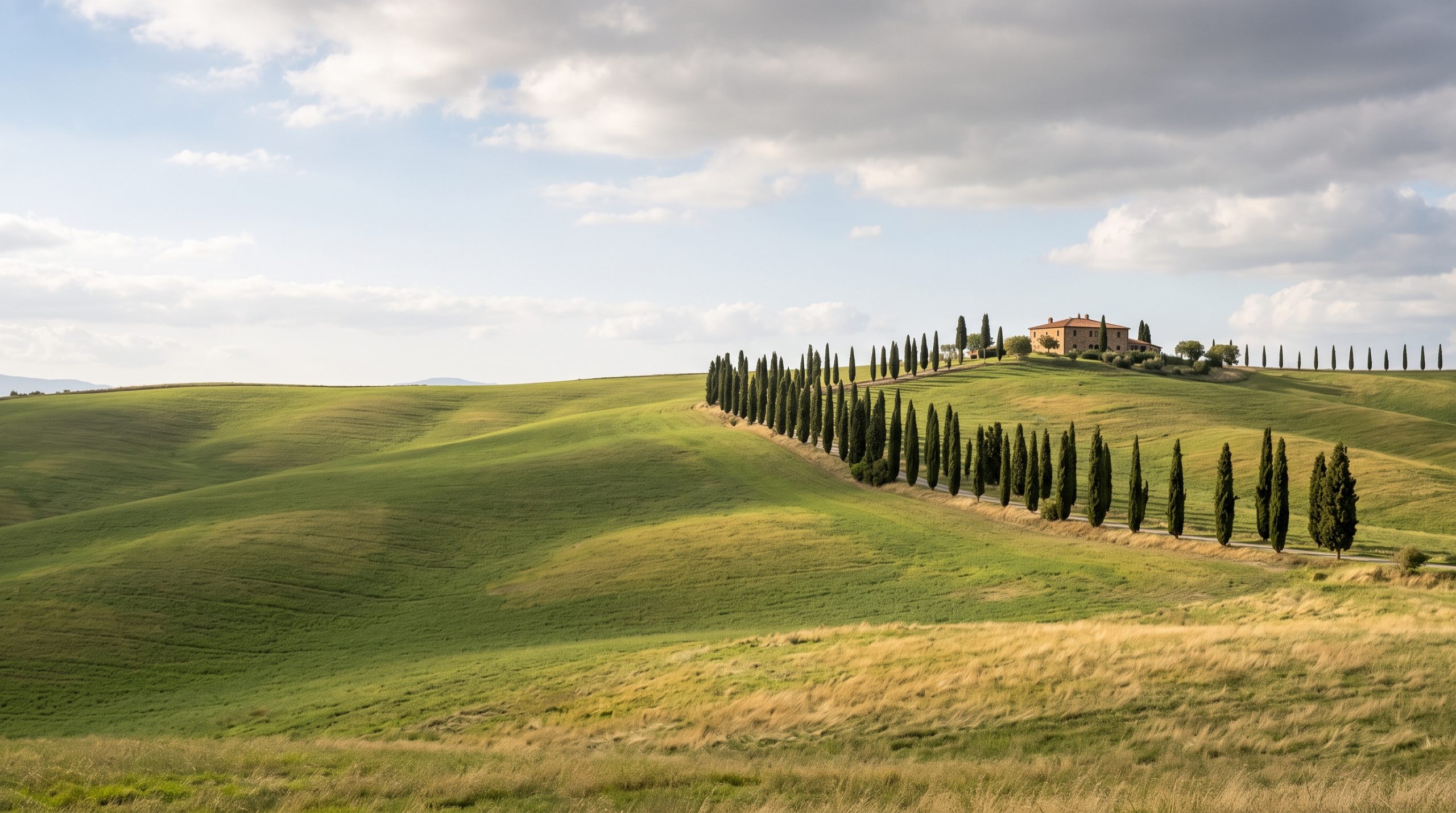
Seven in the morning on the white road above San Quirico d’Orcia, third week of October. The sun clears the hills at about 7:30, and until it does the valley holds a flat sheet of mist that sits under the cypress rows and then lifts inside half an hour. Two cars pass in that time. That is the entire traffic report.
The same road at eleven in the morning in the first week of August is a different country. Eighty-six degrees, hard overhead light, a van parked at the gate of the farmhouse everyone photographs. Neither morning is wrong. They are two different films, and which one you get is settled by a fortnight on the calendar rather than by luck.
So this is the Tuscan year as we actually plan it: sunset times, rainfall, the crop standing in the field, and the weeks we would quietly move a date away from if we could. The temperature and sun figures below describe Florence, the rain figures Siena, which sits in the middle of the hill country most couples mean when they say Tuscany.
The fortnight we book before any other
The second half of September into the first half of October. Sunset falls near 7:25pm in mid-September and 6:30pm a month later, afternoons run around 77°F, and the grape harvest is moving through the vineyards while the coach traffic thins. May is our second choice: greener, longer, busier.
Twelve months in the Tuscan hills, in one table
Daytime highs are Florence averages from the 1990 to 2020 record. Sunset times are mid-month for Florence and move by a few minutes east to west across the region. Rain figures are Siena’s.
| Month | Daytime high | Sunset, mid-month | What the country looks like | Our verdict |
|---|---|---|---|---|
| January | 48°F / 9°C | 5:05pm | Bare vines, frost in the hollows, fog at dawn | Short and quiet; town-based days |
| February | 52°F / 11°C | 5:45pm | Brown fields, low sun all day long | Underrated for hill towns and interiors |
| March | 59°F / 15°C | 6:20pm | Wheat greening, first warm afternoons | Clocks change late March; light jumps an hour |
| April | 64°F / 18°C | 8:00pm | Green everywhere, showers passing through | Strong month, real rain plan needed |
| May | 72°F / 22°C | 8:30pm | Poppies in the field margins, wheat still green | Our second choice; books out first |
| June | 81°F / 27°C | 9:00pm | Wheat turning gold, earliest sunflowers | Longest evenings of the year |
| July | 86°F / 30°C | 8:55pm | Sunflowers at full height, driest month | Sunrise work, then a long gap |
| August | 86°F / 30°C | 8:20pm | Stubble, brown hills, Ferragosto on the 15th | Busiest weeks; last third is better |
| September | 77°F / 25°C | 7:25pm | Vendemmia in the rows, dust on the tracks | Our first choice |
| October | 68°F / 20°C | 6:30pm | Vine leaves turning, mist most mornings | First choice too, and calmer |
| November | 57°F / 14°C | 4:50pm | Wettest month, bare rows, 100 hours of sun all month | First half only, with interiors held |
| December | 50°F / 10°C | 4:40pm | Still air, empty roads, early dark | Compact day, ceremony by mid-afternoon |
Three windows that move every year
Everything photogenic in the Tuscan countryside is a crop, and crops answer to the weather rather than to your date. That is worth knowing before you plan a day around a particular color.
Poppies are the shortest and the least predictable of the three. They come in with late spring in the field margins and along the white roads, they last a couple of weeks in any one place, and the start slides by ten days or more depending on how the spring rain has fallen. We would never sell a poppy field as a certainty. We will tell you, in the week before you fly, which margins south of Pienza are actually red.
Visit Tuscany puts the sunflower season as starting in June, with the fields at their fullest through July and into early August. In practice a single field stands at its best for a shorter stretch than that, and the heads brown quickly once they stop tracking the sun. Sunflowers also rotate. The field that carried them last summer may be wheat this one, which is why we drive the ground in the days before rather than working from a pin dropped a year ago.
The vendemmia is the one window with a whole region’s attention on it. Visit Tuscany describes the grape harvest as a September and October event whose exact date is set year by year by the weather and the sugar in the fruit. For a film this is the best of the three: pickers in the rows, tractors on the track, cellar doors open, and warm dust in the last hour of light. You can see how those weeks look in finished work in our stories, where the harvest days sit next to the cold clear ones.
The weeks we ask couples to shift, and where we shift them
The first three weeks of August. The heat is the smaller half of it; 86°F is manageable when you start at six. The larger half is that Italy takes its holiday around Ferragosto on August 15, a national public holiday and the fixed point of the Italian summer, and the country reorganizes itself around it. Small restaurants shut for a fortnight, family-run farms are away, and the roads into the hill towns carry everyone at once. Move the same plan to the last week of August or, better, ten days into September, and you keep the warm evenings while the machinery of the place starts working normally again.
The other one is the back half of November. Siena averages 121 mm of rain across 14 rainy days that month, with roughly 100 hours of sunshine in the whole of it, and sunset has already fallen back to about 4:50pm. That combination shortens the usable day at both ends. If November is where your date has to sit, take the first ten days and build the day around Siena, Lucca or Florence, where the good ground is stone and covered and a wet hour costs you nothing.
None of this rules a month out. We have shot beautiful days in mid-August and in the rain in November. If your date is already fixed in a hard month, write to us with the date and we will send back the shape that makes it work, which usually means an earlier ceremony hour and a location list chosen for shelter rather than for the postcard.
What the light does between a 4:40pm sunset and a 9pm one
Tuscany’s summer and winter days are not the same day with different temperatures. They are different lengths and the sun travels a different arc.
Around the June solstice Florence gets over fifteen hours of daylight, the sun goes down close to 9:00pm, and it sets well to the northwest, which lights the western faces of the cypress avenues and keeps the ridges warm until late. That evening is generous. A ceremony at seven leaves you two full hours of falling light and a walk back in the dark, and nobody is rushed.
The December solstice runs to about eight hours and fifty-eight minutes of daylight, with sunset near 4:40pm and the sun dropping into the southwest. The trade is real and it is not all loss: the sun never climbs high, so a December day is one continuous low, raking light with no harsh middle to work around. A two o’clock ceremony in a walled garden in Pienza is lit the way five o’clock is lit in June. You simply have fewer hours of it.
September, the month we push hardest, gives roughly twelve and a half hours with sunrise near 6:55am and sunset near 7:25pm. That is the shape we like: a cold blue hour on the ridge, a middle stretch for the drive and the cellar, and vows placed at half past five so the last warm hour lands on the ceremony rather than after it.
The short months are where two people on the ground stop being a luxury and start being arithmetic. When the warm light lasts forty minutes, a photographer cannot pause to let a filmmaker reset an audio channel and still come away with the frames. Our Expedition puts a dedicated photographer and a dedicated filmmaker in the same field at the same time, so the same forty minutes gets covered twice from two positions. In June, with a three-hour evening, the same pair simply gets to work slowly. Check Your Date and we will tell you what your month’s light will actually give you.
Ceremony rooms, white roads and the calendar the city keeps
Tuscany has few seasonal closures of the alpine kind. What it has instead are calendars held by other people, and they fill in a fixed order.
If your legal ceremony is in a city room, the city sets both the price and the slot. The Comune di Firenze currently lists the Sala Rossa in Palazzo Vecchio at 2,500 euros for non-resident foreign couples, with the Salone dei Cinquecento at 5,100 euros, and it requires a declaration of no impediment to be made in person at the marriage office by appointment, with an interpreter if needed, at least two days before the ceremony. Those rooms run on the city’s weekly schedule, not on yours, and September and October dates go early. Many couples we work with handle the legal paperwork at home and keep the Tuscan ceremony symbolic, which puts the hour and the place entirely back in your hands. Both routes are covered in our planning fundamentals.
Out in the country the seasonal question is the surface underfoot. The strade bianche are gravel and clay, and after a wet week in November or March the pretty one is not always the passable one, so we hold a paved approach for every countryside location and check it the morning of. Small family-run estates also staff up and down through the year, which matters most in August and in deep winter, so we confirm who is actually on site in your week before a location goes into your timeline rather than after.
How the Tuscan rain version is built before you arrive
Rain in Tuscany is mostly a spring and autumn business. July is the driest month in Siena at 33 mm across six rainy days; November is the wettest at 121 mm across fourteen. Even in the wet months the pattern tends toward a heavy few hours rather than a grey week, which is why the plan is about hours rather than days.
Every timeline we write carries a second version. The ceremony hour can move by two or three hours without breaking the day, because we build it as a hinge rather than a fixed point. Locations are paired by what the weather is doing: a wet southwesterly off the sea sends us to the loggias and cellars, and a cold northerly, which usually arrives with clean air behind it, sends us up onto the ridges because that is when the long views over the Val d’Orcia come back. The steaming hot-spring pool in the square at Bagno Vignoni is worth more on a raw morning than on a warm one, and we plan it that way.
What we will not do is promise weather. Mist in the October valleys is common and not guaranteed; a clear line of sight to Monte Amiata on a January afternoon is a gift rather than a plan. What we can promise is that nothing on the day is being invented on the day.
Common questions
Is September or May better for eloping in Tuscany?
September, for us. Both give kind temperatures, but September’s sunset near 7:25pm keeps the ceremony hour civilized rather than late, the harvest gives the countryside something to do, and the roads are calmer than in May. May’s advantage is green hills and poppies in the margins. If you want the green, come in May and expect more company.
Is August too hot to elope in the Tuscan countryside?
No, but it changes the clock rather than the location. Florence averages 86°F in August and the sun is up by about 6:20am, so we run the first half of the day from sunrise, break through the middle, and come back out at 7:30pm for a sunset near 8:20pm. The bigger factor is Ferragosto on August 15 and the closures around it, which we plan around by choosing estates that stay staffed.
When exactly do the sunflowers bloom in Tuscany?
Visit Tuscany places the season as beginning in June and peaking through July into the first days of August. Any individual field holds its best form for a shorter stretch, and the crop rotates from year to year, so we scout on the ground in the days before your date instead of promising a specific field.
Can we elope in Tuscany in winter and still get the cypress hills?
Yes, on a compressed timetable. The shortest day gives about eight hours and fifty-eight minutes of light with sunset near 4:40pm, so vows go in around two in the afternoon and the whole day sits inside one long stretch of low sun. Winter also buys you empty roads in Pienza and Monticchiello, and morning fog in the valleys more often than any other season.
How far ahead should we book an October date in the Val d’Orcia?
Earlier than feels necessary. We currently have dates open across 2027, 2028 and 2029, and late September and October dates are the first to go each year. If a city ceremony room is part of the plan, the comune’s own calendar adds another layer of scheduling on top of ours.
Will the grape harvest get in the way of using a working vineyard?
It is the reason to go, not an obstacle. The harvest runs through September and October with the exact start decided each year by the fruit, and picking happens early while it is cool. We build the ceremony for late afternoon, which leaves the morning rows free and gives you the cellar at its busiest and most alive.
What happens if it rains on our elopement date in Tuscany?
The alternative is already written and paired to the wind direction, and the ceremony hour moves rather than the plan collapsing. Siena’s wettest month averages fourteen rainy days, which still leaves sixteen dry ones, and Tuscan rain generally arrives in blocks of hours. A wet afternoon usually means we swap the ridge for a cellar and get the ridge back at seven.
Choosing your fortnight
Pick the month for what you want to walk through: green and poppies in May, cut gold and long evenings in June, harvest and calm in late September, low sun and empty hill towns in December. Then let us build the hours around it. Our destination guides go deeper on the ground itself, and what a full day of photography, film and planning covers is set out on our pricing page, team travel included.
We keep the planning in one written thread, in your own time zone and at your own pace, starting with a reply and a brochure within 24 hours. Send us your date, or two dates you are choosing between, and we will tell you honestly what each one does with the light. Tell Us Your Story.