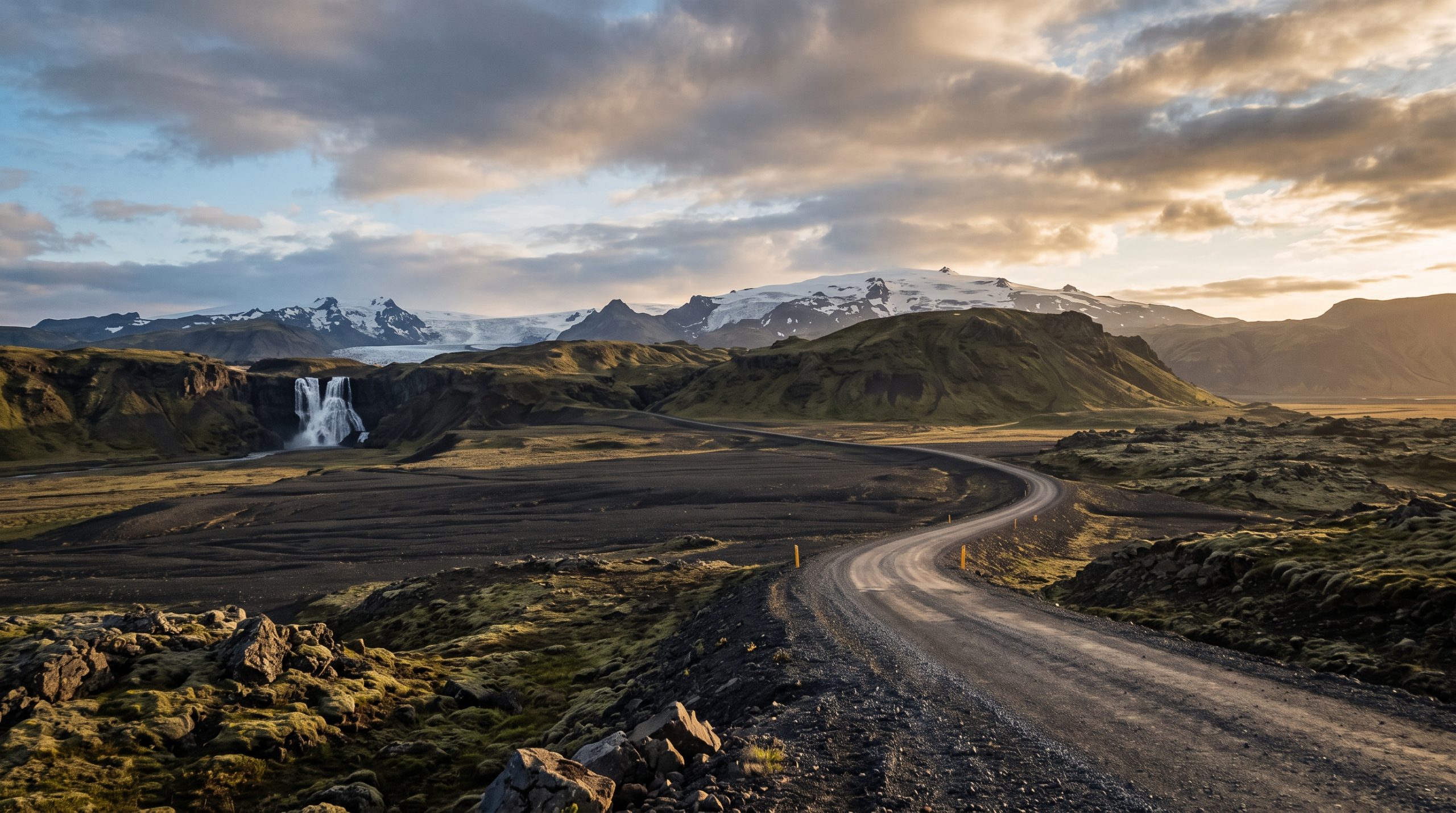
On 21 June the sun comes up over Reykjavík at 2:55am and does not go down again until 12:03am the following morning. That is twenty-one hours of daylight, followed by roughly three hours of twilight where the sun sits just under the horizon and never properly leaves. A timetable built for that day looks nothing like a wedding timetable anywhere else on earth.
Six months later the same city gets four or five hours of light, and the December solstice day runs a full seventeen hours shorter than the June one. Same country, same couple, same two and a half hour drive to the coast. Completely different day.
So there is no single Iceland timeline, and anyone who hands you one has not looked at a sun table. What follows is a real hour-by-hour day built on midnight-sun light from a base in Vík, the same day rebuilt for autumn and for deep winter, and the drive times and gate fees that set those hours in the first place.
Why the timetable swings by seventeen hours
An Iceland elopement day is set by latitude rather than by convention. In late June the ceremony lands near midnight and every drive is made in daylight. Around the winter solstice the whole day is four or five hours of low gold. We choose the base town first, then the hours, then the locations.
A June day on the south coast, hour by hour
Nothing useful happens in the morning. Between about 10am and 6pm in late June the sun is high and the light on black sand goes flat and grey-white, which is exactly when the coaches are parked three deep at every south coast stop. So we invert the day. Sleep late, and treat the evening as your morning.
8:30pm. Getting ready at the guesthouse in Vík. The light through a north window at this hour is soft and enormous, and there is no clock pressure yet, which is the only time all day that will be true.
10:00pm. Fifteen to twenty minutes in the car to the coast. The last of the day visitors are leaving as we arrive, and the car park that held sixty vehicles at two in the afternoon holds four.
10:30pm. First frames. The sun is low in the northwest, which means it is behind the headlands rather than out over open water, and the sand takes a warm sheen instead of a glare.
11:15pm. Ceremony. Vows read with the sun a few degrees above the horizon and shadows running thirty feet across the beach. On the Expedition there is a filmmaker on audio at this point, so the words survive the wind rather than getting lost in it.
12:03am. Sunset. Colour does not stop when the sun goes; it deepens and slides north along the horizon for the next hour and a half.
12:45am. Thermos, dry socks, second location. We move inland to a waterfall or a moss field, where flat twilight works better than direct sun ever does in a canyon.
2:00am. The quiet stretch. No darkness, no people, no queue for a viewpoint. The two hours either side of midnight are the reason we push the whole day this late, and you can see how that light holds up once it is graded and cut in our published galleries and films.
2:55am. Sunrise, from the northeast this time, roughly a quarter of the compass away from where the sun set. Two golden hours in one night from two different directions is a thing Iceland gives you in June and almost nowhere gives you in October.
3:40am. Last frames as the light gets strong again. Back at the guesthouse by half past four, and nobody sets an alarm.
Plenty of couples read that and want no part of it, which is a completely reasonable position. The alternative summer shape is a ceremony around 8pm and bed by one, giving up the sunrise half and keeping most of the good evening light. Tell us which of those two you actually want and we will build the timeline around it.
The same day in October, and in January
Autumn is the easiest Iceland light to work with and the one couples underestimate. Through March, April, September and October the sun rises somewhere between 6:00 and 8:00am and sets between 6:00 and 8:00pm, so a genuine sunrise start and a sunset ceremony both fit inside one day without anybody going nocturnal. The sun also stays low for hours rather than minutes, so the good light is not a fifteen-minute panic.
Deep winter is a different craft. The latest sunrise of the year falls on 25 December and the earliest sunset on 18 December, which leaves four to five hours of usable light in Reykjavík. That is enough for one location done properly, not three done at a jog. We put the ceremony close to solar noon, we keep the drive under an hour each way, and we treat the long blue hour on either side as part of the coverage rather than as leftover time.
| Season | Sunrise | Sunset | How we shape the day |
|---|---|---|---|
| Late June | About 2:55am | Just after midnight | Ceremony near 11pm, two or three locations, no headlamps needed |
| March to April, September to October | Between 6:00 and 8:00am | Between 6:00 and 8:00pm | Sunrise start and afternoon ceremony both fit in one day |
| Around the December solstice | Latest of the year on 25 December | Earliest of the year on 18 December | One location, ceremony near midday, blue hour used deliberately |
Which month suits you depends far more on the region you want than on the calendar, and our destination guides go region by region on that.
Where the map lies, and what the gates add
Route planners in Iceland are optimistic in one specific way. They give you moving time on an empty road in July. They do not know that you will stop at the third waterfall, or that the car park you are aiming for has a gate and a payment machine before it has a view.
The clearest example is the run east. Reykjavík to Jökulsárlón is 380 km and about five hours if you drive it straight through. With south coast stops it is seven to eight. Couples who put that lagoon on a one-day itinerary from Reykjavík are planning ten hours in a car to reach a place they will see for forty minutes in the wrong light.
| Route | Distance | Map time | What we plan on |
|---|---|---|---|
| Keflavík airport to Reykjavík | 48 km | 45 minutes | 90 minutes from wheels down, including the rental desk |
| Reykjavík to Þingvellir | 45 km | 50 minutes | 75 minutes, longer once the lots fill |
| Reykjavík to Vík | 187 km | 2 hours 30 | 3 hours 15 with one stop and a wind allowance |
| Vík to Jökulsárlón | About 190 km | 2 hours 30 | 3 hours |
| Reykjavík to Jökulsárlón | 380 km | 5 hours | 7 to 8 hours if you stop at all |
The second thing the map hides is the highland road network. Vegagerðin, the Icelandic road administration, opens each F-road only after it physically inspects the route and the ground is dry enough to carry a vehicle, and it publishes the live status on umferdin.is. In a normal year F35 over Kjölur goes first in late May or early June, F208 to Landmannalaugar and F249 toward Þórsmörk follow in mid to late June, and the remote interior can wait until July. A route planner will cheerfully send you over F208 in May. If your date is in the first half of June and you have your heart set on rhyolite mountains, tell us early and we will either move the region or build a low-level day that gets you closer to that colour than you would expect.
Then there are the gates. Iceland has quietly moved to paid parking at the busy sites, and the amounts are small but they slow a tight timeline if nobody has warned you about the machine.
- Þingvellir: 1,000 ISK per car for the full day, and one ticket covers every lot inside the park. Roughly seven or eight US dollars at recent rates, which is the only conversion worth doing here.
- Seljalandsfoss: 1,000 ISK to park, paid on arrival.
- Stokksnes and the Vestrahorn beach: private land, with a per-person entry fee at the Viking Café that currently sits around 1,000 ISK. The 6 km gravel access road is fine for a normal car in summer, and Höfn is fifteen minutes west for fuel and food.
- Central Reykjavík: metered streets run up to around 600 ISK an hour in the busiest zone, which matters on a getting-ready morning downtown.
Paperwork sits in the same category of thing that quietly eats hours if it is left late. The examination of marriage impediments in Iceland is handled by the District Commissioner, the sýslumaður, and the documents need to be with the office well ahead of your date rather than in the week of it. We map that timeline with you alongside the shooting timeline, and the wider sequence is set out in our guide on how to plan an elopement. The celebrant and any permit fees themselves are yours to pay directly; the research, the applications and the chasing are ours.
The aerial hour, and what we confirm first
Drone footage is included wherever it is legal, safe and appropriate, and in Iceland that phrase is doing real work. Two separate authorities matter. Samgöngustofa, the Icelandic Transport Authority, sets the national flight rules, and the country now runs on the European framework with a 120 metre ceiling. Underneath the airspace, the land has its own rules.
Vatnajökull National Park is the clearest illustration. Recreational flying is broadly allowed across the park, but regional restrictions apply and most of Skaftafell is closed to recreational drones. Commercial filmmaking and advertising inside the park follow a separate permit process through Vatnajökull National Park’s service portal, and the application must be submitted at least 30 days in advance. We treat aerials as a lead-time item, confirm the permit, airspace and site-specific conditions before we design a single sequence around them, and always hold a ground version of the same shot so the film does not depend on a rotor.
How we build the slack into the day
Every number above is a reason for buffers rather than a reason for worry. We never place the ceremony hour up against a hard edge like last light or a gate closing, we hold a sheltered second location within about fifteen minutes of the first, and we build the coastal hour around the tide table and the wind direction rather than around a pin on a map.
The staffing is what makes that possible on a long driving day. On the Expedition there is a dedicated photographer and a dedicated filmmaker who work together as one team, and on a day that covers 200 km that usually means two vehicles. One of us can run ahead to check whether the light has arrived at the second location and whether the car park is passable, while the other stays with you and keeps shooting. A second set of bodies and lenses is on the ground either way, and with eight of us there is always a colleague in reserve. That full day with both a photographer and a filmmaker starts at $7,900 with the team’s flights and accommodation included worldwide, and the detail of what each experience covers is laid out in full.
Send us your month, your rough region and the kind of morning you actually enjoy, and we will come back with an hour-by-hour built on that date’s real sun times. Check Your Date.
Common questions
What time does the sun actually rise in Iceland in June?
On 21 June in Reykjavík the sun rises at 2:55am and sets at 12:03am the next morning, giving about twenty-one hours of daylight plus a long twilight where it never gets dark. Times on the south coast run within a few minutes of that.
Is four hours of daylight enough for a December elopement?
Yes, if the day is designed for it. The December solstice in Reykjavík is around seventeen hours shorter than the June one, so we plan one location rather than three, put the ceremony near midday, and use the long blue hour on either side as coverage instead of treating it as dead time.
How soon after landing at Keflavík should we plan the elopement day?
Keflavík to Reykjavík is only 48 km and about 45 minutes of driving, but most flights from North America land early in the morning after a short night. We leave a full day between arrival and the elopement day wherever the trip allows it, and longer if the base town is three hours east.
Can we get into the highlands for a ceremony in early June?
Sometimes, and it depends on the road rather than the calendar. Vegagerðin opens each F-road after inspecting it, with F35 typically first in late May or early June and F208 and F249 in mid to late June. If your date sits before that window we build the day on low ground and pick terrain that delivers the same feeling.
How far ahead do you arrange drone permission in Iceland?
Weeks, not days. Samgöngustofa sets the national flying rules and the 120 metre ceiling, while national parks and protected areas each control what happens over their own ground, with a processing window of around a fortnight for filming applications. We confirm both before an aerial sequence goes into the plan.
Who legally marries us in Iceland?
The District Commissioner, the sýslumaður, is the office responsible for examining that the conditions for marriage are met, and a civil ceremony is conducted by a registrar. You book and pay the celebrant directly. We handle the research, the timing and the coordination so the paperwork and the shooting timeline line up.
Can we fit the Golden Circle and Jökulsárlón into the same day?
No, and it is worth knowing that early. Þingvellir is 45 km from Reykjavík while Jökulsárlón is 380 km east, five hours direct and seven to eight with stops. Those are two separate days, or an Odyssey across several days if you want both properly.
How quickly do we see the photographs and the film?
Highlights land within 5 days, so you have something to share while the trip is still fresh. The full gallery or the finished film follows within 3 weeks, whether you eloped in June daylight or a January blue hour.
Send us the month and we will send you the hours
Iceland rewards couples who are willing to let the sun set the schedule rather than the other way around. Sometimes that means vows at eleven at night with the sea going gold behind you, and sometimes it means one hour of low sun in the middle of a short January afternoon. Both are good days. They are just not the same day.
Everything with us happens in writing, at your pace and across your time zone. Send the inquiry form and you get a reply and our initial brochure within 24 hours, then a tailored proposal, and planning begins once the contract is signed and the 30% retainer is paid. We are booking 2027, 2028 and 2029 now. Tell Us Your Story.