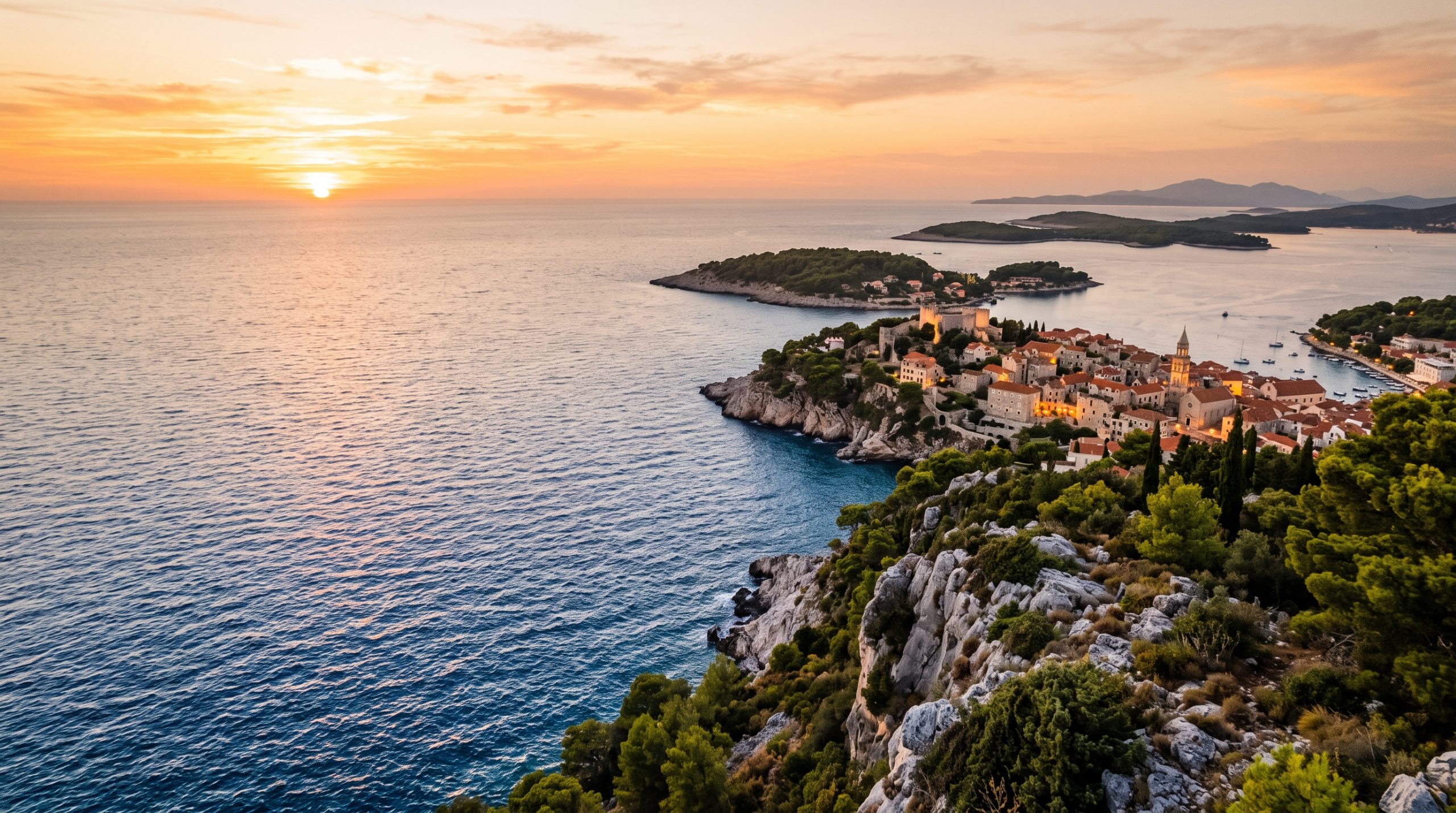
In high season the Dubrovnik city walls open at eight, and for the first hour the 1,940 meter circuit is almost yours. The stone is still cool, the water below Fort Bokar is flat, and the light comes in low off the Lokrum channel. By nine or ten the narrow sections above Stradun are moving at the pace of the slowest group, and the finest walk in the Adriatic becomes a line with a view.
That hour tells you most of what matters about filming an elopement in Dalmatia. This coast is not short of beauty. It is short of empty beauty at convenient times. On 21 June the sun clears the horizon at Dubrovnik at 5:09 and sets at 20:29, and inside that fifteen hour spread there are maybe three hours worth putting on film. The maestral, the northwesterly that lifts off the water through the late morning, decides where a vow can be spoken and whether the audio is usable. The Split to Hvar catamaran runs fifty minutes to an hour in summer and thins to two or three sailings a day out of season.
We are Unmapped Stories: photographers Serg, Alex, Alex and Viktoria, filmmakers Lara, Mike, Anthony and Stas. Eight of us, and photography, film and planning are one service rather than three vendors copying each other into an email chain. This page covers what a Dalmatian wedding film costs, and the hours and permissions that decide what ends up inside it.
Film, photography and planning in one quote
We plan, shoot and cut Dalmatian elopement films ourselves, from Dubrovnik and the Elaphiti islands to Hvar, Vis and the Krka gorge. A full day with one dedicated filmmaker starts at $4,900, team travel included. A photographer working beside the filmmaker for the same day is the next tier up. Highlights reach you five days later.
Between first light and the midday maestral
Dalmatian light works in two short shifts with a long dead zone in between. Anyone who tells you otherwise has not stood on white limestone at one in the afternoon and watched the whole scene go flat and glaring. We build days that use the ends and spend the middle on food, shade and swimming.
Late September is the month we push hardest for on this coast. On 20 September, Hvar town gets first light at 06:09, sunrise at 06:38, sunset at 18:58 and workable dusk until about 19:26. That is a humane start, two full soft shifts, and sea still warm enough to get into between them.
| Date at Hvar town | First light | Sunrise | Sunset | Last light |
|---|---|---|---|---|
| 15 May | 04:59 | 05:31 | 20:09 | 20:42 |
| 21 June | 04:38 | 05:14 | 20:37 | 21:13 |
| 20 September | 06:09 | 06:38 | 18:58 | 19:26 |
| 10 October | 06:32 | 07:00 | 18:22 | 18:50 |
Here is how a late September day tends to fall for a couple staying in Hvar town.
- 05:45 Coffee, and a walk up into the stone lanes of Groda while the town is blue and nobody is out. The filmmaker takes the top of the steps, the photographer works from the bottom, and neither waits for the other.
- 06:38 Sunrise. The first fifteen minutes land on the Spanish fortress and the Pakleni channel, and they are the sharpest frames of the morning.
- 08:15 Down to the harbor. The boat leaves early on purpose, because the maestral builds through the late morning and the water we want is glassy for one more hour.
- 09:15 Vows in a cove on Sveti Klement with the engine off, so the audio carries water and voices and nothing else.
- 11:00 The breeze is in the rigging by now. We stop fighting it and start using it: the sail, the wake, hair going sideways, the couple bracing on the bow.
- 13:00 Stop. Genuinely stop. This is the hour that makes the evening possible.
- 16:30 Second shift. Shade in the lanes, or the terraces above the south side of the island where the vines run down toward the sea.
- 18:00 Golden light until 18:58, then the color that only shows up after the sun is gone and holds until about 19:26.
In June the same day pulls apart. First light at 04:38 and last light at 21:13 give us more raw material but no way to use it continuously, so we split into two blocks and hand you the middle of the day back. Couples who arrive expecting to shoot from ten to four in July are usually relieved when we explain why we are not going to.
The nine o’clock problem
The single thing couples worry about here is people. Dubrovnik takes daily crowds that a town of its size was never built for, and Hvar in August is a party island by mid-morning. We plan around it rather than apologize for it. On the walls that means being at the gate as it opens and being finished before the first groups reach the narrow stretch. In town it means Stradun at 05:30, not at noon, when the marble goes white and there are forty strangers in every frame.
If the picture in your head is the two of you alone on Stradun in the middle of an August afternoon, that frame does not exist at that hour for anyone. Tell us which single image you care about most and we will build the morning outward from it, or say honestly that the third week of September will give you the same place with half the people in it.
If you want to know whether your week is open and what the light does on those dates, Check Your Date and we will come back with the actual sunrise time and a first shape for the day.
Stone, wind and the one boat we all get on
Dalmatia is where hiring a photographer in one place and a videographer in another quietly costs you frames. The reasons are specific to this coast.
The old towns are built of three meter wide lanes with high walls, and the good light inside them lasts twenty minutes. Two people who have worked together for years split a lane instead of blocking it. One stays low at the bottom of the steps for the long stills, the other backs up into the arch above with the gimbal, and the couple walks it twice rather than eight times while two strangers negotiate over their heads.
Then there is the wind. Vows on an exposed headland or an open cove need to happen before the maestral has any strength in it, and they need somebody thinking about which way your backs are turned. On the Expedition our filmmaker runs professional audio for the vows where conditions allow, which on the water means the engine off and the boat drifting. A videographer who met the photographer that morning does not know that the boat needs to be silent, and by the time everyone agrees, the breeze has arrived.
Aerials work the same way. Drone operators in Croatia register with the Civil Aviation Agency and check the geozone map before takeoff, and Dubrovnik’s walled Old Town is restricted airspace under its heritage protections. So we plan the Old Town on the ground, with long lenses and stone, and take the drone to the open coast and the island channels where it is legal, safe and worth having. Because it is one team, that aerial block happens inside the same hour as the stills rather than becoming a separate morning.
The last reason is the timetable. Out of season there may be two or three sailings a day between Split and Hvar, and the car ferry to Stari Grad takes nearly two hours. One team books one crossing and steps off it together. Eight of us means there is always a second camera on the ground and a colleague in reserve. The films and galleries in our stories are the clearest answer to what this actually produces: watch how the film cuts between the two cameras in the same lane, and how the stills sit against the frames that were rolling three feet away.
What we bring, and when the files land
Every experience, whichever tier you choose, includes the following.
- Destination and location design for your dates, built around light and real travel time rather than a map of pretty places.
- A custom timeline, with the ferry, the walls, the boat and the golden hour all in the right order.
- Permit research and logistics guidance, including which municipality your paperwork runs through.
- Weather alternatives and backup planning, because a jugo blowing in from the southeast changes which side of an island you stand on.
- Drone footage where it is legal, safe and appropriate.
- Professional audio for vows and other meaningful moments on the Expedition, where conditions allow.
- Team travel worldwide: flights, accommodation and ordinary travel for the assigned team, with no long-haul surcharge and no European exception.
- Highlights in 5 days. Full gallery or film in 3 weeks.
Your guest count does not change the fee. Six people instead of two changes access, permits, boat size and the timeline, and we plan for all of that, but the price is the price.
Where coverage starts, and the Croatian extras
A full day with a dedicated photographer and a dedicated filmmaker working together, which is what most couples mean when they ask about photo and film in Dalmatia, starts at $7,900. Two to seven days across one or several destinations, from Dubrovnik out to the islands or north to the Krka gorge, is the Odyssey and is quoted as a custom proposal. The full breakdown lives on our coverage and pricing page. There is no half day version, in Dalmatia or anywhere else, because a half day here is the half that does not have light in it.
What sits outside our fee is the third-party spending this particular coast asks for, and Croatia charges in euros.
| Item | Who pays |
|---|---|
| Flights, accommodation and travel for the assigned team | Us, worldwide |
| Permit research, location design, timeline, backup planning | Us |
| Government, venue and landowner permit fees | You |
| Dubrovnik city walls tickets, currently around 40 euros per adult | You |
| National park entry at Krka or Mljet, plus the small return boat ticket to the islet in Mljet’s lake | You |
| Catamaran and car ferry tickets for you and your guests | You |
| Private boat charter, 4×4 transfers, mountain guides | You |
| Celebrant or registrar fees, sworn court interpreter, document translation | You |
Two Dalmatian details worth knowing while you budget. Krka National Park discounts its entrance ticket by 25 percent after 15:00 in June, July, August and September, which happens to be when the gorge is in shade and the water looks its best on film. And park entry on Mljet is cheaper outside high season, which is one more argument for the shoulder months.
Six steps from your first email
- You send the inquiry form with your dates, or your best guess at them.
- We reply within 24 hours with an initial brochure.
- We put together a tailored proposal for your dates, your locations and the tier that fits.
- You sign the contract.
- You pay a 30 percent retainer, and the rest of the payment plan is set out in the proposal.
- Planning begins: locations, timeline, permits, ferries, weather alternatives.
Who Dalmatia fits, and which month fits you
This coast rewards couples who are willing to be awake before the town is. It suits people who are steady on worn stone steps, happy to get onto a small boat, and relaxed about a plan that moves at seven in the morning because the wind arrived early. It suits couples who like the idea of a real gap in the middle of the day, spent swimming, rather than eight straight hours of being photographed.
If early starts are genuinely not for you, say so and we will build the day at the other end of the calendar. Sunrise at Hvar on 10 October is 07:00 and the light stays soft late, which changes the whole feel of the morning. If boats are not for you, Dalmatia still works from the mainland: the Trogir old town, the Krka gorge, and Skywalk Biokovo at 1,228 meters above the Makarska Riviera, reached by a ticketed mountain road with timed entry that we treat as its own block in the day rather than a quick detour.
And if crowds are the thing you dread most, the answer is the calendar rather than a secret location. Late September and early October give you the same water, warmer sea than May, and a fraction of the foot traffic. Our destination elopement guides go deeper on how the Adriatic months compare. Tell us which of these matters most to you and we will tell you honestly which week and which island fit it.
Common questions
Can we legally get married in Croatia as Americans, or should we sign at home first?
Both work. Croatia’s Ministry of Foreign Affairs asks couples to contact the registry office, the matični ured, in the district where the marriage will take place at least three months before the date, and each municipality has its own matičar who conducts the ceremony. For US citizens the paperwork includes a valid passport and a US birth certificate carrying the Apostille seal of the issuing state, issued within the past 90 days and translated into Croatian by a sworn court interpreter. Plenty of couples sign at home and hold the ceremony here instead. We research the route either way and guide you through it.
How much does the film cost if we want photography all day as well?
That combination is the Expedition, a dedicated photographer and a dedicated filmmaker on the same full day, and the starting figure is on our pricing page with everything that sits inside it.
When is the light best on the Dalmatian coast?
Late May and the second half of September are our two favorites. On 15 May, Hvar has first light at 04:59 and last light at 20:42, which is a long, generous day. By 20 September sunrise has slid to 06:38 and sunset to 18:58, the sea is at its warmest, and the towns have emptied out considerably.
Can you fly a drone over Dubrovnik’s Old Town?
No, and nobody can. The walled town is restricted airspace under its heritage protections. Croatian operators register with the Civil Aviation Agency and check the geozone map before every flight, which we do as part of planning. Aerials go up on the open coast, over the Elaphiti channels and above island coves, and the Old Town gets covered on the ground.
Do we have to go to an island, or can everything happen near Split?
Everything can happen within an hour of Split. Trogir’s old town, the Kaštela coast and the Krka gorge give you three completely different looks without a crossing. If you do want Hvar, the catamaran is fifty minutes to an hour in summer, and we build the day around the timetable rather than hoping.
How soon do we see the film?
Highlights come to you 5 days after the day. The full film or gallery follows within 3 weeks.
Does the price change if we bring our parents and two friends?
No. The fee is the same for two people or twelve. Guest numbers affect permits, boat size, transport and how the timeline flows, and we plan all of that, but they do not move the price.
Are ferry tickets and park entry included in your fee?
No. Tickets for you and your guests, park entry, city walls admission and any private boat charter are yours. Our own flights, accommodation and travel are included wherever the day happens, from the Makarska Riviera to Vis.
Tell us the week and we will send back the day
Everything with us runs in writing. You send the form, we reply within 24 hours with an initial brochure, and the plan gets built over email while you sleep on the other side of the Atlantic, six or nine time zones from the Adriatic.
Our Dalmatia calendar is currently open across 2027, 2028 and 2029. Send us the week you are thinking about, the shape of morning you want, and whether the film or the stills matter more to you, and we will come back with sunrise times, an honest read on the crowds and a first version of the day. Tell Us Your Story