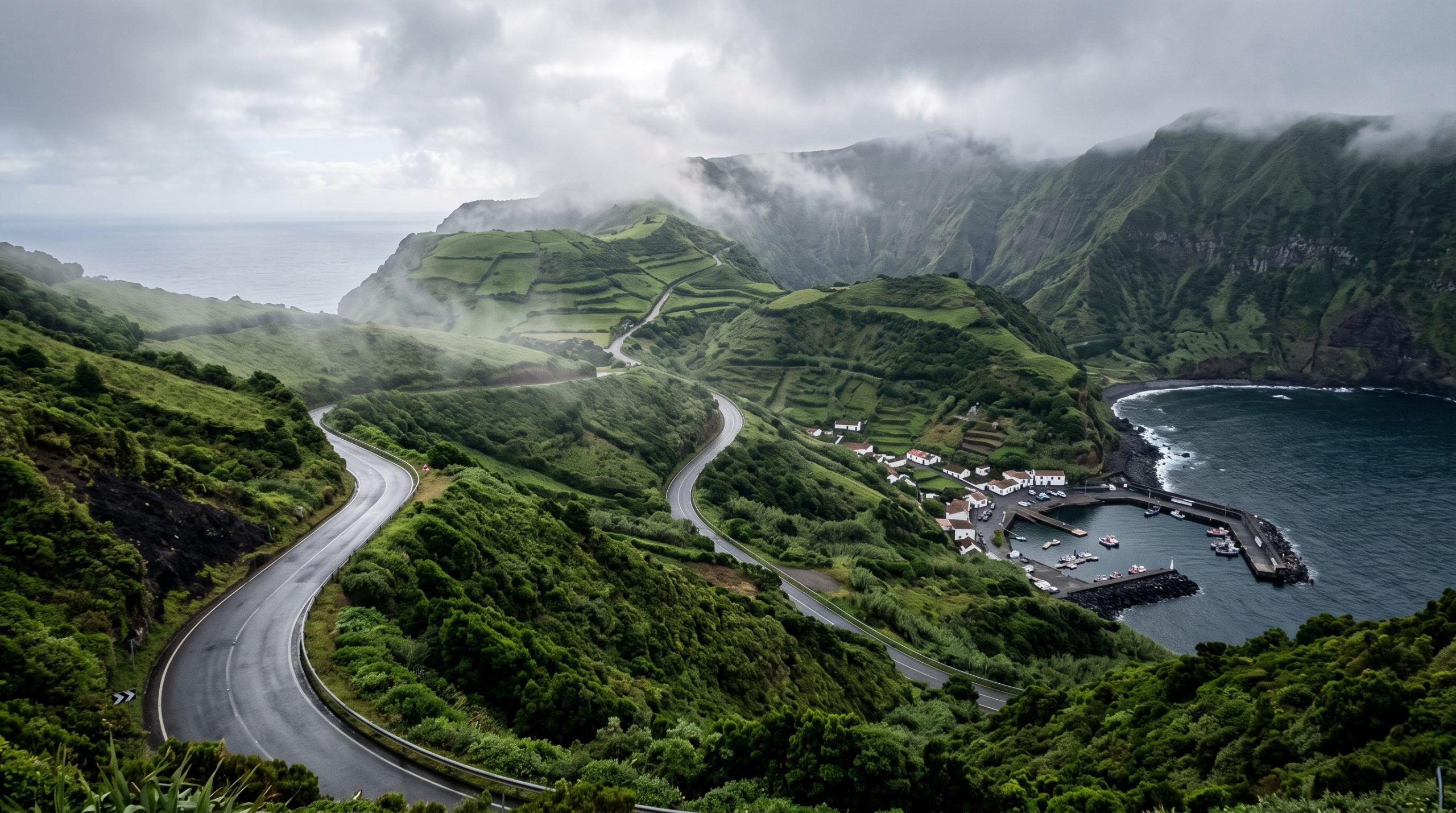
Azores Airlines flies nonstop from Boston and from New York JFK into João Paulo II airport at Ponta Delgada, and the Boston leg is a little over five hours in the air. That is the practical reason this archipelago works for American couples: it is the shortest crossing to a place that looks nothing like home.
The complication is that the Azores are nine islands spread across a long stretch of Atlantic, and most of the planning trouble we see comes from treating them as one destination. A hop that looks trivial on a map can mean a flight through a hub island, a ferry line that only sails in summer, and a night in a town you never meant to sleep in.
So this is the operational guide. Islands and airports, real driving times against the ones a route planner gives you, what the civil registry process costs, what the light does in June against December, and how we build a day around cloud with firm opinions of its own.
What an Azores elopement actually takes: airport, days, paperwork
Fly nonstop from Boston or New York into Ponta Delgada on São Miguel, allow five nights on one island and three more for a second, and open the Portuguese marriage process at a civil registry office a few months out. The process and registration cost 120 euros and stay valid for six months.
Nine islands, and why two is usually the right number
São Miguel is where nearly every couple starts, and the logic is hard to argue with. It is the only island with nonstop flights from the United States, it holds both crater lakes people come here for, and it is large enough that you can stand on a green caldera rim at sunrise and on black lava at sunset without booking a boat or a second flight. It runs about 65 km end to end, and a week is not enough to stop finding new lanes.
The strongest argument for a second island is Pico. Portugal’s highest mountain rises straight out of the sea to 2,351 m, and the ground at its feet is a grid of black lava walls built to shelter vines, protected as a UNESCO World Heritage landscape. Across the channel, Faial gives you Horta’s marina and the grey ash country at Capelinhos, where an eruption in the 1950s added new land to the island. Two islands is usually right for a week. Three is one too many, and we will say so.
| Island | Airport | What the ground gives you | Getting there |
|---|---|---|---|
| São Miguel | PDL | Sete Cidades and Lagoa do Fogo crater lakes, the Furnas thermal valley, lava coast at Mosteiros | Nonstop from Boston and New York JFK |
| Pico | PIX | A 2,351 m volcano, black lava vineyard walls, whale coast | Inter-island flight, or fly to Horta and take the half-hour ferry |
| Faial | HOR | The island caldera, the ash desert at Capelinhos, Horta’s marina | Inter-island flight; year-round ferry to Pico and São Jorge |
| Terceira | TER | Angra do Heroísmo’s UNESCO old town, the field patchwork below Serra do Cume | Inter-island flight from Ponta Delgada |
| Flores | FLW | Waterfall walls and the quietest coast in the archipelago | Connections eat most of a day each way |
If you are still weighing islands rather than dates, our destination guides are organised the way we plan: by what the ground does at a given hour, not by how it looks from a car park.
Why São Miguel drives expand between coast and ridge
São Miguel has a fast four-lane road along its south side, reaching east from beyond the airport past Ribeira Grande and Vila Franca do Campo. Everything you came for is at the end of a road that is not that one. The rim lanes are narrow and hedged with hydrangea, shared with dairy cattle walking to milking, campervans braking for every viewpoint, and delivery vans that cannot be passed.
Route planners are not wrong so much as optimistic about the hour. At 05:30 the road up to Sete Cidades is empty and the planner time is close to honest. At 10:00 it is not, and at 10:00 in cloud it is nowhere near. The rims make their own weather: Vista do Rei sits inside a cloud while Ponta Delgada, 25 km away, is in full sun, and it clears again twenty minutes later.
| Route | Road distance | Route planner | What we build the schedule on |
|---|---|---|---|
| Airport to central Ponta Delgada | about 4 km | 10 minutes | 20 minutes with bags and one-way streets |
| Ponta Delgada to the Sete Cidades rim | about 25 km | 25 to 30 minutes | 40 minutes before dawn, 55 in cloud or traffic |
| Ponta Delgada to the Lagoa do Fogo viewpoint | about 25 km | 30 minutes | 45 minutes, plus the walk down to the water |
| Ponta Delgada to Furnas | about 45 km, mostly expressway | 40 minutes | 50 minutes |
| Ponta Delgada to Ponta do Sossego, Nordeste | about 75 km | 1 hour 15 | 1 hour 45, each way |
| Horta to Madalena, Faial to Pico by ferry | about 8 km of channel | 30 minute crossing | Half a morning, port to port |
Two things worth saying plainly. Nordeste and Sete Cidades on the same day is a bad plan: they sit at opposite ends of the island and you spend the good light driving between them. And Vista do Rei at eleven in the morning is a car park, a railing and a line of vans in front of a view that is genuinely enormous. The view has not changed. The hour has. The same rim at 06:10, with cloud lifting out of the caldera while you watch, is one of the best mornings in the Atlantic.
Moving between islands without losing a day to it
Atlânticoline is the only company running inter-island ferries, and its network has two distinct personalities. A year-round service links Faial, Pico and São Jorge, with the Horta to Madalena crossing going several times a day in about half an hour, and Flores and Corvo have their own year-round link in the west. Then there is the seasonal operation through spring and summer that connects all nine islands. That second network is the one couples find online in November and assume they can use in March.
Inter-island flights are the year-round answer, on small turboprops out of Ponta Delgada and Terceira. The flying is short. The connection is what costs you the day, because a same-day link through a hub island can land you late in the afternoon on an island where you wanted the evening light. We plan a spare day either side of any island move, and we never put the ceremony hour next to a departure.
The 120 euro paperwork and its six-month clock
A legal civil marriage in Portugal runs through a Conservatória do Registo Civil, the civil registry office. The process and the registration together cost 120 euros. If you want the registrar to marry you somewhere other than the office, or inside the office but outside normal working hours, on a Saturday or a public holiday, the fee is 200 euros and the registrar’s travel is arranged and paid by you.
As foreign nationals you will be asked for passports, birth certificates and a certificate of no impediment, the certidão de capacidade matrimonial, confirming you are free to marry. Documents may need certified translation. The timing catch is the one nobody expects: the registrar’s authorisation is valid for six months from the date it is issued, so you cannot file a year in advance and tick it off. Most couples open the process two to three months out, which is also when a specific date and hour get agreed with the office.
Plenty of couples sign the legal paperwork at home and treat the Azores day purely as their ceremony, with a celebrant and their own words. Both routes give you the same day on the same rim. Permit research and logistics guidance are part of every experience we run, and the fundamentals of eloping abroad are worth reading before you choose. The government fees themselves stay in your column.
Sunset after nine, and the shape of a June day
The Azores sit far enough west that the light behaves differently from mainland Europe, and clocks here run an hour behind Lisbon, which makes connecting itineraries read strangely until you notice it. At Ponta Delgada the latest sunset of the year falls on 28 June at 21:10, and the longest day carries 14 hours and 49 minutes of daylight, so the sun is up around 06:20 and there is workable light until nearly 22:00. In December the arithmetic reverses: the earliest sunset is on 6 December at 17:25, with about 9 hours and 36 minutes of daylight and sunrise close to 08:00.
A June day therefore has two long, generous ends and a flat, bright middle. We build for that rather than against it. Here is the shape of a west-end São Miguel day in late June.
- 05:15. Leave Ponta Delgada. Empty roads, coffee in the car.
- 06:05. On the rim path above Sete Cidades, cloud usually still sitting in the caldera.
- 06:20. Sunrise. The cloud lifts off the lakes or it does not, and both versions work.
- 07:15. Down toward the water and the lanes between the two lakes, still empty.
- 08:30. Breakfast in the village. Change, warm up, reset.
- Midday. Furnas, or nothing at all. The cozido pots come out of the volcanic ground around midday and lunch runs a slow two hours.
- 16:30. Out to the west coast. If the seawater hot spring at Ponta da Ferraria matters to you, the tide sets this hour, not us.
- 19:30. Ceremony above Mosteiros, when the wind on that coast usually eases.
- 20:00 to 21:10. The long walk along the lava while the light goes gold and then pink.
- 21:45. Blue hour finishes. Dinner is late here anyway.
One wardrobe note that costs people their dress: the iron-rich water in the thermal pool at Terra Nostra in Furnas stains white fabric permanently. That swim goes at the end of a day, never before the vows. If you want to see how these rims, lanes and lava coasts hold up in finished work, our galleries and films are the honest version, shot in this light on these roads.
Buffers, two vehicles, and the location we keep in reserve
Every timeline we write for the Azores carries a second location we may never mention on the day. If the rim is buried, we go low: laurel woodland, a lava coast, the walled lanes above Furnas. That decision gets made the evening before and again at 05:00, and it is ours to carry, not yours.
A photographer and a filmmaker from the same team matters more here than in a place with wide roads and short drives. On a day that starts at 05:15 on a crater rim, one of us can move ahead to check the cloud line at the next viewpoint while the other stays with you, which on a 40 minute rim drive is the difference between arriving in the good light and arriving after it. Two vehicles when the day is spread out, one when it is not. Two full sets of gear always, which is what a long drive from an airport argues for.
Aerials run on paperwork, and we confirm it before a film ever depends on them. Portugal’s civil aviation authority, ANAC, requires operator registration for any drone of 250 g or more, or any drone carrying a camera that can capture personal data, along with remote pilot competency for the open category. Flight zones are published on the national geozone map, aerial filming needs authorisation from the national aeronautical authority, and inside the island nature parks the Azorean environmental directorate is the office that governs access. Drone footage is included in every experience where it is legal, safe and appropriate, and we always build a version of the film that stands up without it.
Our team’s own flights and accommodation are included wherever the work is, the Azores included, so getting us there is not a separate cost to plan around. One full day with a dedicated photographer or filmmaker starts at $4,900 and a full day with both working together starts at $7,900, with the multi-day option and the full detail on the pricing page.
Tell us the island, the month and the kind of morning you actually want, and we will tell you honestly whether it fits, or which week would fit it better. Send Us a Message.
Common questions
How far ahead do we start the Portuguese marriage paperwork?
Two to three months before the date is the practical window. The registrar’s authorisation is valid for six months from issue, so filing a year out does not help you, and the date and hour are agreed with the registry office as part of the process.
Can we marry legally at home and still have our ceremony on São Miguel?
Yes, and many couples do. You sign at home, then hold the ceremony here with a celebrant and your own vows, which removes the 120 euro process, the translations and the six-month clock from your planning entirely. The day itself looks identical.
How many days should we plan in the Azores?
Five nights on São Miguel is the realistic minimum: one to arrive, three that can carry the coverage day, one spare. Add three nights for a second island, including a buffer day around the flight or ferry.
Do we need a rental car on São Miguel?
For a coverage day, we drive. For the rest of the week, yes, and book it when you book the flights, because July and August tighten up quickly. A small car is better on the rim lanes than a large one.
Which months give the best odds of a clear morning on the crater rims?
July through September are the steadiest and driest, and late June gives you the longest evenings, with light until nearly 22:00. No month guarantees a clear rim in the mid-Atlantic, which is why we plan two light windows a day and a lower alternative for each.
Can we have drone footage over Sete Cidades or Lagoa do Fogo?
Often, and it depends on the specific spot. Both sit within protected island landscapes, so we check the national geozone map, the aerial filming authorisation and the nature park position for your exact locations before the film plan assumes a single aerial shot.
Is Pico worth adding to a São Miguel week?
If you want the lava vineyard walls and a 2,351 m volcano in the frame, yes. It costs you a travel day at each end and a buffer, so it works on eight nights and feels rushed on six.
Holding a week in 2027
We are booking 2027, 2028 and 2029, and the Azores reward early decisions because accommodation on the smaller islands is limited and the registry office keeps its own calendar. Send the inquiry form and you get a reply and our initial brochure within 24 hours, then a tailored proposal for your islands and dates. A signed contract and a 30% retainer start the planning, and all of it happens in writing, on your schedule and across whatever time zone you are in.
Afterwards, highlights reach you in 5 days and the full gallery or film in 3 weeks, while the rim road and the ferry crossing are still fresh. If you have a week in mind, Check Your Date and tell us what you are picturing.