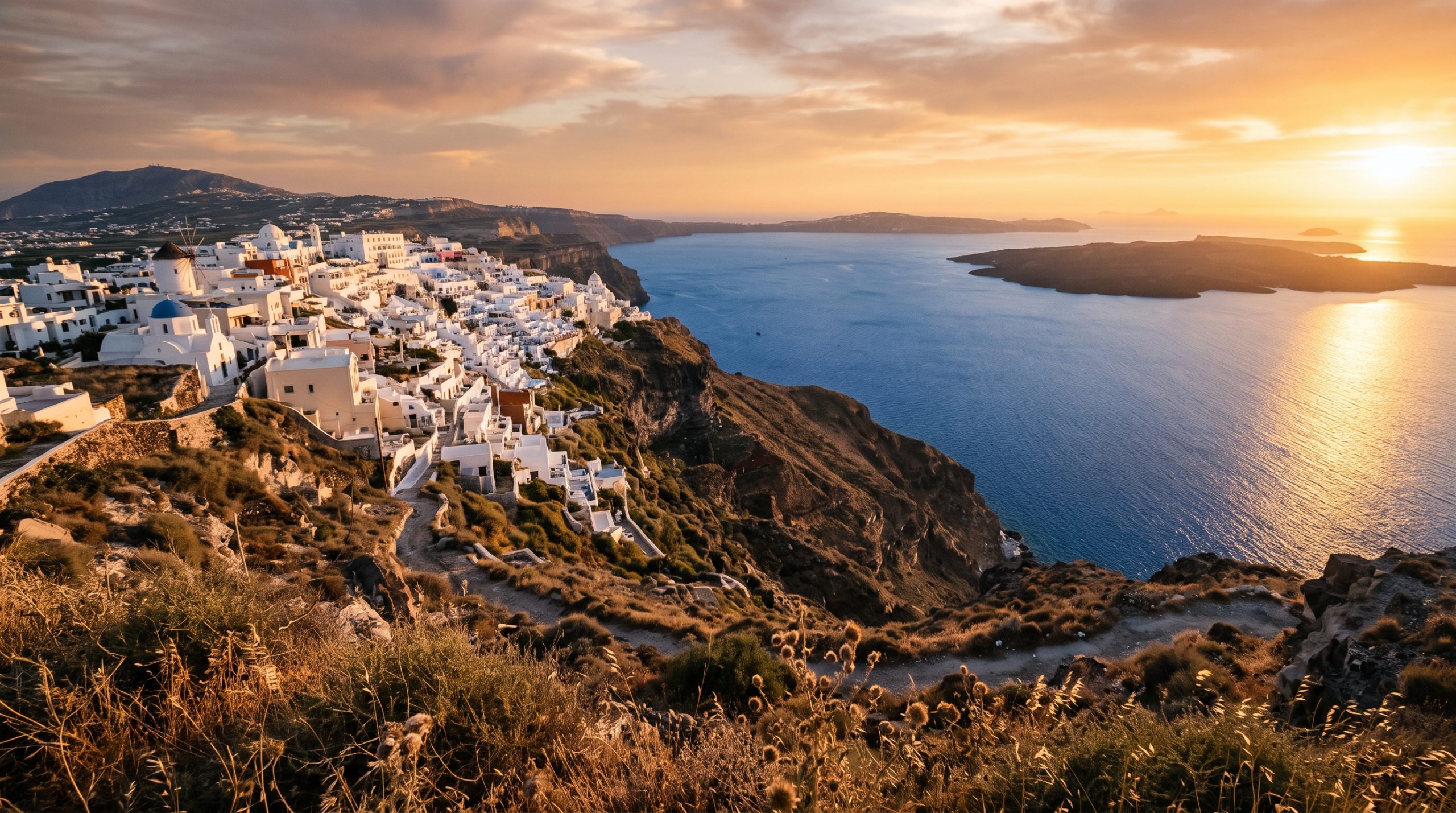
In mid-June the first workable light reaches the caldera rim at about 5:30, a full half hour before the sun clears the horizon at 6:00. For those thirty minutes the whitewash above Oia and Imerovigli holds a cool blue-grey, the stepped lanes are empty, and the loudest thing on the island is a fishing boat working somewhere down in the water. By 10:00 those same lanes carry a share of the 8,000 cruise passengers Santorini now allows ashore in a single day, and the light on white plaster has gone hard.
That is the real economy of a Cycladic elopement film. It is not the equipment and it is not the flights. The cost sits in knowing that the good hour cannot be moved, that it falls before breakfast, and that a photographer and a filmmaker sharing one narrow terrace at 6:15 need to have agreed who walks and who holds before either of them steps outside.
So this page sets it out plainly: the shape of a real island day, where our coverage starts, what Greece bills separately in euros, and how we work when the wind comes up. For the wider regional picture, our destination elopement guides cover the Cyclades island by island.
Cycladic coverage, stated plainly
We are photographers and filmmakers who plan the day as well as film it. In the Cyclades a full day starts at $4,900 with one dedicated photographer or one dedicated filmmaker, and at $7,900 with a dedicated photographer and filmmaker working together. Team travel to the islands is included. Highlights reach you in five days.
Sunrise 6:00, sunset 20:40: why a June day here splits in two
Midsummer in the Cyclades hands you nearly fifteen hours of daylight, and roughly four of them are worth filming. Around the solstice, civil twilight opens at about 5:30, the sun is up at 6:00, and it climbs fast at this latitude. That gives a first window of two and a half hours, then a long flat middle, then a second window that opens again around 18:30 and closes with the blue hour at about 21:10.
We meet before five. You dress in the dark, and the first frames happen in that grey half hour when the caldera reads as shape rather than color.
Then the geometry does something most couples do not expect. The caldera faces west, so at sunrise the light arrives over your shoulder from the far side of the island. It lands warm on the cliffs opposite and on Thirasia across the water while you stand in soft front light, which is the exact reverse of the sunset arrangement everyone plans around. Faces are easy at 6:15. They are much harder at 20:35, when the sun is behind you and dropping into the water.
Vows go early, usually between 6:30 and 7:30. The lanes are empty, the celebrant can reach you without traffic, and the low sun does the work no reflector can. From 7:30 we walk: the rim path, a stair down toward Amoudi, a courtyard, whatever the location design put on the list. By 9:00 the contrast on whitewashed walls has turned unkind, and by 10:00 we are done with the first half of the day.
The middle is the part nobody writes down. From roughly 10:00 to 18:00 the caldera villages belong to the day visitors and the sun sits almost overhead. We do not fight it. That block is for changing, eating, resting, or moving: the inland villages where the walls are shaded most of the day, the black sand and pale cliffs down south at Vlychada, or a ferry to a second island.
The second window is short and worth every minute of the wait. Side light by 19:30, sunset over Thirasia at about 20:40 in late June, and then the twenty-five minutes afterwards when the village lights come on and the sky still has color in it. That stretch after the sun has gone is where the film usually finds its ending.
The calendar changes the shape completely. In late September first light comes at 6:40 and the sky is finished by 19:40, so the two windows sit about thirteen hours apart rather than nearly sixteen, and the day stops feeling like two separate mornings. By mid-October the sun is up at 7:25 and down at 18:43, and once the clocks go back on the last Sunday of October, sunset lands close to 17:20. An October day can run as one continuous piece with no alarm before dawn at all, which is why we ask about your dates before we suggest anything else.
The crowd question, and the timetable that answers it
Being honest about this matters more than reassuring you. The famous three-domes lane in Oia at 19:30 in July is a queue, and it films like a queue. Shoulders, phones, other people’s hats. We do not build a day around it, and any team that promises you that view to yourself in high season is describing something that will not happen.
Santorini’s cap of 8,000 cruise passengers a day limits the ships, not the island, and those arrivals bunch from mid-morning through late afternoon. The fix is not a lens. It is the timetable above, plus four choices we make during planning: the 5:30 start, a private terrace used with the owner’s permission, the inland villages while the caldera is busy, and where it suits you, a second island entirely. Folegandros is 45 to 50 minutes from Santorini on the high-speed ferry and has no airport at all, which does more for your frames than any amount of clever framing.
What the second camera changes on a caldera terrace
Most caldera terraces are barely wider than a dining table, with a wall on one side and open air on the other. One person cannot cover that space twice. A photographer who is also running video spends the best fifteen minutes of the morning switching modes, and you end up with a film built from the three angles that were closest to where the stills were taken.
With a dedicated photographer and a dedicated filmmaker on the same terrace, we assign lanes before you walk out. The filmmaker takes the long axis, holding a single unbroken move down the terrace while you walk. The photographer works across it, close, catching the half second the film cannot hold. Neither one appears in the other’s frame, because that was decided at 4:45 in the morning and not improvised in front of you.
Wind is the second reason two people matter here. The meltemi is the dry northerly that runs across the Aegean from roughly May to September and peaks between mid-July and mid-August, and on the Cyclades it can blow for a day or for most of a week. The Expedition includes professional audio for vows where conditions allow, and in Aegean wind that means microphones placed under fabric and vows staged in a sheltered pocket rather than out on the exposed rim. A filmmaker who is only holding the camera can watch the wind and move you two meters before the vows begin. Someone doing both jobs cannot.
Aerials work the same way. Greek airspace is published through the Hellenic Civil Aviation Authority’s Drone Aware Greece platform, where some zones near airports and archaeological sites require prior approval or are closed, and flights outside those zones need none. We confirm the zone and the window during planning, then design the aerials into the film rather than hoping on the morning. With two of us, the drone can be in the air while the other camera keeps working, which is the difference between an establishing shot and a sequence.
The clearest way to judge any of this is to look at finished work. Our island stories and films show what the two windows actually give you: the 6am frames, the wind in the fabric, and the last minutes of blue over the caldera.
If you already know roughly when you want to be on the islands, Send Us a Message with the dates and we will tell you what that week of light looks like.
What travels with us, and what Greece charges on the ground
In every island day
- Destination and location design across the islands, not just one village
- A custom timeline built around real light and real travel time, ferries included
- Permit research and logistics guidance for terraces, sites and airspace
- Weather alternatives and backup planning for wind days
- Drone footage where it is legal, safe and appropriate
- Professional audio for vows and meaningful moments on the Expedition, where conditions allow
- Team travel worldwide: flights, accommodation and ordinary travel for the assigned team
- Highlights in 5 days, and the full gallery or film in 3 weeks
Guest count does not change the fee. Two of you or twelve, the price is the same. What guests change is access, permits, transport and the pace of the timeline, which is planning work rather than a line item.
Paid in euros, locally
Coverage begins at the figures above and the full structure, including the two-to-seven-day Odyssey, sits on our pricing page. Our travel to the islands is inside that. The costs Greece adds are separate and paid by you, in euros, to the people providing them: the town hall fee for a civil ceremony, your celebrant, certified Greek translations and apostilles for your documents, any landowner or venue fee for a private terrace, ferry tickets, car or ATV hire, and a private boat if you want the sea caves on the south coast of Milos. US citizens also pay for the sworn affidavit notarized at the embassy in Athens, currently 50 dollars per person. Permit fees are yours; the research and the paperwork chasing are ours.
From your first message to a held date, in six steps
- You send the inquiry form with your dates, your islands if you have them, and roughly what you picture.
- We reply within 24 hours with our initial brochure and honest thoughts on those dates.
- We build a tailored proposal: islands, coverage, team, the shape of the day.
- You sign the contract and pay a 30% retainer to hold the date and the team.
- Planning begins in earnest, and if you want the groundwork in advance, our guide on how to elope covers the fundamentals.
- The remaining payment schedule is set out in your proposal, and delivery follows the windows above.
Which Cycladic island fits which kind of film day
Santorini rewards couples who genuinely do not mind a 4:45 alarm and can walk stepped lanes in the dark. Milos suits people who would rather be on rock than in a village, and who are comfortable with sun and no shade at all. Folegandros belongs to couples who want the quietest version of the Cyclades and accept that getting there is a ferry, not a flight. Naxos and Paros both have their own airports and more road, which helps if you are bringing family with different levels of mobility.
| Island | Getting there | What the day looks like |
|---|---|---|
| Santorini | Its own airport; the ferry port at Athinios sits 8 km from Fira and 20 km from Oia | Caldera terraces at first light, inland villages at midday, sunset over Thirasia |
| Milos | Ferry from Santorini, 2.5 to 7 hours depending on the vessel | White volcanic rock at Sarakiniko, a 200 m walk down from a free car park, no shade and no facilities on the rock |
| Folegandros | No airport; 45 to 50 minutes from Santorini on the high-speed, 2.5 to 3 hours on a conventional ferry | Cliff-top Chora, stone lanes, far fewer people at every hour of the day |
If a pre-dawn start is not your idea of a good morning, say so in your first message. Late September and October give you first light after 7:00 and sunset before 19:00, which is a gentler day with the same coastline, and the sea is warmer besides. If mobility or uneven ground is a factor, we design around road access, courtyards and terraces instead of stairs and rock. And if your dates fall in the middle of the windiest fortnight of the year, we would rather tell you which island sits in the lee and plan the day there than let you find out on the morning.
Common questions
Do we have to get legally married in Greece, or can we sign the paperwork at home?
Either works. If you marry in Greece, each of you submits documents to the town hall where the ceremony will take place, and authorities generally issue the license eight days after the application goes in. It holds for six months, the civil ceremony can be performed anywhere in Greece, and you need two witnesses, one of whom acts as interpreter. Many couples sign at home and keep the island day for the ceremony itself. Tell us which route you want and the timeline is built around it.
Can you fly a drone over the caldera?
Where it is legal, safe and appropriate, yes. Greek drone airspace is published through the Hellenic Civil Aviation Authority’s Drone Aware Greece platform: some zones near airports and archaeological sites need prior approval or are closed to flights, and outside those zones no prior approval is required. Camera drones need registration. We confirm the zone and the time window in planning, so the aerials are designed in rather than gambled on.
What happens if the meltemi is blowing on our date?
We plan for it before it happens. The meltemi is the northerly Aegean wind, present from roughly May to September and strongest between mid-July and mid-August, and a spell can run for several days. Your timeline gets sheltered alternatives on the leeward side, courtyards and lower ground, and vows placed where the audio holds. The small fast ferries are the first to stop in strong wind, so we also avoid building a single day that depends on one crossing.
Will there be tourists in our photographs and film?
Almost none at 6:00 in the morning, which is exactly why the day starts there. Cruise arrivals concentrate from mid-morning to late afternoon, so we spend that block inland, on the south coast or off the island. Late in the evening the caldera thins out again, and blue hour is usually quieter than the twenty minutes either side of sunset.
Can we film on two islands in one day?
It is possible on the high-speed ferry, which runs Santorini to Folegandros in 45 to 50 minutes, but the port at Athinios sits 8 km below Fira and vehicle check-in wants you there an hour to ninety minutes early, so the crossing eats the middle of the day. Two islands work far better across two days, which is what the Odyssey is designed for.
Does the price change if we bring our parents and a few friends?
No. The fee is the same whether it is the two of you or a dozen people. Guests affect access, permits, transport and the shape of the timeline, and all of that is handled in planning.
When do we actually see the photographs and the film?
Highlights land within 5 days of the day itself, while you are probably still on the islands or on your way home. The full gallery or film follows within 3 weeks.
Is your flight and accommodation added to the fee?
No. Team travel is included worldwide, which covers flights, accommodation and ordinary travel for the assigned team, with no separate charge for reaching the Cyclades. What sits outside the fee is permit fees, your celebrant, your own accommodation, and unusual transport such as a private boat or a 4×4 charter.
The message that gets this moving
The full planning trail stays written and easy to revisit, at whatever hour suits you. You send the form, we reply inside 24 hours with our initial brochure and a first read on your dates, and the proposal follows from there. We currently have Cyclades elopement dates available through 2027–2029, and with eight of us there is always a second camera on the ground and a colleague in reserve. Tell us the week you are thinking about, which island is pulling at you, and whether 5:30 in the morning sounds like a good idea or a terrible one. Start Your Story