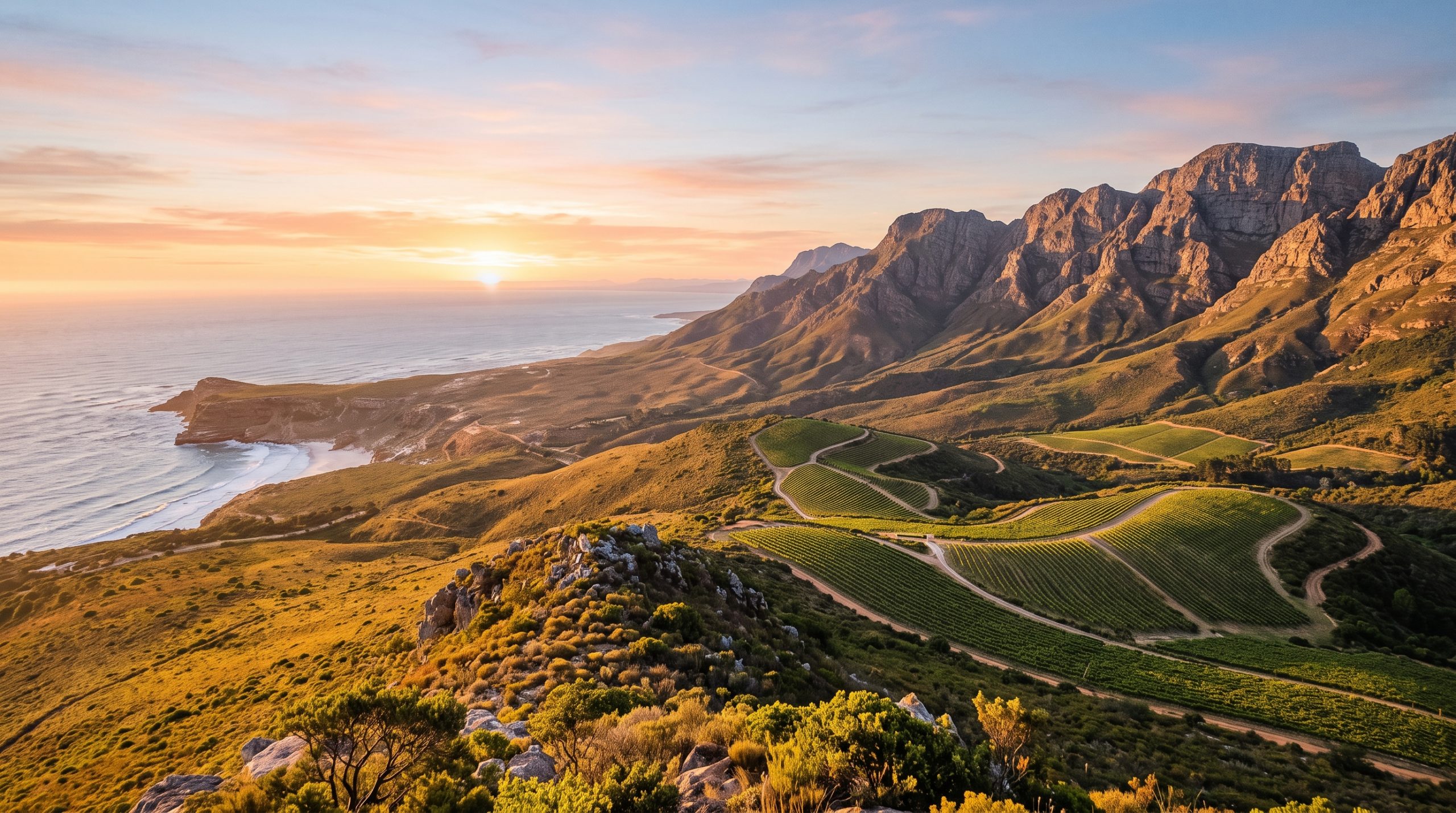
The gate into the Cape of Good Hope opens at six in summer. On 21 December the sun over Cape Town is already up at 5:32, which means the most photographed corner of the peninsula is shut for the twenty-eight best minutes of the day. We plan around that every time, and it decides where the first hour of a December elopement actually happens.
South Africa hands you three completely different elopements inside one trip. There is the Cape Peninsula, where the Atlantic and False Bay squeeze down to a point and the wind sets the running order. There is the Winelands an hour inland, where mountains ring the valley floor and take light off both ends of the day. And there is the Sabi Sand, 1,600 kilometers northeast in a straight line, where the vehicle rolls out before the sun does.
The calendar is where most plans come unstuck. The Cape is at its calmest and clearest in autumn, roughly March into May. The bush is at its best in the dry winter, June to September, which is when the Cape gets its rain. Those two facts pull in opposite directions, and the southern right whales in Walker Bay arrive in the middle of the argument.
One team, three regions, one timeline
We are a team of eight photographers and filmmakers planning and shooting elopements on the Cape Peninsula, in the Winelands and in South Africa’s private safari reserves. Photography, film and planning come from the same people. Coverage starts at one full day with a dedicated photographer or filmmaker, and team travel to South Africa is included.
How the hours fall: peninsula, valley, lowveld
Three landscapes, three completely different clocks. The times below are the ones we actually build days around.
The peninsula: the gate, the wind and the hour before the coaches
In summer the workaround is simple once you know it. First light happens outside the reserve, on the road above Scarborough, on the sand at Misty Cliffs, or on one of the Chapman’s Peak pull-offs, none of which have a gate or an opening time. We work the 5:32 light out there, then drive south and go through the Cape of Good Hope gate as it opens, so you are at the sign or on the steps down toward Dias Beach a clear hour before the first tour coaches come over the rise.
From April to September the arithmetic flips. Sunrise moves back to 7:08 in mid-April and 7:51 at the June solstice, the gate opens at seven, and you can be inside the reserve while the light is still low. Those are the only months when a sunrise ceremony at Cape Point is a real plan rather than a wish.
Evenings are the other half of the answer. In late December the sun sets at 19:56 and there is usable light until roughly 20:26, so a 6:30pm ceremony still leaves ninety minutes of coastline to work with. At the June solstice sunset is 17:44 and everything compresses: the vows, the walk and the last frames all belong to the same forty minutes.
Two things we will say plainly. Signal Hill at sunset is a car park with a view. The sweep over the city is real and so are the forty other vehicles and the engines idling behind you, so we go up there for wide frames and put the ceremony somewhere quieter. And the cableway does not run before eight in the morning in any season, stands down in strong wind, and closes for annual maintenance in winter, so we never build a day whose best hour depends on it. Lion’s Head and Signal Hill both give you Table Mountain in the frame instead of underneath your feet.
Franschhoek and Stellenbosch: late light in, early light out
Stellenbosch sits 41 kilometers from the city and Franschhoek 64, both a little over an hour by road, and both lie on a valley floor with mountains on three sides. That geometry matters more than the almanac. In mid-April the tables say sunrise at 7:05 in Franschhoek, but the sun does not clear the ridge at the head of the valley until well after that, and it drops behind the pass side long before official sunset. Golden light in the vineyards is shorter at both ends than the numbers suggest, which is why we scout the row and its aspect before we set the hour.
These are working farms. Through the late summer harvest there are tractors, crates and voices in the rows at dawn, and a picking team has right of way over everybody. That gives a film texture nobody can stage. It also means a silent vineyard at seven in the morning is something we arrange with a landowner rather than assume. The passes above the valleys, Franschhoek and Helshoogte, carry the wide frames; the oak avenues and the old gabled werfs carry everything close and quiet.
Sabi Sand: the vehicle leaves before the sun does
A bush day is bracketed, not continuous. At the June solstice the sun comes up at 6:38 over the Sabi Sand and is gone by 17:12, with the light finished around 17:37. In late December sunrise is 5:01 and sunset 18:42. Either way the morning drive rolls out in the dark, the middle of the day is hot and flat and most animals are lying down, and the second act starts around four.
So we set the ceremony inside one of those two bracketed windows and use the middle honestly: the lodge, the rooms, the details, the letters you wrote each other, and a couple of hours of real rest. Private reserves are what makes this work at all, because a vehicle can leave the road to follow a sighting, and that is the largest practical difference between a private concession and the public park. Dry season runs May to September, with August and September pulling animals in toward water. October to April is hot, wet and green, with thick bush and big skies.
The flight in the middle
The worry we hear most about this trip is that three regions in one week sounds exhausting. Driven, it would be: those 1,600 kilometers between the peninsula and the lowveld are two long days on the N1 and the N4.
Nobody drives it. Scheduled flights run from Cape Town into the lowveld, and the real answer is to let the travel day be a travel day: no coverage, no ceremony, nothing on the timeline but a flight, a transfer and a first drink on the deck. Coverage days go either side of it. A shape that works often is two days on the peninsula, one in the Winelands, the flight, then two in the bush, which is the multi-day version of our work and is quoted as a custom proposal. Because team travel is included worldwide, the internal leg for your assigned photographer and filmmaker is our cost rather than a line on your invoice.
Send us the dates you are holding and the two regions you least want to give up, and we will come back with the shape that fits them. Check Your Date
What the second camera changes in wind, dust and eight minutes of light
On paper, booking a photographer and then booking a videographer looks like the same thing as booking us. In South Africa it is not, and the reasons are specific to these three places.
On the peninsula the constraint is wind and noise. When the south-easter is running, and spring through late summer is its season, one operator has to choose between the frame that shows the ocean going white two hundred meters below you and the frame that shows your faces while you speak. There is no version where a single camera does both. With a photographer and a filmmaker working from the same timeline, one holds the wide plate on the ridge while the other stays close enough for the words, and the Expedition carries professional audio for vows where conditions allow. That is the difference between a film with your promises in it and a film with weather in it.
In the bush the constraint is repeatability. A leopard in the road at 6:20 gives you a few minutes and then it is over. Anyone shooting stills and video at once will miss one of the two, and it is usually your faces. Two people in the same vehicle, briefed on the same plan, come back with the animal and with the two of you watching it.
In the Winelands the constraint reverses. The valley is quiet, slow and generous, so the filmmaker’s real job becomes sound: the water furrow, bees in the vines, a tractor two rows over, your voices with nothing competing. The photographer works the rows while that is being gathered. Same day, two entirely different jobs.
None of it works if those two people meet for the first time on the morning. Planning, photography and film are one service here and one document: the same timeline, the same permit list, the same weather alternative. Eight of us means there is always a second camera on the ground and a colleague in reserve.
Aerials we treat as earned rather than promised. Drones do not fly inside South African national parks, which rules out Cape Point and Kruger, and every flight in the country sits under Part 101 of the Civil Aviation Regulations. On private farms and private reserves, with the landowner’s permission and the paperwork in order, drone footage is genuinely available, so we design it into the parts of your route where it is legal instead of putting it in a brochure.
How the three landscapes resolve on screen is easier to see than to describe. The coastal films, the vineyard light and the low bush frames all sit together in our published elopement stories and films, which is the fairest way to judge whether our eye matches yours.
Permits, timelines and delivery: our side of the work
Every experience, from a single coastal day to a route that crosses the country, includes all of this:
- Destination and location design, and a custom timeline built around light and real travel time rather than optimistic driving estimates.
- Permit research and logistics guidance, including which sites need a separate commercial photography or filming permit on top of the daily conservation fee.
- Weather alternatives and backup planning: a sheltered coastal option, an inland option, and a decision point on the morning.
- Drone footage where it is legal, safe and appropriate.
- Professional audio for vows and other meaningful moments on the Expedition, where conditions allow.
- Team travel worldwide, including our flights, accommodation and ordinary transport in South Africa.
- Highlights delivered in 5 days, and the full gallery or film in 3 weeks.
If you are still at the stage of working out the order of operations, our notes on how to plan an elopement cover the fundamentals that apply anywhere, and the South African specifics get layered on top of them in your proposal.
Where coverage starts, and what South Africa adds
The Adventure starts at $4,900 and covers one full day with either a dedicated photographer or a dedicated filmmaker. The Expedition starts at $7,900 and covers one full day with a photographer and a filmmaker working together. The Odyssey runs from two to seven days across one or several destinations, which is where the coast, Winelands and bush route lives, and it is quoted as a custom proposal. There is no half-day. Guest count does not change the fee; it changes access, permits, transport and the timeline. Everything is set out on the coverage and pricing page.
Team travel is included in South Africa exactly as it is everywhere else. Our flights, our accommodation and our ordinary transport, including the internal hop to the lowveld, are ours.
What South Africa adds, in rand:
- SANParks daily conservation fees, reviewed each year and effective from 1 November. The Cape of Good Hope section currently runs R515 per international adult per day and Kruger R602. At roughly seventeen to eighteen rand to the dollar, the Cape figure is under thirty US dollars a head.
- Commercial photography, filming and special event permits at national park sites, which are charged separately from the daily conservation fee and are not covered by a Wild Card.
- Your celebrant, your accommodation, lodge rates and your own flights.
- Unusual transport, if you want it: a helicopter over the peninsula, a private boat in Walker Bay, a 4×4 charter into rough ground.
How a South Africa route moves from first message to held date
- You send the inquiry form with your dates, the regions you have in mind and a rough guest number.
- We reply within 24 hours with our initial brochure.
- We build a tailored proposal: the shape of each day, the order of the regions, the permit list, the coverage that fits.
- You sign the contract and pay a 30% retainer.
- Planning begins, which means the timeline, the permit applications, the weather alternatives and the logistics guidance.
- The remaining payment schedule is set out in your proposal, so you know it before you sign.
We currently have South Africa elopement dates available through 2027–2029. The order of the regions is usually the first thing we settle, because the permits, the lodges and the internal flight all follow from it.
Which month suits which couple
| Window | Cape coast | Winelands | Sabi Sand | Walker Bay whales |
|---|---|---|---|---|
| December to February | Longest evenings, sunset near 19:56, south-easter at full strength | Harvest under way, hot valley floor | Hot, wet, green and thick, sunrise 5:01 | Gone south |
| March to May | Calmest air and clearest light, sunrise 7:08 in mid-April | Vines turning, cool mornings | Drying out, bush thinning | Not yet |
| June to August | Rain season, dramatic seas, short days, gate open before sunrise | Bare vines, green grass, snow on the highest peaks in a cold week | Peak game viewing, cold at dawn, light finished by 17:37 | Arriving and building |
| September to November | Wind returns, sunrise back to 5:59 by late October | New growth, long light | Dry and warm, animals holding at water | Peak, and close to certain |
This country suits couples who will set an alarm for four in December and think that is a good start to a marriage. It suits people who are comfortable on uneven ground, because the steps toward Dias Beach, the last pitch up Lion’s Head and the granite at Llandudno all ask something of your legs and your shoes. And it suits couples who can hear at breakfast that the wind has turned and the day has moved, and be interested rather than upset.
If a four o’clock alarm is not your idea of a good morning, tell us. The same coastline in April opens with a 7:08 sunrise and calmer air, and we will build the day around that instead. If whales matter more than anything, September and October are the two months when Walker Bay and dry bush are both true at once, and we will hold the route to that. Our destination elopement guides go deeper on individual regions if you want to read your way into the decision first.
Common questions
Can we legally get married in South Africa as Americans?
Foreign citizens are asked for a letter of no impediment to marry when they apply to marry in South Africa. United States consular officers in South Africa notarize a sworn affidavit instead of issuing that letter, so American couples generally travel with the affidavit and their passports. We set out the document order and the sequence of appointments in writing during planning. Your celebrant is booked and paid by you.
Do we need a permit to elope at Cape Point?
The daily conservation fee gets you in as a visitor. Commercial photography, filming and special event permits at national park sites are charged separately from that fee and are not included in a Wild Card, so they have to be obtained on their own. The research and the applications are ours; the fees themselves sit with you.
Can you fly a drone in Kruger or at Cape Point?
No. Drones do not fly inside South African national parks, and that covers both Cape Point and Kruger. Private reserves and private farms are a different matter, with the landowner’s permission and Part 101 of the Civil Aviation Regulations satisfied. We tell you at proposal stage exactly which parts of your route can carry aerials.
How many days do we need for the coast, the Winelands and a safari?
Six or seven, realistically. Two days on the peninsula, one in the Winelands, a travel day with nothing on it, then two in the bush. Five works if you let one of the three regions go, and the Winelands is the one that folds most easily into a coastal day.
When can we have whales and good game viewing on the same trip?
Southern right whales are in Walker Bay from June to November and are close to certain from September onward, while the dry season bush peaks from June to September. September and October are where those two overlap, which is why they are the months we suggest most often for a combined route.
Will the wind ruin the coastal part of the day?
The south-easter runs from spring through late summer and usually builds through the afternoon, so we put the exposed hour early, keep a False Bay or inland alternative fifteen to thirty minutes away, and make the call on the morning with the forecast in front of us.
Does the price change if our parents and two friends come?
No. Guest count affects access, permits, transport and the timeline, not the fee. Ten people on a private reserve vehicle is a different logistics problem from two, and that is what we plan for.
How soon do we see the photos and the film?
Highlights reach you in 5 days, while you are usually still traveling. The full gallery or film follows in 3 weeks.
Tell us which landscape you cannot leave out
Everything on our side happens in writing: the inquiry, the brochure, the proposal, the timeline, the weather conversation in the last week before you fly. You read it, think about it, and answer from your own time zone. Nothing needs to be scheduled.
Send us the dates you are circling and which of the three landscapes you refuse to give up. We will tell you honestly what fits in the days you have, and what the light will be doing while you are standing in it. Tell Us Your Story