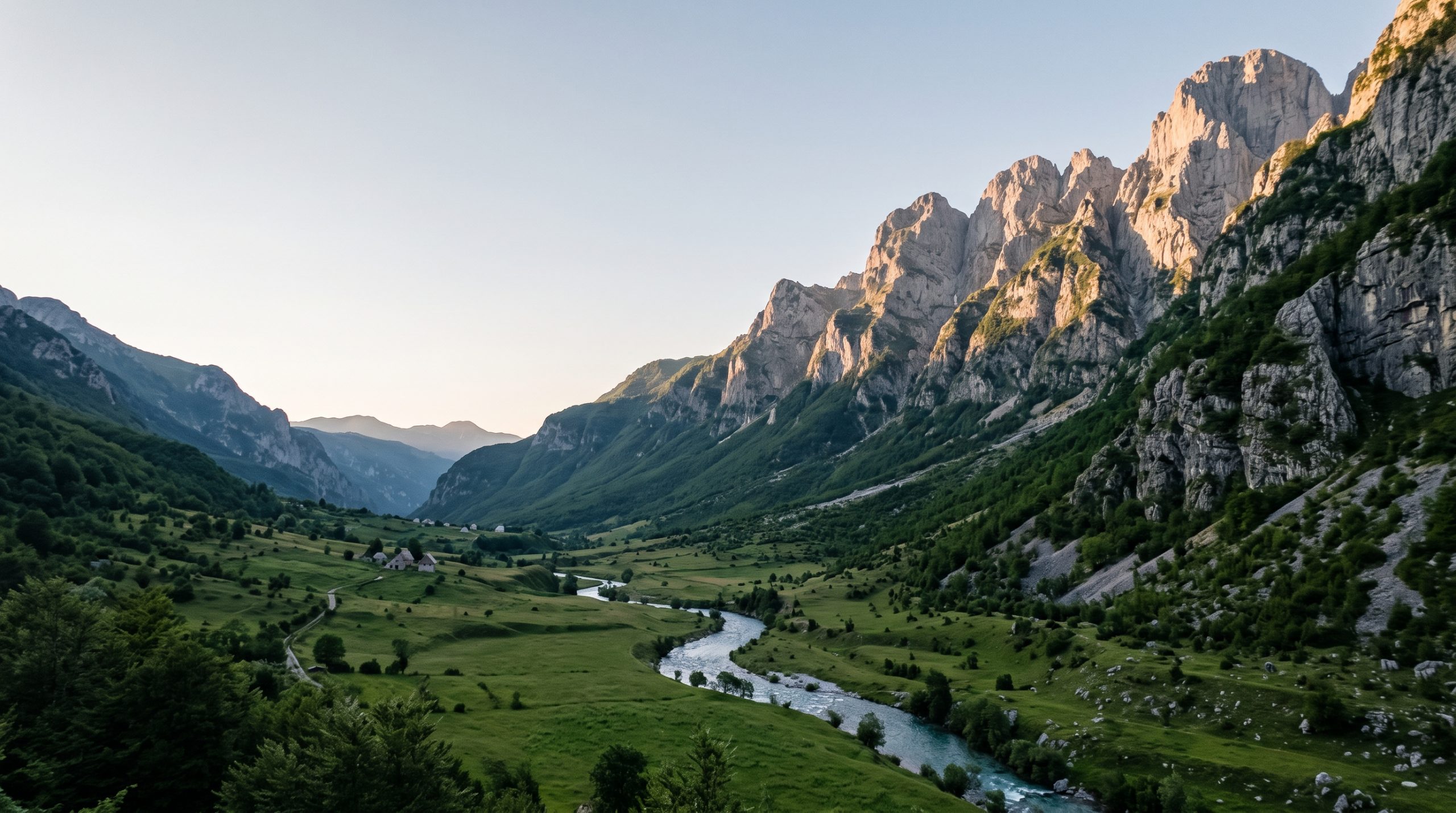
The Albanian Riviera faces west. That sounds like a small piece of trivia until you are standing on the pebbles at Dhërmi in mid-June, twenty minutes after the 5:11 sunrise, and the beach is still in shade. The Ceraunian Mountains rise straight off the water behind you and they hold the sun back while the ridges above Llogara turn gold. On this coast the sea never gets the first light of the day. It gets the last, when the sun drops into the Ionian at 20:12 and civil dusk keeps the sky workable until roughly 20:45.
Go north and the constraint changes shape completely. The Berisha ferry across Lake Koman, which is the way into the Albanian Alps, sails once a day in season: out of Koman at 9:00, back from Fierza at 13:00, about two and a half hours across water squeezed between cliff walls. There is no second attempt until the following morning. Gjipe has its own version of the same rule. No road reaches the beach, so you leave the car above the canyon and walk the last 2.5 km down, twenty-five to forty-five minutes depending on your shoes and how much you are carrying.
We are Unmapped Stories, eight people, four photographers and four filmmakers, working worldwide. This page covers what a photography and film day in Albania costs, how we build one around the light and the access described above, and what happens between your first message and the finished files.
The cost, and who is holding the cameras
Photography, film and planning in Albania come from one team of eight. The Adventure covers one full day with a dedicated photographer or a dedicated filmmaker, from $4,900. The Expedition puts both on the day together, from $7,900. Team travel to Albania is included in each, and the price does not move with your guest count.
Hour by hour on a coast that gets the last light, not the first
A June day on the Riviera starts in the dark, and it starts inland. We leave Himarë or Dhërmi around 04:15 and drive up the SH8 toward Llogara. The pass tops out a little over a thousand meters and it is the highest point on the coast road between Vlorë and Sarandë. Since the tunnel opened beneath it, a good share of the through traffic no longer bothers with the hairpins, which is excellent news at five in the morning.
At 05:11 the sun is technically up, and up there you can see it working: the inland peaks lit, the Ionian below still flat and colorless, the pine terraces going warm from the top down. That gap between sunrise and the moment light reaches sea level is the most useful forty minutes on this coast, and almost nobody plans for it.
By 06:45 we are back down at the coast, in the stone lanes of old Dhërmi or in Vuno on the hillside above the Gjipe trail. Villages are the best hour of the morning here, and the reason is unglamorous: they are quiet, the walls are warm, and the coast has not woken up yet. Vows sit either in the first three hours of the day or in the last two. Between roughly 11:00 and 16:30 the light is hard, the beaches are loud, and there is nothing on this coast worth fighting for at that hour.
So the middle of the day goes to lunch, a swim and sleep. That break is not filler in a timeline, it is what makes a 04:15 alarm and a 20:45 finish possible in the same day. Around 16:45 we walk into Gjipe, everything we shoot with on our backs, and reach the cove as the canyon walls start throwing shade across the pebbles. The last ninety minutes before 20:12 are the reason the whole day was arranged this way.
| On the Riviera coast | Mid-June | Late September |
|---|---|---|
| Sunrise | 05:11 | 06:31 |
| Sunset | 20:12 | 18:34 |
| Light gone | 20:45 | 19:01 |
| Realistic alarm | 04:00 | 05:30 |
| Shape of the day | Two long ends, five hours off in the middle | One continuous arc, dinner at a normal hour |
The Alps run on a different clock again. In Theth the sun is up at 05:03 in mid-June, but the village sits on a valley floor under high walls, so the first workable hour is later than any table suggests and the light leaves the valley early in the evening. The Theth to Valbona trail is 17 km, and we will say plainly that it does not belong inside a wedding day. It belongs to the day before or the day after, which is a conversation about how many days you want rather than how fast you can walk.
Every one of those hours moves with the date you choose, so if you already have a week in mind, send it and we will tell you exactly what the light does on those dates. You can also read the groundwork in our destination elopement guides first. When you are ready, Check Your Date.
One team, one crossing, one set of decisions
Here is the clearest argument for photography and film coming from the same team, and Albania hands it to you for free. The Koman ferry leaves at 9:00. Not at 9:20 for the crew who overslept, and not again at 11:00 for the second take. A photographer and a videographer who were hired separately and met that morning would spend a good part of those two and a half hours working out who stands where. We spend it shooting, one on the bow with the couple and the cliff walls behind, one high on the upper deck for the wide, then trading places when the water opens out.
Sound is the other place it shows. A pebble cove with surf running is a difficult room to record vows in, and the wind on this coast usually builds through the afternoon. On the Expedition our filmmaker brings professional audio for vows and the moments that matter, so we choose the vow position for the microphone as much as the camera: in the lee of the canyon wall at Gjipe, or in a stone lane in Vuno where a wall two feet thick kills the wind entirely. The photographer then works the angles that keep the sound gear out of frame and both of your faces toward the light. Those two decisions are made in the same sentence by people who planned the day together, not negotiated in whispers while you are mid-vow.
Aerials in Albania sit with the Civil Aviation Authority, and individual parks and archaeological sites set their own conditions on top of that. Drone footage is part of what we deliver where it is legal, safe and appropriate, and the way we handle it is to confirm the permission and the time window during planning, then build the aerial beats of the film around that window instead of hoping on the morning. If the answer for a specific location is no, we would rather know in March than at 05:00 on your wedding day.
Eight people also means there is always a second camera on the ground and a colleague in reserve, which matters more in a country where a single ferry or a single mountain track carries the whole plan. If you want to see how the two halves of the work actually sit together, our published films and galleries are the honest answer: the same day, cut and edited by the people who stood in it.
The August problem, and the two weeks on either side of it
Late July and August on the Albanian Riviera are busy, and we are not going to pretend otherwise. Day boats fill the coves south of Dhërmi, the coast road slows behind buses on the Llogara hairpins, and the water at Ksamil is busy from mid-morning. If your mental image of this coast is an empty beach and you arrive in the first week of August, the middle of the day will not match the image.
The two ends of the day still match it completely. The crowd here is a midday phenomenon, and our day is not built in the middle: at 05:30 the pebbles at Gjipe belong to nobody, and by 19:30 the boats have gone back for dinner. Access does the rest of the filtering. Any cove that needs a boat out of Himarë or a forty-five minute walk down a canyon stays quiet in high season, because most people will do neither.
The other answer is the calendar. Late May and the second half of September give you the same water at a lower temperature of crowd, and the September numbers are kinder in every way: sunrise at 06:31, sunset at 18:34, the whole day inside humane hours and the sea still warm from summer. In the north the window is narrower, roughly mid-June to early October for the high valleys, with the Koman ferry running from April into early November. If your dates are fixed by work or family, tell us which week you have and we will build the day that week can actually deliver, which is a more useful piece of planning than a wish list. Our guide to planning an elopement covers the sequence we work through with you.
What travels with us, and what Albania adds locally
Everything below is part of both coverage levels unless it says otherwise. There is no half-day option and nothing here is an add-on.
- Destination and location design, and a custom timeline built around light and real travel time. Albanian roads take longer than a map claims, and the SH8 in August takes longer again.
- Permit research and logistics guidance: which office, which landowner, which window, and who to ask for.
- Weather alternatives and backup planning. For every coastal hour we hold something sheltered and inland, usually twenty minutes away, because a north wind on the Ionian changes a beach and does nothing to a pine terrace.
- Drone footage where it is legal, safe and appropriate.
- On the Expedition, professional audio for vows and meaningful moments wherever conditions allow it.
- Team travel worldwide, including Albania: flights, accommodation and ordinary travel for the assigned team, with no European or long-haul distinction.
- Highlights delivered in 5 days, and the full gallery or film in 3 weeks.
- A price that does not change with guest count. Guests affect access, permits, transport and the timeline, never the fee.
Both figures sit at the top of this page and in full on our coverage and pricing page, alongside the Odyssey, which runs from two to seven days across one or several destinations and is quoted as a custom proposal. Team travel to Albania is inside the price, so there is no travel fee arriving later and no surcharge for the drive north to Koman.
What sits outside it is local and mostly modest. Accommodation, food and your celebrant are yours. So is the paperwork, and Albania has one date-shaped detail worth knowing early: US citizens marrying here need an Affidavit of Eligibility to Marry in the Republic of Albania, certified at the US Embassy in Tirana, where the standard notarization fee is fifty US dollars. The Civil Status Office then posts an announcement, and the marriage cannot be registered until 11 days have passed, with both of you and two witnesses who are not related to either of you signing in person. Plenty of couples handle the legal registration at home and keep the Albanian day for the ceremony they actually care about. Both routes work and we plan around either.
The rest of the local list is short. Permit and site fees where a location charges them, which on the Riviera means cash in lek, usually a few hundred at a parking barrier or a site gate. Ferry tickets across Lake Koman. Unusual transport where you want it: a boat out of Himarë to a cove with no path in, a 4×4 down the Gjipe track in peak season instead of the walk, a mountain guide in the Alps. We do the research and the asking. You pay the fee itself.
From your first message to the 04:15 alarm
Dates are currently open across our 2027, 2028 and 2029 Albania seasons, and the process is the same for all three.
- You send the inquiry form with your dates, or the month you are circling, and a sense of the day you want.
- We reply within 24 hours with our initial brochure and the questions we need answered.
- We put together a tailored proposal: coverage level, the shape of the day, the regions that fit your week.
- You sign the contract and pay a 30% retainer.
- Planning begins in earnest: locations, permit research, the hour-by-hour timeline, the weather alternatives.
- The remaining payment schedule runs as set out in your proposal, then highlights reach you 5 days after the day itself.
Who Albania rewards, and what to tell us if that is not you
This country is generous to couples who are willing to be awake before the sun and relaxed about a plan that shifts on the morning. A 04:15 start in June, a walk down loose stone to a cove, a long lazy afternoon that exists only to make the evening possible, a village lane that is still a working village lane rather than a set. If that reads like a good day to you, the Riviera and the Alps will both pay you back.
If a pre-dawn start is genuinely not in you, say so at the start and we will move the whole thing to the second half of September, where the same coast begins at 06:31 and finishes before 19:00. If uneven ground is the issue, there is a version of this day built on the Llogara pine terraces, in the stone villages and off a boat out of Himarë, with no scramble anywhere in it. If you want the Alps and the sea in one story, that is an Odyssey rather than a single day, because the ferry timetable alone claims a travel day. Tell us which of those sounds like you, and we will either shape the day around it or tell you honestly which month and which region fit it better.
Common questions
How much does an elopement film in Albania cost?
Coverage comes at two levels for a single day: one dedicated photographer or filmmaker, or a dedicated photographer and filmmaker working together. Both include planning, permit research, delivery and team travel to Albania. Current figures are on our pricing page, and multi-day work is quoted as a custom proposal.
Can we hire one person to shoot both photo and video?
We do not split one person across both jobs. Filming and photographing the same vow are two different sets of decisions and each one suffers when it shares a pair of hands. If you want both disciplines, the Expedition puts a dedicated photographer and a dedicated filmmaker on the day, planning it together beforehand.
Can Americans legally get married in Albania?
Yes. US citizens need an Affidavit of Eligibility to Marry in the Republic of Albania, certified at the US Embassy in Tirana for a standard notarization fee of fifty US dollars, plus passports and birth certificates. The Civil Status Office posts an announcement and the marriage cannot be registered until 11 days later, with two unrelated witnesses present at the signing.
Will our Albanian elopement film include drone footage?
Where it is legal, safe and appropriate, yes. Aerials in Albania sit with the Civil Aviation Authority, and some parks and archaeological sites add their own conditions. We confirm what is possible at each location during planning, then design the aerial moments of the film around that window rather than deciding on the morning.
How soon do we see the photos and the film?
Highlights reach you 5 days after the day. The full gallery or the finished film follows within 3 weeks. Nothing is held back for an upsell, and the edit is done by the same people who were standing next to you on the pebbles.
Is late September better than August on the Albanian Riviera?
For most couples, yes. Late September gives a 06:31 sunrise and an 18:34 sunset, so the entire day fits inside sensible hours while the sea is still warm from summer. August works too, as long as the plan puts the two ends of the day to work and leaves the middle alone.
Do we pay for your flights and hotels in Albania?
No. Flights, accommodation and ordinary travel for the assigned team are included, in Albania as everywhere else. What you pay locally is your own accommodation, your celebrant, any government or landowner permit fees, and unusual transport such as a private boat or a 4×4 transfer.
Can we do the Riviera and the Albanian Alps in one trip?
Yes, across days rather than hours. Vlorë to Koman is a long drive and the ferry sails once each morning, so the north takes a travel day of its own. That combination is an Odyssey: two to seven days, one or several destinations, photography and film throughout, built as a custom proposal.
Pick a week, and we will build the light around it
Send us the dates you are holding, or the month you keep coming back to, and we will tell you what the sun is doing on this coast that week and what the day could look like. We keep the planning in one written thread, at whatever hour suits you and across whatever time difference sits between us: the brochure, the proposal, the timeline, and the questions you think of at eleven at night. Tell Us Your Story.