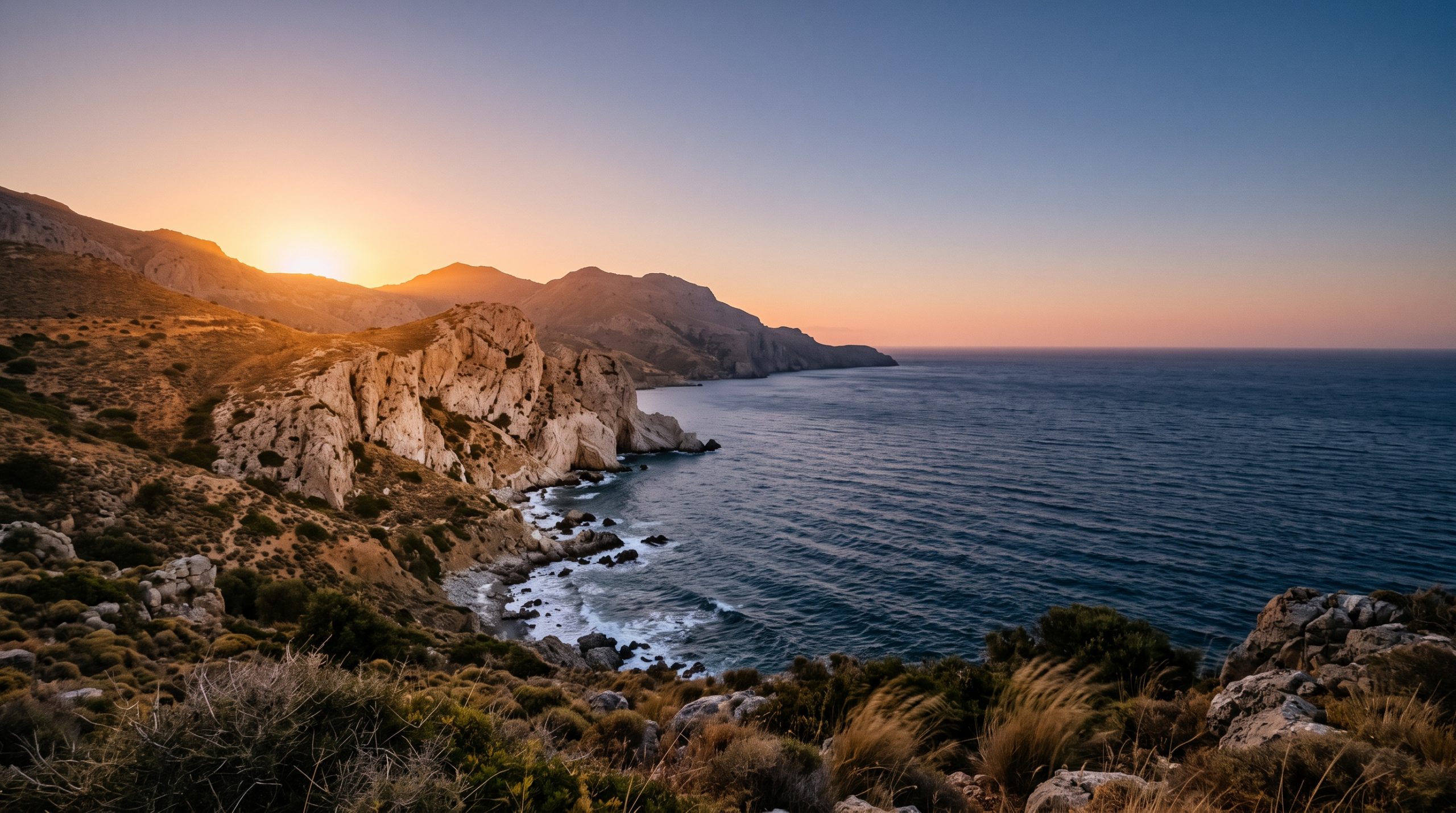
In mid-June the sun is up over northwest Crete a few minutes past six, and the last seven kilometres of road to Balos are not paved. That stretch takes a slow half hour, with a gate five kilometres in where the Municipality of Kissamos collects a small toll for the protected peninsula, currently a euro a head. The big boats out of Kissamos port do not tie up at the lagoon until mid-morning.
That gap is the entire film. From first light until the first ferry, the sandbar belongs to whoever was willing to set an alarm for half past four. By eleven it is a different place, full of good-natured day trippers in swimwear, and no amount of editing puts the quiet back.
So the honest answer to what a Cretan wedding film costs begins with the day rather than the island. You are paying for a full day of coverage, the planning that puts you in the right places at the right hours, and the travel that brings our crew to Chania. On top of that sits a short list of Greek costs in euros: park tolls, beach car parks, a celebrant, permit fees where a site charges them.
Photography, film and planning from one Cretan crew
We are eight people, four photographers and four filmmakers, working as one team. In Crete, a full day with a dedicated photographer or a dedicated filmmaker starts at $4,900. A full day with both of them working side by side starts at $7,900. Team travel to the island is included, and highlights reach you in five days.
Four forty in the morning to blue hour on the harbour
This is the June shape we build most often in the west of the island. Times move with your ceremony, your celebrant and where you sleep the night before, but the bones hold.
- 04:40 Out of Chania on the E75 with coffee in the car. Kissamos is about an hour away, and the dirt track beyond Kalyviani adds another thirty minutes at the speed that road deserves.
- 05:35 Through the gate into the Gramvousa and Balos protected area, then down the path while the sky turns from grey to copper.
- 06:10 Sunrise. The light comes across the lagoon almost horizontally for the first twenty minutes, which is the best of it.
- 06:45 Vows on the sandbar. Your celebrant, witnesses if you want them, microphones placed before anybody speaks.
- 08:00 Portraits on the west side while the shadows are still long, then the walk back up. The climb out is the price of the hour, and it is worth it.
- 09:30 Breakfast in Kalyviani, feet still sandy. The first excursion boats are only now leaving port.
- 11:00 to 17:00 Nothing. Food, shade, sleep, or the drive to the second coast if your day spans two regions.
- 18:45 Chania old town. The Venetian harbour, the breakwater out to the lighthouse, and the alleys behind it that are barely two metres wide.
- 20:40 Sunset. The latest sunsets of the Cretan year fall at the end of June, around twenty to nine.
- 21:15 Blue hour on the harbour front, lamps on the water, the last frames of the film.
Six hours in the middle of that list have no camera in them. That is deliberate. Between eleven and five the Cretan sun is vertical and white, the sea goes flat and hard, and everything you photograph in it looks like a holiday snap taken at the wrong time. We would rather give you those hours back and be sharp again at six.
The whole arc compresses beautifully later in the season. The latest sunrise of the year in Chania falls on 24 October, at 7:36 in the morning, because the clocks have not gone back yet. An October day starts at a humane hour, the two ends of it sit close together, and you can work a headland and a town in one arc with no six-hour hole to fill.
Why we are on the sandbar at six and gone by ten
The objection we hear most about Crete is that everything worth filming is already famous. It is a fair worry. Balos, Elafonissi and Seitan Limania are on every itinerary printed on the island, and two of them are on the excursion boat manifests as well.
We will be straight with you about the trade. At noon in August, Balos is a beautiful place with a great many people in it, and the milky turquoise that sells the postcards actually wants a high sun, which is exactly the hour the boats are in. Dawn gives you the shape of the lagoon, the long light and the emptiness, and the colour arrives as a bonus rather than a promise. If that colour matters more to you than the solitude, say so and we will plan the reverse: a mid-morning window worked from a chartered boat on the water instead of from the sand.
Seitan Limania, on the Akrotiri peninsula, is a forty-five minute drive from Chania followed by a ten to fifteen minute walk down a steep path in proper shoes. At quarter to seven the cove is yours. By one in the afternoon you are sharing a small pebble beach and a narrow path with everyone who saw the same photograph you did. Elafonissi, an hour and a half and roughly 74 kilometres southwest of Chania, sits inside a Natura 2000 site where turtles nest, so we keep to marked ground and use it for the end of the day rather than the middle.
| Place | The hour it actually rewards | Getting there from Chania |
|---|---|---|
| Balos lagoon | First light to about 09:00 | An hour on the E75, then 7 km of dirt track |
| Seitan Limania | The first two hours after sunrise | 45 minutes across Akrotiri, then a 10 to 15 minute walk down |
| Elafonissi | Late afternoon into sunset | About 1 hour 30, some 74 km southwest |
| Chania old town | The hour before sunset, then blue hour | On foot |
| Omalos plateau | Sunrise, May to October | About an hour of climbing road inland |
High ground is the other answer. The Omalos plateau above the Samaria gorge is open, quiet and cold at dawn even in July, and almost nobody there is looking at you. The gorge itself runs on the National Park calendar, 1 May to 15 October, six in the morning until four in the afternoon, with the season sometimes extended a fortnight when the weather allows. It is a one-way walk through a gate, which makes it a hiking day rather than a wedding day, and we will tell you that before you fall in love with the idea. Our destination guides go deeper into how the island splits between the north coast, the south coast and the mountains.
Wind decides plenty here too. Crete’s summer wind arrives from the north, so when the north coast is being scoured we move the day to the sheltered south, and we hold that alternative in the timeline from the day it is written rather than inventing it at breakfast. Send us the date you are circling and we will tell you what the light and the wind are likely to be doing: Check Your Date.
Two cameras, one wind, and audio you can actually hear
The Balos sandbar has sea on both sides of it. Wind crosses open water and arrives with nothing to break it, which makes a whispered vow the hardest thing to record anywhere on this island. That is a craft problem, and it is solved before sunrise or not at all. On the Expedition a filmmaker travels with the photographer and brings professional audio for the vows, placed while the light is still coming up, and we put your ceremony in the earliest calm of the morning rather than at the hour that suits a timetable.
Space is the second Cretan reason to keep the two cameras on one team. The alleys behind the Venetian harbour in Chania are narrow enough that two crews who met that morning will stand in each other’s frames all evening, and you will feel it. Our filmmaker knows where the photographer will be standing before anyone leaves the car park, because they planned the hour together and have done it in worse places. You never repeat your vows for a second camera. The film and the stills come out of the same take, which is the only version of that moment there is.
Aerials are their own piece of homework in Greece. Drone flights run under Hellenic Civil Aviation Authority rules inside the European open-category framework, with operator registration and subcategory limits sitting behind every legal flight, and Seitan Limania is a short drive from Chania’s airport on the same peninsula, which makes aerials there a different conversation from aerials on the southwest coast. Over archaeological sites and monuments the Ministry of Culture is the authority, and Greece has no single national office that issues filming permissions, so applications go to whichever body governs that specific ground. We establish all of it while the timeline is being written, then plan the film around what is genuinely available. Drone footage is included wherever it is legal, safe and appropriate.
What that produces is worth looking at rather than describing. Our published films and galleries show how a coastline like this renders when the same crew planned the hour and then shot it, and how a Chania evening looks once the lamps come on.
What the fee covers, and what stays in euros
Every experience we run in Crete includes the following, whichever coverage shape you choose.
- Destination and location design for this island, based on where the light lands in your month.
- Planning and a custom timeline built around light and real travel time, dirt roads and footpaths included.
- Permit research and logistics guidance, including which authority governs the ground you want to stand on.
- Weather alternatives and backup planning, written in advance rather than improvised.
- Drone footage where it is legal, safe and appropriate.
- Professional audio for vows and other meaningful moments on the Expedition, where conditions allow.
- Team travel worldwide, including flights, accommodation and ordinary travel for the assigned team.
- Highlights delivered in five days, and the full gallery or film in three weeks.
Paid on the ground in Crete
Greek third-party costs stay with you, and in the west of the island they are mostly small. The toll at the gate into the Gramvousa and Balos protected area is currently one euro a head. Most of the big beach car parks now charge a few euros for the day. Then there is your celebrant, your accommodation, government, municipal or landowner permit fees where a site levies them, and any unusual transport you want: a private boat into a cove, a 4×4 up a track, a guide in the mountains.
The Adventure is one full day with one dedicated photographer or one dedicated filmmaker. The Expedition is one full day with both, working together. The Odyssey runs two to seven days, photography and film, across one region or several, and comes to you as a custom proposal. Where each of them starts is set out on our pricing page. Guest count does not change the fee, though it does change access, permits and transport, since a dirt road and a footpath set a practical limit on how many people come along.
From your first message to the finished film
- You send the inquiry form with your date, or the month you are circling, and what you want the day to feel like.
- We reply within 24 hours with an initial brochure and our first read on your dates.
- We build a tailored proposal around your locations, your light and the coverage shape that fits.
- You sign the contract and pay a 30% retainer. The remaining payments are set out in the proposal.
- Planning begins: locations, timeline, permit research, weather alternatives, the lot.
- We shoot your day, then deliver highlights in five days and the full gallery or film in three weeks.
Our planning calendar for Crete currently covers 2027, 2028 and 2029, so a Cretan date two or three seasons out is an ordinary conversation for us rather than an unusual one.
The couples Crete rewards, and the month we would move you to
This island pays back people who will get up at twenty to five, walk down a steep path in trainers rather than sandals, sit patiently through a slow seven kilometres of dirt track, and let a plan change direction on the morning because the north wind decided something. If that reads like your idea of a good day, the west of Crete in June is close to unbeatable.
If a pre-dawn start genuinely is not your morning, the fix is a different month rather than a different island. Late October hands you a 7:36 sunrise and a day you can begin over breakfast. Early May gives you green hills, cool mountain air and beaches that have not filled up yet. If you want to stand on a headland at first light and in a mountain plateau on the same trip, that is two days rather than one, and the Odyssey exists for exactly that. Tell us the morning you actually want and we will shape the day around it, or tell you honestly which month fits it better.
Common questions
How much does a wedding film in Crete cost?
It is priced by the day and by the crew, not by the location. One full day covered by a dedicated filmmaker, or by a filmmaker and photographer working together, are the two one-day shapes, and both starting figures sit on our pricing page. Team travel to Crete is inside that figure.
Do we pay for your flights and hotels in Greece?
No. Team travel is included worldwide, Crete included, which covers flights, accommodation and ordinary travel for the assigned team. There is no long-haul surcharge and no European versus overseas distinction. What stays with you are Greek third-party costs like tolls, car parks, your celebrant and any permit fees.
Can we legally marry in Crete, or is it easier to do the paperwork at home?
Both work. For a civil marriage in Greece you apply to the municipality, and the licence is generally issued around eight days after your application, with an apostilled birth certificate and a certificate of no impediment among the documents. The marriage is then registered within 40 days of the ceremony. Many couples handle the legal side at home and hold the ceremony they care about on the sand. We build the timeline either way.
Can you fly a drone at Balos or over Chania old town?
Sometimes, and never on assumption. Greek drone flights sit under Hellenic Civil Aviation Authority rules within the European open-category framework, airspace near Chania’s airport changes what is possible on the Akrotiri peninsula, and archaeological sites and monuments fall to the Ministry of Culture. We confirm what is available for your specific locations during planning, then build the aerials into the film only where they are legal, safe and appropriate.
What time do the crowds reach Balos and Elafonissi?
The excursion boats leave Kissamos in the mid-morning, so the lagoon changes character somewhere around eleven. Elafonissi fills from late morning and thins again in the last two hours of light. Both facts are why a Cretan elopement day is built at the ends and left empty in the middle.
Which month is best for a Crete elopement day?
June buys the most daylight, with sunrise a few minutes past six and sunset around twenty to nine, at the cost of an early alarm and a hot middle. Late September and October are gentler, quieter and still warm in the sea, with the latest sunrise of the year on 24 October at 7:36. May gives green mountains, and the Samaria gorge above Chania opens on 1 May.
How soon do we see the film and the photographs?
Highlights land with you five days after the day itself, while you are probably still travelling. The full gallery or the full film follows within three weeks.
Do we need a filmmaker as well as a photographer?
You do not, and plenty of couples book one camera. What the second one changes in Crete is specific: the vows get recorded properly on a windy sandbar, the walk down the path exists as motion rather than as a still, and both cameras were planned by the same crew instead of turning up as strangers on the morning. The two coverage shapes and where they start are on our pricing page.
Holding a 2027, 2028 or 2029 date in Crete
From the first reply onward, the whole process stays in writing. You send the form, we come back inside 24 hours with a brochure and a first read on your date, and you can read all of it at midnight in your own time zone and answer when you have actually thought about it. Nothing to arrange in advance, nothing that has to happen inside anyone’s working hours, just a reply from the people who would be standing on that sandbar with you at ten past six.
Tell us the month, the coast you keep coming back to, and how early you are honestly willing to get up. We will send back a shape for the day, and the truth about what that hour looks like in Crete. Tell Us Your Story.