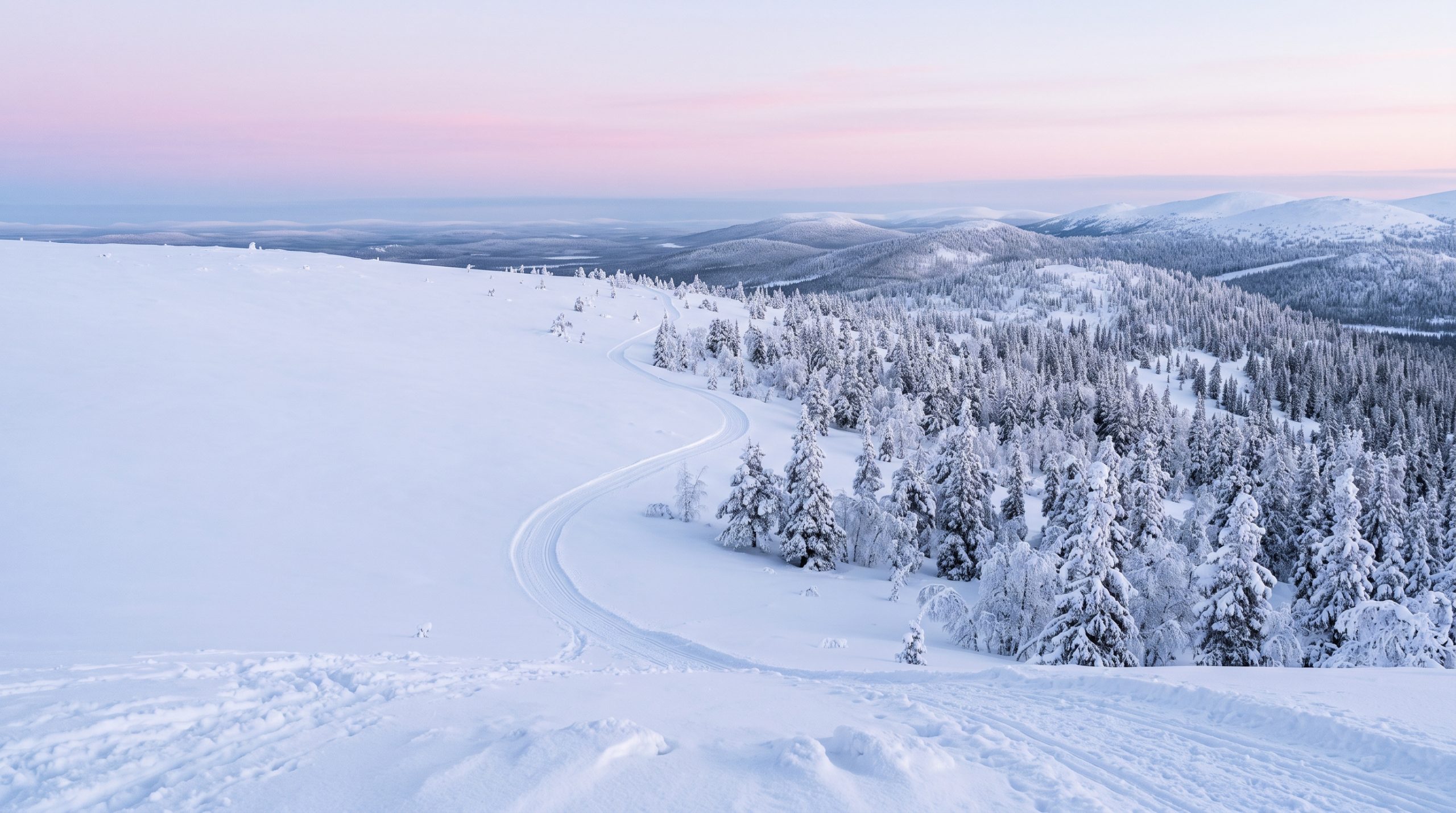
On 23 December in Rovaniemi, the sun comes up at 10:58. It clears the treeline, rolls sideways along it without ever really climbing, and is gone again a little after half past one. At the solstice that is two hours and thirty-three minutes of direct light for the whole day. Everything else is twilight, which is the part nobody warns you about: the sky lifts to a deep, even blue from around nine in the morning and holds it again until past three, and the snow throws all of it back at you.
Here is the wrinkle that decides the shape of a Lapland wedding day, and almost nobody writes it down. A civil ceremony at the Digital and Population Data Services Agency is free of charge at their own premises during office hours, weekdays from 9.00 to 16.15. In late December, those office hours contain the entire daylight window. An officiator who travels out to a venue of your choosing outside those hours costs 250 euros plus their travel. So the first real decision is not a location. It is whether the legal minutes happen indoors in the middle of your only light, or the vows happen outdoors in it with the paperwork arranged around them.
We are eight people: photographers Serg, Alex, Alex and Viktoria, and filmmakers Lara, Mike, Anthony and Stas. Photography, film and planning come from the same team rather than from three suppliers who introduce themselves in a hotel car park at eight in the morning. Dates are currently open across our 2027, 2028 and 2029 Lapland seasons.
What we cover in Finnish Lapland
We photograph, film and plan elopements across Finnish Lapland, from Rovaniemi on the Arctic Circle to the fells north of the polar night line. Coverage starts at $4,900 for one full day with a dedicated photographer or filmmaker. Team travel is included worldwide, planning and permit research are ours, and your highlights arrive five days after we shoot.
Building the day around a 10:58 sunrise
A midwinter day up here runs backwards from most elopements we plan. There is no dawn call. You eat breakfast in the dark, and around nine the windows turn navy rather than black, which is the signal to start dressing. We drive out at ten. Snow at minus fifteen squeaks underfoot, which is unmistakable on film. On arrival we walk the ground first, so nobody’s boot prints end up in the frame where the vows happen.
At 10:58 the sun arrives, and this is the strange gift of the Arctic Circle in December. The sun sits within a hand’s width of the horizon for the whole of its time in the sky. There is no harsh overhead hour, because there is no overhead. The light stays low, sideways and gold, and it does not stop being gold until it goes. In practice you get one continuous sunrise that turns into one continuous sunset, and it lasts roughly two and a half hours. We put the vows inside it, usually between 11:30 and 12:45, which leaves time for the walk in and the quiet part afterwards.
Sunset around 13:30 is not the end of the working day. Civil twilight runs on for nearly two more hours, and blue light on snow is the most flattering condition in the Finnish winter. That is when we go to a frozen lake for the wide frames, and when the sauna and the fire start to look worth photographing. By four it is properly dark, and if the sky is clear the evening is yours.
| When | Direct light at the Arctic Circle | How we shape the day |
|---|---|---|
| Late December | Sun up about 10:58, down about 13:30 | One location, one walk in, vows inside the light window, blue twilight after |
| Mid-January | Around four hours, and lengthening fast | Two locations, ceremony near midday, the evening held open for aurora |
| February | About six hours at the start of the month, eight by the middle | Sunrise and sunset both usable, with a fell or a lake between them |
| Late March | Roughly twelve hours at the equinox, snow usually at its deepest | A full day, and nights still dark enough for aurora at a civilised hour |
| June to early July | The sun does not set in Rovaniemi from about 6 June to 7 July | Vows near midnight in low gold light, with the afternoon spent asleep |
March, when the light comes back faster than you expect
Through February the day gains about seven minutes every twenty-four hours. By the March equinox you are back to roughly twelve hours of light, with the snow usually at its deepest of the winter. It is the month we suggest to couples who want a real sunrise and a real sunset on the same day, and enough darkness left in the evening to look for the aurora without staying up until three.
The June version, where nothing ever sets
In Rovaniemi the sun stays above the horizon from around 6 June to 7 July. Further north in Utsjoki it does not set from the middle of May until late July. Vows at midnight in horizontal gold light are the reason to come in summer. The honest counterweight is that there are no auroras between May and early August, because it never gets dark enough to see them, and that mosquitoes near still water on a warm July evening are not a rumour. We plan summer days on moving air: a fell shoulder, a lakeshore with a breeze.
When the aurora stays away
This is what couples write to us about most often, so here is how we handle it. Visit Finland puts it plainly: in Lapland, auroras appear on roughly every other clear night between August and April, and October and November are statistically among the strongest months for activity because of how the solar wind meets the Earth’s field around the equinox. Cloud, not geomagnetic weather, decides most nights. This far north a KP reading of one or two can be enough, and the Finnish Meteorological Institute publishes space weather openly, which we watch in the days before you arrive.
What that means for planning is simple. We never make the aurora the load-bearing element of a single-day booking, because no one can promise it. On a multi-night shape we hold each evening open, read the cloud cover in the afternoon, and go when it is worth going. The roads here are good enough that driving forty minutes to a gap in the cloud is a normal evening rather than an expedition. If aurora frames matter more to you than anything else, say so in your first message and we will build the trip around dark hours instead of daylight ones. Our destination guides go deeper on how the seasons behave.
Two cameras inside a three-hour window
This is the part of a Lapland elopement that a single operator cannot solve, and it has nothing to do with effort. In December you have one golden window of about two and a half hours, and it cannot be repeated tomorrow, because tomorrow the cloud will be different. Stills want one hundredth of a second at exactly the right instant. Film wants an uninterrupted take running thirty seconds either side of it, with clean audio underneath. One person with two bodies has to choose, and whichever they choose, the other thing is gone.
With a photographer and a filmmaker together, the two of them stand in different places at the same moment. The low sun gives you flare from one angle and modelled light at ninety degrees to it, so the film takes the flare and the frames take the shape. Nobody asks you to do the walk again.
Sound is the other reason, and in Lapland it is a bigger one than most couples expect. There is no traffic. A ceremony on a frozen lake at minus twelve is genuinely close to silent, so every footstep in dry snow, every catch in a voice, every gust through spruce is recorded material rather than noise to be cleaned up. The Expedition adds professional audio for vows and the moments that matter, and the practical consequence is that we site the ceremony in the lee of trees rather than on an exposed fell shoulder, because wind is what ruins vow audio in the Arctic. That decision gets made in planning, weeks out, by the people who will be holding the cameras.
Aerials are planned the same way. Drone flights in Finland run under the European open category, which means Traficom operator registration, visual line of sight, and a ceiling of 120 metres, plus a green flashing light on the aircraft for anything flown after dark. Winter adds its own arithmetic: batteries lose capacity in the cold, so spares live inside jackets and one long flight becomes two short ones. In protected areas Metsähallitus governs both filming and any motorised movement off the road, and applications go in well ahead of your date. Across the reindeer herding areas we check with the local herding cooperative before planning an aerial, and in spring we keep away from calving ground.
What comes out of it is a set of photographs and a film made in the same three hours by two people who agreed in advance where each would be standing. You can see how that resolves in our published stories and films, which is the most useful hour of research you can do before writing to anyone, including us. Because there are eight of us, there is always a second camera on the ground and a colleague in reserve.
Check Your Date and tell us the month you have in mind.
Everything that travels north with us
Every experience, from one day to seven, includes the following.
- Destination and location design for Finnish Lapland, including which fell, lake or forest suits your date and your legs
- A custom timeline built around the real light window for your month and honest winter driving times
- Permit research and logistics guidance, including Metsähallitus requirements and off-road movement in protected areas
- Weather alternatives and backup planning, decided in advance rather than argued about at breakfast
- Drone footage where it is legal, safe and appropriate
- Professional audio for vows and meaningful moments where conditions allow, on the Expedition
- Team travel worldwide: flights, accommodation and ordinary travel for the assigned team, with no European or long-haul distinction
- Highlights delivered in 5 days, and the full gallery or film in 3 weeks
The price does not change with your guest count. Two of you or twelve, the fee is the same. Guest numbers affect access, permits, transport and how long the day takes to move, not what you pay us.
Where coverage starts, and what Lapland adds in euros
The Adventure is one full day with either a dedicated photographer or a dedicated filmmaker. The Expedition, from $7,900, is one full day with a photographer and a filmmaker working together, and it is the one we recommend in midwinter for the reasons above. The Odyssey runs from two to seven days, photography and film, one or several destinations, and comes as a custom proposal. Full detail sits on the pricing page.
Team travel to Lapland is included: flights, accommodation and ordinary travel for the assigned team, in Rovaniemi and equally in Inari or Kilpisjärvi. What you pay separately are the third-party costs, and in Finland they are unusually easy to read:
- The officiator. A civil ceremony at the agency’s own premises inside office hours is free. Outside those hours, at a venue of your choosing, the state fee is currently 250 euros plus the officiator’s travel to you.
- Any government, venue or landowner permit fees. The research and the applications are ours. The fees, where they exist, are yours.
- Accommodation, from a glass-roofed cabin to a log house with a lakeside sauna, plus vendors and any celebrant you bring in for a symbolic ceremony.
- Activities that also happen to be beautiful: a husky team, reindeer and a sleigh, a guided snowmobile route.
- Unusual transport. Helicopters, snowcoach or 4×4 charters, private boats in summer, and mountain guides where the ground calls for one.
From your first message to a signed contract
- You send the inquiry form with your dates, or the range you are considering.
- We reply within 24 hours with our initial brochure.
- We put together a tailored proposal for your month, your region and the shape of day you described.
- You sign the contract and pay a 30% retainer. The remaining schedule is set out in the proposal.
- Planning begins: locations, timeline, permit research, weather alternatives, and the officiator question resolved early.
- We shoot. Highlights reach you in 5 days, the full gallery or film in 3 weeks.
The Finnish paperwork sits alongside that and is more straightforward than most couples fear. Before the ceremony you request an examination of impediments to marriage, and the resulting certificate is valid for four months. If neither of you is a Finnish citizen or resident, you also submit marital status certificates from your home authority, usually less than four months old, plus a clarification that the law of your own country allows you to marry in Finland. Foreign documents generally need to be legalised and translated into Finnish, Swedish or English. Two witnesses aged fifteen or over must be present at the ceremony, and both of you must be there in person. We track the sequence and the deadlines with you during planning, and our guide to eloping covers the fundamentals that apply anywhere.
The couples who do well up here
Lapland suits people who are content to walk twenty minutes off a plowed road in proper boots, and who would rather change plan at breakfast than keep one that no longer fits the sky. It suits couples who will take the wrap off for ninety seconds and put it straight back on, and who find that funny rather than miserable. Almost every good frame we have made in a Finnish winter came from someone who was, at that moment, slightly cold and completely fine about it.
If what you actually want is a long unhurried day with a lot of light, December is not your month and we will say so. March gives you twelve hours and the deepest snow of the year. If you want green in the landscape and vows at midnight, late June is the answer, with the trade that the aurora is off the table until August. If you want the sun to genuinely never rise, you need to be north of about 67.3 degrees, one degree above the Arctic Circle: in Ivalo the polar night runs about forty days from the start of December, and in Utsjoki beyond fifty. Rovaniemi itself sits just below that line, so the sun does rise there every day of the year, whatever you may have read.
Tell us which of those matters most to you and we will either build the day around it or tell you plainly which month and which region fit it better.
Common questions
Do you offer a half-day elopement package in Lapland?
No. One full day is the smallest shape we work in, and in Lapland that is deliberate. The light window is short, winter driving times are long, and a half day here often means arriving as the light goes. If you want an unhurried day with a short ceremony and time by a fire afterwards, say so and we will build that inside a full day.
Can we get legally married in Finland as Americans?
Yes. You request an examination of impediments to marriage, and the certificate you receive is valid for four months. Because neither of you is a Finnish citizen or resident, you also supply marital status certificates from your home authority and a clarification that United States law permits you to marry in Finland, generally legalised and translated into Finnish, Swedish or English.
How many nights do we need for a real chance at the northern lights?
More than one. Auroras appear on roughly every other clear night in Lapland between August and April, so the variable you are buying with extra nights is clear sky rather than activity. Couples who care most about aurora frames usually take the Odyssey shape across several nights, which lets us pick the best sky of the trip instead of hoping for a specific evening.
Is it too cold to wear a dress outdoors in January?
It is cold, and it is entirely workable. Midwinter days on the Arctic Circle usually sit between minus ten and minus fifteen, and we plan in short bursts: a warm vehicle within a two-minute walk, snow boots that come off just outside the frame, layers under the dress, and a wrap that belongs in the pictures rather than hiding from them.
Do you fly a drone in Lapland, and is it allowed?
Where it is legal, safe and appropriate, yes. Finland works under the European open category, so flights run on Traficom operator registration, within visual line of sight and below 120 metres, and anything after dark carries a green flashing light. In protected areas Metsähallitus governs filming and off-road movement, and across the herding areas we check with the local reindeer herding cooperative before planning an aerial.
Should we choose Rovaniemi, or go further north?
Rovaniemi is the easiest arrival, sits on the Arctic Circle, and has an agency service location for the legal ceremony. Go north of about 67.3 degrees and you gain the true polar night, forty days of it in Ivalo and more than fifty in Utsjoki, at the cost of a longer transfer. We choose based on which one your date actually rewards.
Do we need witnesses if we are eloping just the two of us?
Yes. A civil ceremony in Finland needs two witnesses aged fifteen or over, physically present. We raise this in the first planning round because it can change who travels, and occasionally where the ceremony happens. It is a solvable detail, but it is much easier solved in month one than in week one.
When do we get the photographs and the film?
Highlights in 5 days, while you are often still in Finland or just home. The full gallery or the finished film in 3 weeks.
What happens after your first Lapland message
From the first reply onward, the whole process stays in writing, in your own time and your own time zone. You send dates, a rough idea of the day you want, and anything you already love or already know you will hate. A reply and a brochure come back inside 24 hours, then a proposal built for your month rather than a menu. From there we start choosing ground, and the sun at 10:58 stops being a curiosity and becomes the thing your day is built around.
Tell Us Your Story, and tell us the year: Dates are currently open across our 2027, 2028 and 2029 Lapland seasons.