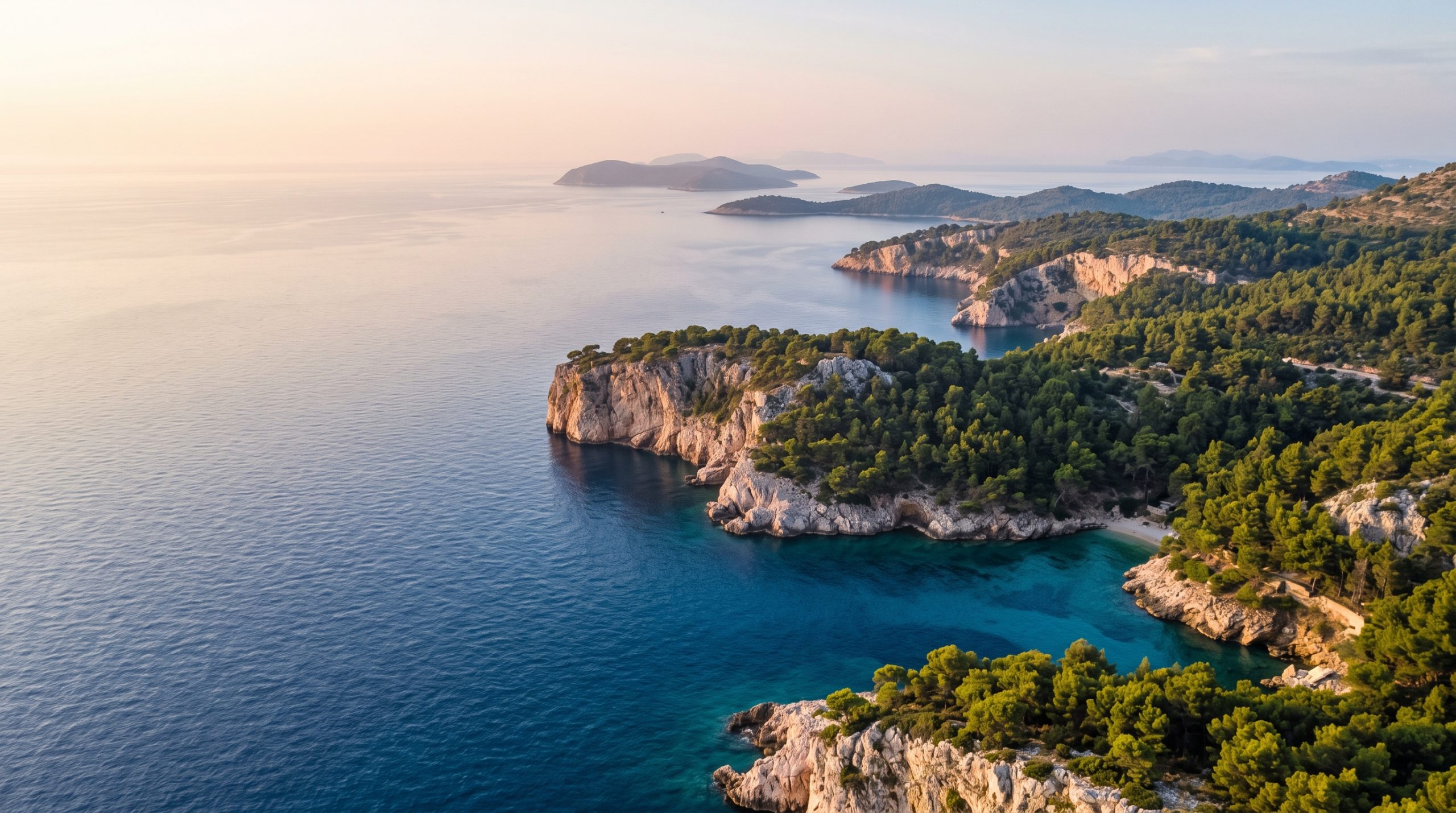
In late June the sun clears the horizon at Dubrovnik at 5:10, and for the first hour it does almost nothing for the old town. Srđ stands behind the walls and keeps the streets in shade. The early light belongs to the water, to the west-facing ramparts and to the boats leaving the Old Port, which is where we plan to be standing.
A Croatian elopement day is a series of narrow windows rather than one long stretch of good light. Each window is governed by something specific: where the sun actually lands, how long the channel stays flat before the afternoon wind arrives, when the first day boats reach the pier, and what hour the registrar can give you. In Dubrovnik-Neretva County the intention to marry is reported 30 to 45 days before the date, so the legal part of your day is settled well before anything else is.
We are eight people, four photographers and four filmmakers, and we work this coast as one team rather than two suppliers who introduce themselves at the harbor on the morning. What follows is the practical version: the hours we use, what comes with the coverage, where it starts, and what Croatia charges on top of it.
What one team covers on the Dalmatian coast
We photograph, film and plan Croatian elopements as a single service, from one full day on Hvar to a week across Dubrovnik, Vis and Brač. Coverage runs from one dedicated photographer or filmmaker up to both working together, and every experience includes team travel to Croatia, planning, permit research and a timeline built around real light.
One island day, from the 4:53 calm to the last light at 21:06
Take a mid-July day based in Hvar town. First usable light arrives at 4:53, the sun is up at 5:28, and the channel out towards the Pakleni islands is still flat. We are on a boat by five with coffee in a thermos, because for the next two hours the water is ours. Taxi boats start later. Swimmers later still.
By 6:30 the light has turned from gray to gold and the coves come alive, because pale limestone under shallow water throws light back up into faces from below. This is the hour that makes Croatia worth the alarm clock. It is also short. We usually work two coves in it, not five, and the boat ride between them is part of the film rather than dead time.
If you are marrying legally in Croatia, the registrar’s slot decides the middle of the day and we build outward from it. Couples who complete their legal file at home keep the whole morning free, and most of them take vows around seven on a beach with nobody else on it, then eat breakfast in a harbor town before the first day boats tie up.
Between about eleven and half past four, the sun is overhead, the harbor towns are full, and there is very little on this coast that photographs well. So we stop, and you swim or sleep. On mainland days that midday gap is an argument for Krka rather than against it: from June through September the entrance ticket drops 25% after 15:00, currently 40 € down to 30 €, and the boardwalks at Skradinski buk clear as the coaches leave.
Evening runs long in July. We move to a second location by 18:30, work a west-facing headland from 19:15, watch the sun go at 20:32, and keep going through the blue hour to about 21:06, when the stone alleys of Hvar town are lit by lamps rather than sky. Dinner happens after the cameras are down, not instead of the light.
The same day in September is roughly four hours shorter at both ends. These are Hvar town times on the local clock, and they are the numbers we plan from.
| Date | First usable light | Sunrise | Sunset | Last light |
|---|---|---|---|---|
| 25 May | 4:48 | 5:22 | 20:21 | 20:55 |
| 21 June | 4:39 | 5:14 | 20:37 | 21:13 |
| 15 July | 4:53 | 5:28 | 20:32 | 21:06 |
| 20 August | 5:34 | 6:05 | 19:50 | 20:20 |
| 15 September | 6:05 | 6:33 | 19:05 | 19:34 |
| 5 October | 6:27 | 6:56 | 18:29 | 18:58 |
A 21 June date asks for a four o’clock alarm. A 15 September date hands you sunrise at 6:33, last light at 19:34, warm sea and a normal night’s sleep. Our destination elopement guides go deeper into that month-by-month trade, and it is the first thing we discuss with couples who are still choosing a week.
Wind, limestone and two cameras working the same hour
Croatian light is generous and brief, and it likes to be in two places at once. That is the practical case for photography and film coming from the same team, and on this coast it shows up in specifics rather than slogans.
Start with the boat. At 5:40 the surface is changing every few minutes. A photographer wants the boat moving and the two of you steady; a filmmaker wants the skipper to hold one heading for thirty seconds, and for the vows, the engine off entirely. Those two requests fight each other when two people who met an hour ago negotiate them in front of you. They do not fight when they were written into the same timeline weeks earlier, when we already asked the skipper for his engine-off minutes and already know which two coves sit inside them.
Then the wind. A sea breeze comes in off the water most summer afternoons here, and it is the single biggest influence on how vows sound. The Expedition adds professional audio for vows and other spoken moments where conditions allow, so we put ceremonies either in the first hours after sunrise or on the lee side of a ridge, where a microphone hears your voices instead of the channel.
Then Dubrovnik itself, which is a city of stairways two or three meters wide, walled in limestone that bounces light straight back at you. A photographer needs one pass up those stairs. A filmmaker needs three, from different positions, to cut the sequence together. Hire the two separately and either one of them stands waiting or you climb the stairs six times in a wool suit. With our own pair, the film passes and the frames happen inside the same seven minutes and you go up once.
There are eight of us, so there is always a second camera on the ground and a colleague in reserve. If the boat time moves or a cove is busy, the plan moves with it and nobody has to renegotiate the day. You can see how the coast reads in finished work on our stories page, including the difference between 5:40 water, which goes silver, and nine o’clock water, which goes hard blue. Highlights reach you within 5 days, and the full gallery or film within 3 weeks.
The crowd question, answered with a timetable
This is what couples ask us about Croatia more than anything else, and the honest answer starts with a concession. Stradun at ten in the morning in July is a slow-moving crowd. The frames people save of an empty limestone street are six o’clock frames, or half past nine at night. Between those hours, Dubrovnik in high summer gives a camera very little that you cannot get in better light somewhere quieter.
None of which is a reason to give up the place. It is a reason to run the clock backwards from the crowd rather than forwards from breakfast.
- We start the old town before the first tenders and cruise arrivals reach the pier, and we finish it after the last of them have gone.
- Twenty minutes of boat solves most of it. The crowding on the islands is concentrated in the harbor towns, and Vis sits farthest out of the big central islands, which does its own filtering.
- The national parks reward reverse timing. Krka gets cheaper and calmer after 15:00 in summer, and Plitvice tickets are tied to the entrance and the time window you choose when you buy, so we book the earliest slot at the entrance that matches the walking route we want.
- Late September and early October keep the sea warm, hand back a couple of hours of sleep, and empty the alleys.
Tell us the week you are looking at and we will tell you honestly what the light, the boats and the crowds do in it, and which island fits the shape of the day you actually want. Send Us a Message with your dates and we will start there.
What travels with the team, and what Croatia bills separately
Every experience, whether it runs one day or seven, includes the same foundation.
- Destination and location design, built around this coast’s light and access rather than a list of famous names.
- Planning and a custom timeline that accounts for real travel time, including boats.
- Permit research and logistics guidance for the locations in your plan.
- Weather alternatives and backup planning, which on the Adriatic means a wind plan, not a rain plan.
- Drone footage where it is legal, safe and appropriate, with the permission and the window confirmed before the film leans on it.
- Team travel worldwide, Croatia included: flights, accommodation and ordinary travel for the assigned team, with no long-haul surcharge.
- Highlights within 5 days of your date. Full gallery or film within 3 weeks.
The Adventure covers one full day with one dedicated photographer or one dedicated filmmaker, from $4,900. The Expedition covers one full day with a dedicated photographer and filmmaker working together, from $7,900. The Odyssey runs two to seven days across one or several destinations with photography and film, quoted as a custom proposal, which is the shape most multi-island trips take. Guest count never changes the fee. It changes access, permits, transport and timing, which is a planning question rather than a pricing one. The full breakdown sits on our pricing page.
Croatia adds its own third-party costs, and they are paid in euros directly to the people providing them. Registry administration in Dubrovnik-Neretva County is modest: currently 9.29 € for the record of intention to marry and 18.58 € for the ceremony itself. Sworn court translation of your documents is billed by the translator. National park entry is the bigger line: Krka’s high-season adult ticket is currently 40 €, and Plitvice sells one-day and two-day tickets tied to the entrance and time slot you pick when you buy. Boat charter, accommodation, a celebrant if your ceremony is symbolic, and any venue or landowner permit fee are also yours. We do the research and the paperwork legwork; the fees themselves stay in your name.
The registry file, and the 30-to-45 day window
The registry office in the district where you marry governs your file, and the ministry’s own guidance is to make contact roughly three months ahead and confirm the document list with that office directly, because it varies by district. For US citizens the core of it is a birth certificate carrying the Apostille seal of the issuing state, translated into Croatian by a sworn court interpreter, and issued as a new copy within the previous 90 days. If either of you is divorced or widowed, apostilled proof of the dissolution joins the file. A visit of under 90 days needs no special visa. Plenty of couples choose instead to complete the legal marriage at home and hold their ceremony here without paperwork, and both routes work; how to elope covers the decision in general terms and we handle the Croatian specifics with you.
How a Croatia package moves from first message to hold
- You send the inquiry form with your dates, the region you are drawn to and roughly what you want the day to feel like.
- We reply within 24 hours with an initial brochure and our first thoughts on your dates.
- We build a tailored proposal: the experience that fits, the shape of the day, the locations and the boats they imply.
- You sign the contract.
- You pay a 30% retainer, which holds your date and our team. The remaining payment schedule is set out in the proposal.
- Planning begins: timeline, permits, registry sequence, weather alternatives, and the small decisions that make a 5am start feel easy.
The couples this coast rewards
Croatia suits couples who will get up at four in July and think it was worth it by six. It suits people who are comfortable stepping off a small boat into knee-deep water, walking on limestone that is slick where it is wet, and hearing at 6am that the wind has turned and we are going the other way around the island. That last one happens, and it usually produces the better morning.
If a four o’clock alarm sounds like a bad start to a marriage, the fix is a different month rather than a compromise on the day. Mid-September onwards gives you sunrise after 6:30 and last light before 19:40, so the whole day fits inside civilized hours. If scrambling down to a cove is not your idea of fun, we build around Korčula’s flat walled town, the lake paths on Mljet, or the stone villages of Pelješac instead, and the film loses nothing for it. If you want one island and one long lunch rather than three islands and a schedule, say so in your first message and we will design that instead.
What does not work well here is a plan that cannot move. The wind decides the running order on this coast, not the itinerary, and the couples who love their Croatian day are the ones who let us hold two versions of it.
Common questions
Can we legally get married in Croatia as US citizens?
Yes. A civil marriage is performed by a registrar in the district where you marry, and your file needs apostilled documents translated into Croatian by a sworn court interpreter. Your US birth certificate must be a new copy issued within the previous 90 days. A stay under 90 days needs no special visa.
How early do we have to file the Croatian paperwork?
In Dubrovnik-Neretva County the intention to marry is reported 30 to 45 days before the date. The ministry advises contacting the registry office about three months ahead, mainly because document lists vary by district and translations take time. We build that sequence into your planning timeline from the start.
Is Dubrovnik too crowded in July for an elopement?
Not if you use the right hours. The old town works before the first tenders arrive and again late in the evening, and the middle of the day is better spent offshore or resting. If your date is fixed in July, we plan the city around its two quiet windows and put the rest of the day on the water.
Do we need to charter a boat, and who arranges it?
Most island days work far better with one, and coastal access here often depends on it. Boat charter is paid directly by you, in euros. We handle the planning side: which harbor, what departure time, how long the crossing really takes, and which coves are reachable in the light window we are aiming for.
What happens if the wind turns on the morning of our date?
We move. Every plan we write includes an alternative built for a different wind direction, usually a sheltered channel or a lee-side cove within a short run of the first one. Because the same team planned it and is shooting it, changing the running order at 6am takes one message, not a negotiation.
Can we split one elopement across islands and the mainland?
Yes, and it is one of the best reasons to spend more than a day here. The Odyssey covers two to seven days and one or several destinations, so Dubrovnik and Pelješac, or Split with Brač, Hvar and Vis, can sit inside one plan with the crossings built into the timeline properly.
How long until we see the photos and the film?
Highlights reach you within 5 days, while you are often still traveling. The full gallery or film follows within 3 weeks. Both windows apply to every experience, whether we cover one day on Brač or a week across three islands.
Does bringing six guests change the price?
No. The fee is the same with two people or twelve. What guests do change is boat capacity, transport, access at some locations and how long each move takes, so we plan the timeline differently and tell you honestly which coves stop being realistic.
Holding a 2027 or 2028 date on this coast
Dates are currently open across our 2027, 2028 and 2029 Croatia seasons in Croatia now, and the good weeks in the shoulder months tend to be claimed by couples who wrote early with an open mind about the island. We handle the planning in writing so nothing depends on matching time zones, at whatever hour suits you: you send the form, we reply within 24 hours with the initial brochure, and a proposal follows once we know your dates and what you want the morning to feel like. Send us the week you are considering, even if the island is still undecided. Check Your Date.