The permit most couples ask us about in Tenerife is not the one they end up needing. Standing on the sand at Las Teresitas with a celebrant and nothing built around you is ordinary public use of a public beach. The file that actually gets opened is ours, because professional photography and filming on the coast of Tenerife runs on an authorization from the Canary Islands Government, requested through its electronic office, in Spanish.
That application is not a form you fill in over breakfast. It asks for a technical report, a site plan at a scale of at least 1:500 showing the coastal boundary lines and the exact area to be used, and a fee paid on the regional Modelo 700 under concept code 163. Which is why the beach question and the paperwork question have to be answered together, and long before the date.
So the useful version of which beaches allow ceremonies is not a list of approved venues. It is an honest account of which stretches of sand hold up at the hour you would actually be standing on them, and how much work the file takes for each one.
Who says yes, and what the asking costs
No beach in Tenerife is licensed for weddings the way a venue is licensed. Every beach is public domain under Spain’s coast law, so a small ceremony with nothing built on the sand sits inside normal public use. Authorization covers professional cameras and anything placed on the beach, filed with the Canary Islands coastal authority and paid on Modelo 700.
Las Teresitas, and the reason it has a paper trail
Las Teresitas is not a natural beach. The shore north of San Andrés was mostly rock and a thin strip of black sand until pale sand was brought in and held behind a breakwater, and what exists now runs roughly 1.3 kilometers long and 80 meters wide, with palms along the back of it.
It faces east. The sun comes up out of the water here, and that single fact is the whole argument for this beach. It also means the Anaga massif stands directly behind you, and the ridge takes the sun away in the afternoon earlier than a printed sunset time suggests. An eight o’clock ceremony in spring or autumn is lit from the front by low sun coming off the sea. The same ceremony at five in the afternoon is lit by bright sky and mountain shadow, and it photographs like a different beach entirely.
Santa Cruz de Tenerife has been fielding requests here for years. When the Canary Islands opened beach ceremonies at a short list of beaches across the seven islands in August 2015, Las Teresitas was Tenerife’s name on that list, and the municipality has handled the traffic ever since. That matters more than it sounds. A desk that has seen the request before moves faster than a desk that has not, and on an island where the paperwork is the long pole, familiarity is worth choosing.
Be clear about who else is there, though. This is the capital’s own beach, and on a Sunday it belongs to families from Santa Cruz who arrive with parasols and stay until the light goes. Early genuinely works at Las Teresitas, which is not true everywhere on this island. At seven in the morning the sand has been raked flat overnight, the parasol frames are still folded, and the only other people on 1.3 kilometers of beach are swimmers. By eleven that is finished for the day.
Benijo: a staircase, a tide table, two roques
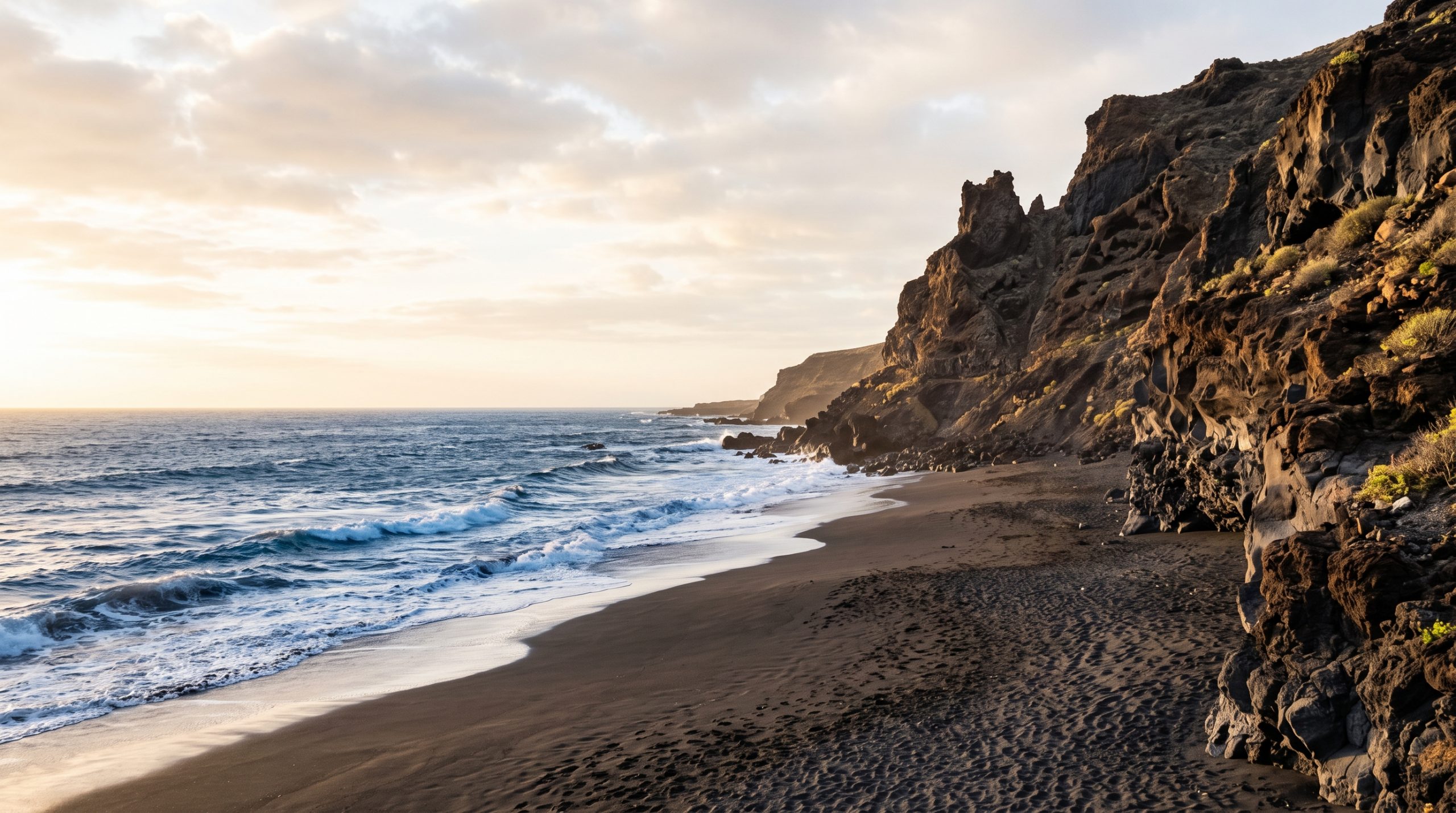
Benijo sits inside Anaga Rural Park on the north coast, at the end of the road past Almáciga. It is about 300 meters long and 30 meters wide, dark volcanic sand and coarse gravel rather than the imported pale stuff, with the Roques de Anaga standing out of the water off the end of it. There are no facilities at the bottom. There is a long flight of steps down, and about fifteen minutes of it.
In wedding clothes, that descent is the whole plan. The steps are uneven and dusty, a long hem collects grit within the first minute, and the sensible order is walking shoes down, shoes off and swapped at the bottom, hair pinned again once the wind has had a look at it. Coming back up takes noticeably longer than going down, which is the part couples forget when they schedule a ceremony for the last light of the day. We build the climb into the timeline rather than hoping it fits.
The light on this coast is seasonal in a way that catches people out. Benijo faces roughly north-northwest, so in June the sun goes down far to the northwest, out past the roques, into open ocean. In December it drops well to the southwest, behind the cliffs to your right, and the useful light on the sand ends a good while before the sunset time you looked up. Sunrise here is the opposite kind of hour: the beach is in the shadow of its own ridge, the sea goes silver, the sand goes almost blue, and there is nobody on the steps.
The Atlantic arrives on this beach with weight behind it, so we work the dry sand and the rock shelves above the water line and set the ceremony hour against the tide table rather than the sunset. At high water the usable sand narrows to a band below the boulders, which changes where a small group of guests can stand and where two of us can work. Black sand also behaves differently in a frame. It absorbs light instead of bouncing it, so faces need the sun low and in front of them, and the finished films from this coast look nothing like the ones from the south of the island. Our published galleries and films are the fastest way to see that difference rather than take our word for it.
One extra step applies here that does not apply at Las Teresitas. Because the beach lies inside a protected natural area, work on the sand also needs a favorable report from the environment department of the Cabildo de Tenerife, alongside the coastal authorization. Two files, not one.
Four desks, and what each one actually decides
There is no single national price for a beach ceremony in Spain, and any page quoting you one number is describing one town on one day. The amount comes from more than one counter. The regional coastal fee is paid on Modelo 700 under concept code 163, the schedule covering reports and discretionary acts, choosing the option for authorizations under article 49 of the General Coasts Regulation approved by Royal Decree 876/2014. Alongside the fee, the coastal service sets a deposit, which is returned to a Spanish bank account after the activity. Municipal charges, where they apply, come from each town’s own fiscal ordinance, so Santa Cruz de Tenerife and Granadilla de Abona are separate answers rather than one shared answer.
| Desk | What it decides | What it wants from you |
|---|---|---|
| Dirección General de Costas y Gestión del Espacio Marítimo, Gobierno de Canarias | Professional photography and filming on the coast, and any use or occupation of the maritime public domain | Application through the regional electronic office in Spanish, passport or NIE, technical report, site plan at 1:500 with the coastal boundary drawn, fee on Modelo 700 code 163 |
| The ayuntamiento, whichever one owns the town behind the beach | Local access, vehicles, the beach services around you, and any municipal charge | Notification of activity in the maritime public domain, plus whatever its fiscal ordinance sets |
| Cabildo de Tenerife, environment department | A favorable report where the beach sits inside a protected area such as Anaga Rural Park | A separate request running alongside the coastal file |
| Registro Civil | Legally binding marriage paperwork, which is a different track entirely | Nothing to do with the sand, and it never touches the coastal permit |
The coastal service also grants annual permits to companies filming on the island continuously, which is a useful thing to know and not the route a single wedding date takes. For one day on one beach, the per-activity authorization is the one that applies.
In practice the money is the small part of this. What costs is lead time, because a technical report and a 1:500 plan are not same-week documents and none of it is submitted in English. Permit research, the logistics around it and the timeline built on top of it sit inside every experience we run, and so does team travel to Tenerife, flights and accommodation for the assigned team included. The permit fees themselves stay with you, along with your celebrant and where you sleep. One full day with a dedicated photographer or filmmaker starts at $4,900, and the rest of the structure, including the Expedition with a photographer and filmmaker working together, is set out on our pricing page. If you are earlier than the permit stage and still deciding what shape the day takes, our guide to planning an elopement covers the order these decisions want to happen in.
El Médano, Costa Adeje, and letting the wind pick the beach
El Médano, in Granadilla de Abona, is the windsurfing and kitesurfing capital of the island, and it earned that title honestly. The wind is the point of the place. It is also the thing that decides whether vows are audible, and whether the ceremony belongs out in the open or in the lee of the hill at the end of the bay. None of that is a reason to avoid El Médano. It is a reason to place the ceremony after we have looked at the wind direction rather than the postcard.
The resort beaches of Costa Adeje, El Duque and Fañabé among them, solve a different problem. They face southwest, so the sun sets over open ocean toward La Gomera and the evening light is genuinely good. They are also raked, lined with sunbeds and busy until the beds are stacked, so the hour worth having is the one right after that. If you want wild empty sand, no hour of the day at El Duque will give it to you, and we would rather say so now. If you want to walk out of your room in a dress and be barefoot four minutes later with your family already there, nothing on the island does it better. Tell us which of those two you are, and if a different coast fits it, our destination guides are where that conversation usually starts.
Standing room for two cameras on a narrow beach
Space is the reason we send a photographer and a filmmaker who already work together. On 80 meters of Las Teresitas there is room for both to spread out and stay invisible to each other. On the band of dry sand at Benijo at high water there is not, so one stays low and close on the sand while the other takes the rock shelf for the wide frame, and they settle that on the walk down rather than in front of you. Wind decides the sound. On the north coast it comes over the ridge and straight into a microphone, which is why audio for vows on the Expedition goes on the couple rather than on a stand three meters away. Two people from the same eight-person team, one plan, no negotiating on the sand.
Common questions
Do we need a permit if it is just the two of us and a celebrant, with nothing on the sand?
The ceremony itself is ordinary public use of a public beach. Nothing is built, nothing is occupied, nobody is shut out. What triggers an authorization is professional camera work on the coast and anything you set down on the sand. That file is ours to prepare, and we start it as soon as the beach and the date are fixed.
Can we have chairs, an arch and a speaker at Las Teresitas?
Anything you put down is an occupation of the maritime public domain, and removable installations have their own route through the coastal authority, with the exact footprint drawn on a plan. It is possible and it is a bigger file. Ceremonies that travel in two hands clear the paperwork faster, and on this particular beach they photograph better against 1.3 kilometers of open sand.
Does the paperwork have to be in Spanish?
Yes. The coastal authorization is submitted through the electronic office of the Canary Islands Government and the application is made in Spanish, technical report and site plan included. The research, the wording and the guidance through it sit with us as part of the planning work, so nothing arrives in your inbox in a language you cannot read.
Will the beach be cleared for us, or are we sharing it with sunbathers?
Sharing it. Spanish coast law keeps beaches in free public use, and no permit buys exclusivity on the sand. That is exactly why the hour matters more than the permission does. At Las Teresitas the first hour after sunrise hands you an almost empty beach, and at Benijo the same hour gives you soft shade and nobody on the steps.
Is there anywhere to change out of walking shoes at Benijo?
There are no facilities at the bottom of the steps, so it happens in the open air or at the car at the top. We plan for it: shoes carried down, a couple of minutes at the bottom for hair and hems before anything begins, and enough time in the timeline for a fifteen-minute staircase that takes longer on the way back up.
How far ahead should we start a Tenerife beach file for a 2027 date?
As soon as the beach and the date are chosen. The coastal authorization, the municipal notification and the protected-area report where one applies each work to their own calendar, and none of them hurries for a wedding. Our Canary Islands calendar is currently open across 2027, 2028 and 2029, and the permit work starts the moment planning opens.
What we would put in motion first
Two things decide a Tenerife beach day, and neither of them is the beach. The first is the hour, because the east coast at Las Teresitas and the north coast at Benijo hand you completely different light at completely different times of day. The second is the file, because the coastal authorization quietly sets the earliest date the whole thing can happen. Describe the morning you actually want and we will tell you which of those two coasts delivers it, and which hour it works in.
Everything from here runs in writing, on your own time. Send the form and a reply with our initial brochure comes back inside 24 hours, then a tailored proposal, then a signed contract and a 30% retainer, and planning begins. Highlights reach you in 5 days and the full gallery or film in 3 weeks. Tell Us Your Story.