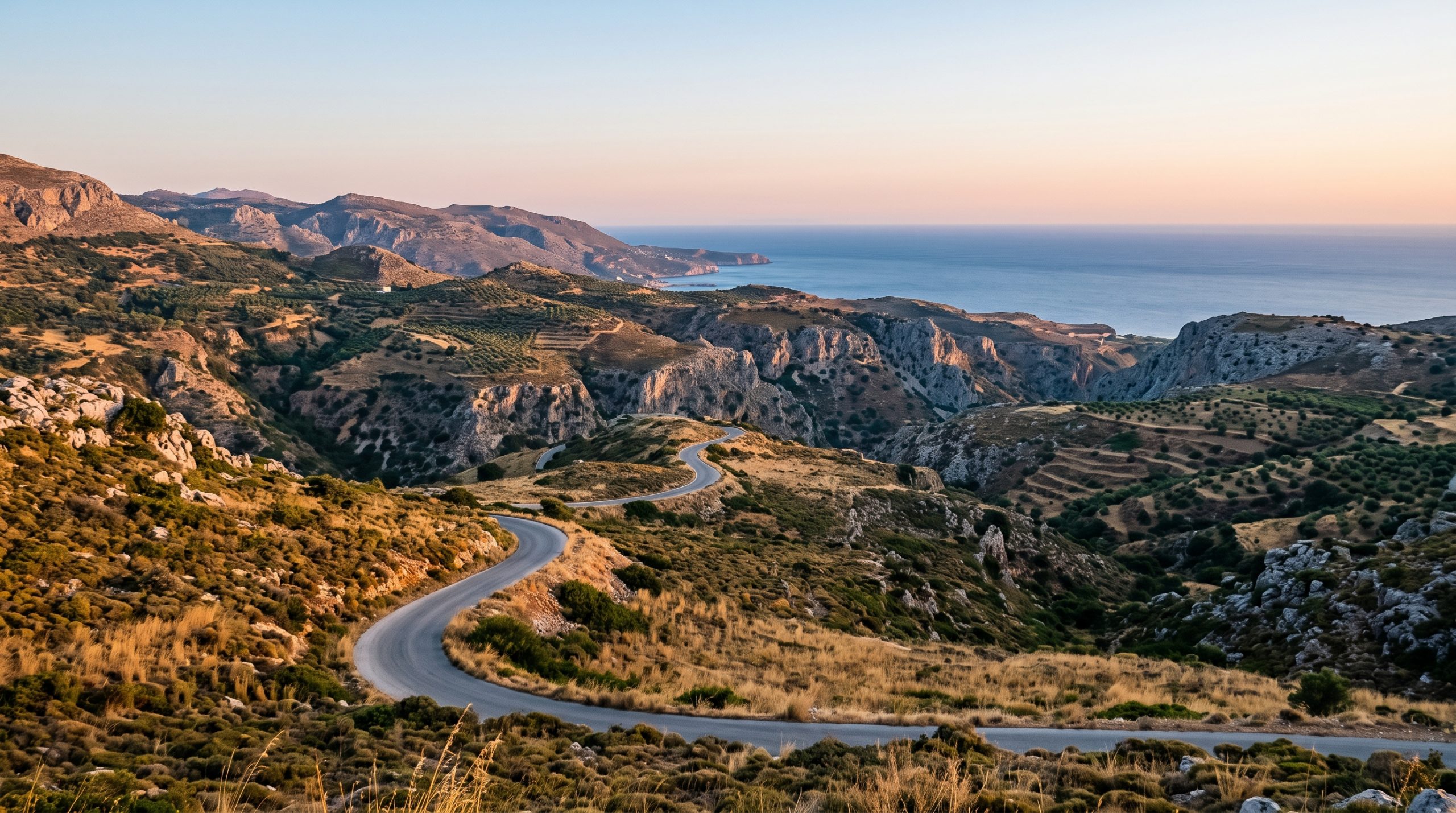
The road west out of Chania is empty at twenty to seven in the morning. You climb through olive terraces, drop into the Topolia gorge, pass through the tunnel cut into the rock, then wind down through Elos and Vathi with the windows open and nothing ahead of you. A route planner calls that run an hour and fifteen minutes to Elafonissi. Leave at nine instead and you will spend the last stretch of it behind a coach on a road with nowhere to pass.
That gap between the map and the morning is most of what Crete elopement planning actually is. The island is long, the good hours sit at either end of the day, and the paperwork runs on a clock that has nothing to do with your flights.
What follows is the order we work in with couples: airport, legal timeline, real travel time, light, wind, clothes.
Two airports, one long island, and an eight-day clock
Crete has two international airports, Heraklion and Chania, and neither takes a nonstop flight from the United States, so you connect through Athens or a European hub. Driving the 142 km between them takes two and a half hours. A Greek civil marriage license is generally issued eight days after you submit your paperwork to the municipality.
Which airport you fly into decides half your week
Crete runs a little over 260 km end to end, and couples routinely book the cheaper arrival and then find they have added five hours of driving to a four-day trip. Pick the airport nearest the landscape you actually came for, and let the fare follow that decision rather than lead it.
Both airports take nonstop flights from Athens, the reliable link if your transatlantic routing puts you there. Chania has Aegean, Ryanair and Sky Express. Heraklion has Aegean and Sky Express. Through the warm half of the year both also fill with direct seasonal services from European cities, which is why a London or Frankfurt connection often beats an Athens one in high summer.
| Airport | Nonstop from the US | Athens link | What it puts you next to |
|---|---|---|---|
| Chania (CHQ) | No, connect via Athens or Europe | Aegean, Ryanair, Sky Express | Chania old town and its Venetian harbour, Kissamos, Elafonissi, the Sfakia coast, the White Mountains |
| Heraklion (HER) | No, connect via Athens or Europe | Aegean, Sky Express | Knossos, the central and eastern half of the island, the Lasithi road |
Rethymno sits roughly midway along the 142 km E75 run between the two, which makes it the one base that works from either arrival. If your week leans west, fly into Chania and stay west. If you want the eastern beaches, fly into Heraklion and stay east. Splitting the difference is the choice that costs the most daylight.
The eight days that set your ceremony date
A civil marriage in Crete is handled by the municipality where the ceremony will take place. Chania publishes its document list for foreign nationals residing abroad in English, and Heraklion runs a dedicated civil marriage office inside the town hall. Those two offices are the authorities on your file, and their word outranks anything you read on a planning blog, ours included.
The shape of it is consistent. Each of you submits a set of documents, including a certificate showing you are free to marry. American paperwork carries an apostille from the Secretary of State in the state that issued it, not from the embassy in Athens, and anything in a foreign language is officially translated into Greek. Authorities generally issue the marriage license eight days after the application goes in, and the certificate is valid for six months. The ceremony needs two witnesses with passports, one of whom acts as interpreter.
The eight days count from the day your file lands at the town hall, not the day you land at the airport. So the honest question is whether your trip is long enough to hold that window, or whether you would rather sign at home and keep the Cretan day entirely for the ceremony. Plenty of couples choose the second and it changes nothing about how the day feels. Greece has recognized same-sex marriage since February 2024, and the civil route is the same one.
Permit research and the logistics around it sit inside every experience we run, and we sequence it alongside the rest of the plan. The government and venue fees themselves are paid by you. If the legal side is where you are stuck, our guide to how eloping actually works covers the fundamentals that apply wherever you go.
Where the route planner lies, and the buffers we build in
Crete has one fast road, the E75 along the north coast, and everything else is a mountain road with a personality. The E75 itself is under upgrade in sections, with works near both the Chania and Heraklion ends, which is why the same journey takes two hours at half past six and two and a half by mid-morning.
| Route | The easy assumption | What we plan on | Why |
|---|---|---|---|
| Chania to Heraklion, 142 km on the E75 | Two hours | Two hours before 7am, two and a half from mid-morning | Roadworks at both ends of the run, plus town traffic at either terminus |
| Chania to Elafonissi, 75 km | An hour and fifteen | An hour and a half to two hours | Topolia tunnel, then continuous bends through Elos and Vathi, shared with tour coaches from about 8am |
| Kissamos out to Balos and Gramvousa | A short hop along the coast | One boat round trip a day in season, out late morning, back late afternoon | The timetable governs, not the distance |
The route that is technically possible and practically miserable is Chania old town at sunrise paired with anything east of Rethymno at sunset. Five hours in a car on your wedding day is five hours spent looking at the E75 instead of at each other. We will build it if you truly want it, and we will also say, before you book flights, that staying west and using the whole day on foot makes the better film.
So we work backwards from the fixed points. If a boat timetable is involved, the ceremony hour never sits next to a departure. If the drive is long, we start earlier than feels necessary and hold a second location fifteen minutes from the first, already scouted, in case the wind has turned. Elafonissi at seven in the morning is a different place from Elafonissi at eleven, and the difference is entirely down to when you left Chania.
Being eight people rather than two changes the mechanics of a long island. On a day with real distance in it, we run two vehicles, so one of us can be ahead at the next cove checking what the light is doing while the other stays with you and nothing about your morning is rushed. A second full set of bodies and lenses matters more here than it does somewhere with a camera shop around the corner. Our two full-day experiences start at $4,900 for one photographer or one filmmaker and $7,900 for a photographer and filmmaker working the same day together, with team travel included worldwide.
If you already know roughly which week you want, Send Us a Message with the dates and the part of the island you keep coming back to, and we will tell you honestly what fits inside it.
Late light, and a wind with opinions
Cretan summer light runs long, and American couples consistently underestimate how late a June evening goes. In Chania in late June the sun clears the horizon around 6:10am and does not set until roughly 8:40pm. That is a ceremony at half past seven with an hour of usable sun still in the sky, and a midday that belongs to shade and a swim rather than to a camera.
| Period | Sunrise, Chania | Sunset, Chania | What the day feels like |
|---|---|---|---|
| Mid-May | 6:20am | 8:20pm | Green hills, cool mornings, water still bracing, very few coaches |
| Late June | 6:10am | 8:40pm | The longest evenings of the year and the hottest middles |
| Mid-September | 7:05am | 7:30pm | Sea at its warmest, the whole day about two hours tighter |
| Mid-October | 7:25am | 6:55pm | Sunrise starts without a brutal alarm, first rain possible |
Heraklion sits further east and runs a few minutes ahead of these times. The honest reading is that September gives you both ends of the day at civilized hours, while June gives you a sunset dinner that never seems to end.
Then there is the meltemi, the dry northerly that blows across the Aegean from late May into October and peaks through July and August. It is not a storm and it is not a problem. It is a design input. On the exposed southwestern corner at Elafonissi it lifts sand across the open beach and turns a long veil into a two-person operation, which is exactly the kind of thing we would rather know at planning stage than at four in the afternoon. The lee side of the lagoon, a sheltered cove, or a switch to the south coast all solve it, and we keep those alternatives named in your timeline rather than improvised on the day.
Two more seasonal notes worth having early. Elafonissi sits inside a Natura 2000 protected area, so the dunes are roped off, nothing leaves the beach, and parking is only in the marked lot. And the Samaria National Park opens for its season in spring once the path has been restored after the winter rain, with the exact date set locally each year, which is why we do not build an April day around the gorge. You can see what this coastline does with late light in our published elopement stories and films, which is the most useful thing to look at before you choose a month.
What survives a Cretan afternoon
Fabric first. Linen, silk crepe and light chiffon move well in a northerly and read beautifully on film. Heavy satin holds its shape in wind but also holds the heat, and by seven in the evening in July the limestone underfoot is still radiating everything it absorbed at noon. A cathedral veil is genuinely lovely on this coast and genuinely needs a plan, which is one more reason we like having a second pair of hands on the ground.
Footwear is the thing couples get wrong. Almost every good Cretan cove is reached down loose limestone, hot stone or a sand track, and the last hundred meters are rarely the photogenic part. Bring grippy sandals for the approach and keep the ceremony shoes in the bag until you arrive. Add a change of shoes for the car, because salt and fine sand get into everything.
For the ceremony hour itself, plan for what comes after it: a linen jacket for the ridge at sunset, water for everyone including us. Our destination elopement guides go deeper on clothing by region.
Aerials over Crete, and what we confirm first
Drone footage is included wherever it is legal, safe and appropriate, and Crete rewards it. The rules are the European framework applied through the Greek civil aviation authority. Any drone carrying a camera, or weighing over 250 g, needs a registered operator behind it, remote pilot competency on top of that, and insurance for professional work. Greek airspace is mapped into zones, and Crete carries restrictions around both airports, around military areas, and around archaeological sites, where filming needs separate permission from the Ministry of Culture.
What this means in practice is a lead time. Before we design a sequence around aerials, we confirm the zone for your specific location and the permission for your specific date, and we do that early enough that the answer can shape the film rather than interrupt it. Where the answer is no, we plan the film from the ground, and on a coastline with cliffs this shape that is rarely a loss.
Common questions
Do we have to be in Crete for eight days before we can get married?
The eight days run from the day your application and documents reach the municipality, not the day you land. If you want the Greek certificate, plan on your file being submitted at least a working week before the ceremony date. Many couples instead complete the legal signing at home and keep the Cretan day for the ceremony itself.
Who issues the apostilles for our American documents?
The Secretary of State in the US state that issued each document, not the embassy in Athens. After the apostille, documents are officially translated into Greek and submitted to the municipality where the ceremony happens. Chania publishes its list for foreign nationals living abroad in English, and Heraklion has a civil marriage office inside the town hall.
Chania or Heraklion airport for a western Crete elopement?
Chania, without hesitation. It puts you inside the old town, under an hour from Kissamos port and within a manageable morning of Elafonissi. Landing at Heraklion for a western day adds two and a half hours of E75 driving at each end of the trip, and that comes out of your daylight rather than your sleep.
How many days in Crete should we allow for an elopement?
Four nights is the workable minimum for a single-day experience: a recovery day after the flights, a scouting and dress-pressing day, the elopement day itself, and a soft day after it. If you want the Greek civil certificate, add the eight-day license window. If you want two coasts, add two more nights rather than two more drives.
Can you fly a drone over Balos or near Knossos?
Aerials depend on the zone and the site. Archaeological sites need separate permission from the Ministry of Culture, and there are restrictions around Chania and Heraklion airports and around military areas. We confirm the zone and the permission for your date before we build any part of the film around aerial coverage.
How windy is western Crete in August?
The meltemi blows from the north from late May into October and is at its strongest in July and August. At Elafonissi, which faces southwest and is fully exposed, it can carry sand across the open beach all afternoon. The lee of the lagoon, a sheltered cove or a south coast alternative all work, and we name the fallback in your timeline in advance.
How far ahead should we book a 2027 Crete date?
We are currently booking 2027, 2028 and 2029, and the western Crete weeks in late May, September and early October are the ones that go first. Start the conversation as far ahead as you can, because ceremony slots at the municipality and the document work behind them both want months rather than weeks. Highlights reach you five days after the day, and the full gallery or film three weeks after.
Choosing your month, and telling us the shape you want
September gives you warm water and manageable hours. Late June gives you a sunset that lasts until nearly nine, in exchange for hiding from the middle of the day. Mid-May gives you green hills and mountain air with the coaches still at home.
Tell us which of those sounds like you, and which corner of the island you keep returning to on the map. We will build the day around it, or say plainly which month fits it better. From here, the planning stays in writing, so you can read, think and reply on your own schedule, and your dates come back with an initial brochure within 24 hours: Start Your Story.