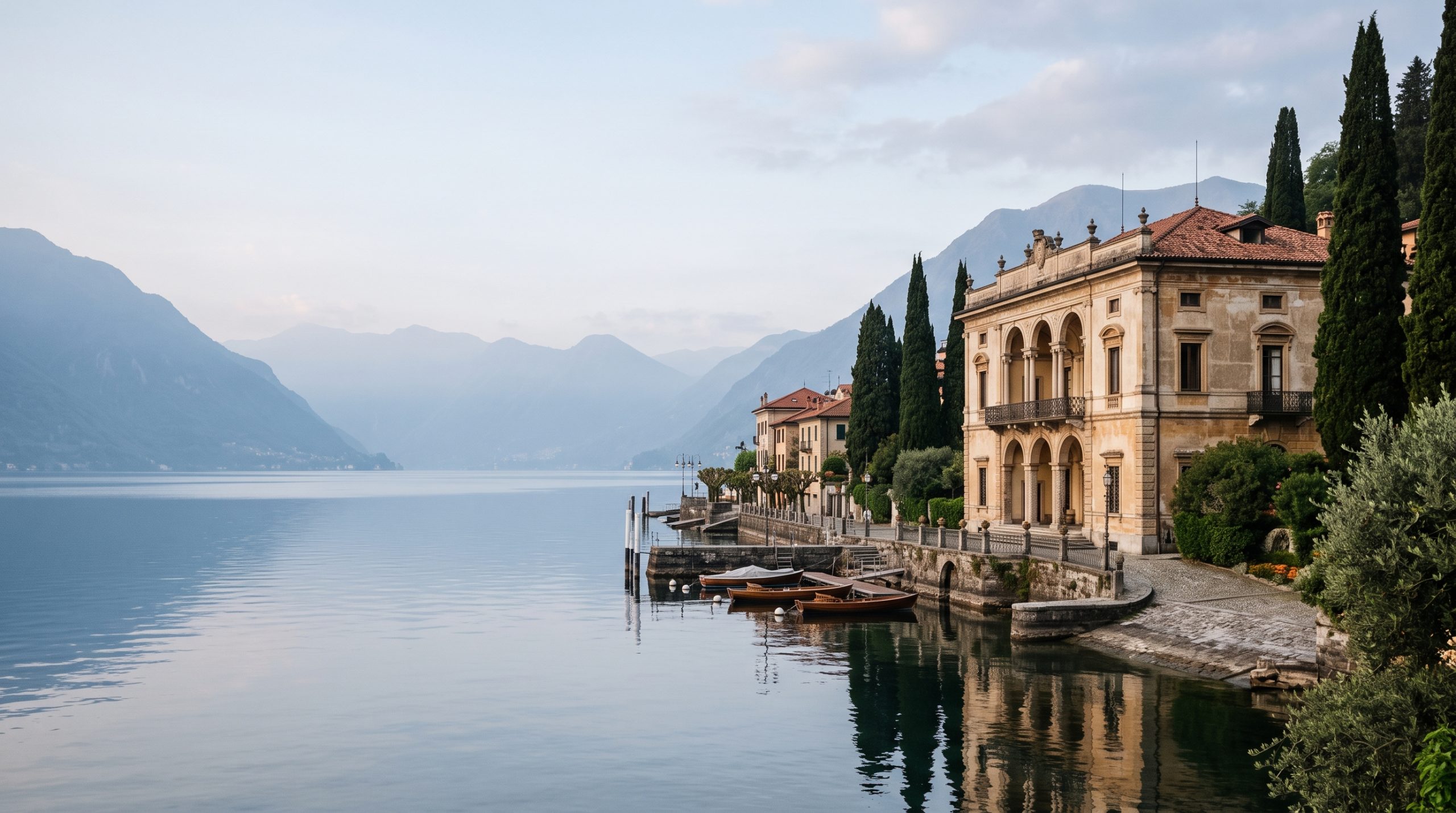
The botanical garden at Villa Monastero in Varenna runs for nearly two kilometers along the shore, and one of the rooms inside the villa that couples can legally marry in seats six people. That is Lake Como’s legal side in a single image. The lake is vast, and the spaces where a registrar can actually marry you are small, specific, and booked by the hour.
Marrying legally in Italy as two US citizens is not hard. It is administrative, and most of the administration happens at home in the States before you fly, which is the part most guides skip past. Two sworn affidavits from two different authorities. Birth records that need a state apostille and an Italian translation. One registry office that wants the whole file in front of it before it commits to an hour.
We plan elopement days around Italian registrars on this lake, and we plan them around a county clerk at home followed by vows on a Varenna terrace. Both versions work, and one of them is far simpler than the other. Here is the chain in the order the offices ask for it, and where the calendar genuinely gets tight.
Two American passports, one Italian registrar
Yes. Two US citizens can marry legally in a Lake Como comune with no residency in Italy. You need two no-impediment affidavits, apostilled and translated birth records, a venue the comune has formally designated, two witnesses over 18, and a sworn interpreter. Publications are waived or cut short for non-residents, so the paperwork rather than the waiting sets your timeline.
Where the Lake Como legal route takes the most preparation
On a scale that runs from straightforward to not realistically available, Italy sits in the middle: entirely doable, with a lot of separate errands. Nothing in the chain is discretionary and nothing is mysterious. What catches couples out is the sequencing, because several documents are only valid once another office has stamped them, and two of those offices are in the United States.
This is practical planning guidance rather than legal advice. Confirm the final requirements for your circumstances with the relevant registry office or consulate before travel is fixed.
The document chain, in the order the offices want it
This is the sequence for two US citizens with no Italian residency, marrying in a comune on the lake. Lombardy sits in the Milan consular district, so the American end of the chain runs through the Consulate General in Milan on Via Principe Amedeo, an easy train ride from Como.
- Atto Notorio, obtained in the United States. A sworn statement that nothing in the law you live under prevents your marriage, signed by witnesses rather than by you. The Italian consulate general with jurisdiction over your US address handles it, and the consulates ask for four witnesses, all over 18, unrelated to either of you and to each other, appearing in person with valid ID. Published guidance varies on the witness count, since the US Embassy in Italy describes two witnesses appearing before an Italian consul abroad or before a court official in Italy. Take the number from the consulate that will issue yours. The Embassy’s own advice is to get this done before leaving the States rather than relying on an Italian court, and we agree.
- Long-form birth certificates, apostilled, then translated. Certified long-form copies from the state where you were born, each carrying an apostille, each translated into Italian. Three separate offices, in that order.
- Evidence that any earlier marriage has ended. A final divorce or annulment decree. The decree needs a professional Italian translation with a certificate of accuracy, and the translation itself needs an apostille from the state where it was certified. The apostille on the decree alone is not enough.
- Dichiarazione Giurata, sworn in Italy. Both of you swear in front of a US consular officer once you are in the country, declaring there is no impediment to the marriage under US law. This is a separate document from the Atto Notorio, not an alternative to it, and the comune expects both.
- Legalization at the Prefettura. The Dichiarazione Giurata is issued by a foreign consulate on Italian soil, so it passes through a Prefettura legalization office before an Italian comune will accept it. Until that stamp exists, the document does nothing for you.
- Declaration of Intention to Marry at the comune. You both appear at the Ufficio di Stato Civile of the town where you are marrying, hand over the file, and make the declaration in front of the registrar. Where neither of you is resident or domiciled in Italy, you sign a verbale in place of banns, declaring that no impediment of kinship, affinity, adoption or affiliation exists between you under articles 85 to 88 of the Civil Code.
- The ceremony. A civil marriage is celebrated by the mayor or a deputy. Two witnesses attend, of any nationality, over 18, carrying valid photo identification. If you do not speak Italian, an interpreter attends both the declaration and the ceremony, and swears before the registrar to carry out the job faithfully.
- Apostille on your Italian marriage certificate. Before you fly home, request a copy of the certificate from the town hall and have it apostilled at the local Prefettura. That apostilled copy is the version American institutions want to see.
Two witnesses over 18 with photo ID is the entire legal requirement, and couples eloping without guests sometimes end up asking a hotel receptionist an hour beforehand. On the Expedition there are two of us on the ground for the whole day, a photographer and a filmmaker, both carrying passports, and where the comune is happy for it we can sign as your witnesses. It is worth raising early so the office can confirm it rather than you improvising in the corridor.
Turn the ceremony hour into an Italy paperwork calendar
Italian registry offices set their own lead times, and it is normal to see the complete file required around ten days before the date, with the pre-marriage record signed at least three days ahead. The bare minimum and the version we would actually work to are not the same thing.
| Stage | The real minimum | What we work to |
|---|---|---|
| Venue slot with the comune | Whatever the booking portal still shows open | Held first, because the room decides the hour |
| Birth records, apostille, translation | Three offices with their own queues, in a fixed order | Finished and in the folder months before departure |
| Atto Notorio | Signed at the Italian consulate before you fly. Obtained in Italy instead, it is generally ready in four to ten days, or the same day at a higher revenue stamp | Signed in the States, so nothing waits on an Italian court calendar |
| Dichiarazione Giurata and Prefettura legalization | Two offices, two Italian working days, once you have landed | Two clear working days with a spare one behind them |
| Declaration of Intention at the comune | Commonly around ten days ahead for the file, three days ahead for the record | Delivered early, with the ceremony hour already matched to the light |
| Apostille on the Italian certificate | Requested after the ceremony, apostilled at the Prefettura | Built into a day you are still in Italy, never your travel day |
Read that table upwards and you have the shape of the trip. Land with the American paperwork complete, spend the first working days on the consulate and the Prefettura, hand the file to the registrar with margin behind it, and keep the ceremony morning for the ceremony. Our planning fundamentals cover how that maps onto travel days, and we build the timeline around real drive and ferry times rather than optimism.
Which rooms and gardens on the lake can legally marry you
In Italy a civil marriage is only valid in a place the comune has formally designated for it. That single rule shapes everything about a Lake Como legal day, because the list of designated spaces is short, and a terrace you love because of the view is not on it unless the comune has put it there.
Varenna is the clearest example on the lake and the easiest to work with. The comune celebrates civil marriages and civil unions in three places: the municipio, Villa Cipressi and Villa Monastero. It runs its own booking portal at varennawedding.com, where you check the date, see which time slots are still free, and confirm online. Non-resident couples, Italian or foreign, pay the comune a fee for the celebration. In the main season it currently runs from roughly 1,200 to 2,000 euros depending on the slot, with daytime cheaper than evening, and it is set by the comune rather than by the villa. Residents of Varenna pay nothing.
Villa Monastero belongs to the Province of Lecco and hosts civil ceremonies under an agreement with the comune, during the villa’s ordinary opening season of March to October. Its designated spaces come with hard capacities, and this is where a guest list stops being a preference and becomes a legal ceiling.
| Designated space at Villa Monastero | Maximum people |
|---|---|
| Sala Fermi | 80 |
| Sala Polvani | 30 |
| Sala Musica | 15 |
| Sala Biliardo | 12 |
| Loggiato | 8 |
| Salottino Orientale | 6 |
The garden in front of the villa is designated too, which is how an outdoor legal ceremony works here at all. Be clear-eyed about what that means in practice: the villa keeps its normal visiting hours through the season, so a garden ceremony in the middle of a July afternoon happens among ticket holders with cameras, and the terraces are busy. The first slot of the day and the last one are the quiet ones, and they are also where the light stops being flat. Varenna’s waterfront follows the same pattern. At eleven in the morning the promenade below Villa Cipressi is shoulder to shoulder with day-trippers off the ferry from Bellagio. At half past six, it is yours.
Como itself keeps a civic option: the Sala Consiliare holds up to 70 people, and the comune celebrates civil unions there and in the Sala Giunta without charging for the celebration. Elsewhere on the lake the rules are local and worth checking one comune at a time. Bellagio, for instance, ties its marriage publications to residency in the comune, which tells you quickly whether an office is set up for visiting couples or not. Our destination guides go further into how the two shorelines differ. If you want to see how these rooms and gardens actually photograph, and what a film cut from a Varenna morning looks like, that is quickest to judge from our published galleries and films.
The small things that catch couples at the counter
None of these are dramatic. Each one is simply a detail that has to be right on the day, and every one of them is fixable weeks in advance.
- The translation needs its own apostille. An apostilled divorce decree with a plain translation attached is an incomplete document. The translation carries a certificate of accuracy and an apostille from the state where it was certified.
- Two affidavits, not one. The Atto Notorio and the Dichiarazione Giurata come from different authorities on different continents and both belong in the file. Couples routinely arrive with one.
- Order matters more than speed. The Dichiarazione Giurata is worth nothing to the comune until the Prefettura has legalized it, and the birth certificate is translated after the apostille, not before.
- Every document has a window. The declarations are issued with a validity date printed on them, so count backwards from your ceremony date rather than from the day you land. Italian paperwork works this way throughout. In Como, where publications do apply, the notice sits on the online register for eight consecutive days, the marriage can be celebrated from the fourth day afterwards, and the permission then lasts 180 days.
- Revenue stamps come from a tobacconist. Italian offices run on the marca da bollo, sold at any tabaccheria and priced at 16 euros for the common one. An Atto Notorio obtained in Italy, for example, takes two of those plus a smaller third. Arrive with the stamps already in your pocket.
- The interpreter is your job, not the office’s. Comuni do not supply one, they need the interpreter’s ID for the file, and the interpreter is sworn in before the registrar. If your two witnesses do not speak Italian either, that requirement follows them.
- Offices work from originals. Bring original documents, not scans, and order a second certified copy of anything you may want to keep. Italian working hours and public holidays are part of your timeline too, especially in August.
The figures in this guide are a planning snapshot, not a permanent tariff. Re-check the current amount and deadline with the issuing office before you lock in flights or appointments for legally marrying on lake como.
If you want the legal chain mapped onto a real date, with the venue slot and the light hour lined up, Send Us a Message and tell us which month you are looking at.
Keep the paperwork at home and the vows in Varenna
Plenty of the couples we work with on this lake are already legally married before they arrive, and there is nothing second-best about it. They sign at home, in ten minutes, with a parent as a witness, and then they come to Italy for the part that actually matters to them. Villa Monastero hosts symbolic ceremonies for couples traveling from the United States and Australia alongside its legal ones, so the setting does not change.
What changes: no Milan consulate, no Prefettura, no comune file, no sworn interpreter, no fee to a registry office. What also changes is your freedom over place and hour. A legal ceremony has to sit in a designated room or garden, inside office hours, on a day the villa is open. A ceremony that carries no legal weight can happen on a boat off Bellagio at seven in the morning, on a stone terrace above Nesso, or in a chestnut wood above Menaggio with two friends and a celebrant you chose yourselves.
What does not change: the vows you read to each other, the two of us working the day, the drone footage where it is legal and appropriate, the professional audio on the Expedition, highlights in 5 days and the full gallery or film in 3 weeks. Nobody looking at your film later can tell which route you took.
The honest version is this. If the words legally married in Italy matter to you, the chain above is worth every errand and we will build the day around it. If what you want is the lake, the light and the vows, marrying at home first buys you hours that no comune can give you. Tell us which of those two you are, and we will shape the day around it.
Common questions
Do we need to live in Italy or spend a minimum number of days there before we can marry on Lake Como?
There is no residency requirement for a non-resident foreign couple. In practice you do need working days in the country before the ceremony: to swear the Dichiarazione Giurata in front of a US consular officer in Milan, to have it legalized at a Prefettura, and to make the Declaration of Intention at the comune. We plan several working days for that, not an afternoon.
Do banns have to be posted if neither of us is Italian?
Banns are posted at the town hall for two consecutive weeks including two Sundays, and only after the Declaration of Intention has been filed. Where neither of you is an Italian citizen or resident, they are waived or shortened to anything from one day to a week depending on the town hall. Instead you sign a verbale before the registrar confirming there is no impediment between you under articles 85 to 88 of the Civil Code.
Can we legally get married outdoors on Lake Como?
Yes, in an outdoor space the comune has designated for it. The garden in front of Villa Monastero in Varenna is one such space. A private terrace or a boat that has not been designated can still hold the ceremony you want, but the legal signature happens somewhere the comune recognizes, and the two can sit on the same day an hour apart.
Will our Italian marriage certificate be recognized in the US?
Request a copy of the certificate from the comune after the ceremony and have it apostilled at the local Prefettura. The apostille is what American institutions look for. Do it while you are still in Italy, because requesting it from overseas afterwards takes considerably longer.
Do we need an interpreter at the ceremony if we only speak English?
Yes. An interpreter attends both the declaration in front of the registrar and the ceremony itself, brings valid ID for the file, and is sworn in to translate faithfully. The comune does not provide one. The same requirement applies if your two witnesses do not speak Italian.
Can our photographer and filmmaker be our two witnesses?
The legal bar is two people over 18 with valid photo identification, of any nationality. On the Expedition there are two of us with you all day, both carrying passports, and where the comune is happy for it we can sign. Tell us early and the office can confirm it in advance.
Can same-sex couples marry legally on Lake Como?
Italy registers same-sex couples as a civil union rather than a marriage, under Law 76/2016, in force since June 2016. The couple make a joint declaration in front of the civil status officer with two witnesses present, and the document chain closely parallels the marriage one. Como celebrates civil unions in its Sala Consiliare, which holds up to 70 people, or the Sala Giunta, and does not charge for the celebration there. A same-sex marriage performed abroad is recorded in Italy as a civil union.
How far ahead should we start the paperwork for a 2027 date?
Work backwards from the venue slot. Hold the date with the comune first, since the portal shows exactly which hours are still free, then deal with the American documents, because vital records offices, state apostilles and translators all have their own queues. The in-country steps come last, in your first days on the lake. Months of margin, not weeks.
What we coordinate and what belongs to the registrar
We hold the date against the comune’s availability and the villa’s opening season, put the ceremony hour where the light is worth filming rather than where the calendar defaulted, and build the rest of the day around real ferry crossings and real drive times on a lake road that is slower than any map suggests. Permit research, weather alternatives and a backup shape for the day are part of every experience we run, and team travel is included wherever in the world you are marrying. What we do not do is file your paperwork or stand in for a lawyer. That belongs to you, the registry office and your consulate, and we will plan around every date they give you.
Coverage levels, what each one includes and the starting figures are all set out on our pricing page. Everything between us happens in writing, so there is nothing to arrange beyond replying when it suits you: send the form, and you will have our reply and the initial brochure within 24 hours, usually with two or three questions about the month you have in mind. Our calendar currently covers 2027–2029.
Send us your date and the shape of the day you want on Lake Como, and we will tell you honestly what the registrar’s hours allow, what the light will do, and which comune fits it best. Check Your Date.