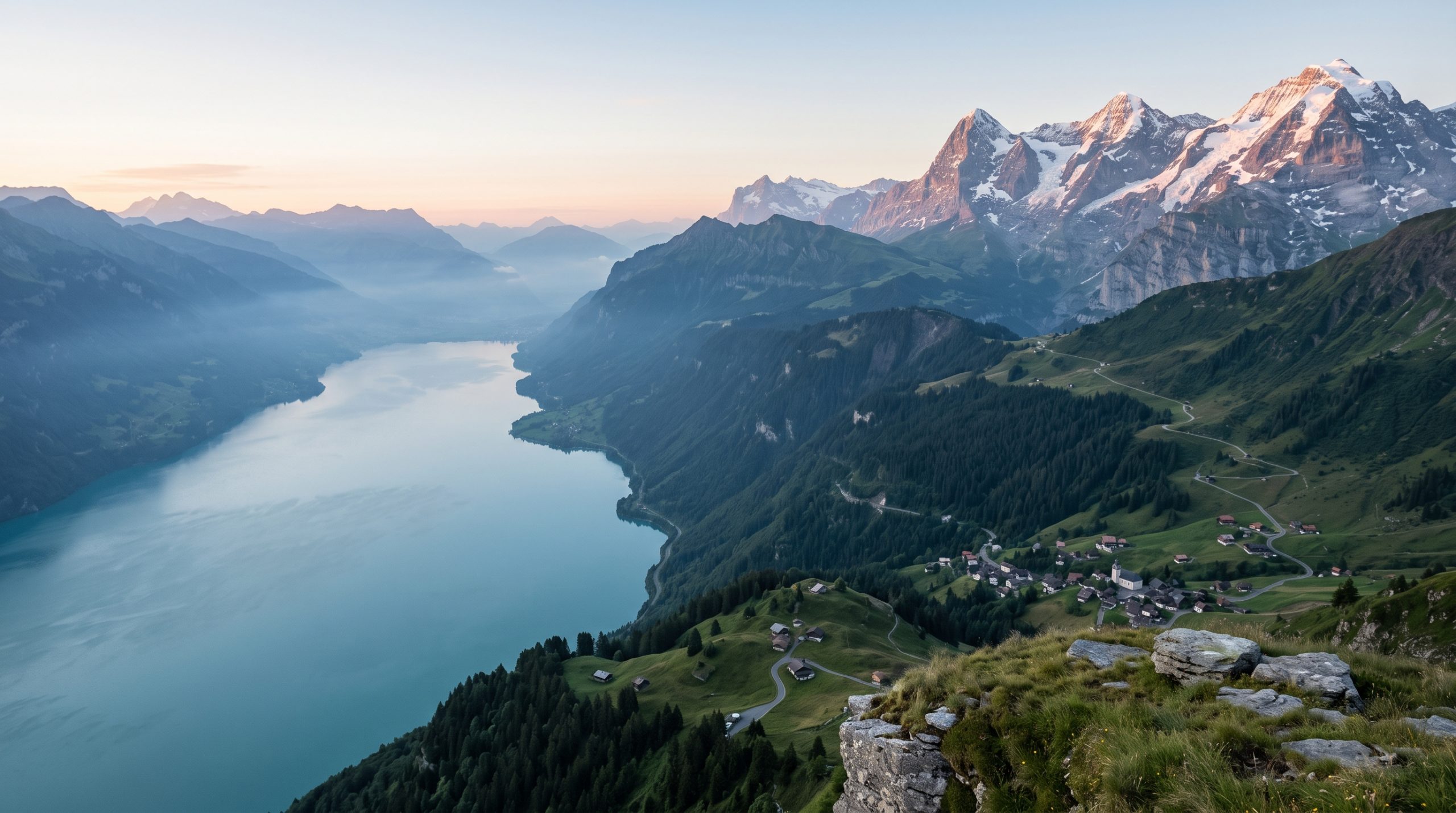
The Schilthorn cableway publishes its first journey of the day at 09:00 and its last at 17:00. In late June, the sun is up over the Lauterbrunnen valley at about 5:35 in the morning and does not set until 21:25. Line those two facts up and you have the constraint that shapes a Swiss elopement budget more than flowers, stationery or a dress ever will: the best light of an Alpine day sits outside the lift timetable at both ends.
Over in Valais it behaves differently. The first Gornergrat train leaves Zermatt at 07:00 in the main season and climbs to just over 3,000 metres in around half an hour, with the regular service running every 24 minutes from 08:00. In late September sunrise lands near 07:10, and by the second week of October closer to 07:37, so that first train genuinely delivers you into the light. In June it is more than an hour late for it, and the choice becomes sleeping high or walking up.
Most Swiss cost guides count florists. The numbers that actually move a budget here are the ones above: how high you want to be, at what hour, and whether the legal marriage happens in a Swiss registry office or at home before you fly. Here is what we charge, what Switzerland charges, and how the two fit together for a 2027 date.
What a Swiss elopement costs, in two parts
Your budget has two halves. Ours covers photography, film and planning from one team, starting at $4,900 for a full day, with our travel to Switzerland included. Switzerland’s half covers mountain railway fares, accommodation, a celebrant if you want one, and a civil ceremony fee of CHF 300 to 400 if you marry here legally.
Sunrise at 5:35, first cable car at nine
Take a Thursday in late September, in Zermatt, because that is roughly the week the timetable and the sun finally agree with each other.
You are out of the door at 06:40, as the sky starts to separate from the ridgeline. Sunrise is not until 07:11 and the village is almost silent, because Zermatt is car free and the only traffic is electric taxis and luggage carts. At 07:00 the first Gornergrat train pulls out. Thirty-odd minutes later you step onto the ridge at over 3,000 metres, and the Matterhorn’s east face is already taking colour while the valley floor below has nothing on it at all.
That colour does not hang around. It arrives on the summit and runs down the face, and the whole thing is over in a handful of minutes. Everything else in the day can move. This cannot.
By 08:15 we are walking down towards Rotenboden, where the Riffelsee holds the peak on its surface, but only while the water is still. Once the mid-morning valley wind arrives, the mirror is gone until evening. Trains come every 24 minutes from 08:00, so moving between stations costs you a short wait rather than a whole hour, and that is what makes a ridge-to-lake morning realistic instead of theoretical.
Vows at 09:45, in the lee of a moraine where the wind drops. If your marriage is being registered in Switzerland, that slot belongs to the registry office in the village instead, and the mountain hour moves either side of it.
Then we stop. Between about 10:30 and 15:00 the top station is a busy viewing terrace with an extremely good view, and the light is flat and white. We are not going to spend your best hours standing in that queue for a picture you can buy on a postcard. You eat, you change, you sit somewhere warm.
Late afternoon belongs lower down. In the first half of October the larch forests above the village turn a deep gold that lasts about two weeks, and low sun through those trees is the frame most couples end up printing. Sunset is at 19:33 in late September, and the thirty minutes after it, while the snowfields go pink and then blue, is the last real working window of the day.
A June day is a different animal. Sunrise just after 5:30, sunset after 21:20, nearly sixteen hours of daylight, and two widely separated windows with a long hollow in the middle. We plan that middle as an actual rest, with a meal and a room, rather than filling it with more walking that photographs like the middle of the day, because it is.
Tell us the week you are looking at and we will tell you what the light is doing that week, what the first lift can and cannot reach, and where the day should start. Check Your Date.
Four minutes of alpenglow, two cameras running
Everything in the section above hangs on a few minutes of colour on a rock face. That is where hiring photography and film as one team stops being a nice idea and starts being the difference between having the moment and nearly having it.
One person alone on that ridge has to choose. Stills of you against the lit face, or the shot of the colour running down it. Switch between the two and you get half of each. On the Expedition, the photographer holds the wide frame with you small under the peak while the filmmaker is already on the long lens watching the light drop, and nobody has to trade one for the other.
Swiss access rewards a two-person team in a way that few landscapes do. Cabins leave the Schilthorn stages every 20 minutes and Gornergrat trains every 24, so one of us can ride a stage ahead and film your cabin arriving out of the cloud while the other travels with you. Mürren sits at 1,638 metres, Birg at 2,677, the Schilthorn summit at 2,970, and the new cableway up from Stechelberg is the steepest in the world at a gradient of 159.4 per cent. Those are three completely different frames in one morning, and splitting them between two people only works when both are on the same plan, briefed by the same planner, working the same timeline.
Sound is the other thing altitude takes from you. Above 2,500 metres the wind is usually the loudest thing on the mountain, so we pick the vow spot partly for its wind shadow, and the Expedition carries professional audio so what you say to each other survives the place you chose to say it. Aerials run under Swiss federal registration and a pilot certificate, with a 120 metre ceiling and reserves where flying is simply off the table, so we confirm the zone and the window in planning and then fly early, while the air is still.
Eight of us work across the team, four photographers and four filmmakers, which means a second camera on the ground and a colleague in reserve. If you want to see how Alpine light actually behaves in finished work rather than in a description of it, our published galleries and films are the honest version.
Included in the day, and what Switzerland bills separately
Every experience we run, in Switzerland or anywhere else, includes the planning that makes the timeline above possible:
- Destination and location design, built around where the light lands and when the lifts run
- A custom timeline using real travel time, not map distances
- Permit research and logistics guidance for each location on that timeline
- Weather alternatives and backup planning, named in advance rather than improvised
- Drone footage where it is legal, safe and appropriate
- Professional audio for vows and meaningful moments on the Expedition, where conditions allow
- Team travel worldwide, including flights, accommodation and ordinary ground travel for the assigned team
Highlights reach you 5 days after the day itself. The full gallery or film follows within 3 weeks.
Coverage comes in three shapes. The Adventure is one full day with a dedicated photographer or a dedicated filmmaker. The Expedition is one full day with a dedicated photographer and filmmaker working together, from $7,900. The Odyssey runs two to seven days, photography and film, across one destination or several, quoted as a custom proposal. Full detail sits on the coverage and pricing page. Guest count does not change our fee. It changes access, permits, transport and timeline, which is a planning question rather than a billing one.
Switzerland then adds its own line items, and they are worth seeing plainly. One note on currency before the table: the franc has been running a little stronger than the dollar, so read a franc figure as slightly more in dollars, not less.
| Cost line | Who covers it | What it looks like in Switzerland |
|---|---|---|
| Our flights, hotels and ground travel | Us | Included worldwide, with no Alpine surcharge and no long-haul distinction |
| Civil ceremony at the registry office | You | CHF 300 to 400 including documents, with an extra charge for a Saturday or an unusual hour |
| Mountain railways and cableways | You | A return to a 3,000 metre station runs into three figures per person, and a Half Fare Card halves most of them |
| Accommodation | You | A night at altitude costs more than a night in the valley and buys you the sunrise |
| Permit fees | You | The research and the applications are ours, the fee itself is charged to you |
| Celebrant, flowers, dinner | You | Booked directly, with our guidance on who works well in your valley |
| Helicopter, private boat, mountain guide | You | Only where you want them, and most Swiss days need none of the three |
Two practical Swiss details that surprise American couples. Zermatt is car free, so if you drive you leave the car at the Matterhorn Terminal in Täsch, which holds 2,100 covered spaces, and the shuttle train covers the last stretch in 12 minutes. And mountain railways take maintenance breaks in the quiet weeks of spring and late autumn, which is exactly when the passes and the light are at their most interesting, so we check the operating calendar for your specific week before anyone books a hotel.
When the Matterhorn spends the morning in cloud
This is the fear every couple writes to us with, and it deserves a plan rather than a reassurance. Alpine cloud is usually a story about the day warming up, which is precisely why we start before the lifts do. Clear air at first light, building cumulus by early afternoon, is the normal shape of a summer day here.
So we build two working windows into every Swiss timeline and we name the alternative for each of them before you travel. A low ceiling ruins a summit and flatters a valley. The Lauterbrunnen floor under cloud, with the Staubbach falling roughly 300 metres off the wall above the village and the tops disappearing into grey, is a stronger frame than the same place under hard midday sun. On an Odyssey across several days we go further and simply choose the best morning of your window instead of accepting the one that lands on the date.
How a Switzerland 2027 date becomes a held date
We publish this because most people in our line of work do not, and a couple deciding between teams deserves to know exactly what happens next.
- You send the inquiry form with your rough dates and the shape of the day you want.
- We reply within 24 hours with our initial brochure.
- We build a tailored proposal around your dates, your region and the coverage that fits.
- You sign the contract and pay a 30 per cent retainer. The rest of the schedule is set out in the proposal.
- Planning begins, and that is where location design, the timeline, permit research and the weather alternatives get built.
- We shoot the day, highlights land in 5 days, and the full gallery or film follows in 3 weeks.
Our current Switzerland availability runs across 2027–2029. If you are reading this with a 2028 week in mind, that is comfortable planning time rather than a scramble, and it lets us choose the week rather than work around it. Our guide to planning an elopement covers the fundamentals if you are earlier in the process than that.
Who the Alps reward, and what to tell us if that is not you
Switzerland is generous to couples who will be awake at 06:00, who are comfortable with forty minutes of uphill on stony ground where the air is thinner than they expect, and who can hear at breakfast that the plan has changed without it spoiling the morning. That is the couple who ends up on the ridge alone at 07:35 while the first day trippers are still buying tickets.
If a sunrise just after 5:30 in June is not your idea of a good morning, say so, because late September hands you the same light three hours later at around 07:10, plus gold larches and thinner crowds. If long walks are not part of the picture, the Alps still work beautifully. Mürren sits at 1,638 metres on a terrace reached entirely by cableway and mountain railway, and the Gornergrat ridge has a station on it. High ground in Switzerland does not require an approach march unless you want one.
What we ask is that you tell us the truth about the day you actually want. We will either build that, or tell you honestly which month or which valley fits it better and build it there. Our destination guides are a good place to start narrowing regions before you write.
Common questions
Can we legally get married in Switzerland as Americans?
A civil marriage conducted by a Swiss civil registrar is the only legally valid form of marriage in Switzerland, and the application goes to the registry office of the commune where you will marry. Two adult witnesses attend, and the fee sits between CHF 300 and 400 including documents. Plenty of our couples handle the legal paperwork at home and keep the Swiss day entirely for vows, which removes the paperwork from the mountain hour without changing a thing about how the day looks.
Do we need a permit to elope in the Swiss mountains?
It depends on the exact spot, the commune and the canton, and on whether a cableway or landowner has its own rules for commercial filming. That research is part of what we do before your timeline exists. Where a permit carries a fee, the fee is yours to pay and we will tell you the figure while there is still time to choose a different location.
How much do the mountain railways add if we want to be at 3,000 metres?
A full-fare return to a high station like the Gornergrat or the Schilthorn runs into three figures in francs per person, and a Half Fare Card cuts most Swiss mountain fares in half. If your week involves several mountain days, a pass usually beats individual tickets, and we will say which one your timeline points to.
Is June or late September better for an Alpine elopement?
June gives you nearly sixteen hours of daylight, snow still high on the peaks, and a sunrise just after 5:30 that arrives long before any lift opens. Late September and early October give you a 07:10 sunrise the first train can actually reach, gold larch forests for about two weeks, and quieter trails. September is the easier day to live through, June is the bigger landscape.
Can we get to a summit for sunrise, or is that impossible?
It is possible three ways. A railway that starts early enough, like the 07:00 from Zermatt in the main season, works from late September onward. A night at altitude works any month. A walk in the dark works if you want it. What does not work is assuming a cableway will be running, since the Schilthorn, for one, starts at 09:00.
Does the price change if we bring our parents?
No. Our fee is the same whether it is the two of you or a dozen people. Guest numbers change access, permits, transport and the timeline, so they change the planning rather than the invoice, and we would rather know early so the logistics are built for the real group.
How quickly do we see the photographs and the film?
Highlights arrive 5 days after the day. The full gallery or the finished film arrives within 3 weeks. There is no separate rush option because that is simply how we work.
Holding a date in 2027
The whole thing runs in writing, in your own time, across whatever time zones separate us. Send the week you are considering, the region you keep coming back to, and how early you are genuinely willing to be awake. You will have a reply and our brochure within 24 hours, and a tailored proposal after that. Tell Us Your Story.