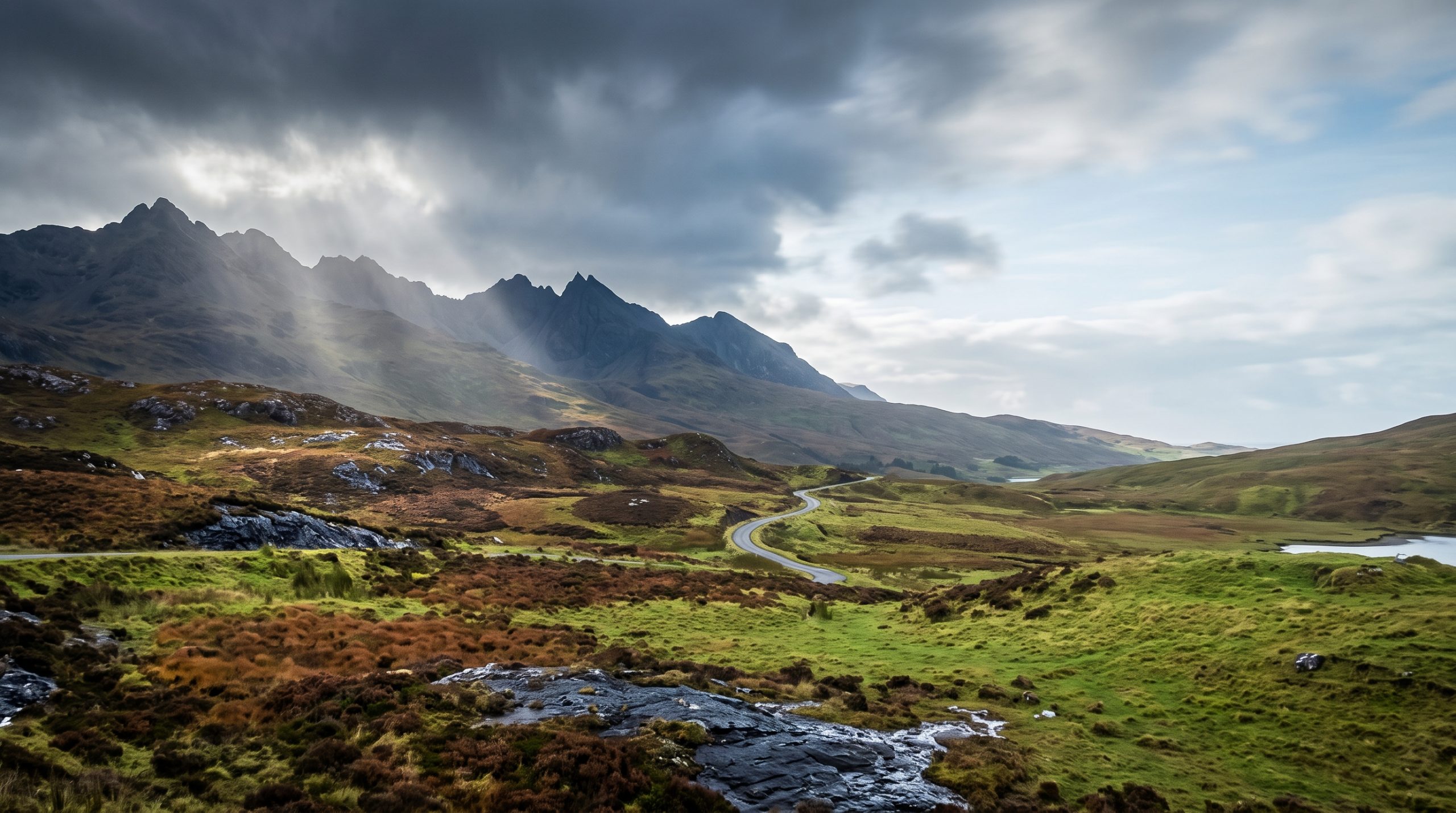
On Skye the calendar does most of the planning for you. On 15 June the sun is up at 4:26am and still going at 10:24pm, close to eighteen hours of light. On 15 December it rises at 9am and is gone by 3:40pm. Same island, same single-track roads, two completely different days.
That gap between midsummer and midwinter runs to eleven hours and twenty-four minutes, which is wider than most couples expect. It decides what hour the ceremony sits at. It decides how many locations honestly fit between first light and dinner, whether the Quiraing pass is a sensible drive or a bonus you take if it is clear, and it decides whether the Old Man of Storr comes with a full car park or with the ridge to yourselves.
So here are the numbers we actually plan from: Met Office long-run temperatures, rainfall totals, real sunrise and sunset times. Plus our verdict on all twelve months, including the two we would gently move a date away from and precisely what we would move it toward.
The last ten days of May
Late May is our first pick for eloping on Skye. May is the island’s driest month, near 115 mm of rain against January’s 223 mm, and its brightest. Daylight already runs past sixteen and a half hours, the midge season has barely begun, and the July crowds are still six weeks off.
Here is what that buys you in practice. On 15 May the sun clears the horizon at 5:05am and sets at 9:39pm: sixteen hours and thirty-four minutes of usable light. You can be on the Trotternish ridge for sunrise, off the hill and eating breakfast by 9am, out at Neist Point or Coral Beach through the afternoon, and still hold a ceremony at 7pm with two hours of warm light behind it. In December that entire sequence has to collapse into one location.
May also sits ahead of the midges. The season gets going in late May and peaks through July and August, and midges cannot fly in a breeze much above 6 mph, which is why our spring plans lean on exposed ground: ridges, headlands, and beaches with the Atlantic doing the work for us.
The honest caveat is that May is not warm. The Met Office long-run average daily maximum at Prabost, in the middle of the island, is 14.1°C in May, around 57°F. If you want bare shoulders at 8pm, August is your month and we will say so. If you want empty hills and clean light, book the last week of May and stop looking.
All twelve months, from conditions to verdict
Temperatures below are Met Office long-run daily maxima for Prabost on Skye. Light is sunrise to sunset on the fifteenth of each month. The verdicts are ours, and we stand behind them.
| Month | Typical daily high | Light on the 15th | Crowds | Our verdict |
|---|---|---|---|---|
| January | 6.6°C | 08:55 to 16:14 | Almost nobody | Low ground, enormous skies |
| February | 7.1°C | 07:55 to 17:24 | Very quiet | Best of the cold months |
| March | 8.5°C | 06:42 to 18:27 | Waking up | Underrated, and we would book it |
| April | 11.2°C | 06:17 to 20:34 | Building | Long days, no midges |
| May | 14.1°C | 05:05 to 21:39 | Moderate | Our first choice |
| June | 15.7°C | 04:26 to 22:24 | Heavy after mid-month | Early June, yes |
| July | 16.9°C | 04:49 to 22:11 | Peak | Sunrise shape or nothing |
| August | 17.1°C | 05:49 to 21:08 | Peak | Warmest, and heather |
| September | 15.1°C | 06:54 to 19:45 | Drops away sharply | Very close second |
| October | 11.9°C | 07:58 to 18:22 | Quiet | Rust colour, empty roads |
| November | 8.9°C | 08:07 to 16:10 | Empty | Short days, huge weather |
| December | 7.0°C | 09:00 to 15:40 | Empty | The whole day is golden hour |
Windows that open and shut inside three weeks
Four things on Skye are worth building a date around, and none of them last long.
- Midsummer light. The earliest sunrise at Portree falls around 18 June at 4:23am, the latest sunset around 24 June at 10:30pm. The extremes hold within a few minutes for roughly a fortnight either side, then start shrinking fast.
- Heather. Bell heather opens from July; ling, the pale purple that colours whole hillsides, peaks in August and holds in patches into September. The peak moves a week or two year to year with how the spring ran, so we treat mid-August as the centre and stay flexible about the edges.
- Bracken and birch. Skye is not a woodland island, so autumn arrives as rust on the hillsides rather than as a canopy. Mid-October is the reliable centre, and it shifts with the first frosts.
- The first hard frost. It ends the midge season outright, usually somewhere in autumn. Nobody can date it in advance, which is why we plan late-season days for wind rather than for insects.
The northern lights belong in a different category. Skye sits at 57.4°N, and from late September the nights are long enough and dark enough that it becomes possible. It is never probable on any given date. We do not build a timeline around it, we never sell it, and if it happens on a clear October night while we are on the island with you, we are already outside with the tripods.
July, August, and what we would swap them for
These are the two months we most often steer a flexible date away from, and it has nothing to do with the weather, which is the best of the year. It is the volume. SkyeConnect recorded 496,753 vehicles crossing the Skye Bridge between April and September, an 11 percent rise on the year before, onto an island whose resident population is a little over 13,000. July and August carry the bulk of it. The Quiraing car park holds roughly 70 cars and fills by late morning; charges there run from 8am to 6pm, currently £3 for up to three hours. The Old Man of Storr, the Fairy Pools and Kilt Rock all charge now too.
Add midges at their annual peak and warm, still, humid afternoons on boggy ground, and the middle of a July day is the least interesting version of Skye we know. Our swap is simple: the last ten days of May, or the second half of September. September’s long-run daily maximum is 15.1°C, within a degree of June’s, daylight on 15 September still runs from 6:54am to 7:45pm, and once the schools go back the roads clear almost overnight.
If your date is already fixed in August, none of that is a problem, and we would rather build the day properly than talk you out of it. August days get shaped around the early hours: ceremony close to the 5:49am sunrise, the famous ground walked and filmed before the 8am parking clock starts, a long slow lunch while the island is at its busiest, then the west coast from 7pm until the 9:08pm sunset. You also get the heather, which nobody in May does. Tell us the date and we will send back the shape we would use for it.
What the light does between June and December
At 57.4°N the sun sets at a shallow angle for most of the year, and the evening golden hour at Portree runs close to two hours. That is the single biggest reason Skye photographs the way it does, and it is why the same headland looks like a different place in March and July.
In June the sun swings far to the north, rising almost behind the Trotternish ridge and setting out over the Minch. An 8pm ceremony still has two full hours of low light after it, so nothing is rushed and there is room to do a moment twice. In December the sun never gets high at all: on the 15th you have six hours and forty minutes of daylight, all of it raking in sideways, and a ceremony at noon is still side-lit like an evening. Fewer hours, but almost no bad ones.
That short winter window is also the clearest argument for the way we work. When the whole day is six hours and forty minutes long, a photographer and a filmmaker covering the same vow at the same second is not a luxury, it is the only way both exist. In June there is time to work slowly and repeat things. In December there is one take, and you want two people on it. Our published galleries and films are grouped by real days on real dates, so you can see what a wet November hour and a still June evening each look like when they are finished; highlights reach you within five days and the full gallery or film within three weeks.
Check Your Date and we will tell you what the light is doing that week, before you book anything else.
The Quiraing pass, the turntable ferry and the 8am parking clock
Season closes things on Skye quietly rather than officially, and access is where a badly planned winter date comes apart.
The road over the Quiraing pass is high, single-track and unlit, and it is among the first roads on Skye to close in snow and ice. So we build January and February days on lower ground, with Sligachan, the Elgol road, Talisker, the Fairy Glen and Portree harbour carrying the day, and we keep the ridge as a bonus hour if the pass is clear that morning. It often is. We just never make the timeline depend on it.
The Glenelg to Kylerhea turntable ferry is a lovely way to arrive, and it is seasonal: Easter to October, six cars at a time, roughly every twenty minutes, five minutes across. First sailings are mid-morning, which means it can never be part of a sunrise plan. It is an afternoon arrival or a next-day departure, and outside the season the Skye Bridge is the only road in.
The parking clock matters more than people think. Charges at the honeypot car parks begin at 8am, so being on the hill before then is both cheaper and emptier, and in May and June the sun has been up for three hours by that point. Our destination guides go deeper on the individual locations; here the point is only that the season sets which of them are reachable at which hour.
Our wet-day plan, written before anyone lands
Portree averages around 2,038 mm of rain a year, and from October through February the monthly totals sit between roughly 195 mm and 222 mm. We do not plan around hoping for a dry day. We plan around knowing which way the rain is coming from.
Every timeline we write for Skye carries a wind-direction pairing. A hard southwesterly, and the eastern Trotternish coast around Staffin and Brothers’ Point is in shelter while the west is unworkable. A northeasterly, and it flips: Talisker and the Neist Point side become the calm option. Each pairing is fifteen to forty minutes’ drive from its partner, which is why the ceremony hour is written as a window rather than a fixed minute, and why we tell you at the contract stage which two hours we are holding.
The other half of the plan is knowing that rain is often the better picture. Cloud sitting on the Cuillin does more for a frame than a cloudless afternoon ever will, and a squall clearing off the Quiraing at 6am is the hour people book us for. What we protect against is not weather. It is a day with only one plan in it, which is the only version of Skye that genuinely disappoints.
Common questions
What is the single best month to elope on the Isle of Skye?
May, and specifically its last ten days. It is the driest month at roughly 115 mm, the brightest, it gives you sixteen and a half hours of daylight, and it lands before both the midges and the July traffic. Late September is the closest alternative.
Will there be midges at our ceremony?
Only between late May and early September, and only in still, humid conditions on sheltered ground. They cannot fly in a breeze above about 6 mph, so we place summer ceremonies on ridges, headlands and open beaches. In July and August we also start early, because the calmest air tends to sit in the evening.
Is a December day on Skye long enough for a full day of coverage?
Yes, but it is a different day. On 15 December the sun is up from 9:00am to 3:40pm, six hours and forty minutes, so we plan one or two locations rather than four and put the ceremony near the middle. Every one of those hours is low, warm light.
September or June, if we can only choose between those two?
June for length, September for calm. On 15 June you have almost eighteen hours of light, which lets a day sprawl. On 15 September you have twelve hours and fifty-one minutes, a long-run high of 15.1°C, no midge peak, and roads that empty out once the schools go back.
How far ahead do we file the paperwork for a legal ceremony in Scotland?
Marriage notice goes to the registrar for the district where the ceremony happens, no earlier than three months before the date and no later than 29 days before it. We send couples on toward it around ten to twelve weeks out. Couples living outside the UK also submit a certificate showing there is no impediment to the marriage, and our how to elope guide walks through the sequence.
What happens if the forecast is bad all week rather than just one day?
The locations move, the ceremony hour moves, and the date holds. A whole wet week on Skye still contains workable hours, usually early, and our job is to know which ones by reading the wind rather than the rain totals. We have never needed a couple to abandon a Skye day for weather.
Pick your month, then tell us what you want from it
The right month depends on one thing: what you actually want the day to feel like. Long, unhurried and green points at late May or early June. Empty and elemental points at February or October. Warm, purple and busy points at August, and we know how to make that work. Tell us the shape you want and we will tell you honestly which weeks fit it, or which nearby month fits it better. Team travel worldwide, planning and permit research are included in every experience, and the coverage shapes are set out on our pricing page.
Our planning calendar currently covers 2027, 2028 and 2029. We keep every planning decision in writing, at whatever hour suits your time zone, and the first reply and brochure come back within 24 hours. Tell Us Your Story, along with the month you are circling, and we will send back the version of that month we would build for you.