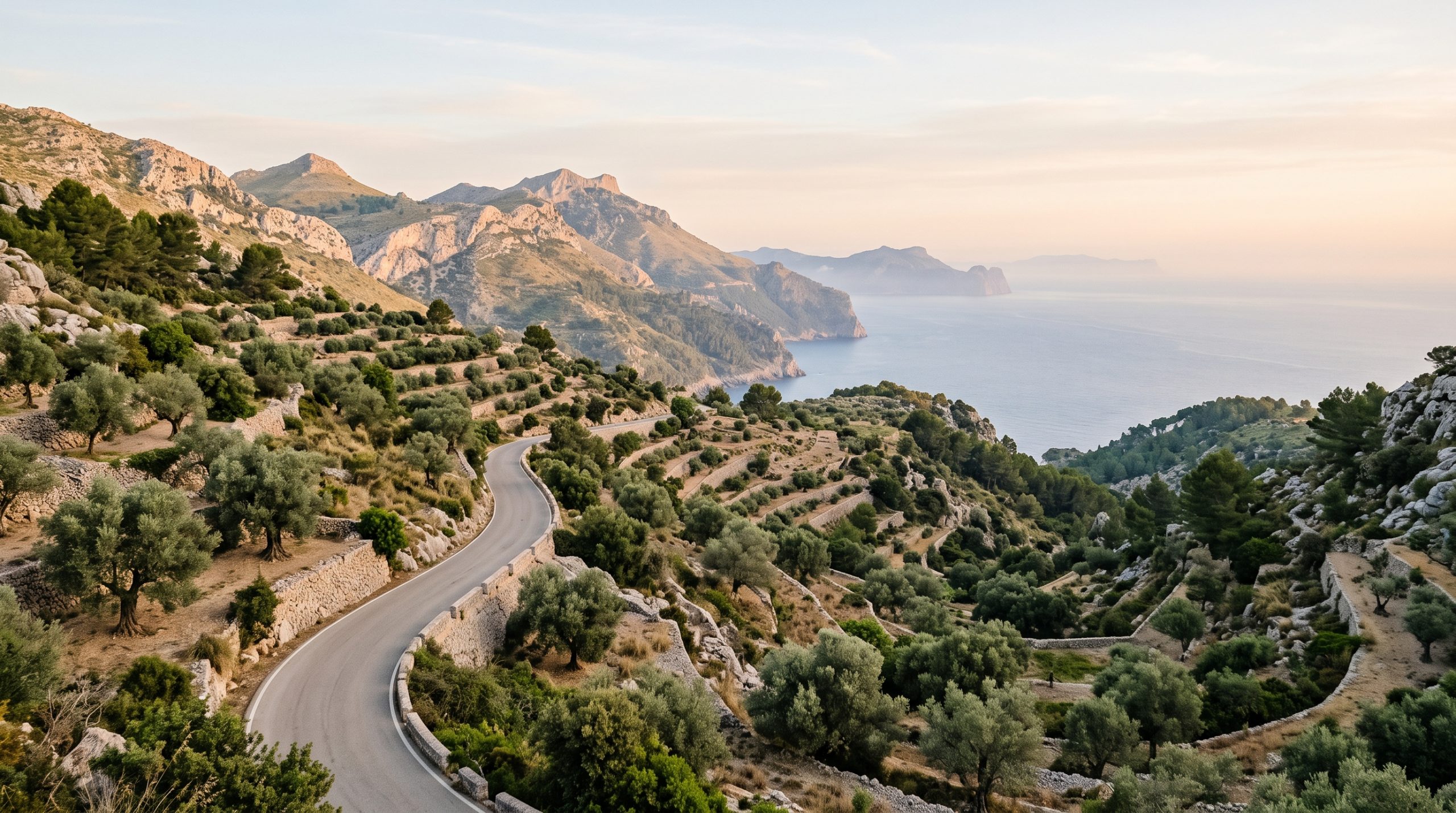
The Ma-2141 down to Sa Calobra is twelve kilometres long. It takes about half an hour, one way, dropping roughly 800 metres through twelve hairpins and one bend that loops a full 360 degrees under itself at Nus de sa Corbata. Twenty-four kilometres an hour, in a car. That figure tells you more about planning a day here than any distance on a map.
The island looks small from a laptop in Denver. One airport, one mountain range, a spine road covering the whole northwest coast in about two hours. Then you arrive and learn that Mallorca runs on clocks rather than distances. The hour a barrier drops across the Formentor road from mid-May. The hour the first tour coaches reach the bottom of Sa Calobra. The hour the sun clears the ridge and reaches the floor of a valley that has been light overhead for half an hour.
What follows is the operational version: which airport, which drives are worth doing on the day itself, what the paperwork asks for, and what the light does month by month.
The practical bottom line: PMI, the Ma-10 and a 10am gate
Fly into Palma (PMI), the island’s only airport, then plan on more driving time than any route planner promises. Give yourselves four or five nights, base inside the Serra de Tramuntana, marry legally at home, and hold the ceremony in the two hours after sunrise, before the Formentor road closes to private cars at ten in summer.
Getting here: one seasonal nonstop, then a lot of hubs
Palma de Mallorca is the third largest airport in Spain and the only one on the island, which settles the first decision for you. From the United States there is currently one nonstop: a seasonal United service out of Newark, a little over nine hours across 3,922 miles, and the longest route PMI has. Every other American itinerary connects, usually through Madrid, Barcelona, London, Frankfurt or Paris, which is painless enough at an airport with flights to 177 destinations in 37 countries across 64 airlines.
The routing matters less than the day you land. We do not put a ceremony morning on the day after a transatlantic arrival. Two clear days buys a night’s sleep, an unhurried afternoon on the ridge you have only seen in photographs, and room if a bag arrives later than you did.
Rent a car. The TIB bus network is useful for getting around, but it is not a timetable you build a first-light ceremony against. Take the smallest vehicle you can live with, too: in a passing place on the Ma-2141, a compact reverses politely and a large SUV negotiates.
Marry at home, then hold the ceremony where you want it
Spain’s civil route runs through the expediente matrimonial, a marriage file opened with the Civil Registry, and the registry expects at least one partner to be registered as a resident of the municipality, the empadronamiento. Visiting couples do not clear that bar, so the workable path is the one almost every international couple takes here: marry legally at home, and keep the Mallorca ceremony symbolic.
Logistically that is a gift. A symbolic ceremony is not tied to a registry office’s rooms or its opening hours, so both the hour and the ground belong to you, subject to whoever owns or governs that ground. A Catholic ceremony is open to non-residents too, but the file travels from your parish to the Spanish diocese and asks for baptism and confirmation certificates plus your parish’s permission to marry abroad, so start that early. The sequence is laid out in our guide to planning an elopement.
Twelve kilometres that take thirty minutes
Route planners treat the Tramuntana as though its roads were roads. Not quite. The Ma-2141 to Sa Calobra is the clearest case, and the number at the top of this page is the honest one: twelve kilometres, about thirty minutes, roughly 800 metres of descent. Behind a coach taking two bites at the loop at Nus de sa Corbata, make it forty. Cyclists are a permanent feature of these climbs, so the right response is to add time rather than expect a clear road.
The Ma-10, the coast road linking Andratx with Pollença, runs over 100 kilometres and can be driven in about two hours if you never stop. Nobody does that, and on a ceremony day it would be a mistake to try. We use a twenty or thirty kilometre slice and leave the rest for the days either side.
The Ma-11 tunnel under the Coll de Sóller has been toll-free since December 2017 and it is the sensible way into the valley when there is a timeline attached to your morning. The old Ma-11A pass over the top of the coll is the better drive by a distance, all switchbacks and long views. It is also the wrong choice with a dress in the back and first light waiting. Save it for a spare afternoon, when arriving late costs nothing.
Deià and Valldemossa were laid out for carts, so village parking is tight and rarely near the spot you want, and the last ten minutes of any drive here tends to end on foot over stone or gravel. We plan the walk in rather than the drive in.
The gate at Formentor and the coaches at Sa Calobra
The Ma-2210, the road out along the Formentor peninsula to the lighthouse, closes to private vehicles for most of the day through the warm half of the year. The restriction has been running from mid-May to mid-October, with cars, rental cars, motorbikes and trucks kept off the road between 10:00 and 22:00. The dates are set each spring and have been creeping earlier.
The road works in two sections. From Port de Pollença to Formentor beach, access during restricted hours depends on space in the official car park, which holds 300 vehicles behind barriers and live signage. From the beach out to the lighthouse, private vehicles are not part of the picture at all during those hours. The TIB 334 shuttle runs from Alcúdia to the lighthouse throughout, and taxis, cyclists and walkers keep their access.
The planning consequence is clean. In season, a Formentor ceremony is a sunrise ceremony, which is what you would want anyway. Mirador Es Colomer at eleven in the morning is a low wall with a queue behind it and flat light on the water. Ninety minutes after first light it is one of the great viewpoints in the Mediterranean.
Sa Calobra works the same way without a barrier to make it official. Arrive with first light and you are climbing back out as the first coaches come down. Arrive at noon in August and you have driven twelve kilometres of hairpins to reach a car park with a pebble beach attached. A passenger boat also crosses from Port de Sóller in season, weather permitting: a lovely approach on a spare day.
| Place | What sets the clock | When we work it | Out of season |
|---|---|---|---|
| Cap de Formentor lighthouse | Ma-2210 closed to private vehicles 10:00 to 22:00, mid-May to mid-October | First light until well before ten, or the late evening after the road reopens | Road open all day, viewpoints quiet on weekday mornings |
| Formentor beach section | Barrier control, 300 official parking spaces | Early, before the car park fills | Straightforward, park and walk |
| Sa Calobra and the Torrent de Pareis | Tour coaches and cyclists on twelve kilometres of hairpins | The first two hours after sunrise | Same road, a fraction of the traffic |
| Sóller and Port de Sóller | Toll-free Ma-11 tunnel; the 1912 railway takes about an hour | Drive it for sunrise, ride the train later for pleasure rather than transport | Valley light arrives late all year |
First light by month, and the ceremony hour it gives you
Sun times decide almost everything else here, and Mallorca sits at the western edge of its time zone, which pushes sunrise later on the clock than most American couples expect. These are Palma times, good to a couple of minutes.
| Month | First usable light | Sunrise | Sunset |
|---|---|---|---|
| Mid-April | 06:45 | 07:15 | 20:25 |
| Mid-May | 06:00 | 06:35 | 21:00 |
| Late June | 05:50 | 06:20 | 21:20 |
| Mid-September | 07:10 | 07:35 | 19:55 |
| Mid-October | 07:30 | 08:00 | 19:15 |
Two things follow from that table. In late June, sunset at 21:20 means you can have both ends of the day: a first-light ceremony on the ridge and a long evening on the water, with hours in between to eat, swim and drive. In mid-October, an 08:00 sunrise is a humane way to start a wedding day, and the light stays workable far later into the morning.
Inside a valley, the table lies as much as the map does. In Sóller, or on the floor of the Torrent de Pareis, the sun clears the ridge well after official sunrise, sometimes by the better part of an hour, so we take the ridgeline first and drop into the valley once it has filled. Our elopement stories and films show both ends of that, and they are the fastest way to work out whether you want hard Tramuntana light or a June evening on the coast.
For the ceremony hour, dress for the ridge and not for the bay. The wind that gives these mountains their name comes over the top and is strongest exactly where the views are, so fabric that moves is your friend and anything stiff fights you. Bring a real second layer for the pre-dawn drive, because the mountain before sunrise is nothing like the coast at noon. Keep grippy shoes in the car for the last stretch down to a cove, and hold the good ones back for the vows.
The buffers, the second vehicle and the drone paperwork
All of that turns into a short list of rules, and the list is ours to run.
Aerials, and the authorization behind them
Drone work in Spain sits with AESA, the national aviation authority, inside the European framework that Royal Decree 517/2024 adapts locally. Operators from outside the EU register with AESA before arrival, drones over 250 grams or carrying a camera are registered, the open-category ceiling is 120 metres, and flying over gatherings of people falls outside that category. The Serra de Tramuntana is a UNESCO World Heritage landscape threaded with protected zones, and the coast adds bird protection areas, all published as geographical zones on ENAIRE’s drone map. Where a zone needs authorization, the request goes to the authority governing that ground, and taking off from public land can also need the town hall’s agreement. We confirm both before designing a sequence around aerials.
Two vehicles on a single-track morning
Ours is a team of eight, and photography, film and planning come from the same place rather than from a photographer and a videographer who meet in a hotel lobby at 5am. On a Tramuntana morning that shows up as two vehicles. One stays with you. The other runs ahead to see whether the trailhead car park has filled, whether the barrier is down, whether the coach has started its descent, and reports back before you commit to the road. A second full set of gear matters more here than somewhere a spare is twenty minutes away.
The rest is arithmetic. Every Tramuntana leg carries a buffer rather than a best case. No ceremony hour sits up against the ten o’clock Formentor gate. The reserve location stays within a short drive of the first, never on the other side of the range. Permit research and the conversations with landowners and town halls are ours, while the permit fees themselves you pay directly. A full day with one dedicated photographer or one dedicated filmmaker starts at $4,900, the version with both working together at $7,900, and multi-day work is quoted as a proposal, all of it on our pricing page. Team travel is included worldwide. Highlights reach you five days after the day itself, the full gallery or film three weeks later.
If you have a month in mind, or a valley, send us the shape of it and we will tell you plainly what that week’s light and roads will give you. Check Your Date.
Common questions
Do we need to live in Spain to get married in Mallorca?
For a legally binding civil marriage, effectively yes. The Civil Registry opens an expediente matrimonial and expects at least one partner to be registered as a resident of the municipality. Visiting couples marry legally at home and hold a symbolic ceremony in Mallorca, which frees both the hour and the location.
How many days should we plan in Mallorca?
Four or five nights suits a single ceremony day: two clear days after landing, the ceremony day, and a day afterwards that is not spent packing. Add nights if you want a second location on the far side of the Tramuntana.
Can we drive to the Formentor lighthouse for a sunrise ceremony in July?
Yes, and sunrise is the only time you can. From mid-May to mid-October the Ma-2210 is closed to private vehicles between 10:00 and 22:00, so a first-light ceremony and a drive back out before ten works perfectly. In restricted hours the TIB 334 bus and taxis are the way in.
Is Sa Calobra worth doing on the elopement day itself?
Only at the start of the day. Twelve kilometres of hairpins take about thirty minutes each way, and by late morning in season you share them with tour coaches. First light down there is extraordinary and almost private. Noon in August is a busy car park.
Can you fly a drone over the Serra de Tramuntana?
In places, with the right paperwork. Spanish drone operations run under AESA with a 120 metre ceiling in the open category, non-EU operators register before arrival, and the protected zones across the Tramuntana and the coastal bird areas appear on ENAIRE’s drone map. Where a zone needs authorization we secure it before building aerials into your film.
Which months give the kindest sunrise for a ceremony?
Mid-September and mid-October, with sunrise around 07:35 and 08:00 in Palma. Late June asks you to be in position by about 06:20, but repays it with sunset at 21:20 and a second act in the evening. Mid-April sits between them, with a 07:15 sunrise and a 20:25 sunset.
Do we need a rental car, or can we plan around the Sóller train?
Rent a car. The 1912 railway covers the 27 kilometres from Palma to Sóller in about an hour, the tram to the port another fifteen minutes, and both are a delight on a free afternoon. Neither runs early enough for a first-light ceremony, and the coves and ridges are not on the line.
Choosing your week and your valley
Once you know the month, the rest falls into place quickly: a valley to base in, one ceremony viewpoint, one reserve within a short drive, and a timeline built around the sunrise for that week rather than a generic summer morning. Our destination guides are worth browsing if you are still choosing between coastlines.
Our Mallorca calendar currently covers 2027–2029. The process stays in writing and moves at your pace: send the inquiry form, receive the first reply and brochure by the next day, then a tailored proposal; planning starts once the contract is signed and the 30 percent retainer is paid. Tell us the week you are considering and the kind of morning you want, and we will tell you honestly what Mallorca does with it. Tell Us Your Story.