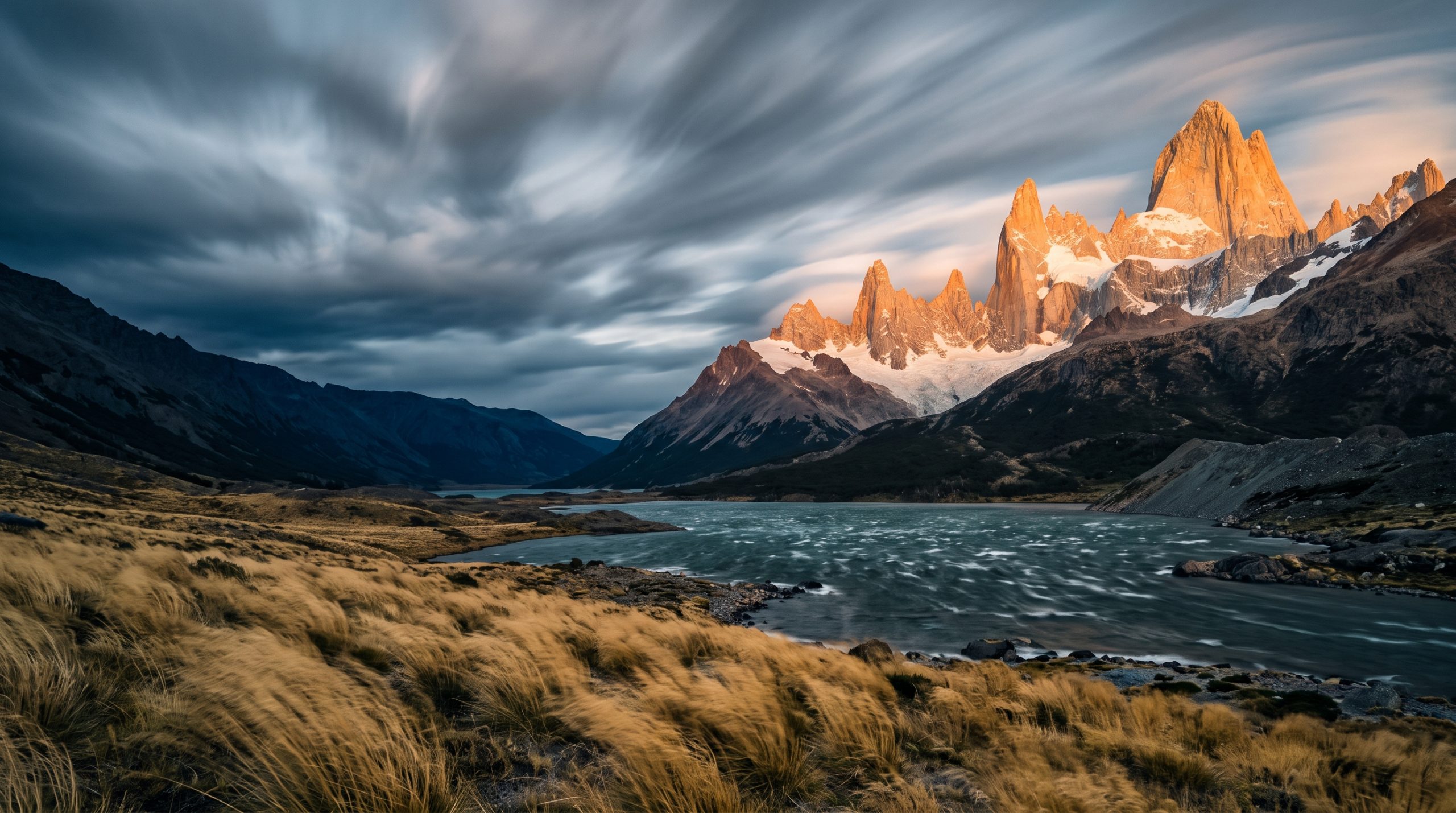
In late December, first light reaches El Chalten at 04:58 and the last of the dusk goes out at 22:41. That is close to eighteen hours of sky. Nobody films all of it, and the couples who try tend to come home with a lot of footage shot in the two conditions Patagonia handles worst: flat overhead sun, and a wind that has had all afternoon to build.
The wind is the second clock, and most days it is the more important one. The westerlies come off the Southern Patagonian Ice Field with nothing in their way, and they keep a daily rhythm as dependable as the light: quiet overnight, quiet through the first hour or two after sunrise, building through late morning, hardest in the afternoon. Almost everything we decide about a Patagonian day follows from that one pattern.
We work both sides of the border. El Chalten and the Fitz Roy valleys sit 220 km up Ruta 40 from El Calafate, in a town that only exists because Argentina founded it in 1985 to hold the frontier. Torres del Paine is roughly two hours north of Puerto Natales on the Chilean side, and the crossing between the two countries at Cerro Castillo is straightforward as long as your picnic is not carrying fresh fruit, meat or dairy into Chile.
The number first, then the weather
We photograph, film and plan Patagonian elopements as one team, in Argentina and in Chile. A full day with a dedicated photographer or a dedicated filmmaker starts at $4,900. A full day with a photographer and a filmmaker working the same hours, sharing one timeline, starts at $7,900. Team travel to Patagonia is included in both.
Light from 04:58 to 22:41: how a December day gets built
A Patagonian summer day is not one long shoot. It is two blocks of good light separated by a gap you should spend eating and sleeping, and the gap is not a compromise. It is the plan.
Here is the shape of a late-December day out of El Chalten, which is the version most couples ask us about.
- The evening before, around 21:00. We look at the wind and the cloud base and choose between the two plans we built weeks earlier. The decision gets made the night before, never at breakfast, because at 04:00 nobody makes a good decision about anything.
- 04:15, leaving town. Headlamps on. The Mirador de los Condores is a 45-minute walk from the last street in El Chalten. Laguna Capri is about 4 km with 250 m of climbing, an hour and a quarter at a steady pace with a dress carried in a pack.
- 05:15, in position. Fitz Roy stands 3,405 m above a valley floor at around 400 m, so the summit takes the light several minutes before anything at your feet does. If you arrive at 05:40 for a 05:42 sunrise, the best of the alpenglow has already happened above you.
- 05:42 to 06:33. Sunrise, then 51 minutes before the sun reaches six degrees. At 49 degrees south the sun climbs at a shallow angle, which buys a long, low, side-lit window instead of the ten-minute scramble you get closer to the equator. It is also the calmest air of the day.
- Around 06:45, vows. Chosen for sound as much as for view, which usually means the lee side of a moraine boulder or a stand of lenga rather than the open shoulder ten metres above it.
- 08:30 to 18:00, the gap. Breakfast in town, sleep, or the hour-long drive up 37 km of gravel to Lago del Desierto if the forecast has given us a reason to go north. High sun and a rising wind is the one combination Patagonia has nothing to offer.
- 19:30 back out, 21:07 to 21:58 the second window. Evening light arrives from behind the range, so Fitz Roy is backlit at sunset rather than glowing. The good frames move to the steppe, the lake surfaces and the ridgelines. Then 43 minutes of civil twilight after the sun goes, which is a genuine working window here and not a token five minutes.
Torres del Paine runs on the same principle and a different geometry. The Torres and the Cuernos face east, so the pink faces belong to dawn from the Laguna Amarga and Lago Sarmiento side, while the evening belongs to Lago Pehoe and Salto Grande. Distances inside the park read shorter on a map than they drive: gravel, guanacos standing in the road, and 25 to 40 km between viewpoints that look adjacent. We build in the travel time honestly, which is why our timelines have fewer locations on them than most couples expect and more usable light in each one.
If you already know roughly when you want to be down here, send us the month and we will tell you what the light does that week. Check Your Date.
What the wind does to a film, and what two of us do about it
Start with the good news, because it rarely gets written down. Wind is half the reason Patagonian footage looks like Patagonia. The Tehuelche name for Fitz Roy is Chalten, the smoking mountain, for the cloud that streams off the summit in a permanent banner. Lenticulars stack over the Paine massif. Wind lanes race across Lago Pehoe in dark stripes. Grass on the steppe moves in long waves. A still photograph shows you a place with weather in it. A film shows you the weather itself, moving, and that is a different and better argument for Patagonia than any wide-angle frame.
Now the part that needs solving. Wind is brutal on three things: audio, aerials, and the number of usable minutes a couple can stand in one spot before hands, hair and eyes give up. On an exposed ridge above Lago Nordenskjold you have maybe six good minutes before everyone is squinting.
Six minutes is where one person doing both jobs quietly fails. A photographer needs the two of you to slow down and hold something; a filmmaker needs you to keep walking, keep talking, keep moving through the frame. Those are opposite instructions, and alternating between them burns the window. With a photographer and a filmmaker working together, one of us is 30 m upwind on a long lens while the other is close in with something wide, and we agreed who takes the first pass before we left the vehicle. The six minutes produce a frame and a sequence rather than half of each.
Audio is the one that separates a Patagonian film from a Patagonian slideshow. The Expedition includes professional audio for vows and the moments around them, and here that means a microphone under a collar, proper wind protection, and a vow spot picked for shelter first. The camera can stand in the open. The microphone cannot. When we walk a location the evening before, we are listening as much as looking, and the person who chose that hollow behind the moraine at 21:00 is the person holding the camera at 05:30. That continuity is the whole reason we do not hand planning to one company and shooting to another.
Aerials run on permission and on air. Drone flights inside the national parks on both sides of the border need authorization from the park authority, so we establish what is possible for your dates and your locations before any sequence in the film depends on one. Then we fly in the calmest air available, which in Patagonia means the hour after dawn, not the middle of the afternoon. If you want to see how a windy morning actually cuts together, our published films and galleries are the honest version of it, weather included.
What travels with us through Patagonia, and when the work lands
Everything below is part of every experience, in Patagonia and everywhere else we work. There is no long-haul supplement, no travel line item, and no separate videographer invoice.
- Destination and location design for both sides of the border, built around where the light lands and where the shelter is.
- A custom timeline based on real travel time, including the gravel and the border queue, not the optimistic version.
- Permit research and logistics guidance for parks, private land and estancia access.
- Weather alternatives and backup planning, which in Patagonia means at least two full plans for every day.
- Drone footage where it is legal, safe and appropriate.
- Professional audio for vows and meaningful moments on the Expedition, where conditions allow.
- Team travel worldwide: flights, accommodation and ordinary travel for the assigned team.
- Highlights delivered in 5 days. The full gallery or film in 3 weeks.
Guest count does not change the fee. Bringing four people changes access, permits, transport and the shape of the timeline, and we will tell you exactly how, but it does not change what you pay us. We are eight people in total, four photographers and four filmmakers, which is also why there is always a second camera on the ground and a colleague in reserve rather than a single point of failure at the end of a very long flight.
Park tickets, boat seats and the costs that are not ours
Patagonia adds third-party costs, and they are worth seeing in advance rather than in an inbox three weeks before you fly. What each of our experiences covers is set out plainly on the pricing page, and everything in this section sits outside it.
Torres del Paine entry is bought online through CONAF’s pasesparques.cl portal before you arrive rather than at the gate, and the park is moving toward tickets tied to the sector you enter as well as the length of your stay, so the route matters when we book. On the Argentine side, Los Glaciares charges entry for the El Chalten sector and for the Perito Moreno glacier, payable locally in pesos and adjusted regularly. Chilean costs are quoted in Chilean pesos and Argentine costs in Argentine pesos; we give you current local figures during planning, when they are actually current.
Beyond entry, the usual Patagonian extras are boats and wheels. The catamaran across Lago Pehoe, the launch on Lago del Desierto, a nautical approach to Perito Moreno, a private transfer or a 4×4 for a gravel road that a rental contract would rather you avoided, horses, or a mountain guide if you want ground above the standard trails. Accommodation, your celebrant and any permit fees charged by a government, park or landowner are yours as well. The research and the paperwork are ours.
How a Patagonia film date moves from message to hold
- You send the inquiry form with your dates, or the month you are circling.
- We reply within 24 hours with an initial brochure.
- We build a tailored proposal around what you have told us you actually want.
- Contract signed, 30% retainer paid, date held.
- Planning begins: locations, timeline, permit research, backup plans, the whole Patagonian logistics chain.
- The day happens. Highlights reach you in 5 days, the full gallery or film in 3 weeks.
The remaining payment schedule is written into your proposal, so you see it before you sign anything. If you want the general shape of elopement planning before you get this far, our guide to how eloping works covers the fundamentals.
Cloud on the summit, and the couples who do well with it
The honest objection about Patagonia is not the cost of getting here. It is the fear of flying thirty hours and never seeing the mountain. It is a fair fear. Fitz Roy is called the smoking mountain for a reason, and there are weeks in every season when the summit shows itself for twenty minutes at dawn and then goes back behind cloud until the following Tuesday.
So we plan as though the summit will be hidden, and treat a clear one as a bonus rather than a foundation. That means locations that hold up in flat light, which Patagonia has in abundance: lenga forest, glacial rivers running grey-blue, the beach at Laguna Capri, the thrombolite shoreline at Lago Sarmiento, wind on open steppe. It means keeping the ceremony flexible until the evening before. And it means that couples who can give us more than one morning almost always get the mountain, because we are out there on the good one. Multi-day coverage across two to seven days, in one region or across the border, is what the Odyssey exists for, and it is the version we suggest most often here.
Patagonia suits couples who are willing to be up at 04:00 in December, comfortable on uneven moraine and loose trail for a few kilometres, and relaxed about a plan that moves at nine the night before. If early starts genuinely are not your idea of a good morning, that is worth telling us, because the calendar has a solution.
| Window | First light, El Chalten | Sunset | What that shapes |
|---|---|---|---|
| Mid-November | 05:20 | 21:15 | Long days, the windiest stretch of the year, fewer people on the trails |
| Late December | 04:58 | 21:58 | Maximum light, earliest alarms, peak season on the classic viewpoints |
| Mid-January | 05:27 | 21:53 | Warmest air, busy trails, a genuinely long evening window |
| Mid-February | 06:25 | 21:11 | A civilised 06:00 start, settling air, autumn colour beginning late in the month |
| Late March | 07:21 | 20:04 | Lenga turning red, calmer conditions, sunrise you can walk to after coffee |
| Mid-April | 08:00 | 19:10 | Short quiet days, snow arriving on the passes, fewest people anywhere |
Late February through March is the answer for most couples who want the mountains without the 04:00 alarm, and the autumn colour in the lenga forest is the best of the year. If walking distance is the concern instead, say so and we will build from short ground: Salto Grande is a fifteen-minute flat walk from the car park in Torres del Paine, Lago Sarmiento and Laguna Azul are effectively roadside, and the Mirador de los Condores above El Chalten is 45 minutes on a good path. Tell us what you actually want the day to feel like and we will shape it, or tell you which month fits it better. Our destination guides are a reasonable place to start narrowing it down.
Common questions
Can we legally marry in Patagonia, or is the ceremony symbolic?
Almost every couple we bring here signs the legal paperwork at home, in their own country, and holds the ceremony itself in Patagonia with a celebrant. The mountain day is the real one either way. We plan around the ceremony you want, and we tell you early what the local requirements look like for the specific place you have chosen.
How many days should we allow in Patagonia for an elopement?
Three or four on the ground is the minimum we would want, and more is better. One booked day and one weather day changes the odds dramatically, especially around Fitz Roy. That is what the Odyssey is built for: two to seven days, one region or several, with a custom proposal rather than a fixed shape.
Will the wind wreck our vows in the film?
Not if the vows are placed properly. We pick the vow location for shelter and sound, use professional audio and proper wind protection on the Expedition, and schedule that part of the day inside the calm morning window rather than the windy afternoon. Wind you can hear in the wide shots is atmosphere. Wind over your vows is a mistake we plan out.
Do we have to hike to Laguna de los Tres in a wedding dress?
Only if you want to. It is roughly 20 km round trip with about 1,100 m of climbing and the final kilometre gains 400 m, which is a serious day before anyone puts a dress on. Most couples choose Laguna Capri at 4 km, the Condores viewpoint at 45 minutes, or a road-accessible valley, and we carry the dress in.
Chile or Argentina for a Patagonia elopement?
El Chalten gives you sharp granite towers close overhead and everything walkable from town. Torres del Paine gives you scale, guanacos, water and a road network that lets you cover a lot of very different ground in one day. If you have several days we cross at Cerro Castillo and use both, and we build the border crossing into the timeline as a real hour, not a footnote.
What happens if the forecast turns before our date?
We already have a second plan and usually a third, written during planning rather than invented on the morning. We make the decision the evening before, move the shape of the day, and if you have given us more than one date we move the whole thing. Nothing in the fee changes when the weather does.
Does the price change if we bring our parents and a few friends?
No. Guest numbers affect access, permits, transport and how the timeline is paced, and we will be direct with you about what a group of eight does to a narrow trail at dawn. They do not change what you pay us.
Everything before Patagonia happens in writing
Everything between your first message and the morning itself happens in writing. You send the form, we reply within 24 hours with a brochure, and from there it is email, documents and a timeline you can read at midnight from a different hemisphere without anyone needing to be awake at the same time as you. Our Patagonia calendar is currently open across 2027, 2028 and 2029, and Patagonian planning usually starts a year or more ahead, because the flights do too.
Send us the month you are thinking about, the kind of morning you want, and how you feel about a 04:15 alarm. We will tell you what the light and the wind are likely to do, and what we would build. Tell Us Your Story.