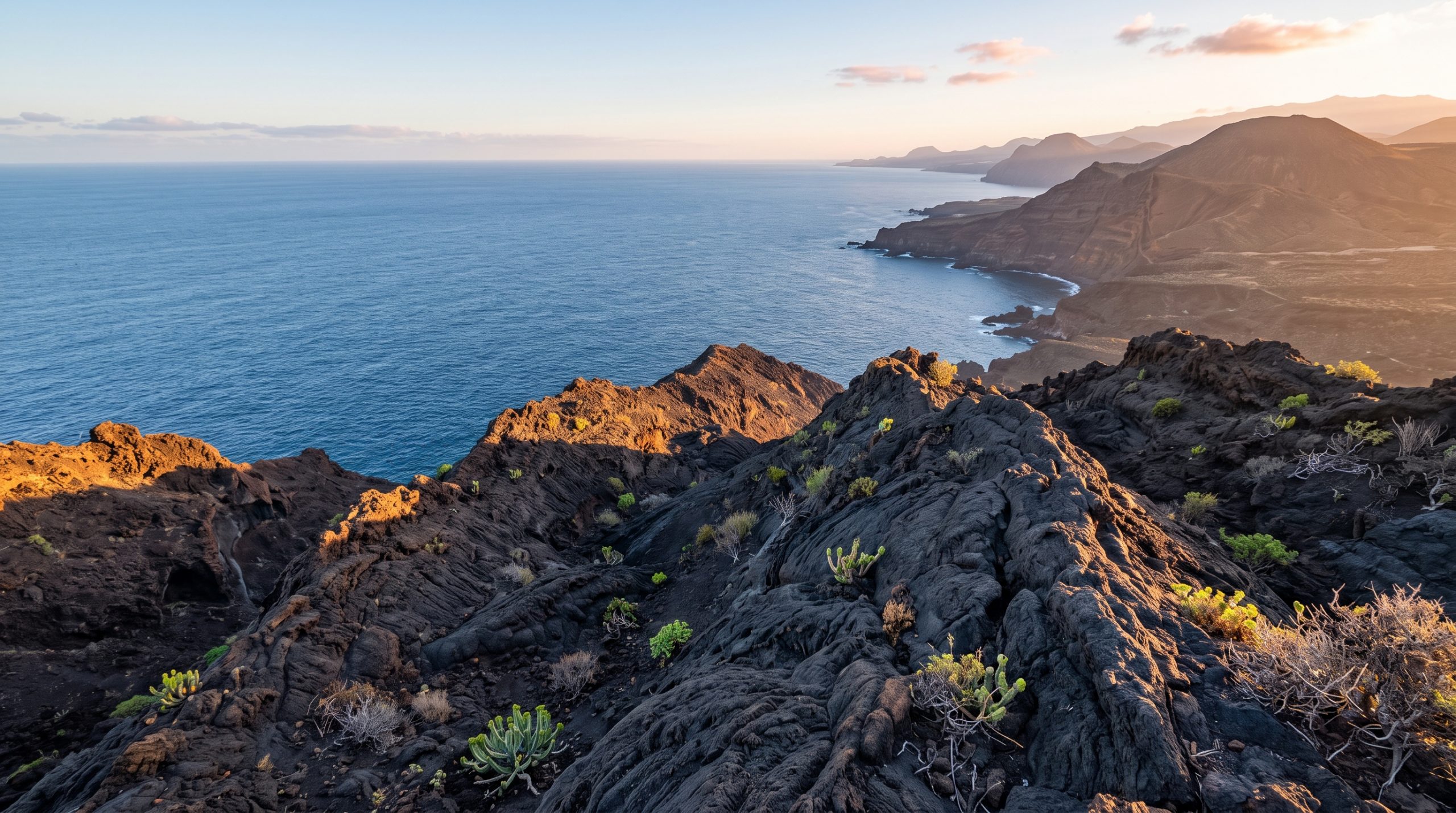
The Teide cable car will not let you board in heels. Not in wedges, not in platforms, not in flat-soled dress shoes, not in anything open at the toe. Closed hiking or sports shoes with high-grip, non-slip soles, or you stay at the bottom station. That rule is published by the operator, it is checked at the boarding gate, and it is the most useful sentence in this guide, because it tells you exactly what kind of place you are planning in.
From five hours behind on the US East Coast, the Canary Islands look like a warm, simple idea. Spanish, reliable, a volcano, good flights from Europe. The ground is more interesting than that, and more governed. Two national parks with working permit systems, a summit you book a slot for, a ferry that does not sail early enough for sunrise, and an island hop that eats a morning despite being thirty-two minutes in the air.
None of that is hard. All of it is specific. This is what we plan around.
Airport, paperwork and how many days
Fly into Tenerife South, Lanzarote or Gran Canaria on one European connection, allow four to five days on the ground, and sign the legal paperwork at home before you travel. Spanish civil marriage is built for residents. Your ceremony here is yours, held where you want it, led by a celebrant.
Your license gets signed at home, and that is genuinely the easy part
Spanish law ties civil marriage to residency. For a civil ceremony in Tenerife, Lanzarote or anywhere else in the archipelago, one of you needs Spanish citizenship or legal residency, and the threshold the town halls quote is two consecutive years. American couples do not clear that, and almost none of them try.
What they do instead is straightforward. The license is signed at a county clerk’s office at home, quietly, weeks before the flight. The ceremony on the island is then the real one in every sense that matters: your words, your celebrant, your witnesses if you want them, on a lava field at seven in the morning with nobody else on the road. We walk couples through the sequencing in our guide to how eloping actually works.
Six islands, and what each one is actually for
Most couples arrive at this decision having looked at photographs, which is the wrong order. Look at the ground and the transfer first. These islands are close together on a map and genuinely separate in a schedule.
| Island | Main airport | What the ground gives you | Worth knowing |
|---|---|---|---|
| Tenerife | Tenerife South (TFS) | Pico del Teide at 3,718 m, high pumice desert, pine forest, black-sand coast, laurel ridges in Anaga | The most governed island, and the one where permits are real and bookable |
| Lanzarote | Arrecife (ACE) | Lava fields, low cones, white walls against black volcanic soil | The interior of Timanfaya is seen from an official park coach, and you stay aboard for the whole route |
| Fuerteventura | Fuerteventura (FUE) | Dunes, long open beaches, the widest horizons in the archipelago | The flattest and most exposed island, so fabric choice matters most here |
| La Palma | La Palma (SPC) | Steep ridges, laurel forest, terraced coastline | The smallest flight schedule. Most couples route through Tenerife North or Gran Canaria |
| La Gomera | Ferry from Los Cristianos | The laurel forest of Garajonay, deep barrancos, terraced hillsides | The 50-minute crossing shapes the entire day unless you sleep on the island |
| Gran Canaria | Las Palmas (LPA) | The Maspalomas dunes plus a mountain interior on one island | The widest range of terrain inside the shortest drives |
Volcanic and vertical, Tenerife or Lanzarote. Soft, wide and windswept, Fuerteventura. Green and steep and quiet, La Palma or La Gomera. Our destination guides go further into individual locations, but the island-level choice determines how much of the trip you spend moving.
One honest note about Timanfaya, because couples ask for it by name. The interior is reached only on the official park coach along the Ruta de los Volcanes, roughly fourteen kilometres through the lava, and you do not get off. Remarkable to see, useless as a ceremony location. The lava country immediately outside the boundary is open, extraordinary and empty at six in the morning.
Where island distances stop being simple
This is the section worth keeping open in a tab. Every leg below is technically accurate on a mapping app and misleading as a plan.
| Leg | Commonly quoted | What we block out | Why |
|---|---|---|---|
| Tenerife South to the Teide cable car base | About an hour, which the operator quotes from anywhere on the island | The whole pre-dawn block if it is a sunrise | Continuous switchbacks, 220 spaces in the base car park, and a 20-minute check-in before your slot |
| Los Cristianos to San Sebastian de La Gomera | 50 minutes | Half a day, door to door | Port arrival and boarding at both ends, and the first sailing leaves somewhere around nine rather than at dawn |
| Tenerife to Gran Canaria | Around 32 minutes in the air | Most of a morning | Binter flies from Tenerife North, which sits beyond Santa Cruz, and Santa Cruz is already 60 km from Tenerife South |
| Santa Cruz into the Anaga ridge | The distance looks trivial | A half-day of its own | Hairpins stacked on hairpins, single-lane sections with passing places, and an average speed unrelated to the distance |
| Los Cristianos to Tenerife South airport | 10 minutes | 10 minutes | The one leg on this list that is exactly what it says it is |
The inter-island flight is the trap. Thirty-two minutes to Gran Canaria is a real number and useless on its own, because the regional carriers work out of Tenerife North in La Laguna while your transatlantic connection lands at Tenerife South. Tenerife North also sits inland and high, in the belt where the trade-wind cloud likes to settle, so we never hang a ceremony hour off a tight connection through it. Two islands in one trip means moving the evening before.
The ferry is the other one. Fifty minutes is accurate for the crossing, and Fred Olsen, Baleària and Naviera Armas run Los Cristianos to San Sebastián several times a day, year round. That number excludes the drive to the port, the queue, the boarding and the same again coming back, and the first boat does not sail early. If you want La Gomera at first light, you sleep on La Gomera.
Teide, Timanfaya and the permissions that actually matter
Teide is not a place you turn up at and improvise. It is a working national park with a booking platform, checkpoints and a management plan, and once you understand the system it is entirely manageable. Driving through the park is open and free. Everything above a certain line is not.
The cable car, the slot and the shoes
The cable car runs from the base station up to La Rambleta at 3,555 m, and a one-way ticket is currently around €23.50 for a non-resident adult, with children about half that. Only your ascent time is reserved. The descent is by queue, in order of arrival, and you are asked to be at the boarding area 20 minutes before the time on your ticket. Time at the top is capped at one hour, extended to two if you hold a permit for the crater route.
Then the footwear. Closed mountain or sports shoes with high-grip, non-slip soles are compulsory to board, and heels, wedges, platforms, flat-soled shoes, beach shoes and anything open are refused. This is not a suggestion made politely at the gate. Plan the dress and the boots as one decision, carry the shoes you actually want in the frames in a bag, and change on the caldera floor where the light is better anyway.
Above La Rambleta, the final trail to the 3,718 m summit needs a separate permit through Tenerife ON, the island council’s official platform. Slots are limited, they include an early window from six in the morning and an evening one, and the permit is checked at a control point in digital or printed form.
Filming permission, and aerials
The park’s own regulations are explicit: professional filming or recording for commercial purposes requires prior authorization from the park. Handling that sits with us in the planning phase, and it is why we ask for your dates early rather than late.
Aerials work the same way, one layer up. Spain sits under the EASA framework with AESA as the national authority, so operator registration, pilot certification and the airspace check on the official ENAIRE Drones map all have to be current before a shot is planned around a drone. Inside Teide and Timanfaya, take-off and landing need the park’s own consent on top of that. We confirm all of it in writing before the film is designed, and where the answer is no, we design a film that does not need it.
Sunrise at eight, sunset after nine
The Canaries run on the same clock as the UK and Portugal, one hour behind mainland Spain and five hours ahead of the US East Coast. They also sit near the western edge of that time zone, which produces something planners rarely mention: the sun comes up late here. A December first-light start on Tenerife is not a 4am alarm. Times below are for Tenerife and shift by a few minutes across the archipelago.
| Time of year | Sunrise | Sunset | What we do with it |
|---|---|---|---|
| Late December | 07:54 | 18:15 | A civilised start. Coffee at seven, on the caldera floor before eight, done by mid-afternoon |
| Mid-March | 07:17 | 19:15 | The best balance of the year. Early enough to be alone, long enough to move twice |
| Late June | 07:10 | 21:06 | An enormous evening. Ceremony at seven, coastal light running past nine |
| Mid-October | 08:07 | 19:37 | The latest sunrise on this list, and warm water still on the coast |
Winter and early spring bring the highest Saharan dust concentrations, the calima. A thin one turns the sky into a soft orange filter and flattens the contrast at altitude in a way that suits skin and fabric far better than a hard blue noon, and it is one of the few conditions we quietly hope for. A heavy one moves the mountain hour to the coast, which is why a second location is always in the plan. You can see how that light behaves at both ends of the range in our published stories and films.
A real shape for a Tenerife day in March: leave the coast at 05:30, parked inside the park by 06:45, first light and ceremony between 07:15 and 08:30, breakfast in Vilaflor around ten, then the black-sand coast for the last two hours before 19:15. Two locations, one long gap, nobody running.
The buffers we build in, and why two of us travel
Everything above turns into a small number of scheduling rules. We never place the ceremony hour next to a ferry departure or a flight. We hold a second location within about fifteen minutes of the first, on lower ground, for mornings when the mountain is not cooperating. On long-drive days we run two vehicles, so one of us is ahead scouting where the light is landing while the other stays with you.
That is also the practical argument for a photographer and a filmmaker from the same team rather than two freelancers meeting in a car park at dawn. We are eight people, so there is always a second full set of bodies and glass on the ground. Photography, film and planning are one service here, not three invoices. The full range, from a single day to a multi-island Odyssey of two to seven days, is on our pricing page, and team travel to any of the islands is already inside it.
Delivery is fixed: highlights within 5 days, the full gallery or film within 3 weeks. Booking runs on a 30 percent retainer once the proposal is signed, and we are taking dates for 2027, 2028 and 2029. For a Teide morning, earlier is better, because the park permissions and summit slots are the least flexible parts of the plan.
Check Your Date and tell us which island you keep coming back to.
Common questions
Do we need to live in Spain to get married in the Canary Islands?
For a legally binding Spanish civil marriage, yes, one of you needs Spanish citizenship or legal residency, with two consecutive years the figure the town halls quote. Almost every couple we work with signs the license at home first and holds a celebrant-led ceremony here, which has no residency requirement at all.
Which airport should we fly into from the United States?
Tenerife South (TFS) for Tenerife, Arrecife (ACE) for Lanzarote, Las Palmas (LPA) for Gran Canaria. Most American couples come through Madrid, Lisbon, London or Frankfurt on one connection. Skip Tenerife North unless you are island-hopping, since it sits beyond Santa Cruz, 60 km from the south coast.
How many days do we need on the ground?
Four to five is the number that works. One day to arrive and reset, one buffer day so weather never forces a decision, one for the elopement itself, and a spare. Anything shorter and the day carries all the pressure of the trip on its own.
Can we actually have our ceremony on top of Mount Teide?
Above the top cable car station at 3,555 m you need a permit through Tenerife ON, time at the summit is capped, and everyone must be in closed grippy footwear to board. It is possible and it is tightly scheduled. The caldera floor below, at Las Cañadas, gives you far more room and far more time.
What should we wear if the day includes Teide?
Layers you can lose in ninety seconds. It is cold before sunrise at 2,000 m and warm on the coast by eleven, so we plan a merino layer under a jacket for the drive up, hiking shoes for any cable car section, and the shoes you actually want photographed carried in a bag. Structured fabrics hold their shape in wind. Light chiffon does something wilder, which some couples love.
Is it worth adding a second island?
Only with a night in between. A same-day hop burns the light at both ends, by ferry or by air. Move in the evening and you get two full mornings instead of one good one and one spent in transit. Tell us how many days you have and we will say honestly whether the second island earns its place.
Does calima ruin the day?
Rarely. Light haze is beautiful to work in and softens the contrast at altitude. Dense haze is a reason to swap the mountain hour for the coast, which is already in the plan as the alternative location. Winter and early spring see the most of it.
Choose the island, then tell us the shape of the day
The best planning starts with a sentence like this one: we want the volcano, we can be up at five, and we would rather eat well afterwards than shoot for ten hours. From that we build the timeline, the permits and the alternative. Everything with us happens in writing, asynchronously, so nothing depends on catching each other awake across five time zones.
Send us your dates, your island, and the part you are least sure about. We reply within 24 hours with an initial brochure and honest thoughts on whether the month you have chosen fits the day you are describing. Start Your Story.