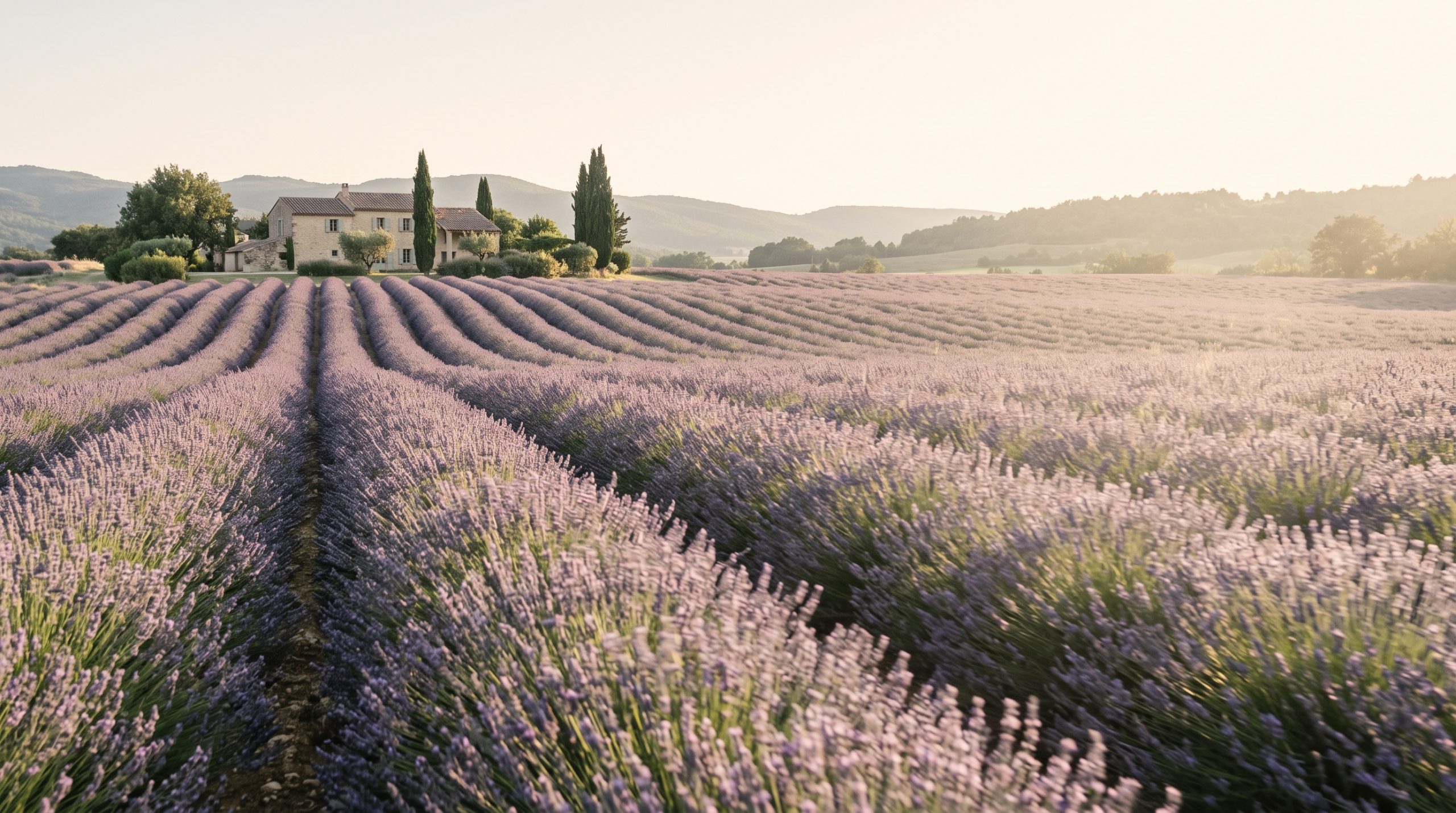
Lavender in Provence is a crop, not scenery. In the Luberon the cutting usually starts around the middle of July, and on the Valensole plateau the best rows are often already down before the plateau’s own lavender festival on the third Sunday of the month. Couples pick a July date for the purple and arrive to stubble. That one fact shapes every timeline we build here.
So we plan Provence by altitude and by week rather than by month. The low fields around Gordes come into flower from mid-June. Valensole, spread between roughly 350 and 700 metres, peaks from late June into the first half of July. Up at Sault, on the flank of Mont Ventoux between 700 and 900 metres, the harvest does not begin until mid-August, which is why the Sault festival on 15 August is the one that still has standing fields behind it.
The second number to know before you choose a date is the length of the day. On the longest day the sun is above the horizon here for fifteen and a half hours, up just before six in the morning and down at about half past nine at night. That gives you two separate golden ends and a long, hot, empty middle, and knowing what to do with all three is most of the work.
Two shapes of coverage, and where each starts
In Provence we handle photography, film and planning as one team. The Adventure covers one full day with a dedicated photographer or a dedicated filmmaker, from $4,900. The Expedition puts both on the plateau together for a full day, from $7,900. Travel for the assigned team is included, and longer multi-day work is quoted as a proposal.
From first light at 5:20 to a sky that holds past ten
Civil twilight opens about forty minutes ahead of sunrise, so on a late-June date the sky above the plateau starts to lift around 5:20 and there is workable light by 5:40. We leave your accommodation between 4:30 and 5:00, which is the least romantic sentence on this page and the whole reason the first hour looks the way it does.
From 5:40 until around eight the sun sits low enough to come sideways through the lavandin, and the rows are yours. The plateau is genuinely quiet then. Vans and coaches start arriving from about nine, the growers’ shops open, and by ten the well-known field entrances have people standing in them. So the vows, the walk and the close work all happen before that, and then we move.
Something worth knowing about the most photographed lavender frame in France. The Cistercian abbey at Senanque, five kilometres north of Gordes, has lavandin rows running straight up to its wall, and it is a working monastery rather than a venue. Entry into the field is not allowed. Professional camera equipment is not permitted on the site. The interior is seen on a guided tour with fixed slots, and the self-guided window on weekdays is roughly 9:30 to 11:00, with eleven as the last entry. We take the abbey from the road as a two-minute establishing frame and we do not plan a ceremony there, which is useful to know before it goes onto a moodboard.
Eleven to five is the flat part of a Provence summer day. High sun, hard shadow, heat on open ground with no shade in it. We stop. That is a long lunch, a drive, an hour in the cool of a village. If you want the ochre country, this is where it belongs: the Sentier des Ocres at Roussillon runs two loops of about thirty and fifty minutes, entry is a few euros a head, currently 3,50 €, and closed shoes are required on the sand. We take the short loop, and we take it while the light does not matter.
From seven the day comes back. In high summer we put ceremonies in the 19:00 to 20:00 window, because the heat has gone out of the air and the sun is still an hour and a half above the horizon. Then the long gold from 20:40 to sunset at about 21:26. The latest sunset of the year here falls on 27 June, at 21:29. After the sun drops the sky holds colour for another half hour, the cicadas fall away, and the last frames of a Provence film are usually the quietest ones in it.
The week matters more than the month
The thing couples ask us most often about Provence is what happens if the fields are cut the week they arrive. The answer is altitude, not luck. We choose the region from your travel dates rather than asking you to choose dates for a region.
Before we commit a field we speak to the grower who farms it, because those rows are private working farmland and visitor pressure has already put fences around some of them. We also build the day so that lavender is one hour of your film instead of all of it. Durum wheat goes gold beside the purple in July, the sunflowers arrive in the same weeks, and the Verdon country east of the plateau gives you water and rock long after the last field is cut. Our destination guides go deeper into the regional detail.
| Area | Usually in flower | Harvest usually begins |
|---|---|---|
| Luberon around Gordes and the Senanque valley | Mid-June to mid-July | Around 15 July |
| Valensole plateau, 350 to 700 metres | Late June to mid-July | Second week of July |
| Sault, Aurel and Ferrassieres, 700 to 900 metres | Early July into August | Mid-August |
Aix-en-Provence sits about 65 kilometres from the Valensole plateau, which is under an hour on a quiet morning and considerably more once the day has started. That drive is one of the reasons we build the timeline around real travel time rather than map estimates. If you already know the week you can travel, send it to us and we will tell you which plateau it puts you on. Check Your Date
What the second camera changes in a lavender row
A lavender field is a set of parallel lines. That is what makes it photograph so well, and it is also why two people working it have to be choreographed rather than merely present. A row offers one clean sightline. If a photographer is in close with a wide lens while a filmmaker comes down the same axis on a long one, somebody is in somebody’s frame. We work it as a single unit: the filmmaker takes the length of the row from behind while the photographer stays tight, they swap ends on a signal, and neither of them has to negotiate mid-take. A photographer and a videographer who met that morning sort all of this out loud at 5:40 in the half dark, and the couple hears every word.
Sound is the other thing Provence decides for you. The mistral comes down the Rhone corridor as a cold, dry northerly, it can hold for several days once it settles in, and in a strong episode it averages around 74 kilometres an hour. Open ground on the plateau is the last place you want to be standing while it does. The Expedition includes professional audio for vows, and the way we protect that is positional before it is technical: we read the forecast days out, put the ceremony in an east-facing fold of ground or a walled courtyard, set you with your backs to the wind, and hold a sheltered alternative fifteen minutes from the first choice. On a still July evening the opposite is true and it is lovely. The cicadas rise with the heat and sit under a vow like a soundbed nobody had to design.
Aerials are planned, never improvised. In France the DGAC publishes the restriction zones for open-category drone flight on Geoportail, and parks, reserves and individual communes add rules of their own on top of that map. We check both before a location enters your timeline, then we place one aerial window in the hour when the sun is low and the air is still. On the plateau that is a slow lift straight up a row, with you getting smaller and the lines running away to the hills. Where the map or the commune says no, the film is built without it and the gap is invisible.
You can see how all of that cuts together in the galleries and films we have published, which is a more honest answer than anything we could write here about how a Provence morning looks at 6am. There are eight of us, four photographers and four filmmakers, so there is always a second camera on the ground and a colleague in reserve.
What the fee covers, from permit research to delivery day
Every experience, from a single day to a week across several regions, includes the same foundation. Nothing on this list is an upgrade.
- Destination and location design for your specific dates, chosen by bloom altitude and by drive time.
- Planning, and a custom timeline built around the light and around real travel on Luberon back roads.
- Permit research and logistics guidance, including which commune, landowner or grower has to say yes.
- Weather alternatives and backup planning, including a sheltered option for a mistral morning.
- Drone footage where it is legal, safe and appropriate.
- On the Expedition, professional audio for vows and the moments that carry them, where conditions allow.
- Travel for the assigned team, worldwide: flights, accommodation and ordinary ground travel, with no European or long-haul distinction.
- Highlights in 5 days, and the full gallery or the finished film in 3 weeks.
What we charge, and what Provence charges
Coverage starts at the two figures near the top of this page, and what sits inside each experience is set out on the pricing page. Two things about it matter particularly in France. Team travel is included here exactly as it is everywhere else we work, so flights and accommodation for the photographer, the filmmaker, or both of them together are not a line item you will be quoted later. And the fee does not move with your guest count. Ten people instead of two changes access, permissions, transport and the shape of the timeline, all of which is our problem to solve. It does not change what you pay us.
What you pay locally, in euros, is separate and we would rather you saw it early. Permit fees where a commune or a landowner charges one. Tickets if you want the abbey cloister on the guided tour. Entry to the ochre trail. Village parking, which at Roussillon is charged from the start of March until mid-November. Your celebrant, your accommodation, your hire car. Unusual transport if you decide you want it, such as a private boat on the Verdon or a helicopter. We do the research and we secure the permissions. The fees themselves are yours, and you know each one before a location is confirmed.
How a Provence film date moves from enquiry to hold
- Send the inquiry form with your dates, or the week you are circling, and what you picture.
- We reply within 24 hours with our initial brochure.
- We put together a tailored proposal: coverage, locations by altitude and light, the shape of the day.
- You sign the contract and pay a 30% retainer. The rest of the payment plan is laid out in the proposal.
- Planning begins in earnest: locations, permissions, timeline, weather alternatives, small logistics.
- We shoot your day. Highlights reach you in 5 days, the full gallery or film in 3 weeks.
The couples this landscape rewards
Provence in bloom suits couples who will get up at 4:30 without resenting it, who are comfortable on uneven farm tracks and soft ochre sand in whatever they are wearing, and who can hear at breakfast that we are driving twenty minutes further east than planned because the field we wanted was cut on Tuesday.
If a 4:30 alarm is not your idea of a good morning, tell us in your first message. Provence is one of the few places where you can skip sunrise entirely and still have a full day, because the light runs to half past nine at night and the best hour is at the end of it. If you want lavender but can only travel in the back half of August, we take you up the altitude to the late fields and plan the day there instead. If crowds are the thing you most want to avoid, the quieter plateaus around Albion, Simiane-la-Rotonde and Aurel give you the same purple with almost nobody in it, and we would happily point you there first. And if none of the bloom weeks work at all, tell us the month you actually have and we will say honestly what Provence looks like then, or which of our other regions suits it better. Our planning fundamentals are a good place to start while you decide.
Common questions
Can we legally get married in Provence, or do we handle the paperwork at home?
France asks one of you to have lived in the commune for around 30 days before the banns are published, and only the civil ceremony at the mairie carries legal weight there. Most couples travelling from the States marry on paper at home and treat the Provence ceremony as the one that counts. We plan the day around the ceremony either way.
Which weeks in Provence still have lavender standing?
Around Gordes and the Senanque valley, mid-June to mid-July. On the Valensole plateau, late June until the harvest opens in the second week of July. Above 700 metres at Sault, Aurel and Ferrassieres, early July into August, with cutting from mid-August. We match the region to the week you can travel.
Can we stand in the lavender rows for photos?
Sometimes, and only with the grower’s permission, because the fields are private working farmland and visitor pressure has already put fences around some of them. We ask before a field goes into your timeline. At Senanque the field is closed to visitors, so the abbey is a frame from the road rather than a location.
What happens if the mistral is blowing on our date?
We plan for it rather than hope around it. The mistral is forecast days ahead, so we reorder the timeline, move the ceremony into an east-facing fold of ground or a walled courtyard, and keep a sheltered alternative nearby. Vow audio is protected by where we stand first and by equipment second.
Can you fly a drone over the lavender fields?
Where it is permitted, yes. The DGAC publishes drone restriction zones for France on Geoportail, and parks and communes layer their own rules on top. We confirm both before an aerial goes into the plan, and the film is designed so it works whether or not the drone goes up that morning.
Does the price change if our parents and a few friends come?
No. The fee is the same for two people as for twelve. Guests change access, permissions, transport and the timing of the day, and those are the things we plan. A small group on a farm track simply needs more minutes than a couple does, so we build those minutes into the timeline.
How soon do we see the photos and the film?
Highlights land in 5 days, so you have something to send your family in the same week you fly home. The full gallery or the finished film follows within 3 weeks. Delivery is the same in Provence as anywhere else we work, whatever the season and whatever the guest count.
How far ahead should we book a lavender-week date?
Our Provence calendar is currently open across 2027, 2028 and 2029. The bloom is a three to four week window across the whole region, so the earlier we know your dates, the more of that window we can plan against and the more say you have over which plateau and which grower’s field you end up in.
Writing to us about a Provence date
Send us the week you are thinking about, and whether you want the sunrise plateau, the long evening, or both. We come back within 24 hours with our initial brochure, and everything after that happens in writing, at whatever hour suits you, from wherever you are. Provence rewards a plan made early for one reason: the lavender keeps its own calendar, and we would rather build your day around it than apologise for it. Tell Us Your Story