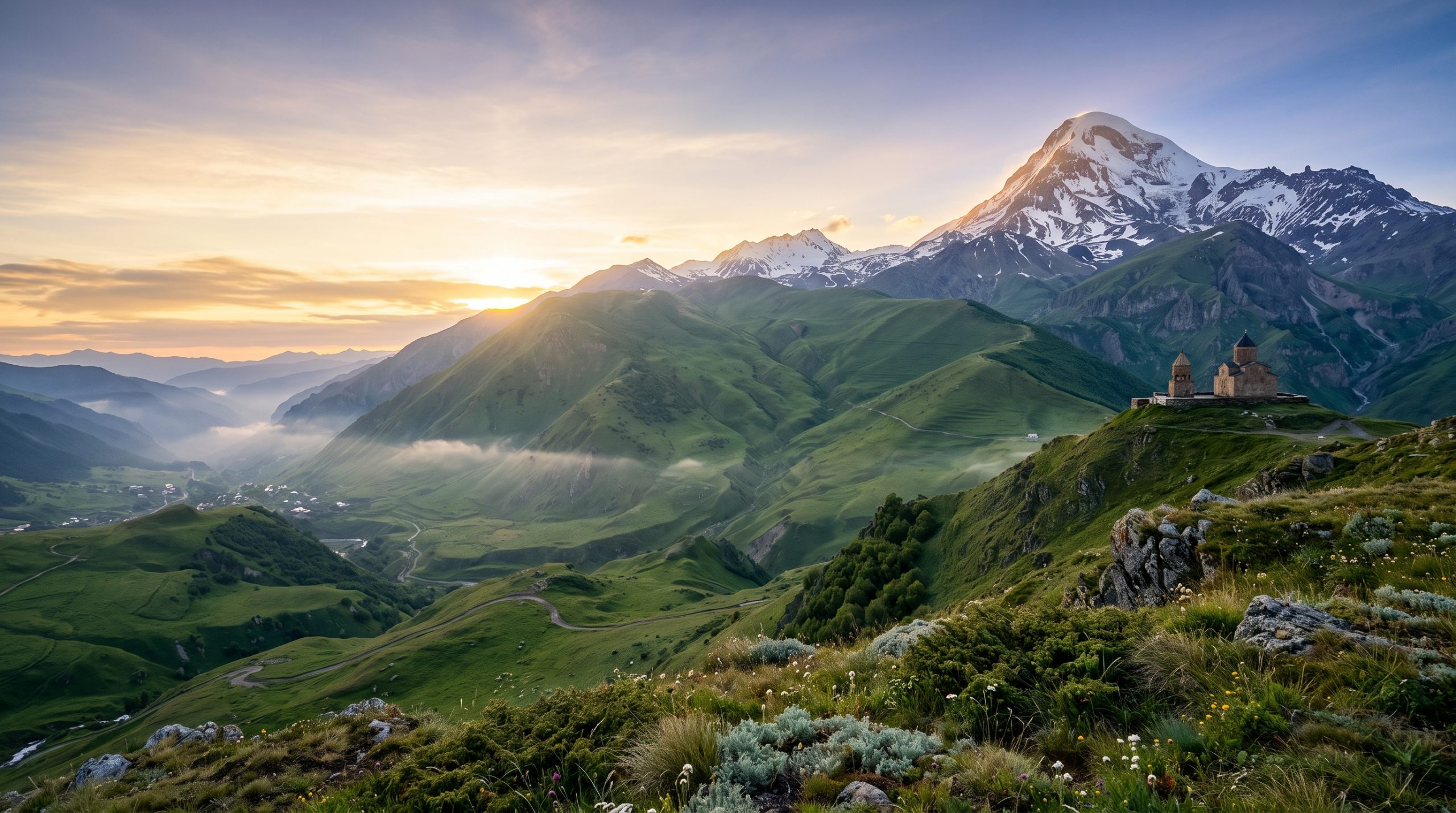
The road up to Gergeti Trinity Church was paved in 2018, and it quietly changed the best hour to be there. Any rental car now makes the climb from Stepantsminda, so the first day-trip vans out of Tbilisi reach the terrace in front of the church by late morning, and it stays the busiest thirty square meters in the Caucasus until dinner. Before eight in the morning there is nobody. Fourteenth-century stone, and a five-thousand-meter wall of mountain standing behind it.
Georgia is also one of the few countries where the legal part of marrying is genuinely simple. A civil marriage here is registered at a House of Justice or Public Service Hall, the state’s own registry counters, and with documents in order it can be finished in a morning. The complication is geography rather than bureaucracy. Those counters are in the city, and the high Caucasus begins 150 kilometers north up the Georgian Military Highway, roughly three hours of driving past the Zhinvali Reservoir and over the Jvari Pass.
We are eight people, four photographers and four filmmakers, and we plan these days as well as shoot them. We are currently taking Georgia elopement bookings for 2027 through 2029. We would also rather tell you the unflattering thing early: Kazbegi is often overcast, and that single fact shapes more of our Georgian planning than anything else on this page.
Registry in Tbilisi, vows under Kazbek
We are an eight-person team of photographers and filmmakers who plan, shoot and film elopements across Georgia, from the registry counters in Tbilisi to the saddle below Gergeti Trinity Church. A full day with one dedicated photographer or filmmaker starts at $4,900. A day with a photographer and a filmmaker working together starts at $7,900, team travel included.
A Kazbegi morning, and the hour the vans arrive
The first thing we do with a Georgian timeline is refuse to start it in Tbilisi. Leave the city at five and you reach the Gergeti saddle around eight, by which time June’s best light is an hour gone and the terrace is filling up. You sleep in Stepantsminda, or in Gudauri half an hour back down the highway, and the morning becomes possible.
Georgia does not put its clocks forward, so the sunrise time you look up in February is the sunrise time you get in February. In late June, light reaches the valley before six. It does not reach the ground. Kazbek takes the first color while the valley floor is still blue and cold, and the gap between a lit summit and a dark valley is the most useful twenty minutes of the day. We are standing in position before it opens, not walking toward it.
By half past seven the light on the church has flattened and the road below is working. That is the schedule rather than a problem. We leave the terrace as it fills and take the rest of the morning south into Sno Valley, a wide green floor with a river down the middle and, most mornings, nobody else on it. If the ground is dry we keep going toward Juta, higher and rougher, where the walking starts to count.
The registration is the one piece that will not compress. You cannot be at a Tbilisi registry counter and on the Gergeti saddle in the same morning, because the highway does not allow it. So the legal half hour goes on the arrival day, in the city, and we drive north afterwards. That drive is not a transfer. Ananuri fortress stands on the edge of the Zhinvali Reservoir about an hour out of Tbilisi, and the Soviet-era Friendship Monument sits on the rim above Gudauri, a curved concrete amphitheater lined with mosaic that faces straight into the afternoon sun. Both of those are locations, and we build in the time to stop at them properly rather than photograph them through a window.
Evenings here work backwards from the ridge line, not from the almanac. The valley is walled high enough to the west that direct sun leaves the grass well before the printed sunset, and what follows in June is a long blue hour with snow still lit high on Kazbek above a dark valley. We plan the last frames to that ridge, and then it is khinkali in a guesthouse kitchen, because the alternative is a long drive on an empty stomach and nobody has ever regretted the dumplings. The order of the day is what couples get wrong first, and our guide to planning an elopement works through it from scratch.
Two cameras on the Gergeti saddle, and why the wind matters
There are perhaps two compositions on that saddle that hold the church, Kazbek and the two of you in the same frame at the right scale. A photographer and a separately hired videographer both want both of them, in the same eight minutes of color, and the negotiation happens in front of you while the light goes. We have watched it happen to other people’s mornings. It is the single strongest argument for photography and film coming from one team who wrote the timeline together weeks earlier.
In practice that means one of ours climbs the slope for the wide film frame while the other stays close for the vows, and they trade positions on a nod rather than a conversation. Nobody is stepping into anybody’s shot, because the shot list was agreed in the same document as the driving times. With eight of us on the roster there is always a second camera on the ground and a colleague in reserve.
Wind is the other reason this valley rewards a filmmaker who came prepared. At 2,200 meters above sea level on an exposed saddle, the air rarely stops moving, and on-camera audio in that environment is worthless. The Expedition carries professional audio for vows and the moments that matter where conditions allow, which is why your vows exist afterwards as sound and not only as footage of two people’s mouths moving. The same wind is a gift for the picture. Veils, coat hems and low cloud pouring over the saddle all move, and moving landscape is what film has that stills do not.
Aerials run on rules and a window. Georgia’s Civil Aviation Agency governs drone flying under the Air Code, with a framework aligned to the European one: the aircraft registered in the national database, kept in sight, and flown under a 120-meter ceiling. This particular valley also runs north toward a state border, so the aerial plan for Kazbegi is agreed by location and by time slot before we fly out, and where the answer for one spot is no, the shot simply moves to the next one. That is planning, not luck. If you want to see how the two halves look when they come out of the same team, our published stories and films are the honest test of it.
When the mountain will not show itself
Here is the objection nobody selling Georgia writes down. Kazbek hides. The valley collects cloud, mornings arrive gray, and the mountain that brought you 150 kilometers north can stay behind a ceiling for a couple of days at a time. Every couple asks about it in the last week before booking, and the answer is a plan rather than a reassurance.
Three things do most of the work. We build two mornings into any Kazbegi day rather than one, so the vow hour can move to the better of them and we decide the night before, not at 4am on a fixed date. We hold lower-altitude ground in reserve, because Sno and the Truso valley floor stay workable when the high saddle does not. And we treat cloud as a frame in its own right, since Gergeti with a ceiling moving through it and no summit at all is one of the strongest things in the region. Where a couple wants the mountain itself, two to seven days of coverage under The Odyssey buys the one thing that genuinely raises the odds, which is more mornings.
| Season | What the valley usually gives | How we shape the day |
|---|---|---|
| Late May to June | Green valley floor, deep snow still high on the peaks, changeable skies | Long light, early starts, high tracks treated as a bonus rather than a plan |
| July and August | The most settled weather and the largest crowds, with accommodation at its highest | Church before eight, upper valleys through the middle of the day |
| September to mid-October | Autumn color, quieter roads, weather that turns fast | Two-morning planning, more time held in Sno and Truso |
| November to March | Around nine hours of daylight in December and January, snow on everything | A Gudauri base, short travel legs, the whole day built inside the light |
Tell us the month you are considering and we will tell you what this valley usually does in it, including when a different region of Georgia would serve you better. Check Your Date.
What the fee covers, and the lari that goes elsewhere
Photography, film and planning are one service here, not three invoices. Every experience includes destination and location design, a custom timeline built around real light and real driving times on the Military Highway, permit research and logistics guidance, and weather alternatives worked out in advance rather than improvised on the morning.
- Drone footage where it is legal, safe and appropriate, with the Kazbegi aerial plan confirmed before we travel.
- Professional audio for vows on The Expedition, where conditions allow.
- Team travel worldwide, included: flights, accommodation and ordinary travel for the assigned team, with no long-haul surcharge for reaching Tbilisi.
- Highlights delivered in 5 days, and the full gallery or film in 3 weeks.
- A price that does not change with guest count. Numbers affect access, permits, transport and timeline, never the fee.
What you pay elsewhere is worth naming plainly, and in Georgia most of it is small. The registry’s own charges are measured in tens of lari rather than hundreds: currently around 50 GEL for standard marriage registration, roughly double that for same-day processing, and about 50 GEL again for the apostille that makes your certificate work abroad. Add a notarized Georgian translation of your passports. Then the ordinary things: rooms in Stepantsminda or Gudauri, food, a celebrant if you want a ceremony separate from the civil registration, and any permit fee a specific venue or landowner charges. Unusual transport sits outside the fee too, which in this region means a chartered 4×4 for the upper Truso or Juta tracks, a mountain guide, or a helicopter if you want Kazbek from the air.
Coverage runs from The Adventure, one full day with a single dedicated photographer or filmmaker, up through The Expedition, one day with both working alongside each other, to The Odyssey, which covers two to seven days across one or several regions and is quoted as a custom proposal. The full breakdown lives on our pricing page, and there is no half-day version of any of it.
How a Georgia enquiry moves from first message into planning
- Send the inquiry form with your dates and the shape of day you have in mind.
- We reply within 24 hours with an initial brochure.
- We write a tailored proposal: the assigned team, the coverage, and a first timeline built on your actual date.
- Contract signed, 30% retainer paid. The remaining schedule is set out in the proposal.
- Planning begins in earnest, with locations, permit research, the hour-by-hour timeline and named weather alternatives.
- After the day, highlights reach you in 5 days and the full gallery or film in 3 weeks.
The morning this country asks of you
Georgia suits couples who are willing to be walking uphill before the day starts, who do not mind uneven ground and thin morning air at 2,200 meters, and who can hear the words “the plan has changed, we are going to Sno instead” without their shoulders dropping. The good hours here are early and they are outside. Guesthouse kitchens beat hotel ballrooms, and the best afternoon of your week may well be the one you spend on a gravel road with a river beside it.
If that is not your idea of a good morning, the answer is a different shape rather than a different country. Kakheti’s vineyards around Sighnaghi are gentle, warm and largely flat in September, and the ceremony can happen at a civilized hour. The Black Sea coast is a different Georgia again. There are also months in Kazbegi that ask far less of you than a June sunrise does. Tell us what you actually want your morning to feel like, and we will either build the day around it or say honestly which region and which month fit it better. Our destination elopement guides are a reasonable place to start narrowing it down.
Common questions
Is a marriage registered in Georgia legally valid in the United States?
Yes. Registration at a House of Justice or Public Service Hall is a civil act carried out by the state registry, and Georgia is a party to the 1961 Hague Apostille Convention. The apostille added to your Georgian certificate is what makes it recognized at home, and it is issued in the same building, usually inside a couple of business days.
Can we get legally married the same day we land in Tbilisi?
With documents fully in order it can happen, and same-day processing exists for exactly that. Passports need a notarized Georgian translation, and if either of you was married before, the registry will want apostilled proof that it ended. We schedule the registry morning separately from the mountain morning, because the two do not fit into one day.
Do we need witnesses, and can you sign as ours?
A witness’s citizenship, language and nationality do not matter in Georgia, so whoever is standing with you can put their name down. If the registrar asks for two and you have flown in as a pair, the team on the ground that morning can sign. It is one of the quieter advantages of not hiring two vendors who arrive separately.
Does a ceremony at Gergeti Trinity Church make us married?
Not by itself. A religious ceremony in Georgia is not the legal act, the registry is. Gergeti is also a working monastery, so anything held on church ground is arranged with the church rather than booked online, with heads and shoulders covered inside. Most couples register in Tbilisi and keep the mountain for their vows.
How many days do we need in Kazbegi?
Two nights in Stepantsminda is the working minimum and three is better if seeing Kazbek itself matters to you. Because the valley collects cloud, an extra morning does more for your pictures than any other decision you can make. That is the situation The Odyssey exists for, across two to seven days.
Can you fly a drone over Gergeti and the Kazbegi valley?
Georgia’s Civil Aviation Agency regulates drones under the Air Code, with a framework aligned to the European rules: a registered aircraft, kept in visual sight, under a 120-meter ceiling. Because the valley runs north toward a state border, we confirm each aerial by location and time window before traveling, and move the shot when a spot is not available.
Do we need a 4×4 to reach Gergeti Trinity Church?
Not in summer. The road up from Stepantsminda was paved in 2018 and an ordinary car manages it, while the walk up from Gergeti village takes 30 to 60 minutes if you would rather earn the view. The rough tracks toward Juta and the upper Truso valley are a different question, and that is where a chartered 4×4 pays for itself.
Your date, and what happens next
Everything between your first message and the morning on the saddle happens in writing, in your inbox. Georgia runs eight or nine hours ahead of most of the United States, and nothing in our planning asks you to be awake at an inconvenient hour for it. Send us the dates you are holding, the region you are drawn to, and the one thing you would be sad to miss. We will come back with an honest read on the light, the roads and what that week usually does in the Caucasus. Tell Us Your Story.