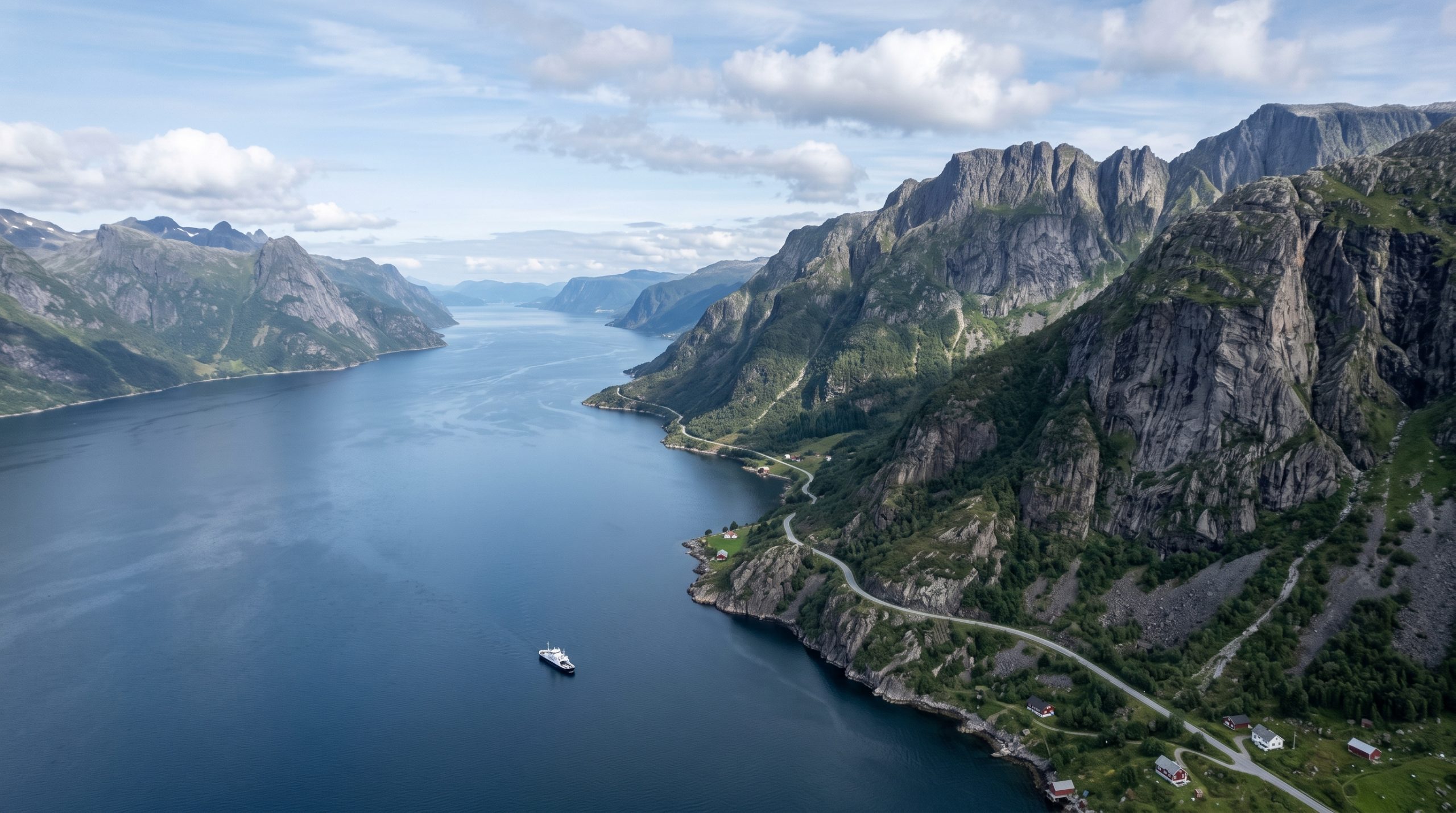
On 15 February 2027 the sun comes up over Reine at 08:27 and goes back down at 16:19, and in between it never climbs higher than about nine degrees above the horizon. That is seven hours and fifty minutes of daylight, nearly all of it at the angle most photographers get for twenty minutes a day. Add the twilight on either side and you are working from 07:25 to 17:21.
The ceremony inside that day is often the cheapest part of it. Vestvågøy, the municipality that holds Leknes, Haukland and Uttakleiv, offers civil ceremonies to couples who are not resident in Norway at all, and states plainly that for a ceremony away from the town hall the couple covers the officiant’s travel and any extra costs it creates. Small, published, easy to plan around once you know it exists. Most of the Norwegian numbers on this page look like that.
What costs real money in Norway is getting two people and a team onto the right stretch of coast at the right hour, in a country where the road, the ferry and the light all have opinions. So this page splits the total into the two halves that actually matter: what we charge, and what Norway charges.
The cost of a Norway elopement, in two halves
Our Norway coverage starts at $4,900 for one full day with a dedicated photographer or filmmaker, and $7,900 for a full day with both working together. Team travel is included, Lofoten to the western fjords. Your own side holds flights, lodging, the officiant’s travel to an outdoor ceremony, parking, permit fees and any boat or helicopter.
Eight hours of low sun: a February day on Moskenesøya
Nothing about a Lofoten winter morning is early the way a Utah morning is early. We are out at 07:20 while the two of you are still eating breakfast in a rorbu at Sakrisøy, one of us walking the shoreline to see which way the wind is pushing the water and whether the peaks across the sound are in or out of cloud.
By 08:00 the sky behind Olstinden has gone from grey to copper and you are dressed. Sunrise at 08:27 happens in the southeast and barely happens at all: the sun slides sideways rather than upward, so the light you get at half past eight is roughly the light you get at eleven. That single fact is why we schedule ceremonies here at 09:15 rather than fighting for a twenty minute window at dawn. The officiant drives out from the town hall, we put the vows in the lee of a headland where a microphone can hear them, and nobody is rushing.
Late morning is for moving. The E10 is the spine of the whole archipelago, and from Reine you are about forty five minutes from the Leknes side and twenty minutes further to the sand at Haukland and Uttakleiv. We use the middle of the day for the drive, for coffee in the car with the heater on, and for the frames that only work when the sun is at its highest and least interesting, which in mid-February is still lower than a summer evening anywhere in California.
Then the day tips back down. From about 14:45 the light warms again and keeps warming until sunset at 16:19, which on a clear day is the best hour of the entire trip. Civil twilight holds until 17:21. After that we hand you back for dinner, and if the sky clears we go out again with tripods, because the hours after a February sunset in Lofoten belong to the aurora when it decides to show.
The same day in summer inverts completely. Visit Lofoten puts the midnight sun season at 28 May to 14 July, with Uttakleiv keeping it from 25 May to 18 July, and when the sun never sets we move the ceremony to 22:30, walk out to the water at midnight and let everyone sleep until ten.
What we do when the forecast moves overnight
Atlantic weather arrives fast here and it arrives sideways. So we never plan a Norway day as one location with one hour attached to it. We plan it as a wind direction: north-westerly means the outer beaches are loud and the inner shores at Reine and Sund are workable, and a southerly flips that. Because the E10 links the bays, a decision made over breakfast puts you on a sheltered shore twenty to forty minutes later, still inside your own timeline. The ceremony hour is the most movable object in the plan once the officiant knows it might move, and we ask them that question when we book, not on the morning. There are eight of us, so there is always a second camera on the ground and a colleague in reserve.
Two cameras when the good light lasts ninety minutes
Here is the arithmetic that decides how much a day yields. On 20 September the sun is up over Reine from 06:41 to 19:20, but the portion of that day when it sits below six degrees, the portion that makes the pictures, totals roughly two and a half hours split between morning and evening. In mid-February the sun never rises above nine degrees, so that low window stretches to about three and a half hours. Under the midnight sun it runs past five hours a day. The prize changes size every month, and so does the question of how much of it one person can hold.
A single photographer switching between a stills body and a cine rig loses the middle of a moment, every time. The still frame wants you standing quietly with Olstinden behind you and the two of you small in it. The film wants you walking toward the lens, which on that shore means walking into the wind, which is a different request made of the same four minutes. When photography and film come from one team, those two requests get settled the night before over the timeline, and the couple never becomes the referee.
The Expedition adds professional audio for vows where conditions allow, and on an exposed Norwegian coast that changes where we stand rather than whether we bother. It means choosing the lee of a boulder field over the open sand, placing the officiant with their back to the wind, and knowing before we arrive that the surf at that particular bay is loud enough to matter. Aerials work the same way: inside national parks and other protected areas a drone needs a specific permit, and the airspace near the airstrips at Svolvær and Leknes needs clearance, so we confirm what is legal for your date and location before the film leans on a single aerial frame.
What that produces is best judged by looking rather than reading, so our published galleries and films are the honest version of this page. Watch what happens in the last twenty minutes before a northern sunset, and notice that the stills and the footage are looking at the same moment from two positions that were agreed in advance.
What the day comes with before you add anything
- Destination and location design for your region and your month, built from scratch rather than from a template.
- Planning throughout, and a custom timeline built around the light and real travel time on the E10 and the ferries.
- Permit research and logistics guidance, including which municipality performs your ceremony and what it needs from you.
- Weather alternatives and backup planning for every block of the day, not just the ceremony.
- Drone footage where it is legal, safe and appropriate.
- On the Expedition, professional audio for vows and other meaningful moments where conditions allow.
- Team travel worldwide: flights, accommodation and ordinary travel for the assigned team, with no long-haul distinction.
- Highlights delivered in 5 days, and the full gallery or film in 3 weeks.
- A price that does not change with your guest count.
Where coverage starts, and what Norway bills separately
The figures are at the top of this page and they sit alongside the full detail on our pricing page. The Adventure is one full day with a dedicated photographer or a dedicated filmmaker. The Expedition is one full day with both. The Odyssey runs two to seven days across one destination or several, quoted as a custom proposal because a plan that crosses from Lofoten to Senja to the Sunnmøre Alps is not a package.
Team travel is included worldwide, which in practice means getting our people to Svolvær, Leknes or Ålesund is not a line on your budget. The Norwegian side of the budget is yours, and in kroner, which currently run around ten to the dollar. It usually holds these:
- The officiant. The civil ceremony itself is commonly free, including for couples not resident in Norway. Taking the officiant out of the town hall is not: you cover their travel, and some municipalities also publish a flat surcharge for ceremonies outside their own rooms or outside office hours, generally in the low thousands of kroner.
- Parking. Most of the well-known beaches and trailheads now charge. Haukland is 20 NOK an hour, about two dollars, with the first twenty minutes free and a sixteen hour maximum, paid at the meter, through the EasyPark app or inside the café while it is open.
- Accommodation. Rorbu cabins, hotels, whatever suits you. Since summer 2028 Norwegian municipalities have been able to apply for the right to add a visitor’s contribution of up to 3 percent to overnight stays, so where it has been adopted it appears on your accommodation bill.
- Getting yourselves there. Visit Lofoten’s own routing is the sensible one: fly to Bodø, then Widerøe onward to Svolvær or Leknes. The Hurtigruten coastal ship leaves Bodø daily at 15:00 for Stamsund and Svolvær, and the Bodø to Moskenes car ferry is the option if you want your own vehicle on the islands.
- Permit and landowner fees where a specific location requires them. The research and the applications are ours; the fee itself is yours.
- Unusual transport. A RIB charter into a fjord arm, a private boat, a helicopter, a mountain guide for higher ground.
- Your own vendors. Flowers, hair, dinner, and a celebrant if you want a symbolic ceremony alongside the legal one.
None of those numbers are the reason a Norway day is worth planning carefully. They are simply knowable in advance, which is the whole point of writing them down. If you send us the region and the month, we will put the ones that apply to you into your proposal so there is nothing left to discover in week three. Tell Us Your Story and we will start with the map.
How a Norway date moves from enquiry to hold
- You send the inquiry form with your dates, or with the two months you are choosing between, and the part of Norway you keep coming back to.
- We reply within 24 hours with an initial brochure.
- We build a tailored proposal: region, coverage, the shape of the day and what the light is doing that particular week.
- You sign the contract and pay a 30% retainer, and the date is yours.
- Planning begins: location design, the timeline, permit research, the order to handle your paperwork in, and the weather alternatives.
- The remaining payment schedule is set out in the proposal. After the day, highlights land in 5 days and the full gallery or film in 3 weeks.
If you are earlier in the process than that, our guide to planning an elopement covers the fundamentals in the order they actually matter. Our planning calendar for Norway currently covers 2027, 2028 and 2029.
Which month of Norway suits you
The light does more to shape a Norwegian day than any other decision you make, so it is worth choosing the month before the island. These are real numbers for Reine in 2027, which is as close to the middle of Lofoten’s photographic territory as you can get.
| Window | Light at Reine | The day it makes |
|---|---|---|
| Mid-February | Sunrise 08:27, sunset 16:19, sun never above nine degrees | Snow on the peaks, one long low-angle light, short drives, dark evenings with aurora potential |
| Around the March equinox | Sunrise 06:09, sunset 18:24 | Twelve hours to work with and nights still properly dark |
| Late May to mid-July | No sunset at all; the sun’s lowest point stays about one degree above the horizon | Vows at 22:30 in warm light, green mountains, busy roads and full cabins |
| Late September | Sunrise 06:41, sunset 19:20 | Colour on the ridges, two sharp golden windows, far fewer cars |
Norway rewards couples who are willing to be outdoors for six hours in conditions that change, who are steady on wet rock and uneven ground, and who can hear at 07:00 that the plan has moved to a different bay without it spoiling anything. If you would rather not be on a headland in a February wind, that is genuinely useful information: late September gives you the same coastline with softer air, and the midnight sun weeks let you sleep until ten and marry near midnight. If long drives are not your idea of a good time, Lofoten’s bays sit close together while Senja and the western fjords ask more of the road.
Our destination guides go deeper region by region. Tell us what you want the morning to feel like and we will tell you honestly which month and which island give you that.
Common questions
Can we legally get married in Norway if we live in the United States?
Yes. You both need a prøvingsattest, the Norwegian marriage licence, issued by Skatteetaten, and it is valid for four months from the day it is issued. Municipalities perform civil ceremonies, and many of them, including Vestvågøy in Lofoten, extend that to couples who are not resident in Norway. For a ceremony out on the coast rather than in the town hall, you cover the officiant’s travel.
How early should we start the Norwegian paperwork?
Vågan, the municipality covering Svolvær and Henningsvær, puts Skatteetaten’s processing time at two to three weeks, and the licence is only valid for four months, so the filing window is narrower than most couples expect. We work backwards from your date and tell you which week to file. Two sponsors each submit a statement, they must be 18 or over, you cannot act as sponsors for each other, and they do not have to be the people standing beside you.
Do we pay for your flights and accommodation in Norway?
No. Team travel is included worldwide, so flights, accommodation and ordinary travel for the assigned team are covered whether the day happens in Lofoten, on Senja or in the western fjords. There is no long-haul supplement and no distinction between destinations.
Do we need a permit for a ceremony on a Lofoten beach?
Often not. Norway’s tradition of open access is generous, and many of the shorelines we work on need no ceremony permit at all. Protected areas, certain private land and access, and drone flights are the exceptions, and permit research is part of every experience. Where a fee applies, it is paid by you and it appears in your proposal rather than as a surprise.
What happens if the weather is wrong on our date?
We build the day as a set of options rather than one itinerary, and we choose between them on the morning based on wind direction and cloud base. The alternatives are researched in advance, which is why they take twenty to forty minutes to reach rather than half a day. Rain in Lofoten also photographs extremely well, and a low ceiling on the peaks is often better than a blue sky.
Is December too dark for photography in Lofoten?
It is dark, and it works. In Svolvær the sun stays below the horizon from 7 December to 5 January, and the middle of those days is a long blue twilight with real, usable light in it. December days are short, so we build them tightly, use the harbour lights at Henningsvær and Svolvær, and keep the evening open in case the sky clears.
Does it cost more if six people come with us?
No. The price does not change with guest count. Guests change access, permits, transport and the timeline, which is planning work rather than a fee, so tell us the number early and we design the day around it.
How soon do we see the photographs and the film?
Highlights are delivered in 5 days, while you are probably still travelling. The full gallery or film follows within 3 weeks.
Tell us the month you can already picture
We keep every planning decision in writing, which suits a plan that crosses seven time zones: the brief, the proposal, the timeline, the paperwork order and the question that occurs to one of you at 1am. Send the form with your dates, or with the two months you are weighing against each other, and we will reply within 24 hours with a brochure and a first read on what that week of light will give you. Check Your Date and we will take it from there.