The marble gate on the islet of Palatia faces west. The Naxians began that temple around 530 BC and never finished it, and the only part they completed is the doorway, four blocks of about 20 tons each, standing in the middle of foundations and a colonnade that was never raised. Because it opens toward the sunset, the platform is shoulder to shoulder by evening in August. At ten past six in the morning there is nobody on it at all.
You reach it on a paved footpath from the edge of Chora, and the site is free and open around the clock. That one fact decides the shape of most days we plan on this island. Nobody has to open a gate for us. The only competition at that hour is other people’s alarm clocks, and very few of them are set for five.
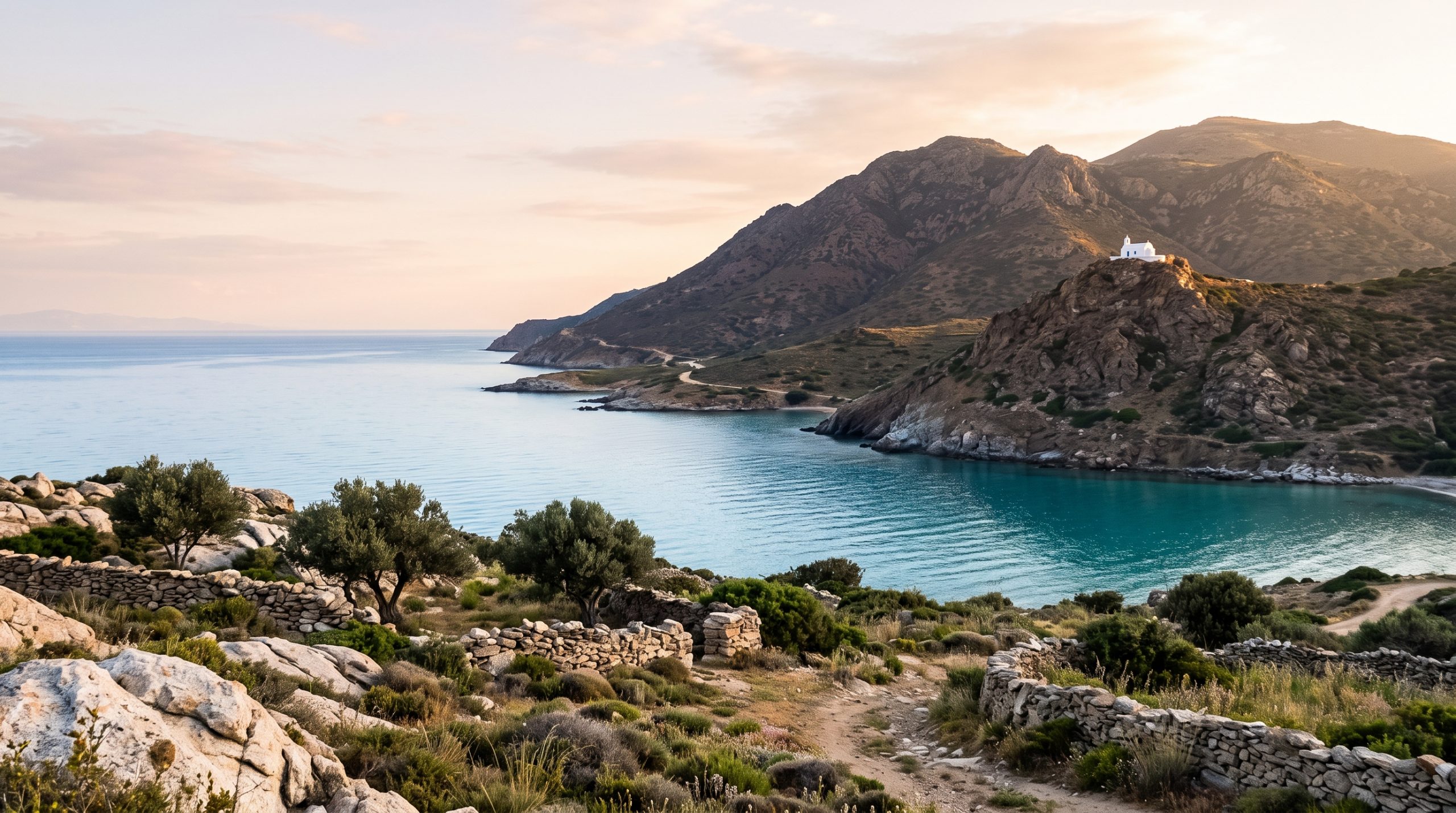
Naxos is also the largest of the Cyclades and the one with real mountains. Zas rises just over 1,000 meters, the highest ground in the island group, with the cave linked to Zeus roughly 628 meters up its western slope. You can stand on a threshold at sea level at sunrise and be on bare rock above Filoti with the whole Aegean behind you before dinner, and that vertical range is the reason we keep coming back here rather than to the islands next door.
Naxos in one paragraph
We are an eight-person team of photographers and filmmakers who plan and shoot elopements on Naxos as one service: photography, film, location design and permit research together. One full day of coverage with a dedicated photographer or a dedicated filmmaker starts at $4,900, and team travel to Greece is included in every experience.
Palatia at first light, the ridge at dusk: how a Naxos day runs
Light is the only thing on this island you cannot negotiate with, so we build backward from it. In mid-June the sun clears the horizon around six in the morning and sets around twenty to nine in the evening. At this latitude the useful glow after sunset lasts about half an hour, not the long slow fade you get further north, which means the last block of the day is short and has to be in position before it starts.
| Month | Sunrise | Sunset | Usable light after sunset | What that does to the day |
|---|---|---|---|---|
| Mid-May | around 6:10 | around 20:20 | about 30 minutes | Long day, mild ground, thin crowds at Palatia even in the evening |
| Mid-June | around 6:00 | around 20:40 | about 30 minutes | Two early alarms and a real midday break in the middle |
| Mid-July | around 6:10 | around 20:40 | about 30 minutes | Same spine, but the wind and the heat set the location order |
| Mid-September | around 7:00 | around 19:25 | about 25 minutes | Everything tightens by nearly two hours, warm sea, easier mornings |
| Mid-October | around 7:25 | around 18:40 | about 25 minutes | Ceremony can sit in late afternoon and still catch the coast |
Here is how a June day usually runs. We meet on the causeway at a quarter past five, in the dark, with coffee from a thermos rather than a cafe. First light hits the marble before the sun does, and for the twenty minutes between the two the gate turns from gray to pink while the harbor is still asleep. From the town side the blocks are front-lit with nothing but water behind them. Step around to the seaward face and the same gate frames Chora and the Kastro climbing the hill above it.
By quarter to seven we are walking back into the old town, and this is the hour most visitors miss entirely. The Kastro lanes are narrow, whitewashed and paved in marble that reuses whatever the centuries left lying around, and before the shutters go up they belong to one cat and one bread delivery. Two hours later the same alleys are full and the light is straight overhead and hard. We would rather be somewhere else by then, and usually that somewhere is inland.
Sangri is a twenty-five minute drive south, and the Temple of Demeter sits about a kilometer and a half below the village at Gyroulas, built from local Naxian marble around the same decade as the unfinished temple at the harbor and partly re-erected by Greek and German archaeologists from the mid-1990s. It is a fenced site with museum hours: the gate opens at 8:30, it closes in the early afternoon, and it is shut on Tuesdays. That rules out any golden-hour idea there, so we treat it as a mid-morning location and put the ceremony either on the olive terraces around it or in the shade of a courtyard nearby.
Midday is for eating and lying down. Between noon and five the sun is unhelpful, the wind is at its strongest and the interesting ground is either baking or busy, so we build a genuine break into the timeline instead of pretending professionals can shoot straight through a Cycladic afternoon. Late afternoon goes high or goes coastal. High means the Zas paths, either the gentler line that starts at the Agia Marina chapel or the longer approach past the cave, with terraces and stone walls the whole way up. Coastal means the west and southwest sand, wide dunes and shallow water and space to be alone in.
The last hour is a decision, not a default. Most couples want the sun down over the sea, so we are on the coast for it. Some want the gate again, and the honest advice there is to wait: in high summer the Portara at sunset is a viewing platform with a queue for the same photograph, while the same rock thirty minutes after sunset is nearly empty, the sky is deeper, and the town has switched its lights on behind you. We have shot both. The later one is the better frame almost every time.
If you already have a week or a month in mind, Check Your Date and tell us which end of the day matters more to you. We will send back a shape for it.
When the meltemi is up
This is what couples actually write to us about, and it deserves a straight answer. The meltemi is the dry northerly that prevails across the Aegean from May to September and peaks from mid-July to mid-August. It typically builds through the morning and eases toward evening, it runs in spells of a few days rather than all summer, and the hardest of it in this island group is felt around Mykonos, Tinos and Evia rather than here.
Because it has a direction, it can be planned for. Northerly wind means the lee is on the southern side of every headland, and Naxos has a long, indented coast full of them. So the timeline names a wind alternative for each block rather than one vague backup: the exposed dunes if the morning is calm, a south-facing cove fifteen minutes away if it is not, vows behind a wall or on a terrace where the air is still, portraits back out on the open ground once the vows are recorded. If your dates land in the peak weeks we will say so plainly and suggest the two shoulder windows where wind and heat both drop, and if those weeks do not work for you we build the day around the lee instead. Either way you hear it from us before you book, not on the morning.
Sound, aerials and the second angle on a crowded rock
Photography and film want different things from the same forty minutes, and on Naxos the conflict is unusually sharp. At six in the morning on Palatia a photographer wants the couple on the seaward edge, small under the gate, moving slowly. A filmmaker wants that too, plus a clean line of movement, plus a microphone that is not being scoured by a north wind, plus nobody else in the wide shot. One person cannot serve both roles. Two people who met for the first time that morning will spend the hour negotiating instead of working.
We assign the rock before we walk onto it. Photographer low and wide on the seaward side, filmmaker up on the footpath with a long lens, a swap at an agreed minute, and the crowd factor solved by being there before the crowd exists. The plan is not a courtesy between two vendors, it is a schedule written by the same team that then goes out and shoots it.
Sound is the part couples underestimate here. Vows spoken on an exposed marble platform in July are vows spoken into wind. The Expedition adds professional audio for vows and the moments that matter where conditions allow, which is exactly why the ceremony location gets chosen for the microphone and the portrait location gets chosen for the view. Those do not have to be the same place, and on this island they usually should not be. A courtyard in the Kastro, the sheltered side of a terrace wall at Sangri, a cove set below a headland: any of them will hold a voice, and the ridge is still fifteen minutes away when you want it.
Aerials work the same way. Greece runs the European drone framework with a national layer on top, and both aerial filming and work at monuments and archaeological sites need permission from the authority that governs them. So we research it, confirm the window, and place the aerial ground away from the protected sites, out over the dunes and the terraces and the water. The film is never built to depend on a shot we have not cleared, and where drone work is legal, safe and appropriate it is included rather than sold as an extra.
What that combination looks like when it is finished is easier to see than to describe, so it is worth spending ten minutes in our published galleries and films before you decide how you want your own day covered. The stills and the film are the same day told twice, by two people who were standing three meters apart because a plan put them there.
What travels with us, and where Naxos coverage starts
Every experience, on Naxos and everywhere else, includes the following.
- Destination and location design across the island, from Palatia and the Kastro to the Sangri terraces, the Zas paths and the southwest coast.
- Full planning and a custom timeline built around real light and real driving time, not a template.
- Permit research and logistics guidance for the sites you want, including the archaeological ones.
- Weather alternatives and backup planning, with named substitutes for wind, heat and swell.
- Drone footage where it is legal, safe and appropriate.
- Professional audio for vows and meaningful moments on the Expedition, where conditions allow.
- Team travel worldwide: flights, accommodation and ordinary travel for the assigned team, with no European or long-haul distinction.
- Highlights delivered in 5 days, and the full gallery or film in 3 weeks.
There are eight of us, four photographers and four filmmakers, which is the practical reason any of this holds together. There is always a second camera on the ground and a colleague in reserve. Our Cyclades calendar is currently open across 2027, 2028 and 2029.
The Adventure is one full day with a dedicated photographer or a dedicated filmmaker. The Expedition, from $7,900, puts a dedicated photographer and a dedicated filmmaker on the same day, working together from the same timeline. The Odyssey runs from two to seven days across one or several destinations with photography and film throughout, costed as a proposal once we know the shape of it. Full detail sits on the coverage and pricing page, and the fee does not move with your guest count.
Team travel to Greece is inside that figure. Flights, accommodation and the ordinary travel of whoever is assigned to your day are ours to pay, on Naxos exactly as anywhere else.
What Naxos adds on top, paid by you directly, is short and predictable. Government, venue and landowner permit fees, including any Ministry of Culture licensing where professional work happens inside an archaeological site, and the municipality’s own charge for a civil ceremony. Your accommodation, your celebrant and any vendors you want. Transport: ferry tickets from Piraeus start around 52 euros one way, a rental car for the week is worth having, and anything unusual such as a chartered boat out to the Small Cyclades or a 4×4 up a rough track is booked separately.
How a Naxos enquiry becomes a held island date
- Send the inquiry form with your dates, your rough plan and anything you already love about Naxos.
- We reply within 24 hours with an initial brochure and our first questions.
- We build a tailored proposal: locations, hour-by-hour timeline, coverage option, permits to chase.
- You read it, ask for changes, and we revise until the day is the one you want.
- Contract signed and a 30% retainer paid, which holds the date. The remaining schedule is set out in the proposal.
- Planning begins in earnest, and it runs until we meet you on the causeway.
Couples who do well on Naxos
The island rewards people who will get up at five for forty minutes of light, walk on uneven marble and dry stone in decent shoes, and eat lunch at two because the plan says the afternoon is for resting. It suits couples who want a landscape that changes character three times in one day, and who would rather be alone on a rock at dawn than photographed in front of a famous view at the hour everyone else shoots it.
If early starts are not your idea of a good morning, say so in your first message. There is a gentler version of this day that leans on late afternoon and evening, and there are months where the shape works better for it, and we would much rather build that with you than watch you push through a schedule you never wanted. The same goes for uneven ground, for boats, for heat. Tell us what you actually want and we will shape the day around it, or tell you honestly which weeks and which side of the island fit it better. If you are earlier in the process and still deciding what an elopement even looks like, our guide to planning one covers the fundamentals before location comes into it.
Common questions
Can we legally marry on Naxos as Americans, or does it have to be symbolic?
Both work. For a civil marriage you apply to the municipality that governs your location, and the license is generally issued about eight days after the application is submitted. Each foreign partner submits their own set of documents, the marriage certificate is valid for six months, and a civil ceremony can be performed anywhere in Greece. You will need two witnesses, one of whom acts as interpreter, carrying passports. Greece legalized same-sex marriage in 2024, so this applies to every couple. Many couples marry at home and hold a symbolic ceremony here instead, which removes the paperwork entirely.
Do we need permission to photograph and film at the Portara?
The islet at Palatia is free and open around the clock for visitors, but professional photography and filming at archaeological sites and monuments in Greece sit under Ministry of Culture licensing, and fees can apply. Permit research and the paperwork are part of what we do; the fee itself is paid by you. We confirm the position for your specific date before the timeline depends on it.
Is August too windy on Naxos for an elopement?
August is the peak of the meltemi, along with the second half of July, and it usually builds through the morning and softens in the evening. It is workable with a plan that respects the direction. We put exposed locations early or late, keep south-facing alternatives fifteen minutes from each one, and record vows somewhere sheltered. Late May, early June and the second half of September give you calmer air with the same warm sea.
Should we fly to Naxos or take the ferry from Athens?
Flying is quick: 40 to 50 minutes from Athens into an airport with a 900 meter runway about 3.5 kilometers from Chora, which means small aircraft and few seats. Ferries run year-round from Piraeus with up to seven crossings a day in season, roughly three and a half hours on a high-speed catamaran or five to five and a half on a conventional ship, docking in Chora itself. We plan the day around your arrival, not the other way round.
Can you film with a drone on Naxos?
Often, yes, and it is included when conditions allow. Greece applies the European drone rules with national requirements on top, and aerial filming needs permission, with separate written consent required over monuments and archaeological sites. We research and confirm before planning, then place the aerial work where it is cleared, which on Naxos usually means the coast, the dunes and the mountain terraces rather than the protected sites.
Does it cost more if we bring our parents and a few friends?
No. The fee does not change with guest count. Guests affect access, permits, transport and how the timeline is built, so we need to know the number early, but they do not change what you pay us. The coverage options are the same whether it is the two of you or the two of you plus twelve.
Can we spend two or three days and include the Small Cyclades?
Yes, and Naxos is a good base for it. Boats run from Chora to Koufonisia, Schinoussa, Iraklia and Donoussa, and multi-day coverage across one or several destinations is what the Odyssey is for. Tell us how many days you have and we will propose a route that does not spend all of them on ferries.
Writing to us about a Naxos date
All of this happens in writing, at whatever pace suits you and whatever time zone you are in. You send us the dates and the rough idea, we reply within 24 hours with a brochure and questions, and a tailored Naxos proposal follows. Nothing is committed until a contract and a retainer, and the planning that comes after it is where the day actually gets built.
If Palatia at six in the morning sounds like your kind of start, Tell Us Your Story and we will tell you what that week of the year is doing on this island.