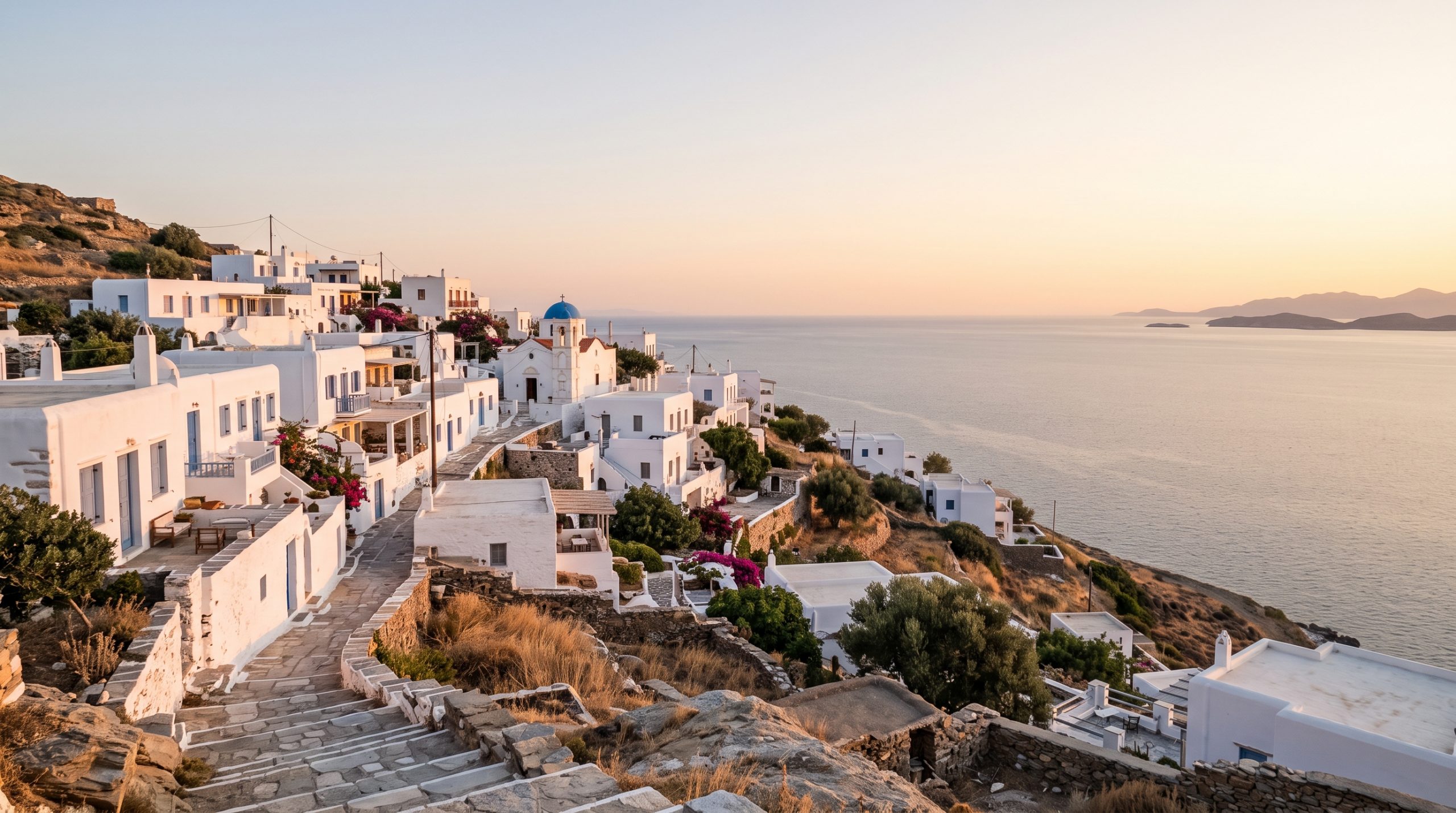
On Paros in the third week of June, the sun is at its highest at about 1:20 in the afternoon. Greece keeps UTC+3 through the summer and the island sits at 25 degrees east, so the whole day lands late: first light near 5:30, sunrise around 6, sunset around 8:45 in the evening, and enough glow afterwards to keep working past 9. Plan a Paros day on American instincts about when evening happens and you will lose two hours of the best light on the island.
The wind is the other thing nobody puts in writing. The meltemi comes down the Aegean from the north, and it is at its most insistent in July and August. It usually builds through the morning and eases toward evening, which is why Golden Beach on the southeast coast is a windsurfing address and why an itinerary that puts you on an exposed north-facing headland at eleven in the morning was written by somebody who has never stood on one.
We are eight people: photographers Serg, Alex, Alex and Viktoria, and filmmakers Lara, Mike, Anthony and Stas. Photography, film and planning are one service, not three vendors introducing themselves in a hotel driveway at dawn. Paros rewards that, because a good day here moves. Rounded granite coves on the north coast, marble-paved lanes in the hill villages, and a seven-minute car ferry across the channel from Pounta to Antiparos.
One team for photo, film and planning on Paros
We photograph, film and plan Paros elopements as a single service. Our own team designs the locations, the paperwork route and the hour-by-hour timeline around the island’s late light and its north wind, then shoots the day itself. A full day of coverage starts at $4,900, with either a dedicated photographer or a dedicated filmmaker.
Hour by hour: a late-September day from the east coast to the Antiparos channel
Late September is the week we would choose if you let us. Sunrise is around 7:05, sunset around 7:20 in the evening, and the sea still holds all of August’s warmth. This is the shape of a day we would build, with the real times rather than rounded ones.
- 05:45 We meet you where you are staying. The drive to the east coast takes almost nothing on an island that is not awake yet.
- 06:40 First light on the east side, around Molos or Ambelas. The sea is flat because the meltemi has not woken up. Calmest air of the day, and the first window for aerials.
- 07:06 Sunrise over the channel toward Naxos, then roughly 35 minutes of low, sideways light before the contrast hardens.
- 08:00 Vows, if yours are symbolic. The wind is still asleep and this is the easiest hour of the whole day for recording what you say to each other.
- 09:00 Breakfast in a village that is up before the day-trippers reach it.
- 10:30 The civil ceremony slot, if you are marrying legally on the island. That hour belongs to the municipality’s clock, not ours.
- 11:30 Inland to Lefkes. Marble-flagged lanes, deep shade at the right hour, and a whole ridge between you and the north wind.
- 13:14 Solar noon. We stop, and you swim or sleep. Nothing we could shoot between one and half past four would stand next to what we get at either end of the day.
- 17:00 Back out. The granite at Kolymbithres, or the Naoussa harbor front with the half-sunken Venetian fortress at the mouth of it.
- 18:48 Golden hour proper, on the west-facing side of the island.
- 19:22 Sunset, the sun dropping behind Antiparos across the channel.
- 19:50 Last usable light. The 25 minutes after sunset are the ones the film wants most, and they are the reason we do not book dinner for 8pm.
Move that day to mid-July and every number slides later by more than an hour. Move it to the second week of October and the whole thing compresses into civilized hours. The differences are big enough to change which coast you get married on:
| Week | Sunrise | Sunset | Light gone by |
|---|---|---|---|
| Third week of June | around 06:00 | around 20:45 | 21:15 |
| Mid-July | around 06:10 | around 20:40 | 21:10 |
| First week of September | around 06:50 | around 19:50 | 20:15 |
| Third week of September | around 07:05 | around 19:20 | 19:50 |
| Second week of October | around 07:25 | around 18:50 | 19:20 |
After the clocks go back on the last Sunday in October, sunset on Paros arrives before 5:30 in the afternoon. A late-October day is short, and all of it happens in hours you would call reasonable.
One hour is not ours to move. Under Greek practice the mayor sets, by standing decision, the days of the week and the start time for civil ceremonies, and can designate outdoor municipal spaces as well as rooms inside the town hall. So we build the light around the ceremony rather than the other way round, and we ask you about the paperwork route early. If you are still working out what a legal Greek ceremony involves versus a symbolic one, our guide to planning an elopement from the beginning covers the groundwork we take couples through.
The meltemi, and where we go when it blows
This is what couples actually write to us about, so here is the straight version. The meltemi is a dry north wind that funnels down through the Cyclades, most reliable from late June through August, and at full strength in the Aegean it reaches 7 to 8 on the Beaufort scale. It also has a daily rhythm: it gathers through the morning and drops off in the evening. Paros sits directly in its path, which is exactly why the island produced a generation of world-class windsurfers.
None of that moves a date. It changes the order of the day.
- Exposed ground goes early. North coast headlands and the Ai Yannis Detis peninsula get the two hours after first light, when the air is still. The beach cafe out on that peninsula opens at 10am in summer, so our hour there sits well before the place has a day at all.
- Every location on the plan has a sheltered twin. The southwest bays near Parikia and the inland villages of Lefkes, Prodromos and Marpissa sit behind terrain. A fifteen-minute drive changes the wind more than an hour of waiting for it to ease.
- Aerials are scheduled for the calm ends of the day and confirmed in advance, not attempted on the off chance.
- We are honest about fabric. A long veil on the Naoussa breakwater at six in the evening in August will fly, and that is sometimes the best frame of the day. It also means you cannot hear each other, which is why the vows go somewhere sheltered even when the wide shots do not.
- We ask you to land on the island a day ahead rather than on the morning. Aegean ferry timetables answer to the weather, and a couple already on Paros is unaffected by that.
Two cameras on the granite, and what the film hears
Kolymbithres is granite that wind and water have rounded into shelves and partitions, standing in shallow, very clear water. In low sun it does something particular: the rock turns gold and every edge throws a hard shadow across the sand. That lasts about half an hour after sunrise. A photographer wants you still, framed in the gap between two boulders, wide and then long. A filmmaker wants you walking through that same gap twice, from two positions, with the water in the foreground.
One person cannot deliver both inside thirty minutes. The version where a photographer and a separately hired videographer meet for the first time that morning is a negotiation, conducted in whispers, while the light you flew to Greece for goes flat. Our filmmaker’s needs are already in the timeline because the same team wrote it, which means the walking shot and the still frame were planned as one sequence weeks earlier.
Audio is where it matters most on this island. The Expedition includes professional audio for vows and meaningful moments where conditions allow, and on Paros that condition has teeth. A hard northerly across open ground sits on top of every word you say. So we pick the vow spot for the microphone and the surrounding frames for the camera, and on a windy morning those two things can be two hundred meters apart. That trade only gets made well by people who planned the morning together and are both standing there.
Aerials work the same way. Greece runs the European open-category framework, drone operators register nationally, and airspace is checked in the country’s Drone Aware Greece system before a flight goes into a plan. Paros has its own airport on the island, and archaeological ground anywhere in Greece needs written permission from the Ministry of Culture, which shapes where a camera can be in the air at all. We settle that on paper first and fly in the calm window. Drone footage is included wherever it is legal, safe and appropriate.
Eight of us on the team means there is always a second camera on the ground and a colleague in reserve. If you want to see how Aegean light and Aegean wind actually render before you commit to any of this, our published galleries and films are the honest answer to that question.
What we bring, what comes back, and where coverage starts
Every experience includes the same planning work. Not a document, but decisions made for the specific week you are coming:
- Destination and location design, built for your dates rather than a general list of beaches.
- A custom timeline around light and honest travel time between coasts.
- Permit research and logistics guidance, including which sites need written permission and which do not.
- Weather alternatives and backup planning, which on Paros means the sheltered twin of every location.
- Drone footage where it is legal, safe and appropriate.
- Team travel worldwide. Flights, accommodation and ordinary travel for the assigned team are included in every destination, with no long-haul distinction.
- Highlights delivered in 5 days. The full gallery or film in 3 weeks.
The Adventure is one full day with one dedicated photographer or one dedicated filmmaker. The Expedition is one full day with a dedicated photographer and filmmaker working together, from $7,900, and it adds professional audio for the vows. The Odyssey runs from two to seven days, photography and film, across one or several destinations, quoted as a custom proposal. There is no half-day version of any of it, and the full detail sits on our coverage and pricing page. Your guest count does not change the fee. It changes access, permits, transport and the timeline, which is a planning conversation rather than a billing one.
What you pay directly on Paros: government, venue and landowner permit fees, where they apply. Official Greek revenue stamps for a marriage license, currently 15 euros per applicant. Certified translations and Apostille certification of your documents, plus the paid announcement of the marriage in a daily newspaper that forms part of the file. Accommodation, your celebrant, and any vendors or activities you want in the day. Car ferry tickets if we cross to Antiparos, and charter costs if we reach a cove by private boat rather than by road. Sunbed and site charges at organized beaches. We do the research and the guidance on all of it.
If you have a week in mind, send it to us with the shape of day you want and we will tell you what is possible in that light. Check Your Date.
How a Paros enquiry becomes a held island date
- You send the inquiry form with your dates, your destination thoughts and how many people will be there.
- We reply within 24 hours with an initial brochure and our honest read on the week you have picked.
- We put together a tailored proposal: the coverage that fits, the shape of the day, the locations we would build it around.
- You sign the contract and pay a 30% retainer to hold the date and the team.
- Planning begins. Locations, timeline, permit route, travel between coasts, weather alternatives.
- The remaining payment schedule is set out in the proposal, so nothing about money arrives as a surprise later.
Who Paros fits, and which month fits you
Paros suits couples who are willing to be up at a quarter to six in September, who are steady on uneven granite and on marble that centuries of feet have polished smooth, and who are relaxed about a plan that changes coast on the morning because the wind said so. It suits people who want dinner at a harbor taverna afterwards rather than a reception. It suits anyone who likes the idea of a day that includes a swim in the middle.
If a pre-dawn start is genuinely not your idea of a good morning, tell us, because there is a different shape of day here. Mid-July gives you usable light until past nine at night, which means the whole thing can run from mid-afternoon to late dusk with no alarm at all. If you want the calmest, emptiest version of the island, late September and October read very differently from August, when Naoussa’s harbor front in the evening is shoulder to shoulder and the fortress breakwater is one of the most photographed spots in the Cyclades. And if what you actually want is a caldera edge or a Nordic fjord, say so and we will point you at the right island or the right country instead. Our destination guides are where most couples start that comparison.
Common questions
Can we legally get married on Paros, or does it have to be symbolic?
Both happen here. A Greek civil marriage runs on a license from the mayor, with each partner filing a separate application. Foreign documents need an official Greek translation and an Apostille, and an announcement of the marriage is published in a daily newspaper, with the whole paper submitted to the registry. There is a wait of roughly a week between filing and the license being issued, so it is a months-ahead task rather than a fortnight-ahead one. Plenty of couples marry at home first and keep the Paros day symbolic, which removes the file entirely. We research the route either way.
How windy is Paros really in July and August?
Windy enough that the island is known for windsurfing, and at full strength the meltemi reaches 7 to 8 Beaufort in the Aegean. It typically builds through the morning and eases in the evening, so a summer day here is planned around the calm ends rather than through the middle. Every location on your plan gets a sheltered alternative within about fifteen minutes.
Should we fly to Paros or take the ferry from Athens?
Both work. The flight from Athens is about 40 minutes into the island’s national airport, which handles domestic traffic only, so you connect through Athens either way. High-speed ferries from Piraeus take roughly 3 to 4 hours and conventional ships around 5. We ask you to arrive at least a full day before the date, whichever route you choose.
Can you fly a drone over Kolymbithres or Naoussa?
Aerials run on national operator registration and an airspace check in Greece’s Drone Aware Greece system, and over archaeological ground they need written permission from the Ministry of Culture. We confirm what is possible for your specific locations before the film is planned around it. Drone footage is included wherever it is legal, safe and appropriate.
What time will we have to be up?
For a sunrise day in late September, we would collect you at 05:45 for a 07:06 sunrise. In mid-July that becomes closer to five in the morning. If early is not your thing, we build the day from mid-afternoon into the long dusk instead, which in July still runs to about 21:10.
Does the price change if we bring our parents and a few friends?
No. The fee is the same whether it is the two of you or a small group. Guest numbers affect access, permits, transport and how the timeline is built, and all of that is planning work we do anyway.
How long until we see the photographs and the film?
Highlights reach you 5 days after the day itself. The full gallery, or the finished film, comes 3 weeks after.
Is Antiparos worth crossing for part of the day?
Often, yes. The car ferry from Pounta takes seven minutes and runs roughly every half hour, with the first sailing around 6:15 in the morning, so a sunrise on the other side is genuinely available. Two crossings plus the driving at each end costs you an hour of the day, so we build the day around Antiparos rather than bolting it on.
Choosing your week on Paros
We are currently taking Cyclades elopement bookings for 2027 through 2029, which is enough runway to pick the week by the light rather than by what is left. We keep every planning decision in writing, at whatever hour suits you: you send the form, we reply within 24 hours with the brochure and a real opinion on your dates, and the plan gets built over email from there. Tell us the week, the shape of day you want, and whether you would rather be on a headland at 7am or a harbor front at 9pm. Tell Us Your Story.