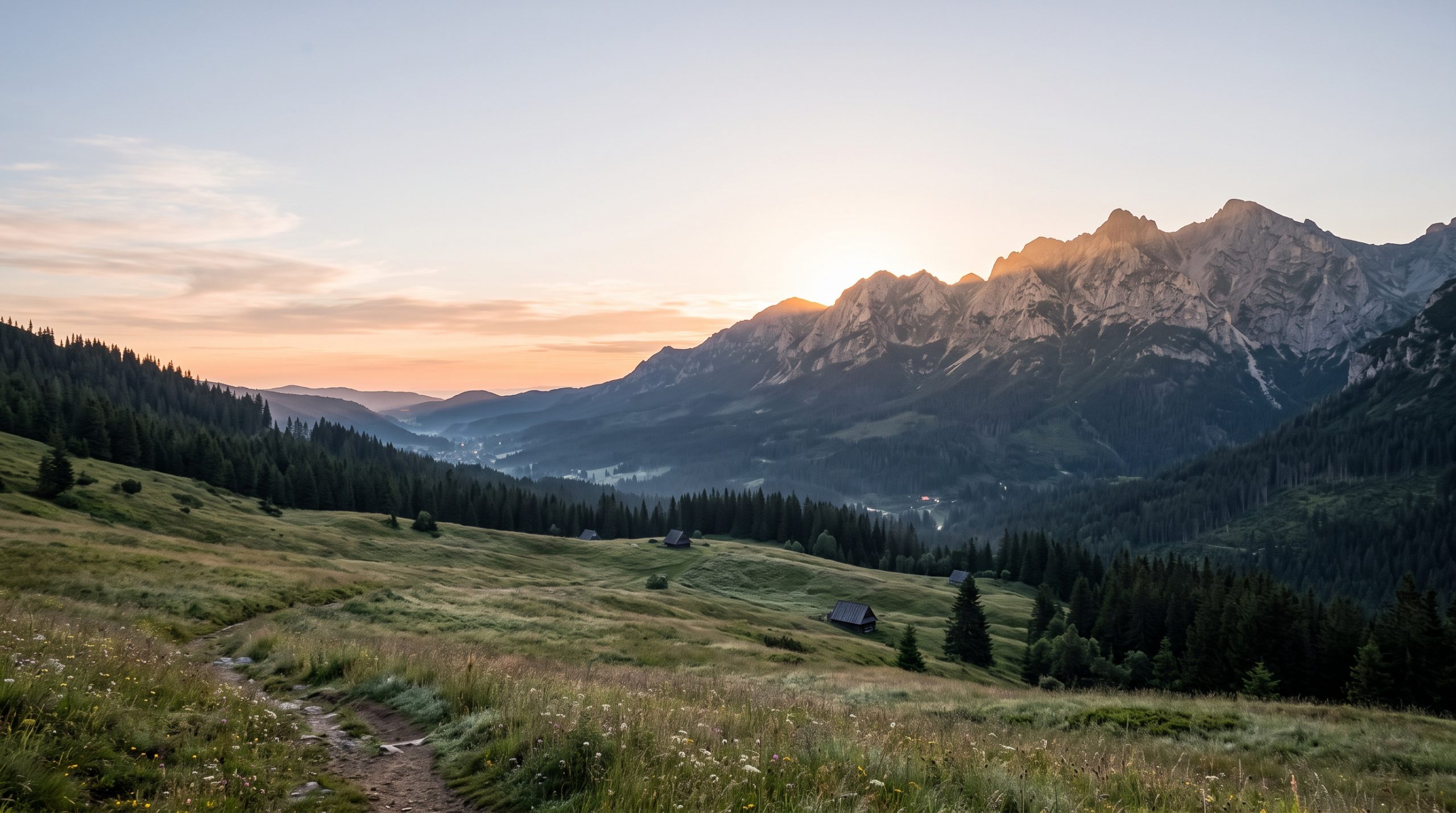
In mid-June the sun clears the horizon over Podhale at about 4:34 in the morning. That is not the same thing as light on the water at Morskie Oko. The lake sits at 1,395 m in a basin walled by rock, so the first sun lands high on the faces above it and the surface stays a cold blue-grey for a good while after the official sunrise has passed.
The walk in from the gate at Palenica Białczańska is close to nine kilometers of paved road, roughly two hours at a steady pace, and the car park sits about 30 km from the middle of Zakopane. Do that arithmetic backwards from 4:34 and you can see why sunrise at the most famous lake in Poland is a two o’clock alarm and a headlamp, not a lie-in. It is also worth saying plainly: that approach is a road, not a wild trail, and from mid-morning it carries a steady line of walkers. Tatra National Park sells the parking and the shuttle transport for the Morskie Oko area itself, and in summer those go early.
We are eight people, four photographers and four filmmakers, and Our current Tatras availability runs across 2027–2029. In the Tatras the plan gets built around three hard things: the hour the day-trippers arrive, the ridgeline that decides when light actually reaches you, and the fact that no drone flies inside the national park.
Photo, film and planning from one Tatra team
We photograph, film and plan Zakopane elopements as one team, never a photographer plus a videographer hired separately who meet on the morning. Coverage runs from one full day with a dedicated photographer or filmmaker, to a full day with both working together, to two to seven days across Podhale and further afield. Team travel to Poland is included.
A day built on the gate, the ridgeline and the ten o’clock arrivals
Mid-June gives you more than sixteen hours between sunrise and sunset, with civil light beginning around 3:50 and holding until about 21:30. That sounds generous until you notice that the sky does its best work at both ends and the middle of the day belongs to everyone else. So we build a June day in two acts with a long, deliberate gap in the centre.
A shape we use often, adjusted to your dates and your appetite for early mornings:
- 03:15 Meet in the dark. Coffee in the car, dress bag in the back, headlamps on the seat.
- 04:00 to 05:15 First light from the Podhale side, on the open meadows above Bukowina Tatrzańska and around Głodówka, where the whole High Tatra wall stands up in front of you and lights from the summits down. No walk-in, no gate, and outside the park boundary, which is also the only place an aerial can legally belong in the film.
- 06:00 to 09:30 Into the park. Vows on the marked trail in Dolina Kościeliska, or on the pasture at Rusinowa Polana with the Tatra faces behind you and sheep bells somewhere below. This is the quiet hour that matters most, and it exists because you got up.
- 10:00 The arrivals. The car parks fill, the Morskie Oko road turns into a procession, Krupówki wakes up. We are walking out by now, or somewhere else entirely.
- 11:00 to 16:00 The long middle. Lunch in a wooden inn, feet up, a change of clothes, a nap that nobody regrets. In July and August this is also when cloud stacks up over the ridges, so being indoors is a plan rather than a compromise.
- 16:30 to 19:00 Second act. A lower ridge such as Nosal, a side valley, or the cable car to Kasprowy Wierch at 1,987 m if the forecast holds. Where a lift is involved we build backwards from the last descent of the day rather than hoping.
- 19:30 to 21:30 Golden hour on the meadows facing the range, sunset near 20:50, then a long blue dusk that is the best light of the whole day for film.
If Morskie Oko itself is the frame you came for, the sums change and we will say so in the proposal. Two hours in, two hours out, park parking booked in advance, and a start in full dark. What you get for it is twenty or thirty minutes of first sun on the Mięguszowieckie faces with the shore almost to yourselves. That is a genuinely good morning for the couples who want it and a long slog for the couples who do not, and we would rather ask which one you are before we write the timeline.
Winter changes the arithmetic completely. Around the December solstice Zakopane gets 8 hours and 14 minutes of daylight, with sunrise close to 7:35 and sunset before 15:45, so a full day of coverage fits comfortably between breakfast and dark.
| What changes | Mid-June | Late December |
|---|---|---|
| Sunrise and sunset | About 04:35 and 20:50 | About 07:35 and 15:45 |
| Daylight | Over 16 hours | 8 hours 14 minutes |
| Realistic alarm | Around 03:00 for first light | Breakfast first, out by 06:45 |
| High ground | Mornings, before afternoon cloud | Weather decides, valleys carry the day |
| Where the crowds are | Trails from mid-morning | Town and the ski lifts, not the valleys |
Autumn sits between the two and is our own favourite. By early October the sun is up around 6:50, the larches in the valleys turn, and you get low light at a civilised hour. Send us the dates you are holding and we will tell you what the light does on those exact days: Check Your Date.
Wind, no aerials, and two cameras on one narrow trail
Inside Tatra National Park you stay on the marked trail. The park’s own fee list for filming distinguishes shots taken from the trail from shots taken off it, which tells you exactly how seriously that line is held. It also creates a practical problem that almost nobody warns couples about: a photographer and a videographer who met that morning end up fighting for the same two metres of gravel, and one of them is always in the other’s frame.
Our pairs work the trail as a choreography instead. One is twenty metres up the path holding the wide frame while the other stays close for the hands, the vows, the laugh at the wrong moment, and then they swap without a word. Nobody asks you to do anything twice for a second camera. That is the whole practical argument for photo and film from one team, and this landscape makes it obvious faster than most.
The drone question shapes the film here more than anything else. No flying device goes up inside the park, and the park covers Morskie Oko, Giewont, Kasprowy Wierch and every valley on your list. So the visual language of a Tatra film is built from the ground: long lenses compressing one ridge behind another, movement on foot along the trail, the stream in Dolina Kościeliska running loud under the vows. Where an aerial genuinely adds something, it belongs to the Podhale foothills outside the boundary, and only once the airspace and the permission are confirmed. You can see how both halves come out of the same day in our published galleries and films.
Sound is the other thing this place gives you. When the halny pours down off the ridges the air goes glass-clear and the whole range sharpens, and it also means an exposed saddle is no place to record vows. The Expedition includes professional audio for vows and the moments that matter where conditions allow, so on a windy morning we move the vows to the treeline, a hollow below the pass, or a wooden chapel, and we know that before we leave the house rather than at 6am on the ridge. One team means one decision. Weather here rewards people who can change their mind at breakfast, and we would rather move the plan than shoot a compromise.
Being eight matters on the day too. There is always a second camera on the ground and a colleague in reserve, which is a different kind of comfort from a single freelancer with a single bag.
Everything the experience carries, and when the work lands
The same things travel with every couple, in Poland and everywhere else we work:
- Destination and location design for Podhale and the Tatras, built from what is actually open and legal on your dates.
- Planning, and a custom timeline built around light and real travel time, including the drive up from Kraków, which is around two hours when the road behaves and longer on a July Friday.
- Permit research and logistics guidance. Tatra National Park requires written consent from the park director for professional photography and filming, applied for through the park’s own online form, and we prepare and file it.
- Weather alternatives and backup planning, which in this range means a second location for every hour rather than a vague hope.
- Drone footage where it is legal, safe and appropriate, which here means outside the park boundary.
- Professional audio for vows and meaningful moments on the Expedition, where conditions allow.
- Team travel worldwide: flights, accommodation and ordinary travel for the assigned team, with no European or long-haul distinction.
- Highlights delivered in 5 days. The full gallery or film in 3 weeks.
The fee does not change with your guest count. Two of you on a pasture at dawn, or fourteen people and a minibus, costs the same from us. Guest numbers change access, permits, transport and the shape of the timeline, not the price.
Where Zakopane coverage begins, and which costs stay local
The Adventure is one full day with a dedicated photographer or a dedicated filmmaker, from $4,900. The Expedition is one full day with a dedicated photographer and filmmaker working together, from $7,900. The Odyssey runs two to seven days across one or several destinations with photography and film throughout, quoted as a custom proposal. There is no half day. Full detail sits on the pricing page.
Our travel to Poland is inside that figure. What sits outside it are the third-party costs this particular destination adds, and they are modest by the standards of alpine Europe:
- Park entry, currently 11 zł per adult per day with a reduced rate of 5.50 zł and a seven-day ticket at 55 zł. The park has raised these most springs, so treat them as a floor rather than a fixed number.
- The park’s fee for photography and filming on its land, set by the park and paid to the park alongside the consent we file.
- Parking and shuttle transport tickets for the Morskie Oko approach, sold by the park and worth booking well ahead between June and September.
- Cable car or funicular tickets where the day uses one, at Kasprowy Wierch or Gubałówka.
- A civil ceremony held away from the registry office carries a statutory extra fee of 1,000 zł, plus 84 zł for the marriage certificate.
- Accommodation, your celebrant, flowers, hair and makeup, and any unusual transport such as a 4×4 charter or a mountain guide.
From your first message to a signed date, in six steps
- You send the inquiry form with your dates, or the two or three months you are choosing between, and what you picture.
- We reply within 24 hours with an initial brochure and honest thoughts on those dates.
- We build a tailored proposal: coverage, locations, the shape of the day, what the park will and will not allow.
- You sign the contract and pay a 30% retainer. The remaining payments are set out in the proposal.
- Planning begins in earnest. Location design, the timeline, the park application, weather alternatives, and the practical fundamentals we cover in our guide to planning an elopement.
- After the day: highlights in 5 days, the full gallery or film in 3 weeks.
Busy trails, early alarms, and who this suits
The honest objection to Zakopane is crowds, and it is a fair one. This is the most visited mountain town in Poland, the road to Morskie Oko is paved and popular, and the queue for the Kasprowy cable car can eat a morning in August. None of that is a reason to go elsewhere. It is a reason to plan properly.
What actually works here is hours nobody else wants and valleys nobody else has heard of. First light from the meadows on the Bukowina side while the coaches are still in Kraków. A weekday rather than a Saturday. The upper end of a side valley in Dolina Kościeliska instead of the lake everyone photographs. Shoulder months, when the trails empty and the light lasts longer at both ends. We also keep the whole plan on the marked trail, which sounds like a limitation and is in fact the reason our applications get approved and our mornings run without friction. Our destination guides cover the same ground for other ranges if you are still comparing.
This landscape suits couples who are willing to be up before three in June, or content with a December day that starts after a proper breakfast. Who can walk two to four hours on uneven ground and enjoy it. Who are relaxed about a plan that changes at breakfast because the ridge is in cloud and the valley is not.
If a three o’clock alarm is not your idea of a good morning
Say so in your first message. There is a gentler shape to a Tatra day and it is a good one. Early October puts sunrise near 6:50 with gold larches in the valleys. Winter gives you low sun all day and no alpine start at all. A day can sit entirely on valley floors and wooden architecture, a chapel and a pasture fifteen minutes from town, with the high ground kept as an optional extra if the morning looks right. Tell us what you actually want and we will either build the day around it or tell you honestly which month or which side of the range fits it better.
Common questions
Do we need permission to be photographed in Tatra National Park?
Yes. Professional photography and filming on park land needs written consent from the park director, applied for on the park’s own online form, and the park sets a fee that is paid to it. Photography tied to a family celebration on a marked trail needs only a couple of days of notice; film needs longer. We prepare and file the application, and we keep the plan on the trail so what we submit matches what we actually do.
Can you fly a drone over Morskie Oko or Giewont?
No. Flying devices are not permitted inside Tatra National Park, and the park covers Morskie Oko, Giewont, Kasprowy Wierch and every valley on your shortlist. Aerials belong outside the boundary, over the Podhale foothills, and only after the airspace and permissions are confirmed. Inside the park the film is made on foot, with long lenses and real sound, and it is stronger for it.
Can we have a legal ceremony in the mountains as Americans?
Poland does allow a civil ceremony away from the registry office. It carries a statutory extra fee of 1,000 zł and 84 zł for the marriage certificate, needs two adult witnesses, and there is a wait of at least a month between filing your assurance at the registry office and the ceremony. The registrar also has to be satisfied the location is safe and suitably formal, which a windy saddle at 1,900 m is not. Most couples we work with here keep the legal signing simple and indoors and take their vows on the mountain, and we build the timeline around whichever order the registry office confirms.
Which month gives us the best chance of clear ridges?
No month guarantees it. Late September and October give low sun from about 6:50, gold larches and thinner crowds. June gives you sixteen hours of light and the highest chance of a summit that is actually visible in the morning. February gives snow and ten hours of usable daylight. We plan two options for every hour whichever you pick.
How early will we really be getting up?
In June, if first light matters to you, around three in the morning. For a sunrise at Morskie Oko, closer to two. In October it is a five o’clock start, and around the December solstice you can leave the house at 06:45 and still be early. Tell us your appetite for alarms honestly and we will build the day to it.
Is the walk to Morskie Oko realistic in a dress?
Yes, with planning. It is about two hours each way on a paved road with a gentle gradient up to 1,395 m, and it is not technical. It is still four hours of walking, so we carry the dress up and change near the lake, and we book the park parking in advance so the day does not start with a queue.
When do we get the photographs and the film?
Highlights land 5 days after the day itself. The full gallery or the finished film follows within 3 weeks. Those windows hold in every destination we work in.
Can one trip cover both the Polish and Slovak sides of the Tatras?
It can. The border at Łysa Polana sits right beside the Palenica Białczańska car park, so the Slovak side of the range is a short drive rather than a separate trip. That is Odyssey territory, two to seven days across one or several destinations. Each country has its own permissions and we handle the research for both.
Your Tatra date, in writing
We keep the planning in one written thread, at whatever hour suits you. You send the form, we reply within 24 hours with a brochure and real thoughts on your dates, and the proposal follows. No time zones to negotiate and nothing to arrange in real time, just a written conversation you can read back later when you are deciding between a June sunrise and a December morning in the snow. Tell us the dates you are holding and what you picture standing in, and we will tell you exactly how the light behaves in Podhale that week: Tell Us Your Story.