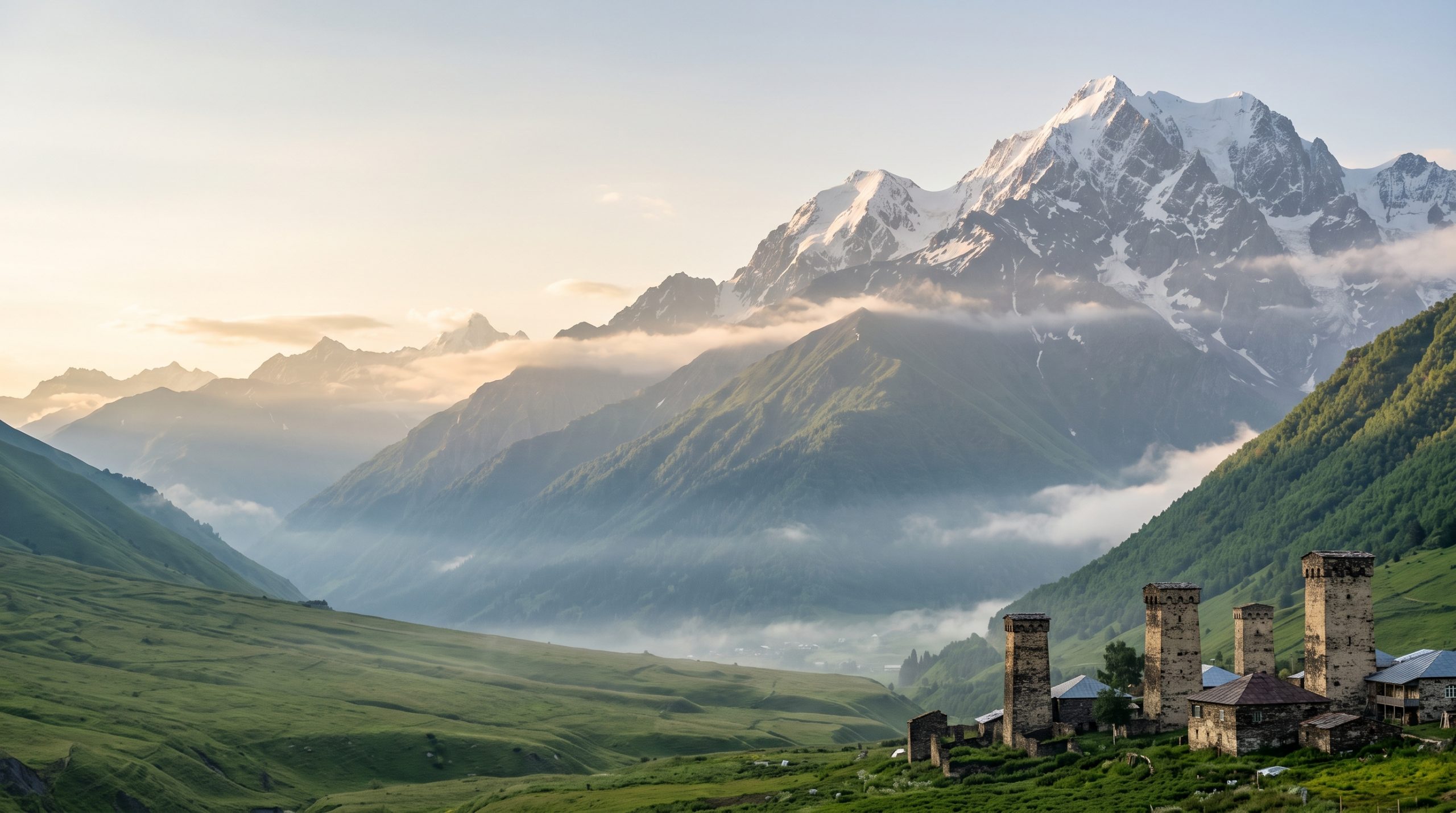
Ushguli sits at 2,100 metres at the head of the Enguri gorge, with Shkhara, Georgia’s highest mountain at 5,193 metres, closing the horizon behind it. In late June the sun comes up over Mestia at about 05:31 and stays out until almost 21:00, which reads on paper like fifteen hours of shooting time. It is not. In a valley walled by four thousand metre ridges, the clock tells you when the sun rises and the ridgeline tells you when the light lands, and those are two different hours in two different places.
The other thing nobody writes down: Ushguli at eleven in the morning is a car park. The day-trip jeeps come up from Mestia after breakfast, the lanes between the towers are muddy most of the summer, and there are cows in them. None of that is a problem. It is simply information, and it decides everything about when you stand where. At 06:15 the same lanes belong to the village, the light is climbing down the snow toward the roofs, and you can hear the river.
Upper Svaneti has been on the UNESCO World Heritage list since 1996, and the village of Chazhashi alone still holds more than two hundred of those stone houses and towers. That is the backdrop. Getting a couple in front of it at the right hour, with both a photographer and a filmmaker already standing in the right place, is the work.
What we cover in Upper Svaneti
We plan, photograph and film elopements across Upper Svaneti, from Mestia to Ushguli at 2,100 metres. Photography, film and planning come from one eight-person team, so whoever builds your timeline is who shoots it. A full day with a dedicated photographer or filmmaker starts at $4,900. A photographer and filmmaker working the same day starts at $7,900.
A June day, 04:40 to 22:00
This is the shape we build most often in the long weeks around the solstice, when Mestia gets a little over fifteen hours of daylight. The December version of the same valley is roughly six hours shorter and runs on an entirely different plan.
04:40. Out of the guesthouse in the dark. Nobody photographs well at 04:40 and that is not the point; the point is that the drive up-valley, the walk in, and the ten minutes of standing still that people need before they can hear each other all have to happen before the light does anything. We do the moving in the dark so the light is spent on you.
05:31 to 06:00. Official sunrise, and nothing happens on the ground yet. What happens is high above it. The snow on Shkhara and the ice faces around Ushba go warm first, and for twenty or thirty minutes the mountains are lit while you are standing in cool blue shade. This is a gift, not a problem, and it is the reason we like starting high or on an open meadow with a clean sightline. The photographer works you against a lit mountain; the filmmaker holds long on the peak, because a slow shot of moving light on snow is the frame that opens a film.
06:15 to 08:00. Vows. The sun reaches the valley floor, and for the first hour it comes in almost horizontal, through grass and past the towers, which is the best light Svaneti gives all day. Ushguli is still local at this hour. We keep the ceremony spot within a short walk of where the car can stop, because the difference between a ten minute walk and a forty minute one at 06:00 is the difference between arriving present and arriving out of breath.
08:30 to 11:00. The jeeps begin to arrive and the light gets hard. We eat. This is also the window for the things that photograph quietly rather than grandly: the Lamaria church at the top of the village, a stone doorway, the two of you sitting on a wall with khachapuri and no audience except a dog. If your legal registration is happening on this trip, this is the part of the day it belongs in, not the golden hour.
11:00 to 16:00. Flat, overhead, unkind light. We use it to move. The Mestia to Ushguli road has been improved a great deal in recent years, and it is still a stretch that deserves respect and real hours in the timeline rather than an optimistic guess. If the day spans both ends of the valley, this is when we drive it. If we are staying put, it is when you sleep, and we mean that seriously.
17:30 to 19:30. Light comes back, softer and lower, and the valley starts to look like the photographs that made you search for Svaneti in the first place. Forest edges, the river, the meadows below the towers. Wind usually rises in the afternoon, so this is when a veil earns its keep and when we choose which side of a ridge to be on.
19:30 to 21:00. The long run. The sun drops behind the western ridge well before the 20:54 that the almanac gives for the end of June, so the last direct light on the valley floor comes earlier than couples expect, and then the high snow keeps burning above you for another quarter of an hour. We plan for that gap instead of being surprised by it. It is the best five minutes of the whole day and it is easy to be in the wrong place for it.
21:15 to 22:00. Blue hour, then stars over the towers if the sky is clear. Short, cold, worth it. Then a late dinner, because in June in Svaneti dinner is always late.
That is one shape. A day that keys off Koruldi Lakes and the view across to Ushba runs differently, because the track up from Mestia takes a jeep about four hours return and eats the middle of the day. Our destination and location design exists to work this out for your date, your fitness and your appetite for early mornings, and our destination elopement guides show how the same thinking plays out elsewhere. If you already know roughly when you want to be here, tell us and we will send back a version of this day built for your week: Check Your Date.
River noise, short light, and what the filmmaker changes here
Svaneti is loud. In June the Enguri and the Patara Enguri are carrying snowmelt, and if you say your vows within thirty metres of the water, a camera microphone hears the river and not you. On our Expedition days the filmmaker brings professional audio for vows and the moments that matter, and places it before you start, which is a decision that has to be made at 05:50 by someone whose only job is sound and motion. A photographer improvising with a clip-on recorder at 06:00 is not the same thing, and you will hear the difference for the rest of your life.
The second thing is arithmetic. The window when light is on the towers and not yet on the coaches is short. One person cannot shoot stills and motion inside it without giving up half of each. When the cloud opens for eight minutes over Shkhara, we do not choose between a photograph of your face and a film of the mountain clearing; one of us takes each, standing four metres apart, working from a timeline we wrote together weeks earlier.
Aerials get planned rather than improvised. Georgia requires drones above 250 grams to be registered with its civil aviation agency, and there is a clearance zone around airfields, which matters here because Mestia has an airstrip at the edge of town. We confirm where and when a flight is legal, safe and appropriate before the film leans on it, and we shape the up-valley aerials around what is actually permitted. Our published galleries and films are the honest way to judge all of this, because they show what a Caucasus valley looks like when the same team lit, planned and shot both halves of the story.
There is also the plainest advantage. A photographer and a videographer hired separately meet for the first time on the morning, in a village at the end of a mountain road, and negotiate the day in front of you. We travel in the same vehicle, off the same document, and there are eight of us, so there is always a second camera on the ground and a colleague in reserve.
If Shkhara stays behind cloud all week
This is the real question about Svaneti, and it deserves a real answer rather than reassurance. The high Caucasus makes its own weather. Cloud can sit on the ridge for three days, lift for a morning, and come back down by ten. Any photographer who promises you a clear peak is promising something they do not control.
So we plan the day so the mountain is a bonus and not the load-bearing wall. Svan towers photograph better in flat light than they do at noon in July, because the stone holds detail instead of blowing out. Mist between towers is one of the strongest frames the place offers. Low cloud gives you the forest above Mestia, the glacier snouts, the rivers running grey with rock flour, and interiors with a wood stove going. Every plan we write carries weather alternatives, and in Svaneti that means a named second location with a known drive time, not a vague promise to improvise.
The structural answer is time. A single day gives the valley one chance to behave. Two to seven days, which is what our Odyssey coverage is built for, lets us hold the ceremony hour until the morning that deserves it and use the other mornings for everything else. If your dates are fixed and short, say so early and we will build around a low-level day with the high ground as an upgrade, rather than the reverse. The planning fundamentals we walk every couple through start from exactly this question.
What the fee covers, and what Georgia charges separately
Team travel is inside the figures named above, in every destination, with no European or long-haul distinction. Getting four wheels and two cameras from wherever we are to the head of the Enguri valley is our cost, not a line on your invoice. Kutaisi is the closest useful airport for you, at roughly four hours of driving to Mestia; from Tbilisi the road is a full day, and the morning train to Zugdidi followed by the mountain road is the gentler way in.
Included in every Svaneti day
- Destination and location design, and a custom timeline built around light and real travel time on these roads.
- Permit research and logistics guidance, including what applies at protected and heritage sites.
- Weather alternatives and backup planning, with named second locations and known drive times.
- Drone footage where it is legal, safe and appropriate.
- Professional audio for vows and meaningful moments on Expedition days, where conditions allow.
- Highlights delivered in 5 days, and the full gallery or film in 3 weeks.
The fee does not change with guest count. Bringing four people or fourteen changes access, permits, transport and the timeline, not the price. Full detail on all three coverage levels sits on our elopement coverage and pricing page.
Paid locally, in lari
- Any government, venue or landowner permit fees. The research and the paperwork guidance are ours; the fees themselves are yours.
- Your accommodation, food, celebrant and any vendors such as florists or musicians.
- Legal registration costs, including notarised Georgian translations, an interpreter if you want one, and an apostille on the certificate for use back home.
- Unusual transport. A private car from Zugdidi up to Mestia generally runs 150 to 200 GEL, and a jeep and driver for the Koruldi Lakes track is usually around 250 GEL return. Helicopters, private 4×4 charters for a full day and mountain guides sit in the same category.
The lari has been trading near 2.7 to the US dollar for some time, which puts every figure in that last list in two or three dollar digits rather than four. We quote these in lari on purpose, because that is what you will hand over.
How a Svaneti enquiry becomes a held mountain date
- You send the inquiry form with your rough dates and what you picture.
- We reply within 24 hours with an initial brochure and our first questions about the valley and your week.
- We build a tailored proposal: coverage level, the shape of the day, locations, and what the trip actually asks of you.
- You sign the contract and pay a 30% retainer. The rest of the payment plan is set out in the proposal.
- Planning begins in earnest. Location design, permit research, timeline drafts against sunrise for your exact date, weather alternatives, and the transfers.
- We photograph and film the day. Highlights reach you in 5 days, the full gallery or film in 3 weeks.
Our Georgia calendar is currently open across 2027, 2028 and 2029, and Svaneti is a place where a year of lead time genuinely buys you a better plan.
The couples this valley is kind to
Svaneti suits people who are honestly fine with a 04:40 start and then being out again at 21:00 on the same day. It suits couples who do not mind uneven ground, livestock in the lane, a guesthouse rather than a hotel, and a plan that changes at breakfast because the ridge cleared. If that sounds like a good week rather than an endurance test, this is your valley.
If early mornings are not your idea of happiness, that is worth telling us in your first message. There is a version of this day that starts at four in the afternoon and runs to the last light, based in one place with almost no driving, and it works. If what you really want is a high probability of clear peaks in one fixed 24 hour window, we would rather talk you into a wider date range or a different Caucasus valley on our side of the map than let you plan a day that depends on luck. Tell us what matters most, the mountain or the morning, and we will tell you honestly which month and which end of the valley fits it.
Common questions
Do we need both a photographer and a videographer, or can one person do both?
One person can do both, and in Svaneti’s short light windows they will do each at about half strength. The reason we run a photographer and a filmmaker together on Expedition days is that the good hour at Ushguli happens once, and audio, motion and stills all need someone’s full attention inside it.
How do Americans legally get married in Georgia?
Registration happens at a House of Justice branch, and the requirements are unusually light: two valid passports, no residency requirement, no waiting period and no medical certificate. Witnesses are needed and your passports may require notarised Georgian translations. A ceremony in a mountain meadow carries no legal weight on its own, so we plan the registration as its own step and keep the Svaneti day for the part you will remember.
How many days should we allow in Svaneti?
Four nights in the region is the shortest stay we would build a serious plan around, and five or six is better. That covers the travel in, one weather buffer, the elopement day itself, and a morning that is yours alone. Add a day at each end for the journey from Kutaisi or Tbilisi.
Can you fly a drone over Ushguli?
Sometimes, and it depends on the exact spot and day. Drones above 250 grams must be registered with Georgia’s civil aviation agency, there is a clearance zone around Mestia’s airstrip, and heritage ground has its own sensitivities. We confirm what is permitted for your locations before the film is designed around aerials, and we always plan a version that stands up without them.
What happens if the Ushguli road is not open on our date?
We move the day rather than lose it. Snow keeps the higher side roads shut later into spring than most planners expect, so a May plan lives on lower ground around Mestia by design and treats Ushguli as an upgrade. For summer dates we hold a second location with a known drive time, decided the evening before once we have seen the forecast and talked to the drivers.
Is Ushguli too crowded in summer?
At 11:00 in August, yes. At 06:15 it belongs to the village and to you, and by 19:30 the jeeps have gone back down to Mestia. Crowding here is a question of hours, not months, which is exactly why the timeline matters more than the date.
What does elopement coverage in Svaneti cost, and what is extra?
The starting figures for a single-discipline day and for a photographer and filmmaker together are named above, and team travel to Georgia is included in both. Your separate costs are accommodation, permit fees where they apply, legal registration paperwork, and any unusual transport such as a private 4×4 day.
How soon do we see the photos and the film?
Highlights land 5 days after the day itself, and the full gallery or film follows within 3 weeks. That holds in Svaneti exactly as it does anywhere else we work.
Choosing your week in Svaneti
Pick the week, and we will tell you what the light does in it, what the roads are likely to be doing, and where in the valley we would put your vows. The planning stays in writing from the first message onward, at whatever hour suits your time zone, from the first message to the final delivery, so nothing about planning this requires you to be awake at the same time as us. Send us your dates and the version of the morning you actually want: Start Your Story.