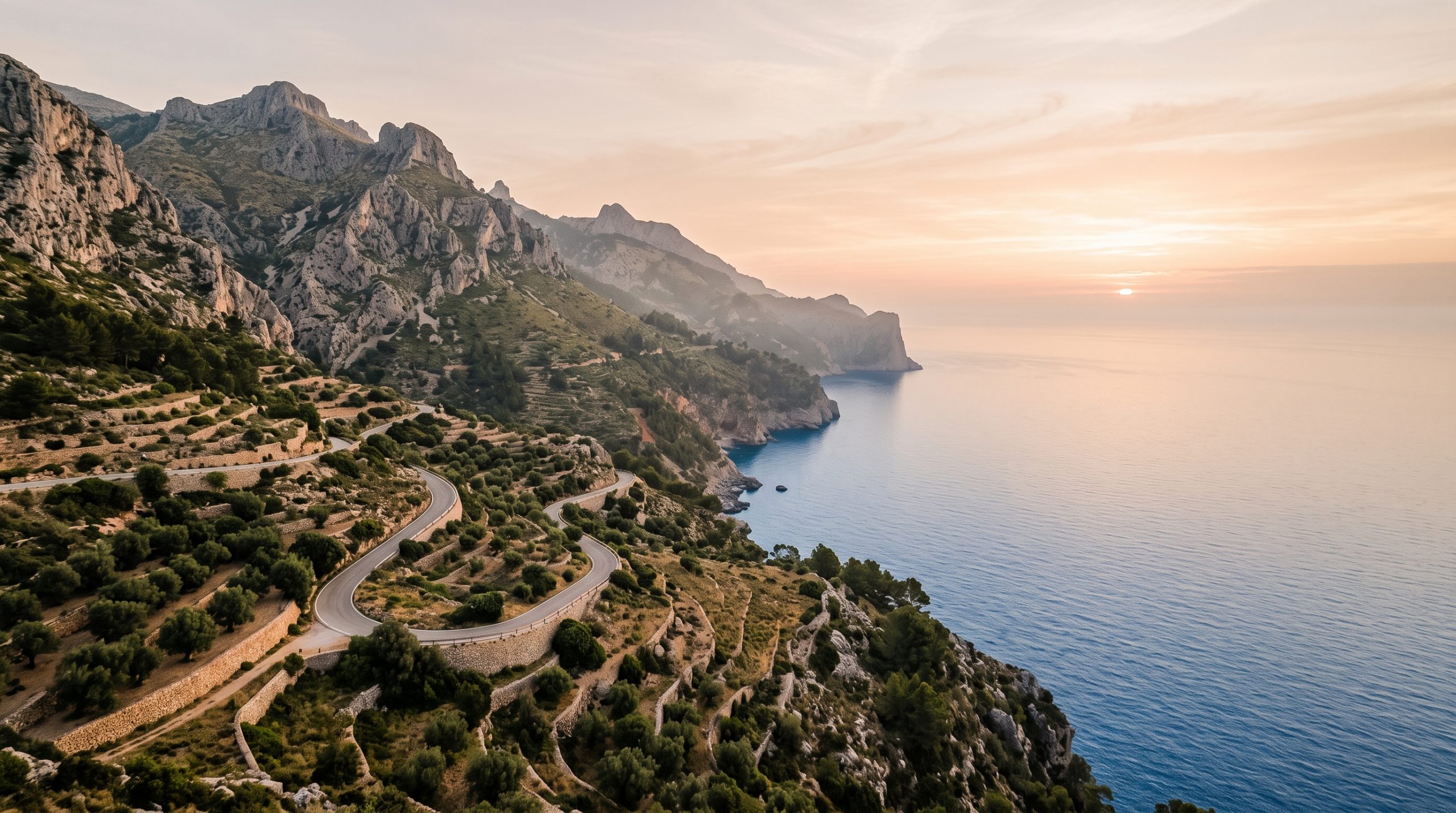
The gate at Formentor is the first thing we plan around. From the middle of May into October, the last stretch of the Ma-2210, from Formentor beach out to the lighthouse, is closed to private cars from 10:00 until late evening, and for 2028 that regulation runs to 18 October. Which sounds like a problem until you look at the sunrise. On 15 June the sun lifts out of the sea off the cape at 6:18, on a bearing of 58 degrees, almost straight down the axis of the peninsula. By the time the barrier matters we have been working for three hours and are already driving south with the light behind us.
The second thing worth knowing is that Mallorca’s two great coasts face opposite ways. The northeast, out past Pollença and Alcúdia, opens to sunrise over open water. The northwest, the Serra de Tramuntana, takes the sunset: in mid-June the sun goes down on a bearing of 302 degrees, which from the cliffs above Deià means straight into the sea with nothing in the way. Between the two runs one road, the Ma-10, threading the spine of a UNESCO World Heritage cultural landscape, 30,745 hectares of terraced mountain inscribed in 2011 for the dry-stone farming that built it.
Almost nobody builds a day that uses both ends. The default Mallorca itinerary puts couples at Sa Calobra at eleven in the morning, in flat overhead light, sharing the mouth of the Torrent de Pareis with four coach parties. We would rather have you standing on a warm limestone slab at the cape while it is still grey, and on an olive terrace above the water fourteen hours later.
What we do on Mallorca, in one paragraph
We are a team of eight, four photographers and four filmmakers, and we cover Mallorca elopements with photography, film and planning as a single service rather than three bookings. Coverage starts with one full day and a dedicated photographer or filmmaker. The step up puts both on the ground together. Team travel to the island is included.
A June day: the cape at 6:18, the Ma-10 by noon, Deià at nine
Mid-June is the extreme version of a Mallorca day, so it is the useful one to walk through. First usable light at Formentor arrives around 5:45. Sunset is 21:17, and there is still workable colour until roughly 21:50. That is close to sixteen hours between the two ends, which is a gift and a trap at the same time. Nobody can be photographed for sixteen hours. The whole craft is deciding which four of them matter.
04:40. Out of Port de Pollença. The drive to the cape is short in kilometres and slow in practice, because the Ma-2210 is a sequence of blind curves cut into the headland. We build in the extra twenty minutes and take it gently in the dark.
05:30. On the rock. Wind assessment first, because the north wind that named the Tramuntana decides where the dress can go and where the vows cannot. Then we place you. Nothing is happening in the sky yet and that is exactly the point: the cool blue half-hour before the sun arrives is the most underrated light on this island, and it is the one hour of the day the cape belongs to you.
06:18. Sunrise, hard and orange, coming up the peninsula almost head-on. Twenty minutes of it before the contrast gets ugly.
07:15. Down onto the pine and limestone below the road, where the light is now sidelighting the cliffs and the coves cut in from the east. This is the hour that fills a gallery.
09:00. Breakfast somewhere with a table, in Pollença or Port de Pollença. You change out of the dress. We back up cards. Nobody photographs anything.
10:30 to 16:30. The dead hours, and we say that plainly. Mediterranean summer light between eleven and four is white, vertical and unkind, and no amount of talent fixes it. This is when we drive the Ma-10, when you swim, when you sit under a carob tree and do nothing. If you want Sa Calobra, this is not the window for it. The road down from the Coll dels Reis knots back over itself and gives way to coaches and to cyclists all day in spring and summer, and the port area itself is a controlled-access zone where Escorca reads number plates at the entrance, so visitors park up the hill and walk in through two rock tunnels. It is a magnificent piece of coast, and it is at its best at seven in the morning, which is why we treat it as its own early start rather than a stop on the way through.
17:30. Arrival on the northwest coast. Deià, Banyalbufar, the terraces above Port de Sóller, or the headland at Sa Foradada. The Tramuntana falls into the water here in stone steps built by hand, and the low sun rakes along them rather than hitting them flat.
19:00. Vows. Late enough that the heat has gone, early enough that we are not rushing the part of the day you will actually remember. If there is wind, we move the ceremony into a walled olive terrace fifteen minutes back from the cliff, where the audio is clean, and take the exposed edge afterwards for stills, where the wind is a friend.
20:20 to 21:17. The hour everything else was arranged around. The sun sits low over open sea, the sea haze goes copper, and the terrace walls behind you turn the colour of a lit match.
21:17 to 21:50. Sunset, then the long blue tail. Half an hour of soft, even, almost shadowless light that most people walk away from because the sun has technically gone.
Shift that whole plan to mid-October and it becomes a different, gentler animal. Sunrise moves to 07:57 and swings round to a bearing of 101 degrees, so the sunrise light now comes across the bays rather than down the cape. Sunset is 19:08. You get eleven hours of daylight instead of fifteen, the Formentor road is open to cars again once the seasonal regulation lifts, and the alarm goes off at seven instead of half past four. If you want to talk through which of those two days is yours, Check Your Date and tell us the month you are thinking about.
Two cameras on a terrace three metres wide
Here is the part that sounds like a small detail and is not. A Tramuntana terrace, a marjada, is a shelf of soil held up by a dry-stone wall. Some of them are five metres deep. Plenty are closer to three. You get one clean line to stand on, one clean line to shoot from, and a wall behind you that you cannot back through.
Put a photographer and a separately hired videographer on that shelf and they will spend your ceremony negotiating. One of them needs to be low and moving; the other needs the same square metre and needs it still. On our Expedition days the photographer and the filmmaker have worked together before, have already agreed on the terrace before we drive up, and have split the space: film takes the long lens from the terrace above, stills work the near edge, and they swap on a signal rather than a whisper.
The same logic runs through everything Mallorca does to a crew. At Formentor there is one time window and it is before 10:00, so there is one vehicle, leaving once, with everybody in it. The wind on the northwest cliffs is the other one. Photography wants that wind. Film wants shelter for the vows and then wants the wind back for the wide shots. Because both disciplines answer to the same timeline, we can sequence those two conditions twelve minutes apart instead of arguing about which one gets the ceremony.
Aerials over the Tramuntana and the cape run on a permit and a stated window, which is why drone work sits inside the plan rather than being decided on the morning. Where it is legal, safe and sensible it is included, and here it earns its place, because the terraces only read as terraces from above. On the Expedition we also record proper audio for the vows, which is the difference between a film you watch once and one you put on in ten years. The best way to judge any of this is finished work, so spend ten minutes in our stories and see how a full day comes back as both a gallery and a film.
What travels with us, and when the work lands
Everything below is in every Mallorca experience, at every level. There is no half-day version and nothing here is an upgrade.
- Destination and location design for this island, not a shortlist copied from a guidebook.
- Full planning support, including a custom timeline built around real sunrise and sunset times and honest driving times on the Ma-10.
- Permit research and logistics guidance for the places you want, including the seasonal access rules at Formentor and the controlled zone at Sa Calobra.
- Weather alternatives and a written backup plan, because the north wind arrives when it likes.
- Drone footage where it is legal, safe and appropriate.
- Professional audio for vows and other meaningful moments on the Expedition, where conditions allow.
- Team travel worldwide: flights, accommodation and ordinary travel for the assigned team, included in every destination, with no European or long-haul distinction.
- Highlights delivered in 5 days. The full gallery or film in 3 weeks.
Our current Mallorca availability runs across 2027–2029. Eight people on the team means there is always a second camera on the ground and a colleague in reserve, which is the only reason we can hold a date on an island where the good hours are not negotiable.
Where coverage starts, and what the island charges on top
The Adventure covers one full day with one dedicated photographer or one dedicated filmmaker, from $4,900. The Expedition covers one full day with a dedicated photographer and a dedicated filmmaker working as a pair, from $7,900. The Odyssey runs from two to seven days, photography and film together, across one destination or several, and comes back to you as a custom proposal. Full detail sits on the pricing page.
Team travel to Mallorca is inside those figures. Flights, accommodation and getting the team where it needs to be at 5:30 in the morning are ours to arrange and ours to pay for. What Mallorca adds on top, in euros, and paid by you directly: your accommodation, your celebrant, hire car or a driver for the Ma-10, paid parking at the popular coastal sites, any municipal or landowner permit fee that a specific location carries, and the cost of document translation and apostille at home. If you want a private boat out of Port de Sóller or Port de Pollença to reach a cove from the water, that is booked separately too. We do the research and the paperwork chase; the fees themselves are yours.
The paperwork question, and the shape that answers it
This is the one thing couples worry about with Spain, and it deserves a straight answer. A legal marriage application in Spain is made to the Registro Civil or the Juzgado where at least one of you resides, and the US Embassy in Spain notes that approval of an application can take up to 45 days. For two Americans on a two-week trip, that is not the route.
So we plan the far more common shape instead. You complete the legal side at home, before or after the trip, and in Mallorca you have a real ceremony with a celebrant, in English, wherever you actually want to stand. Vows, rings, readings, someone you love reading something out loud on a terrace at seven in the evening. Nothing about the day is diminished, and the ceremony is not squeezed into a registry office slot at eleven in the morning when the light is at its worst. If you would rather your legal ceremony happen in Spain, we will say so early and help you work out the sequence, and our guide to planning an elopement covers the groundwork. Either way, the paperwork stops being the thing that shapes your day.
How a Mallorca photo-and-film enquiry becomes a signed date
- You send the inquiry form with your dates, or the month you are circling.
- We reply within 24 hours with an initial brochure.
- We ask what you actually want from the day, and you tell us in writing.
- You get a tailored proposal for Mallorca: locations, timeline, team, coverage.
- Contract signed and a 30% retainer paid.
- Planning begins, and the remaining payment schedule is set out in the proposal.
That is the whole process, and most of it moves while you are asleep in a different time zone.
The couples this island fits, and the month that fits them
Mallorca rewards couples who are willing to be somewhere before the day starts. Not every day, and not for long, but once. It also rewards people who are relaxed on uneven ground: the terraces are stone, the coves are pebble, and the good places all involve twenty minutes of walking in shoes you can actually walk in.
If a 4:40 alarm is genuinely not your idea of a good morning, say so in your first message, because the answer is usually a different month rather than a different island. Look at what the calendar does to the same day.
| Month | First usable light | Sunrise | Sunset | Daylight |
|---|---|---|---|---|
| Mid-April | 06:42 | 07:10 | 20:25 | 13h 15m |
| Mid-June | 05:45 | 06:18 | 21:17 | 14h 59m |
| Late September | 07:05 | 07:32 | 19:48 | 12h 16m |
| Mid-October | 07:30 | 07:57 | 19:08 | 11h 11m |
October gives you a civilised sunrise, warm sea and a Ma-10 you can drive without meeting a coach on every third corner. It is the month we push hardest for couples who want the island’s drama without its crowds. April does something similar at the other end, with green terraces and colder water. June is for couples who want the maximum: the longest day the island has, the sun setting northwest into open sea, and the willingness to get up in the dark to earn it.
And if one full day on one coast feels tight once you see the map, it usually is. Two days lets you take the northeast at sunrise and the Tramuntana at sunset without either being a compromise, and it is the most common change couples make after reading a proposal. Tell us what you want the day to feel like and we will tell you honestly what shape it needs.
Common questions
Can we reach the Formentor lighthouse for sunrise in July?
Yes. The seasonal restriction on the Ma-2210 applies from 10:00 in the morning, so a sunrise start is outside it entirely. In mid-summer that means being on the cape by around 5:30, well before the barrier is relevant. During restricted hours the TIB shuttle, line 334, runs from Alcúdia through Port de Pollença to the lighthouse in about an hour, but for photography it is the early window that matters.
Who can marry us in Mallorca if we do the legal paperwork at home?
An independent celebrant, in English, anywhere you have permission to stand. Most couples we work with on Mallorca register the marriage legally in their home state and hold the ceremony itself on the island. You choose the celebrant and pay them directly; we build the timeline around the hour the light is right rather than the hour an office is free.
Is Sa Calobra worth it for an elopement?
At seven in the morning, absolutely. Later in the day, less so than the photographs online suggest. The Ma-2141 carries coaches and large groups of cyclists through spring and summer, the port itself is a controlled-access zone with number-plate cameras at the entrance, and you walk in through two rock tunnels. It works beautifully as a dedicated early start on its own day, which is one reason couples add a second day.
Do you fly a drone over the Serra de Tramuntana?
Where it is legal, safe and appropriate, yes, and it is included rather than extra. The Tramuntana is a protected World Heritage landscape, so aerials run on a permit and a defined window, and we confirm both before we build the film around them. From above, the terraces finally read as the vast hand-built staircase they are.
Does the price change if we bring our parents and two friends?
No. Our fee is the same whether it is the two of you or the two of you plus eight. Guest numbers affect access, permits, transport and how long the timeline needs to breathe, not what we charge. The pricing page sets out what each level of coverage includes.
When do we get the photos and the film?
Highlights land 5 days after the day itself, which is usually while you are still on the island or just home. The full gallery, or the finished film, arrives within 3 weeks.
Can we do the northeast and the northwest coast in one day?
In June, yes, and we have built exactly that day. It means a 4:40 start, a long middle with no cameras out, and a second location call at half past five in the afternoon. In October the daylight window is eleven hours, so one coast per day is the honest answer. We will tell you which version your dates support before you commit to anything.
What happens if the tramuntana wind is blowing on our date?
We move, and we move to somewhere we have already chosen. Every Mallorca plan we write carries a sheltered alternative within fifteen minutes of each main location, usually a walled terrace, an olive grove or the lee side of a headland. The wind changes where we stand. It does not change the hour or the plan.
Your Mallorca day, in writing
Every planning step stays in one written thread, at whatever pace suits you. Send the inquiry form and you will have a reply and our initial brochure within 24 hours, then a proposal built for your dates, your locations and the exact hour the sun does what you want it to. Read it in your own time, ask us anything, change it as often as you like. When you are ready, tell us the month, the coast and whether you would rather be awake at 4:40 or at seven, and we will build the rest around it. Tell Us Your Story