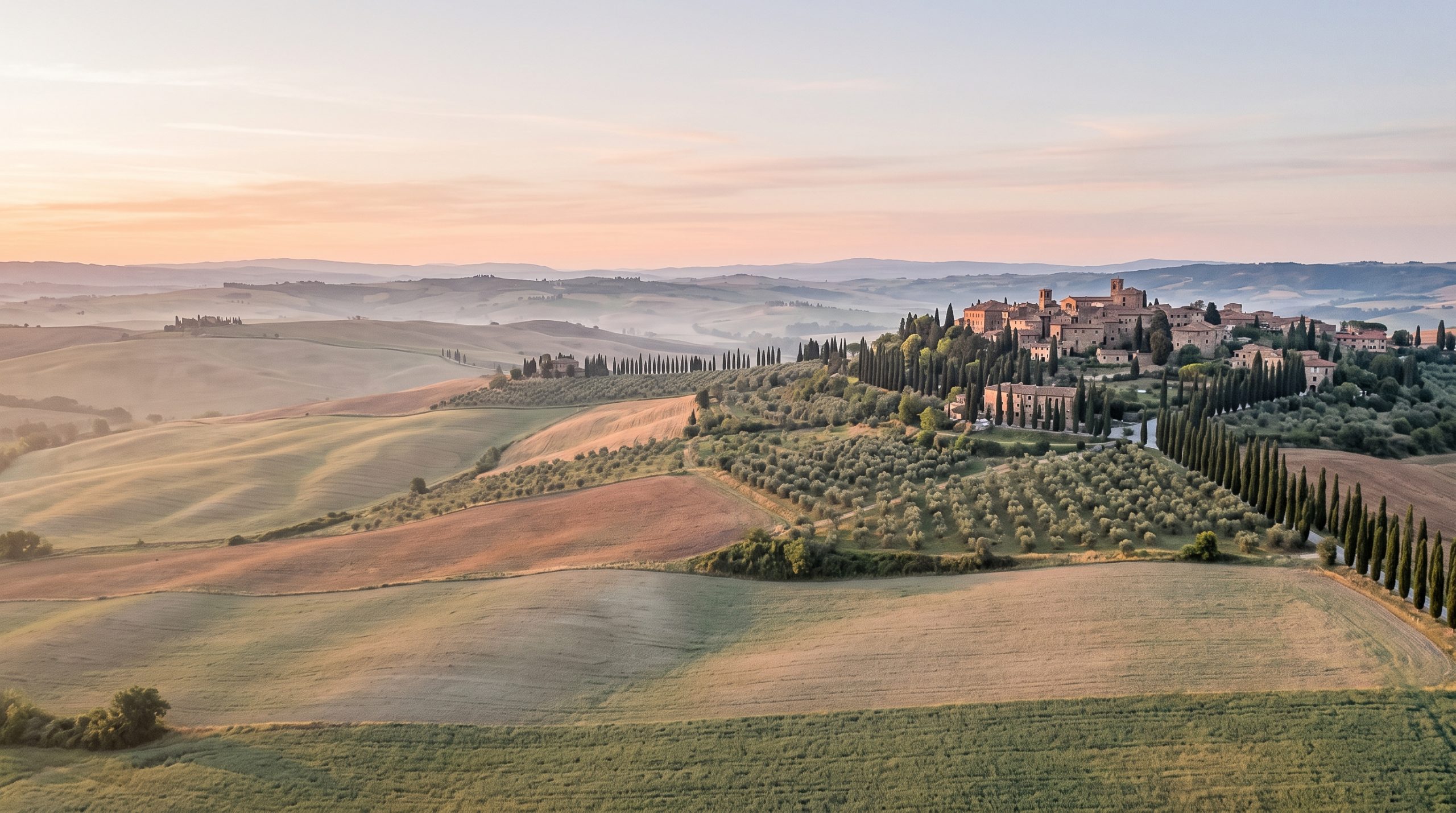
In mid-June the sun clears the hills east of Pienza a little after 5:30 in the morning, and the mist lying along the Orcia has perhaps twenty minutes of life left in it. To be standing above Podere Belvedere when the first colour reaches the valley floor, you are setting an alarm for 4:15 and driving the SP146 in the dark.
What surprises couples is what happens after that. Tuscany hands you one superb hour and then closes the door for twelve. By eight the hills have gone white and flat, by one the air over the wheat is shimmering, and nothing worth pointing a camera at happens again until the sun drops back toward Monte Amiata. The one appointment you cannot move, the civil ceremony at the comune, sits in the middle of that quiet stretch, because Italian registrars work civic hours rather than golden ones.
So a Tuscan elopement carries two sets of numbers. There is what a photography, film and planning team costs, and there is what Tuscany itself charges you for a ceremony room, a revenue stamp and a translated document. This page sets out both, in the order you will actually meet them.
Tuscan elopement costs in one paragraph
We photograph, film and plan Tuscan elopements as one team of eight. A full day in Val d’Orcia or Chianti starts at $4,900 with a dedicated photographer or a dedicated filmmaker, and our travel to Italy is included. Two people working together start higher. Tuscany bills separately for the comune ceremony room, revenue stamps, translations and your stay.
Two good windows, twelve hours apart
Everything about the shape of a Tuscan day comes from that gap. In mid-June first light reaches the valley around 5:00am, the sun rises about 5:35am, and it does not set until close to 8:55pm, with dusk still usable until roughly 9:30pm. By the middle of October the same valley gives you a 7:20am sunrise and a 6:40pm sunset, with the light gone by about 7:10pm. June asks more of you and gives you a long, generous evening. October asks for a civilised alarm and hands you the mist far more reliably.
Between those two windows sits the part nobody writes down: the ceremony itself is a civic appointment. A legal civil ceremony in Tuscany happens in the room and at the hour the municipality offers, in Italian, with an interpreter present if you do not speak it. Florence states outright that its office does not supply that interpreter. So we build the day as two landscape halves either side of a mid-morning appointment, or we move the legal paperwork off the day entirely and hold a symbolic ceremony at first light instead. The sequence for both is laid out in our guide to planning an elopement.
| Part of the day | Mid-June | Mid-October | What we are doing |
|---|---|---|---|
| Alarm and drive | 4:15am | 6:00am | Meeting at the car, driving out with headlights on |
| First light in the valley | 5:00am | 6:50am | Wide frames while the ridges are still separating out of the mist |
| Sunrise | 5:35am | 7:20am | The cypress lines get their edge and hold it for about forty minutes |
| Back to town, breakfast, change | 7:30am | 9:00am | Coffee standing up in Pienza or San Quirico, then dressing properly |
| Ceremony | Late morning, set by the comune | Late morning, set by the comune | Interpreter present, witnesses in place, documents already lodged |
| The long gap | 1:00pm to 5:00pm | 1:00pm to 4:00pm | Lunch, an hour flat on a bed, driving to the second landscape |
| Light returns | 7:30pm | 5:30pm | Ridge walking, vows if the ceremony is symbolic, the film’s best movement |
| Sunset and after | 8:55pm | 6:40pm | Long shadows across the crete, then dusk frames and lit interiors |
Two landscapes in one day is realistic here in a way it is not in most places. Pienza to San Quirico d’Orcia is a quarter of an hour. Montepulciano is twenty minutes the other way, Montalcino under an hour, and the crete senesi north of Asciano changes the ground under you completely for a forty-minute drive. The historic centres are closed to traffic, so we plan the last stretch of every move on foot and build the walking time into the timeline rather than discovering it on the day.
The tripod line above Podere Belvedere, and what we do instead
Here is the honest part. The famous pullouts on the road between San Quirico and Pienza fill up well before sunrise from May onward, and the frame everyone gets from them is the frame that has been on a thousand postcards since the eighties. It is a beautiful composition and it is not yours.
We treat those places as ten minutes of insurance, taken early, and then we leave. The valley is full of unnamed ridges, farm tracks and field edges where the same light does the same work with nobody else in it, and the difference between a generic Val d’Orcia morning and one that belongs to you is usually four hundred metres of walking. Where the ground we want is a working agriturismo or private farmland, which most of it is, we ask first and we agree a window with the owner. That research and those conversations are part of the planning, not an extra.
Wind in the wheat, bells over Pienza: what the second camera is for
Photography, film and planning come from one team here, and Tuscany is a place where that stops being a marketing line and becomes arithmetic. The morning mist separating the ridges lasts about twenty minutes. In that same twenty minutes the photographer wants you still, small and perfectly placed against the layers, and the film wants you walking, the dress moving, the gravel under your feet audible. One person cannot hold both. They can alternate, and what they hand you afterwards is two half-records of the best light of the day.
With a dedicated photographer and a dedicated filmmaker working the same hours, the morning divides cleanly. One holds the wide frame while the mist is doing something extraordinary. The other is running the long lens on your faces, then repositioning for the walk back up the track, then getting the drone up while the sun is still low enough to throw the cypress shadows out sideways. Aerials in Italy run on operator registration and a zone check before flight, and Val d’Orcia’s protected status means the check is not a formality, so we confirm where and when a flight is possible before we design the film around it.
Tuscany also gives a filmmaker something most landscapes do not: sound. The bells over Pienza on the hour. Cicadas from the middle of July, loud enough to be a soundtrack. Wind through ripe wheat in the last week of June, before the cutters come through. A tractor working two valleys away, which reads as distance better than any shot of a distant hill. On our two-person days we record professional audio for vows and the moments that matter, so the film has your voices in it and not a music bed over silence. What that looks like when it is finished is on our galleries and films, including the ones shot in this light.
Eight of us means something practical as well. There is always a second camera on the ground and a colleague in reserve, which is why we can commit to a date in a foreign country three years out without hedging.
What arrives with us, and when the work reaches you
Every experience, from a single day to a week, includes the same foundation:
- Destination and location design for the specific hills, towns and light you want
- Full planning, and a custom timeline built around real sunrise times and real Tuscan driving times
- Permit research and logistics guidance, including comune requirements and private landowner access
- Weather alternatives and backup planning, which in autumn Val d’Orcia is not optional
- Drone footage where it is legal, safe and appropriate
- Professional audio for vows and meaningful moments on our two-person days, where conditions allow
- Team travel worldwide: flights, accommodation and ordinary travel for the assigned team, in Italy and everywhere else, with no long-haul surcharge
- Highlights delivered in 5 days, and the full gallery or film in 3 weeks
Guest count does not change the fee. Bringing four people or fourteen changes access, permits, transport and the shape of the timeline, and we plan for all of that, but it does not move the price.
Where coverage starts, and what Tuscany bills separately
The one-camera day is the figure at the top of this page. A dedicated photographer and a dedicated filmmaker working the same day together starts at $7,900. Our multi-day work, the Odyssey, runs from two to seven days across one or several destinations and is quoted as a custom proposal, which is how a Val d’Orcia dawn followed by three days in the Apuan Alps or the Dolomites actually gets planned. The full breakdown lives on the coverage and pricing page.
Our flights and accommodation to Italy are inside that. What sits outside it is everything Tuscany itself invoices, and those are the numbers couples tend not to have found yet:
| Cost | Who sets it | How it works |
|---|---|---|
| Comune ceremony room | The municipality | Each town publishes its own tariff. Pienza currently charges around 750 euros for a civil ceremony in the Sala Consiliare; Florence’s published schedule runs up to 5,100 euros for the Salone dei Cinquecento for non-residents |
| Revenue stamps and legalisation | The Prefettura, stamps bought at any tabacchi | A 16 euro marca da bollo per document authenticated |
| Sworn declarations and translations | Your consulate and a certified translator | Paid where each document is issued, before you travel where possible |
| Interpreter at the ceremony | You engage one | Required if you do not speak Italian, and not supplied by the registrar’s office |
| Celebrant for a symbolic ceremony | The celebrant | Booked directly, and worth doing early for October dates |
| Stay, food, flowers, unusual transport | Agriturismo, florist, operator | Direct. A vintage car on a gravel road or a dawn balloon flight is arranged by us and billed by them |
If you already know your month and your corner of Tuscany, send us the dates and we will tell you what the real total looks like for that specific combination, including which comune fits the day you have in mind. Check Your Date.
How a Tuscany 2027 date moves from enquiry to hold
- You send the inquiry form with your dates, your rough idea, and how many people are coming.
- We reply within 24 hours with our initial brochure.
- We put together a tailored proposal for your Tuscan days, with the coverage that fits and the shape we would recommend.
- You sign the contract.
- You pay a 30% retainer, and the remaining schedule is set out in the proposal.
- Planning begins: location design, the timeline, permit research, the paperwork order, and the backup plan for grey mornings.
Early alarms, uneven ground, and a plan that moves
Tuscany suits couples who will get up at 4:15 in June and think it was worth it by six. It suits people who are comfortable on ground that is not flat: ploughed field edges, gravel tracks, the stone stairs of a hill town in the wrong shoes. And it suits couples who can hear at breakfast that the mist has gone to the wrong valley and we are driving twenty minutes east instead, and be fine about it.
If a pre-dawn start is genuinely not your idea of a good morning, say so in your first message. October gives you a 7:20am sunrise, the most reliable mist of the year and a sunset early enough to still have dinner properly, and it is the month we most often suggest for exactly this reason. If what you actually want is water rather than wheat, the Maremma coast and the Tuscan islands are a different day again, and our destination guides are the place to start comparing. Tell us the day you are imagining and we will either build it, or tell you honestly which month or which part of Tuscany fits it better.
Common questions
Can we legally marry in Tuscany as Americans, or should we plan a symbolic ceremony?
Both work. For a legal civil ceremony you need a sworn declaration made in front of a US consular officer in Italy, authenticated at a Prefettura with a 16 euro revenue stamp, plus an atto notorio sworn with witnesses at an Italian consulate before you travel. There is no residency requirement, and marriage publications are not required for non-resident foreigners. Many couples marry at home and keep the Tuscan day entirely their own.
Is your travel to Italy an extra cost?
No. Flights, accommodation and ordinary travel for the assigned team are included in every experience, in Italy and in every other destination. There is no European or long-haul distinction and no surcharge for reaching a hill town at four in the morning.
Which month gives us mist rather than heat haze?
Late September through November for mist, and the second half of October most reliably. May brings poppies and green hills, late June the ripe wheat before the cut. July and August are hot, hazy by mid-morning and busy, and Florence’s own ceremony calendar drops some of its extra weekend slots in August, which tells you something.
Can we hold a Saturday ceremony at Palazzo Vecchio in Florence?
Florence’s guidance for non-resident foreign couples reserves Saturday celebrations for residents and citizens registered with AIRE, so plan a weekday if Palazzo Vecchio is the room you want. Smaller comuni in the Val d’Orcia are more flexible, and we check the exact calendar for your chosen town before you commit to a date.
Do we need a photographer and a filmmaker, or will one do?
One is enough if you know which record you want more. If you want both the still frame and the moving one from the same twenty minutes of dawn mist, that is two people, and it is the most common upgrade couples make once they understand how short the good light here is.
When do the photos and the film arrive?
Highlights reach you within 5 days, while you are often still in Italy. The full gallery or the finished film follows within 3 weeks.
What happens if the morning is grey?
We plan for it from the start, because in autumn Val d’Orcia a grey morning is a normal outcome rather than bad luck. Every timeline we build carries an alternative landscape within a short drive and a second window later in the day, and low cloud sitting on the crete produces some of the best work we make here.
Holding a 2027 date in Val d’Orcia
Dates are currently open across our 2027, 2028 and 2029 Tuscany seasons, and everything between your first message and the morning itself happens in writing, on your schedule and across whatever time zone you are in. Send us your dates, the month you are drawn to and what you picture yourselves doing at six in the morning, and you will have a reply and our brochure within 24 hours.