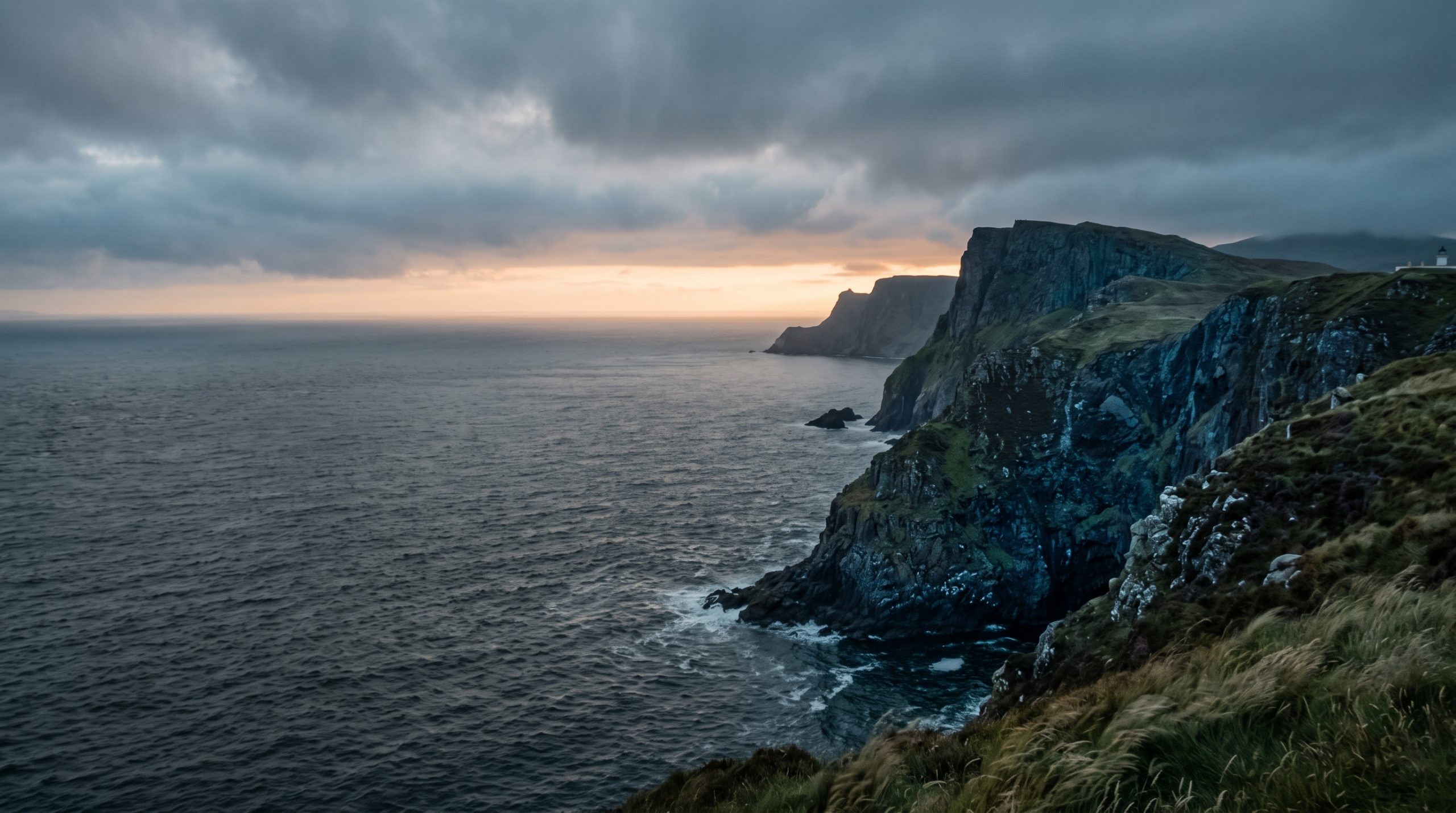
On the longest day of the year the sun clears the hills of Raasay at 4:26 in the morning, and it does not drop into the sea off Waterstein until 22:27. Civil twilight opens at 3:15 and has not closed by 23:38. For the whole of solstice week the sky above the Trotternish ridge never goes properly dark, which means a single day on the Isle of Skye can hold two separate golden hours, a ceremony, a long drive west and an hour of afterglow at the end.
The same island runs on a much shorter clock in the other direction. In late December the sun comes up at 9:04 and is gone by 15:41, roughly six and a half hours, all of it low. Neither version is better. They are different films, and they need different plans.
Access has its own timetable. The Quiraing car park belongs to Highland Council and is charged through the day, currently around £3 for three hours, and in July it is full long before lunch. The car park at the Old Man of Storr fills earlier still. The Fairy Pools car park at Glen Brittle is run by the Outdoor Access Trust for Scotland, which charges by vehicle, currently £8 for a car. Midge season runs from late May to early September and peaks in July and August, worst in still, humid, sheltered air. We are a team of eight, four photographers and four filmmakers, and Skye is a place we plan by the hour rather than by the view.
Photo, film and planning from one team of eight
We photograph, film and plan Isle of Skye elopements as one team, not a photographer plus a separately hired videographer. A full day with one dedicated photographer or one dedicated filmmaker starts at $4,900. The same day with both working together starts at $7,900. Team travel to Skye is included, and your highlights arrive five days later.
Working a June day that starts before three
Here is the shape of a solstice-week day on Skye, built out from where you sleep rather than off a map.
We leave Portree at about 2:50am. The drive north to the Quiraing car park takes roughly forty minutes, and we want to be parked and walking while the sky is still grey. At 3:15 the terraces read as silhouettes and the wind at the saddle tells us which side of the ridge we work. By 4:26 the sun is up behind Raasay and the light runs north along the Quiraing in bands, moving fast. Nobody else is there. That hour is the reason for the alarm, and it cannot be manufactured later in the day.
By 6:30 we are usually down at sea level with the first coach still an hour away. Then we stop. A June day is too long to shoot end to end, so we build a real break into the middle of it: breakfast, dry clothes, sleep. This is the part couples do not expect and the part they thank us for.
Vows go late. With sunset at 22:27 there is no reason to stand somewhere important at two in the afternoon, so we place the ceremony in the evening, when the light has softened and the road out to Glendale has emptied. A registrar or a belief celebrant needs travel time built into the timeline, and single-track roads on the Duirinish peninsula do not reward optimism about journey times, so we work backwards from the ceremony hour and hold the margin ourselves.
Then Neist Point. The path down from the road end to the lighthouse is concrete and steep in places, about three quarters of a mile each way, an hour and a half on the ground if you want to stand out on the headland rather than glance at it. The sun goes into the Minch to the northwest, which is why this is an evening place and not a morning one. After 22:27 the colour keeps going. The last frames of a June day here are shot in light that has no name, somewhere between 22:40 and 23:20, and the film ends quiet and handheld with the sea working below you.
The same island in late September
If a 2:50am alarm is not your idea of a good start, September buys you almost everything and asks for far less. Sunrise moves to 7:05, sunset to 19:31, and the day becomes one continuous twelve and a half hours instead of two shifts. The coach traffic has thinned. The midges are mostly finished. Heather is over but the moor has turned, and the Cuillin get their first proper cloud caps. It is the month we suggest most often to couples who want the ridge at first light without the split day.
| When | Sunrise | Sunset | What that gives you |
|---|---|---|---|
| Mid-April | 6:17 | 20:34 | Fourteen hours of light, snow still on the Cuillin, no midges |
| Mid-May | 5:05 | 21:39 | Sixteen hours, early start, ahead of the peak season traffic |
| Solstice week | 4:26 | 22:27 | Two golden hours, a night that never darkens, a split day |
| Late September | 7:05 | 19:31 | One continuous day, quieter car parks, low sun |
| Mid-October | 7:58 | 18:22 | Sunrise after breakfast, colour on the moor, empty ridges |
| Late December | 9:04 | 15:41 | Six and a half hours, every one of them low-angle |
Those are local clock times for Portree, and they shift by a few minutes across the island. Winter has one extra planning line: the road over the Quiraing is high, single-track and unlit, and it can close in snow and ice, so we build December and January days on low ground and coastline and treat the ridge as a bonus rather than a fixture.
When the forecast is wrong in both directions
The question we are asked most about Skye is what happens if it rains. The honest answer is that some rain is likely, that the forecast on this island is frequently wrong at both ends, and that none of this needs to touch your plans, because the planning already assumes it.
Every timeline we build for Skye carries alternatives that are chosen for wind direction rather than for postcard value. If the northwesterly is loading squalls onto Trotternish, Elgol and the southern coast are often forty minutes of driving away from a different sky. Woodland and waterfalls at Glen Brittle photograph better wet than dry. Sea cliffs in moving cloud give a film something a clear day cannot. What we protect is the ceremony hour, the drive time and your energy; what we move, sometimes at 6am on the morning itself, is the order of the day. You will get a message with the revised plan, and it will already have the celebrant, the light and the tide accounted for.
Skye is not a place that hands you a guaranteed sky. It is a place that hands you weather that is worth photographing, if somebody has planned for it. Tell Us Your Story and we will send back the version of this day that fits the month you are looking at.
What film adds when the wind never drops
Skye is a loud, moving island. Grass lies flat on the Quiraing saddle. Water comes off the Fairy Pools steps in sheets. At Neist Point the wind comes off the Little Minch with only the Outer Hebrides between you and open ocean. Stills hold the shape of that place beautifully. Only a film holds the movement and your two voices inside it.
Which is exactly where a photographer and a filmmaker hired separately run into each other. On an exposed edge those two crafts want opposite things at the same minute. The photographer wants you on the windward side with the ridge line clean behind you. The filmmaker wants your vows in a wind shadow, because a microphone in a 3am gale returns nothing usable. Somebody has to give, and if the two of them met for the first time that morning, the negotiation happens out loud, in front of you, while you are holding your notes.
When both are ours it is settled long before that. The Expedition adds professional audio for vows and meaningful moments where conditions allow, so the filmmaker will have already found the hollow behind the basalt, or asked for the ceremony to sit two hundred metres along the ridge where the wind breaks, and the photographer will have built the frame that still gives you the terraces. Same team, same timeline, one conversation the night before instead of a compromise at the moment you speak.
The other thing two cameras solve here is speed. Skye light changes in minutes, not hours: a squall crosses the Sound of Raasay and the terraces go from slate to gold and back again while you walk fifty metres. One camera has to choose which of those two minutes it keeps. Two cameras keep both, and the walk in stops being dead time and becomes the material the film is actually made of, the twenty-five minutes up the Storr path, the burn at Glen Brittle, the boat cutting into Loch Coruisk from Elgol.
Aerials matter more on Skye than almost anywhere we work, because the scale of Trotternish simply does not read from the ground. Drone footage is included where it is legal, safe and appropriate, and we confirm the airspace position and the landowner position before we design any sequence around it, so nothing in your film depends on a permission that may not exist. With eight of us on the team there is always a second camera on the ground and a colleague in reserve. You can see how the island renders in finished work in our galleries and films, which is a more useful answer than anything we could write about our own style.
What travels with us, and what lands afterwards
Every Skye experience, from a single-day Adventure to a multi-day Odyssey, includes the following.
- Destination and location design for Skye, chosen for your month and your walking appetite, not from a shortlist of five car parks.
- A custom timeline built around the actual sunrise, sunset and twilight for your date, and around real travel time on single-track roads.
- Permit research and logistics guidance, including landowner and car park questions before they become a problem on the morning.
- Weather alternatives and backup planning, matched to wind direction rather than to convenience.
- Drone footage where it is legal, safe and appropriate.
- Professional audio for vows and meaningful moments on the Expedition, where conditions allow.
- Team travel worldwide, which on Skye means flights, accommodation and ordinary travel for the assigned team, with no long-haul surcharge and no mileage line.
- Highlights delivered in five days. The full gallery or film in three weeks.
Guest count does not change the fee. It changes access, permits, transport and the timeline, which is a planning conversation rather than a pricing one. Two of you on the Quiraing path move differently from twelve, and we would rather know in March than find out at 3am.
Where coverage starts, and the sterling costs that are not ours
Three shapes of coverage, all of them including the planning above. The Adventure is one full day with one dedicated photographer or one dedicated filmmaker. The Expedition is one full day with a dedicated photographer and filmmaker working together, which is what most couples choose for Skye once they understand what the wind does to sound. The Odyssey runs two to seven days across one or several destinations, photography and film, quoted as a custom proposal. There is no half-day option, and the full figures sit on our pricing page.
What you pay locally on Skye, separately from us, is short and worth knowing early. Marriage notice costs £45 per person, paid to the registration office. Highland Council publishes its own fees for ceremonies at a registration office, at a venue and outdoors in a natural setting, and a humanist or independent celebrant sets their own. Car park charges are a few pounds a vehicle at the honeypots, £8 for a car at the Fairy Pools. Then accommodation, and anything unusual we agree to add: a private boat out of Elgol into Loch Coruisk, a 4×4 to a road end, a mountain guide if you want the Cuillin properly. Flights and accommodation for our team are not on that list, in any destination, ever.
How a Skye film booking moves from message to plan
- You send the inquiry form with your dates, or the month you are circling.
- We reply within 24 hours with our initial brochure.
- We build a tailored proposal around your Skye dates, the light for those dates and the coverage that fits.
- You sign the contract.
- You pay a 30% retainer, and the proposal sets out when the rest is due.
- Planning begins, which is when the timeline, location design and permit research start in earnest.
Our planning calendar for Skye currently covers 2027, 2028 and 2029. Nothing in those six steps needs you to be awake at the same time as us, and the first four cost you nothing but an email.
Who Skye rewards, and which month to ask us for
Skye suits couples who are genuinely willing to be walking at 3:15am in June for the sake of forty minutes of light nobody else on the island is seeing. It suits people who are steady on uneven basalt, wet grass and boggy ground, and who own real boots rather than borrowing them. It suits couples who can hear at 6am that today runs backwards, and answer with coffee rather than panic.
If that is not you, say so in the first message, because the fix is easy and it is not a smaller day. A late September or mid-October date gives you a 7:05 or 7:58 sunrise and one unbroken day. A coastal shape built around Elgol, the old bridge at Sligachan and the Waterstein road end keeps the walking short and the car close. Two or three days as an Odyssey lets the ridge be optional instead of load-bearing, which is often the right answer for couples who want Skye and want to sleep. Tell us which of those sounds like your morning and we will shape the day around it, or tell you honestly which month fits it better. Our destination guides are a good place to compare Skye against the mainland Highlands before you decide.
Common questions
How much does an Isle of Skye elopement film cost?
Coverage is priced by the shape of the day rather than by the hour, and film sits alongside photography in the same experience instead of being a separate hire. Current starting figures for each of the three experiences are on our pricing page, along with what each one includes.
Can we legally get married outdoors on Skye?
Yes. You each submit a marriage notice to the registration office, at least 29 clear days before your date and no more than three months ahead, at £45 per person. Highland Council publishes fees for civil ceremonies at an office, at a venue and outdoors in a natural setting, and humanist and independent celebrants work outdoors across the island.
Do we need permission to film at the Quiraing or the Fairy Pools?
It depends on the landowner and on who operates the car park, and it changes from site to site. Researching that and telling you exactly what applies to your locations is part of our planning. Any government, venue or landowner fee is paid by you, and the car park charges themselves are a few pounds a vehicle.
What actually happens if it rains all day?
The day goes ahead with a different running order. Your timeline is built with wind-direction alternatives already in it, so we move locations and hours, not the marriage, and you get the revised plan in writing that morning.
When are the Old Man of Storr and the Quiraing quiet?
Before about 8am, and again late on a summer evening. Both car parks fill from mid-morning through the afternoon in July and August. In October you can have the Quiraing more or less to yourselves at civilised hours.
How soon do we see the photos and the film?
Highlights reach you five days after the day itself. The full gallery or the finished film follows within three weeks.
Can our parents and a few friends come?
Yes, and it does not change what you pay us. Guest numbers change access, permits, transport and pacing, so we plan the walking and the timing around the least mobile person coming, and we need to know the number early rather than late.
Will midges ruin a summer date?
They are a factor from late May to early September and peak in July and August, worst in still, humid air in sheltered inland spots. We put the calm hours on exposed coast and ridge lines, save the glens and woodland for breezy ones, and mid-May, late September and October are largely clear of them.
Choosing your date on Skye
From the first reply onward, the whole process stays in writing, at whatever hour suits you, from the first message to the final delivery, which matters when you are five or eight time zones away from the island. Send us your dates or the month you are circling, tell us how early you are prepared to be awake, and we will come back within 24 hours with the brochure and honest thoughts on the light you would get. Check Your Date.