The road over Llogara Pass tops out at 1,027 meters, and in June it is one of the few places on this coast where you can stand and watch the sun actually clear the horizon. Down in the bays below, the sun has technically been up since 05:11. It has not arrived. The Ceraunian ridge sits between those pebble beaches and the eastern sky, and a full hour after the printed sunrise time the sun is still only about ten degrees off the horizon, nowhere near high enough to spill over the crest.
So the first light on the Albanian Riviera is not light at all. It is a long, cool, shadowed hour when the sea is glass, the sunbed crews have not come down yet, and nobody has walked the pebbles. Then, fifteen hours later, the coast gives you the other thing it does better than almost anywhere in Europe: an open-water sunset with nothing in the way. Two good windows, at opposite ends of a very long day. Everything we build in Albania hangs off that shape.
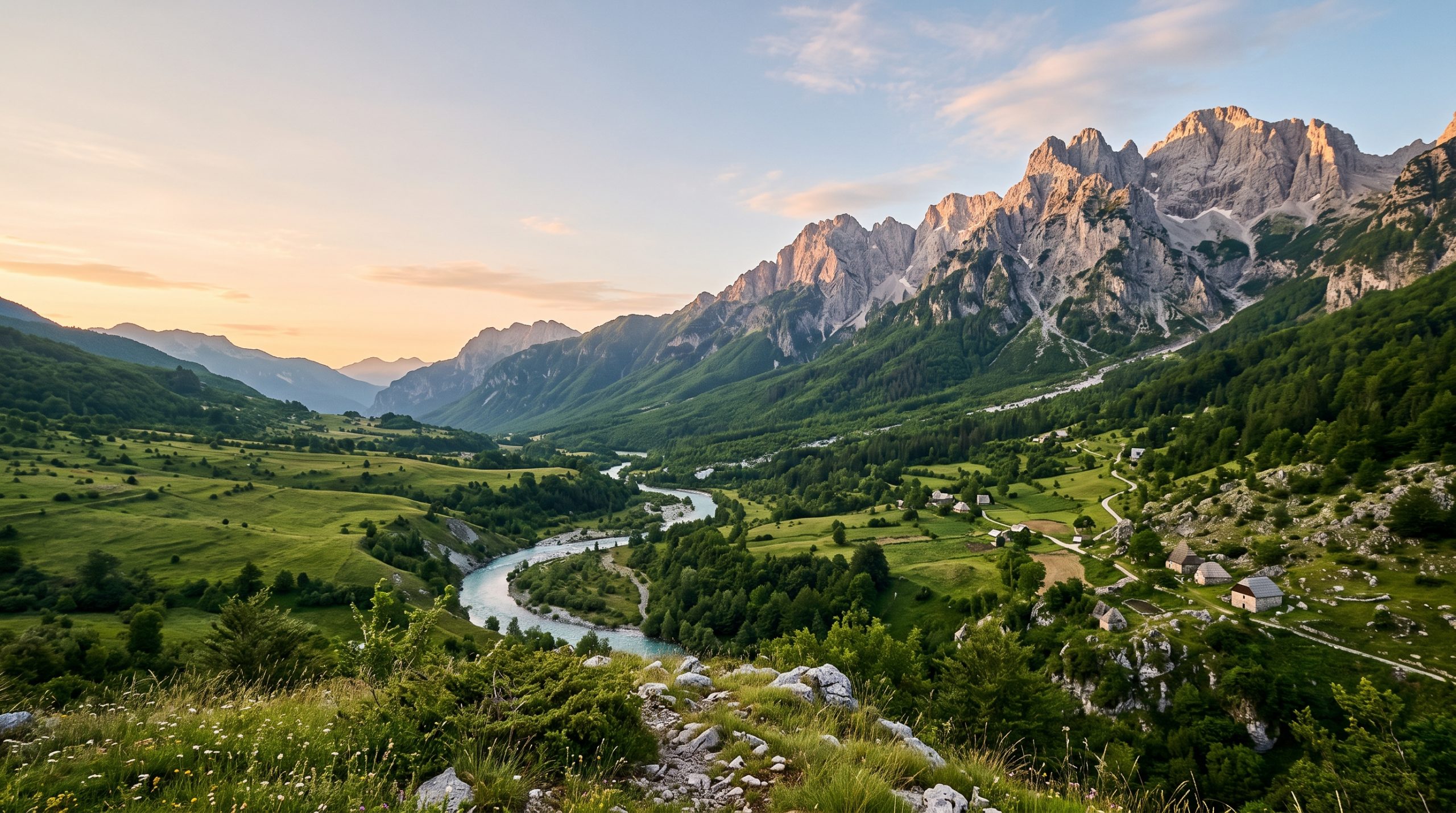
Head north instead and the country becomes unrecognizable. Theth sits on a valley floor walled by peaks over 2,000 meters, reached on a paved but genuinely slow mountain road that turns off at Koplik, and the ferry up Lake Koman leaves in the morning, currently around 09:00, and takes roughly two and a half hours to reach Fierzë. Same country, same week, two completely different films.
Photo, film and planning across the Riviera and the Alps
We are an eight-person team who photograph, film and plan Albanian elopements as one service: the Ionian coast, the stone towns of Berat and Gjirokastër, and the northern Alps around Theth and Valbona. A full day of coverage starts with one dedicated photographer or filmmaker, and team travel is included. Our Albania calendar is currently open across 2027, 2028 and 2029.
A Riviera day, from ridge shadow to the last light on the water
This is a mid-June shape, on the coast between Dhërmi and Himarë. Move it to September and every number changes, which is the point of building the timeline around your month rather than around a template.
04:30. Civil dawn is 04:38 and the sky over the mountains is already pale. If you want the sun itself, this is when we drive up to Llogara, because at 1,027 meters the pass gets sunrise more or less on the clock while the bays underneath stay blue.
05:30 to 07:00. The shadowed hour on the pebbles. No harsh edge on anything, the water still flat before the day’s breeze, and the beach effectively empty. This is the hour we most often put vows in when couples want soft, quiet light and no audience. The sun finally tops the ridge closer to 07:00 than to 05:11.
07:30. Gjipe, if you are willing to walk. Cars stop at the top of the track and parking runs a few hundred lek for the day. The last stretch down is 15 to 20 minutes of loose stone, and 25 to 30 back up in the heat, because the final kilometer is a rocky jeep track that no rental car should attempt. The reward is a beach at the mouth of a gorge, cliff walls on both sides holding shade long after the open coast is lit, and an hour or two before the first boats come round from Himarë.
10:00 to 16:30. We stop, and we say so plainly rather than filling the hours to look busy. Overhead Ionian sun in July gives you white pebbles, black shadows and squinting. So the middle of the day is lunch, a swim, a drive, or a change of clothes. If we go inland, Gjirokastër’s stone lanes stay in shade most of the afternoon and the Blue Eye at Muzinë, 22 kilometers from Sarandë, is honestly a half-hour stop and best taken at opening time, currently 50 lek a head in cash. By late morning it is scooters, tour vans and a queue at the viewing platform, and no photographer on earth can make that feel private.
17:30. Back on the coast, watching the wind. The onshore breeze usually has its say in the afternoon and softens through the last hour, which is one reason we do not lock a cove until we have seen the day.
19:00 to 20:11. The hour that earns the trip. The sun is 11 degrees up at 19:00 and the whole Riviera turns gold and then pink. Here is the detail that decides which bay we use: in mid-June the sun sets at about 302 degrees, well north of west, so on a west-facing beach it slides down the coastline rather than dropping into the water in front of you. By mid-September it sets at around 275 degrees, close to due west, straight into the sea at the end of the sand. Same beach, completely different final frame.
20:11 to 20:45. Sunset, then a little over half an hour of afterglow before civil dusk. Long enough for a second sequence somewhere with a table and a bottle in it, which is often the footage couples end up watching most.
High summer on this coast, told straight
July and August on the Albanian Riviera are busy in a way the photographs you have been looking at do not admit. The SH8 through Dhërmi and Himarë moves slowly, the beaches at Ksamil are laid out with rented loungers well before nine, and the drive from Sarandë north takes longer than any map suggests. None of that ruins an elopement here, but it does dictate the plan. We put the ceremony in the shadowed hour before eight, we favor bays reached on foot or from the water rather than from a car park, we send the middle of the day inland to the stone towns, and if your dates are flexible we will push for September or early October, when the light lasts two and a half hours less and the coast belongs to fewer people. Tell us which weeks you actually have and we will tell you honestly what those weeks look like here.
If a shape like this reads like your kind of day, Tell Us Your Story and we will send back a version of it built around your month and your idea of a good morning.
What a second camera changes on a fifteen-hour Ionian day
Photography, film and planning come from the same eight people here. Not a photographer plus a videographer who introduce themselves in a hotel car park at 4am and negotiate over who stands where.
On this coast that matters more than it does in gentler places, and the reason is arithmetic. The evening window is about 34 minutes wide, from the sun touching the water at 20:11 to civil dusk at 20:45. One person alone in that light is forced to choose, second by second, between holding a still frame and running the moving one. Something is always being abandoned. With a photographer and a filmmaker working together, both are already in position, because we walked that cove in the afternoon and agreed who takes the low line along the pebbles and who takes the rock above it.
Wind is the other reason. The breeze coming off the Ionian is why so many coastal films have vows you cannot hear. The Expedition adds professional audio for the vows and the moments that matter, where conditions allow, and just as importantly we position you in the lee of the gorge wall at Gjipe rather than out on open pebbles with the mic taking the full force of the sea.
Access does the rest of the arguing. That last kilometer into Gjipe is walked, not driven, and two full kits down and back up is work for two people. A single operator carrying everything alone leaves half of it at the top of the track and shoots the day they can manage instead of the day you planned. In the north the constraint is a timetable: the Koman ferry runs once in the morning, the crossing is about two and a half hours, and there is no second boat for a second attempt. Both cameras go on the same crossing, and the drone goes up only where permission and the time window are confirmed in advance, so the aerials add to the film rather than carry it.
Eight of us also means there is always a colleague in reserve and a second camera on the ground. What that looks like when it is finished, on Albanian stone and Albanian water, is the clearest thing we can show you: the galleries and films on our stories page are the same coverage described here, delivered.
Included in every Albanian day we shoot
The planning is not a bonus attached to the coverage. It is half of what you are paying for, and in a country where the good hours are this narrow it is the half that decides whether the day works.
- Destination and location design, down to which cove faces the sunset in your specific month
- A custom timeline built around real light and real driving times, not the numbers a mapping app gives for Albanian mountain roads
- Permit research and logistics guidance for beaches, parks and private land
- Weather alternatives and backup planning: a second bay, an inland town, a valley on the other side of the ridge
- Drone footage where it is legal, safe and appropriate
- Professional audio for vows and meaningful moments on the Expedition, where conditions allow
- Team travel worldwide, which means flights, accommodation and ordinary travel for the assigned team, with no long-haul distinction
- Highlights delivered in 5 days, and the full gallery or film in 3 weeks
- A price that does not move with guest count, whether it is the two of you or the two of you plus fourteen
Where coverage starts, and what you will spend in lek
The Adventure starts at $4,900 and covers one full day with either a dedicated photographer or a dedicated filmmaker. The Expedition starts at $7,900 and puts a dedicated photographer and a dedicated filmmaker on the same day, working together. The Odyssey runs from two to seven days across one or several destinations, photography and film, and comes to you as a custom proposal. Full detail lives on the coverage and pricing page. Albania carries no travel surcharge, because getting our team to Tirana is our cost, not yours.
What you pay locally is separate, and in Albania it is refreshingly small. Butrint charges around 1,000 lek per person to enter, which is close to ten US dollars at recent rates. The Blue Eye at Muzinë is 50 lek a head plus a few hundred for the car, cash only. Parking at the top of the Gjipe track is a few hundred lek. Accommodation, food, your celebrant and any government, park or landowner permit fees are yours; the research and the applications are ours. If you want a cove with no path to it, a rough track driven rather than walked, or a guide in the northern Alps, then a boat, a 4×4 or that guide is booked separately and we will tell you exactly what it costs before you commit to it. Couples marrying legally in Albania should also budget the US Embassy notary fee of 50 dollars for the affidavit of eligibility.
From first message to planning underway
No mystery here, and no pressure built into any step of it. Most of what people find stressful about hiring a team for a foreign country comes from not knowing the order of events, so here it is.
- You send the inquiry form with your month, a rough idea of coast or mountains, and anything you already know you want.
- We reply within 24 hours with an initial brochure.
- We build a tailored proposal: which experience, which region, which dates, what the day would look like.
- You sign the contract.
- You pay a 30% retainer, with the rest of the payment plan set out in that proposal.
- Planning begins in earnest: location design, the timeline, permit research, weather alternatives.
If you are earlier than that and still working out the shape of the thing, our guide to how to plan an elopement covers the fundamentals before any of this becomes relevant.
The kind of morning this country asks for
Albania rewards a particular sort of couple, and it is worth being straight about which sort. In June and July it asks for a 04:30 alarm, because the good hour on the pebbles is over by the time most people are eating breakfast. It asks for shoes you can walk loose stone in: the Gjipe track, the pebble coves, and in the north the trail from Ndërlysaj to Theth’s own Blue Eye, which is roughly 3 kilometers each way with real elevation in it. It asks you to be relaxed about a plan that changes at seven in the morning, because on a west-facing coast the wind decides which bay is calm and we would rather move than force the original one.
If the pre-dawn start is not your idea of a good morning, that is genuinely useful information rather than a problem. Sunrise on the coast is 06:21 by mid-September and 06:45 by the second week of October, and a 12-hour day instead of a 15-hour one gives you the same two windows with a civilized gap between them. If steep or loose ground is out, the day moves to Berat and Gjirokastër’s stone streets, the walkways at Butrint and headlands you can reach by car, and it loses nothing. If you want the Alps instead of the sea, Theth and Valbona are a different proposition with a ferry timetable at the center of them, and our destination elopement guides are the place to start comparing. Whichever of those you recognize, write it down in your first message. We will either shape the day around it or tell you honestly which month and which region fits it better.
Common questions
Can we legally get married in Albania as Americans?
Yes, and the process is administrative rather than difficult. US citizens need an Affidavit of Eligibility to Marry in the Republic of Albania, issued by the US Embassy in Tirana for a 50 dollar notary fee. The marriage is registered at a Civil Status Office, there is an 11-day announcement period before it can be registered, and both of you plus two witnesses sign in person. Plenty of couples handle the legal paperwork at home and keep the Albanian day entirely about the landscape and the vows.
Do we need a permit to elope on an Albanian beach or in a national park?
It depends on the site, the season and who owns the ground, and that is exactly the kind of question we take off your plate. Permit research and logistics guidance are part of every experience. Where a municipality, park or landowner charges a fee, the fee is yours and the legwork is ours.
Can you fly a drone for our Albanian elopement film?
Where it is legal, safe and appropriate, yes, and aerials over places like the Gjipe gorge or the Llogara hairpins are worth having. Drone work runs on permission and a time window, so we confirm both before we plan any part of the film around them, and the ground coverage is always built to stand on its own.
Is September better than June on the Albanian Riviera?
For most couples, yes. June gives you 15 hours between sunrise and sunset and a sun that sets well north of west. September gives you a 06:21 sunrise, a sunset closer to due west that drops straight into the water off a west-facing bay, warm sea, and noticeably fewer people on the coast road. June wins if you specifically want the longest possible evening.
How do we get from Tirana to Theth and the Koman ferry?
By road to Shkodër, then north on the mountain road that turns off at Koplik. It is paved the whole way now and still slow, so allow much more than a mapping app suggests. Transfers to the Koman ferry terminal leave Shkodër early, around 06:30, because the crossing to Fierzë leaves around 09:00 and takes about two and a half hours. We build these days backwards from the boat.
Can we do the coast and the mountains in the same trip?
That is what the Odyssey is for: two to seven days, photography and film, one or several destinations. A common shape is two coastal days on the Ionian and then two in the north around Theth or Valbona, with the travel day used properly instead of wasted. It comes to you as a custom proposal.
How soon do we see our photos and film?
Highlights reach you in 5 days, and the full gallery or film in 3 weeks. That holds for Albania the same as anywhere else we work.
Does bringing our parents and a few friends change the price?
No. The fee is the same whether it is the two of you alone at Gjipe or a group of sixteen. Guest numbers change access, permits, transport and the timeline, so tell us the number early and we plan for it.
Choosing your month, and what happens next
Everything on our side happens in writing, at whatever hour suits you, from the first message to the final delivery. You write, we answer within a day, and nothing needs to be discussed out loud for a plan to take shape. Dates for 2027, 2028 and 2029 are open, and the two useful things to send us first are the month you are thinking about and whether you would rather wake to the Ionian or to a valley floor in the Alps.
Tell us that much and we will come back with a real day: which cove faces the sunset that week, when the sun clears the ridge, and where you will be standing when it does. Start Your Story.