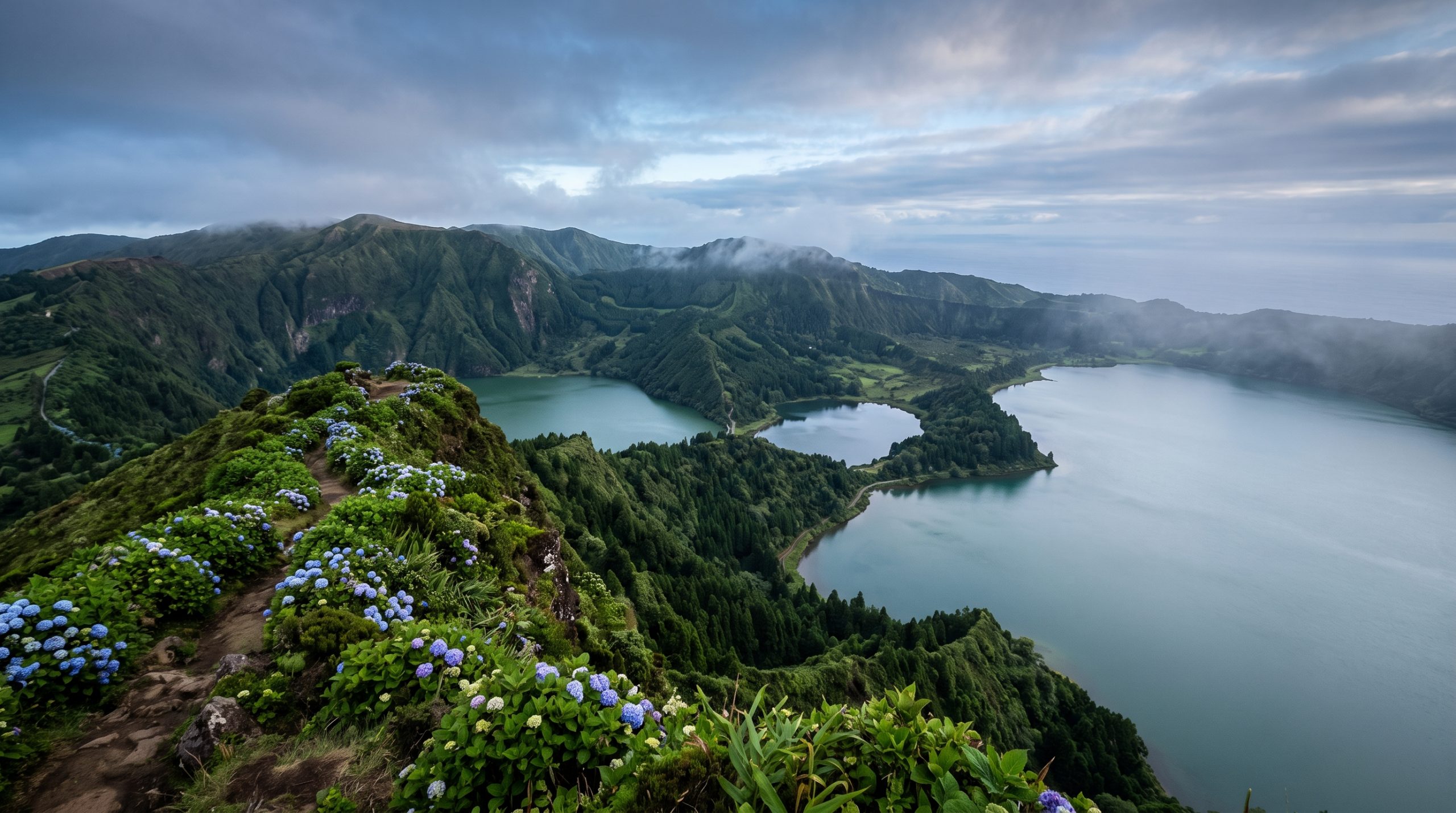
The road to Lagoa do Fogo belongs to whoever is awake first. From 15 June to 30 September the stretch between Caldeira Velha and Casa da Água runs on a shuttle from 9am to 7pm, five euros a head for visitors and free for people who live in the Azores. Outside those hours you drive it yourself. That one line in a bus timetable decides the shape of most of our São Miguel mornings.
The lake sits at 575 meters, which is roughly the height Atlantic cloud likes to park at. We have stood on that rim at 6:15 in July looking at gray wool, watched it tear open around 6:40, and lost it again before eight. Brochures do not tell you that the high ground here is frequently in cloud even in July and August. It is the most useful single fact about planning a day on these islands, and everything below is built on it.
The compensations are large. In late June the sun goes down after nine and the day runs close to fifteen hours, long enough for first light on a crater rim, thermal water at noon and a west-coast dusk with no part of it feeling hurried. And because São Miguel has no ferry link to the rest of the archipelago, an Azores elopement is a decision about which island rather than a plan to see them all.
Photo, film and planning across the nine islands
We are a team of eight, four photographers and four filmmakers, covering elopements on São Miguel, Pico, Faial, Flores, Terceira and the rest of the archipelago. Photography, film and the planning behind both come from one team, and travel to the Azores is included. Coverage levels are set out on our pricing and coverage page.
Before nine, and again after six: a São Miguel day in summer
Sunrise and sunset write the timetable here, and the Azores run an hour behind Lisbon, so the numbers surprise couples who have looked up mainland Portugal by mistake. In Ponta Delgada the latest sunset of the year falls on 28 June at 9:10pm, and the longest day stretches to 14 hours 49 minutes. The earliest sunset is on 6 December at 5:25pm, with the shortest day under ten hours. A December elopement here means genuine sunrise light without a 4am alarm.
This is a July day we have actually built, with the times we actually used.
05:40. Out of Ponta Delgada and up the EN5-2A with coffee in the car. In the last week of June sunrise lands just after 6:20, and there is usable sky well before it. The shuttle window has not opened, so the crater road is ours and we park where we want to park.
06:20 to 07:15. The rim above Lagoa do Fogo. Wind here comes over the ridge rather than up it, which means the sheltered side of the path is two steps away and worth knowing about before anyone puts on a veil. We work the wide frames while the light is low and directional, then move down as soon as the sun is high enough to flatten the lake.
07:45 to 09:15. Across to Sete Cidades. Vista do Rei sits at 544 meters above sea level, looking straight down on the twin lakes, and the view from it was voted one of Portugal’s seven natural wonders, which tells you exactly how many people will be there by ten. Before nine it is a different place. From the viewpoint we walk up onto the ridge above Lagoa do Canário, where the ground gives you the crater and the ocean in the same frame.
09:30. Down inside the crater to the lake shore for vows, because the water level is where the wind finally drops and the audio becomes usable. Ceremony first, celebration second, and then breakfast in the village while everyone comes back down to earth.
11:30 to 15:00. Furnas. Terra Nostra opens to the public at 10:30 and closes at 16:30, so the iron-brown thermal pool at a steady 40 degrees is a mid-day answer and never a sunrise one. The camellias and the 250-year-old planting hold up in flat light in a way that open coastline does not, which is precisely why we put the harshest hours of the day inside a garden.
15:00 to 18:00. Rest. Real rest, in a room, with shoes off. Cloud tends to build over the interior through the afternoon, and there is nothing on the high ground worth trading a nap for.
18:30 to 21:20. The northwest coast around Mosteiros, where the sea stacks sit offshore and the sun drops behind them. In late June the last color is still going after nine, which gives a couple two and a half hours of falling light on the same stretch of black rock. Most of what people recognize from an Azores film happens in that window.
The morning the rim is in cloud
This is the question every couple asks us about the Azores, and it deserves a straight answer rather than reassurance. Cloud on the crater rims is normal, not unlucky. What matters is that cloud has a height, and the coast is at zero meters.
So we plan two versions of every day. The high version uses Fogo and Sete Cidades in the first three hours. The low version moves the same hours to sea level: the lava coast at Mosteiros, the hydrangea lanes that line the roads through summer, the woodland and steam of the Furnas valley, the cliffs and pastures of Nordeste in the east where weather often behaves differently from the west on the same morning. We decide the order the evening before, look again at 5am, and we tell you which one we are running while you are still getting dressed.
Two other things make this workable. São Miguel is small enough that a sea-level alternative is rarely more than forty minutes from a mountain one. And a ceremony that sits inside a window rather than on a fixed minute lets us move it by ninety minutes if the crater is going to open late. When couples let us build that flexibility in from the start, cloud stops being a problem and becomes one more thing the timeline accounts for.
If you have one date in mind, or two and no idea which is the better bet, send them to us and we will tell you what the light and the access hours do on each. Check Your Date
What a second camera does when the rim clears for twenty minutes
On a good Azores morning the gap in the cloud is short. It opens, the lake changes color, and it closes. A photographer and a filmmaker who were hired separately and met that morning will spend part of that gap negotiating: who stands where, which direction the couple walks, whether the tripod is in the photographic frame. We have watched it happen from the sidelines and it costs about four usable minutes, which on that ridge is most of what you had.
When both people work for the same team, the gap is already allocated. The photographer takes the ridge line and the couple walking into it. The filmmaker takes the movement, the wind in fabric, the lake behind. Neither one is in the other’s frame because the frames were agreed the previous evening over the same map, drawn by the same people who chose the location in the first place.
Wind is the other thing this landscape does to a film. Vows spoken on an exposed rim are close to unusable as audio, however good the gear. Because the ceremony spot on our timeline is chosen partly for its wind shadow, the vows are recorded somewhere they can actually be heard, and the enormous exposed frames get made twenty minutes later when nobody is talking. That is a planning decision, not an equipment decision, and it only happens when the people planning the day are the people filming it.
Aerials are worth having here, because the scale of a caldera is the one thing a ground camera argues with. Drone work runs on registration, authorization and the rules that protect nesting sites and airport airspace, so we confirm what is permitted at each location and in what window before we design a single sequence around it. Where a site does not allow it, we get the same sense of scale with a long lens from across the crater instead. You can see how both look in finished work in our stories and films.
Eight people also means something practical. There is always a second camera on the ground and a colleague in reserve, which is the reason we can commit to a date on an island where the weather writes half the plan.
What travels with us, and when the files arrive
Every experience includes the same foundations, whichever island you choose.
- Destination and location design for your date, not a list of the same four viewpoints everyone photographs.
- A custom timeline built around real light and real driving times, including the shuttle and opening hours that govern access.
- Permit research and logistics guidance for every location on the plan.
- Weather alternatives and backup planning, which on these islands means a full second version of the day.
- Drone footage where it is legal, safe and appropriate.
- The Expedition adds professional audio for vows and other meaningful moments where conditions allow.
- Team travel worldwide, including flights, accommodation and ordinary travel for the assigned team. There is no long-haul surcharge and no European exception.
- Highlights within 5 days. The full gallery or film within 3 weeks.
Our current Azores availability runs across 2027–2029.
Where coverage starts, and what the islands charge on top
The Adventure covers one full day with one dedicated photographer or one dedicated filmmaker, from $4,900. The Expedition covers one full day with a dedicated photographer and filmmaker working together, from $7,900, and it is the one most couples choose for the Azores because the landscape moves and the light does not wait. The Odyssey runs from two to seven days across one or several islands, photography and film, quoted as a custom proposal. There is no half-day option.
Your price does not change with your guest count. Guests affect access, permits, transport and the timeline, and never the fee.
What the Azores add on top is paid directly by you, and it is modest by destination standards. The Lagoa do Fogo shuttle is five euros a head if your plan puts you up there inside the summer window. Thermal parks like Terra Nostra are ticketed per person. Where a municipality, landowner or protected site charges a permit fee, that fee is yours while the research and the application work are ours. So are accommodation, your rental car, your celebrant, and any unusual transport such as a private boat, a 4×4 charter or a helicopter. Most of what we plan on São Miguel runs on paved roads and a standard rental car.
How an Azores enquiry becomes a held date
- Send the inquiry form with your dates, the island if you have chosen one, and what you actually want the day to feel like.
- We reply within 24 hours with an initial brochure and honest thoughts on your dates.
- You get a tailored proposal: shape of coverage, who from the team is assigned, how the day works in that month.
- Contract signed and a 30% retainer paid. The remaining schedule is set out in the proposal.
- Planning begins. Locations, timeline, permit research, weather alternatives, vendor coordination.
- The day itself, then highlights within 5 days and everything else within 3 weeks.
Couples these islands reward, and the month that might suit you better
The Azores are generous to couples who are happy to be moving at 5:40am and untroubled by uneven volcanic ground. It helps enormously if you can hear at 5am that the day now runs in reverse order and simply get in the car. If that sounds like you, one day on São Miguel carries more variety than three days in most places.
If pre-dawn is genuinely not your idea of a good morning, say so in your first message. There is a version of the day that starts late, uses the Furnas valley through the middle hours and puts everything that matters into the long west-coast dusk. In late June that dusk runs for over two hours, so nothing is lost except the alarm.
If your priority is the calmest possible odds on your weather, that is worth telling us too. Santa Maria takes under 800 millimeters of rain a year against more than 900 on São Miguel and 1,000 or more on Terceira, and it is a flight of minutes away. Our destination guides go into how the islands differ, and the table below is the short version we send couples who are still choosing.
| What matters most to you | Island | Getting there |
|---|---|---|
| The driest odds in the archipelago | Santa Maria | Short flight from São Miguel; no practical ferry |
| Every landscape type in one day | São Miguel | Most international arrivals land at Ponta Delgada |
| A mountain in the frame | Pico | Fly to the central group, then boats between the near islands |
| Waterfalls and near-empty roads | Flores | Fly via the central group; plan extra buffer days |
| Sea cliffs and fajãs | São Jorge | Central-group ferries, which run mainly spring to summer |
Whatever shape you want, tell us plainly and we will build it, or tell you honestly which month or which island fits it better.
Common questions
Can we legally marry in the Azores, or is it easier to do the paperwork at home?
Most American couples we work with complete the legal marriage at home and hold the ceremony here, which keeps the Azores day about the day. A Portuguese civil marriage runs through a Conservatória do Registo Civil and the paperwork starts well ahead of your date. Either way we build the timeline and locations around it, and celebrant fees are paid directly by you.
Which island suits a single day of coverage?
São Miguel, almost always. A crater rim at 575 meters, a thermal valley and two different coasts sit within about an hour of each other, so one day genuinely holds three landscapes. Smaller islands are wonderful and better suited to the multi-day Odyssey, because getting to them costs you a travel day at each end.
What if Lagoa do Fogo and Sete Cidades are both in cloud that morning?
We run the low version of the day, which is planned in full before you arrive rather than invented on the spot. Sea-level locations on São Miguel are rarely more than forty minutes from the crater roads, so the switch costs you driving time and nothing else. We tell you the decision at 5am, not at the trailhead.
Do you fly a drone in the Azores?
Yes, where it is legal, safe and appropriate. Aerial work here depends on registration, authorization, protected-site rules and airport airspace, so we confirm what each location permits and in what window before the film is designed around it. Where flying is not allowed, we build the same sense of scale with a long lens across the caldera.
Is your travel to the Azores added on top?
No. Flights, accommodation and ordinary travel for the assigned team are included in every experience, in every destination, with no distinction between a European trip and a long-haul one. What you pay for on the ground are your own accommodation, transport, celebrant and any permit fees.
Can our parents and a few friends come?
Yes, and the price does not move with the number. Guests affect access, permit paperwork, transport and how long a transition takes, so we build them into the timeline rather than pricing them in. Twelve people on a crater ridge simply need a different plan from two.
How long until we see the photographs and the film?
Highlights reach you within 5 days, while you are often still traveling. The full gallery or the finished film follows within 3 weeks.
Your date, answered in writing within a day
The full planning trail stays written and easy to revisit, at whatever hour suits you. You send the form, we reply within 24 hours with a brochure and a straight opinion on your date, the island and the month. There is nothing to arrange in advance and nothing that has to fit into your working day, just a message you can write tonight and an answer to read tomorrow. Tell us the shape of the day you have been imagining on these islands and we will tell you exactly how we would build it. Start Your Story