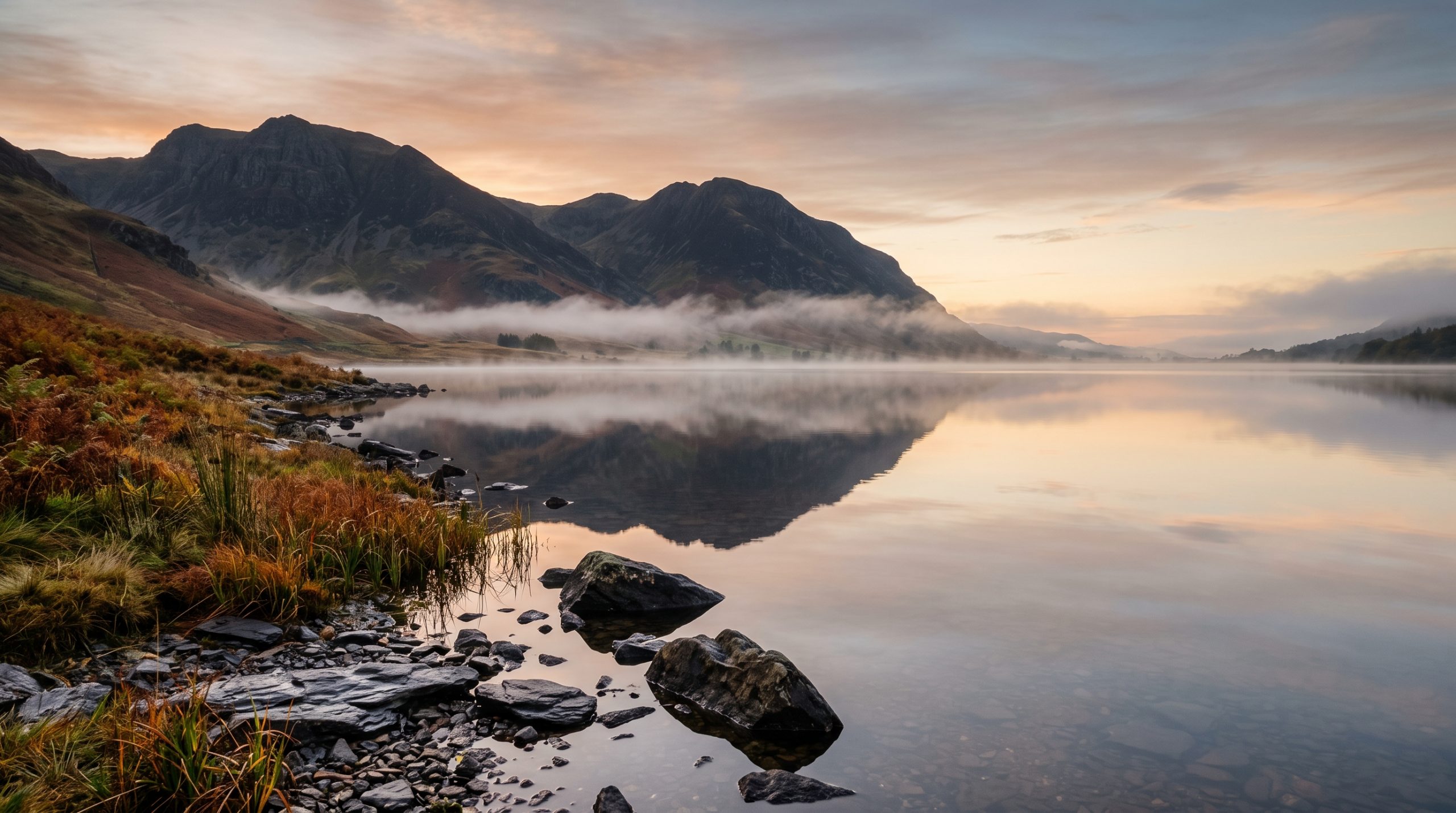
The road up Borrowdale ends at Seathwaite, the wettest inhabited place in England. From there the shortest line into Wasdale climbs over Sty Head on foot, because no road crosses the gap. Drive it instead and you go the long way round the coast for well over an hour, to reach a valley you can almost see from the top of the pass. That distance between the map and the clock is the real planning problem in the Lake District, and it is why we build every day here backwards from the light.
In mid-June the sky over Derwentwater is already grey at twenty to four. The sun clears the fell rim around 4:36 and does not set until 9:53 at night, which gives you two separate hours of good light and a long, busy middle where the coaches arrive and the valley car parks fill. By late December the same valley gets sunrise at 8:33 and sunset at 3:48, and the whole thing becomes one continuous arc with no room for a second act.
We are eight people, four photographers and four filmmakers, and photography, film and planning come from the same team rather than three separate bookings that meet in a car park on the morning. We are working across the Lakes through 2027, 2028 and 2029, from the Crummock Water shoreline to the head of Great Langdale.
Photo and film in one Lake District booking
We plan, photograph and film Lake District elopements as one team: location design, a timeline built around Cumbrian light and honest driving times, permission research, and alternatives held for weather. One full day with a dedicated photographer or filmmaker, or both working together, and team travel to Cumbria is included. Where coverage starts is published.
Sunrise at 4:36 in June, 8:33 in December
A Lake District day is not one shape. Choose midsummer and you get seventeen hours of daylight, which sounds generous until you realize the good light sits at both ends and the middle belongs to everyone else. Choose the third week of October and you get a single arc from a 7:41 sunrise to a 6:15 sunset, low all day, larch going copper on the valley sides, and the fells largely to yourselves after four in the afternoon.
| Date | First light | Sunrise | Sunset | What it does to the day |
|---|---|---|---|---|
| 21 June | 3:39am | 4:36am | 9:53pm | Two working blocks with a genuine rest between them |
| 21 September | 6:19am | 6:55am | 7:15pm | Humane start, and the paths empty out by six |
| 15 October | 7:04am | 7:41am | 6:15pm | One continuous arc, color on the valley sides |
| 21 December | 7:48am | 8:33am | 3:48pm | Seven hours of usable light, all of it low |
Those are Keswick times on the clock you will actually be reading, British Summer Time from late March to late October and GMT after that. Here is how the June version runs when we build it.
We leave the house at 3:15 with headlamps, because the walk in matters more than the walk out and you want to be standing on the ground you chose before the sky separates from the ridge. First light at 3:39 is grey and flat for twenty minutes, which is exactly when we work close: hands, the back of a jacket, the two of you walking. Then the color arrives, the sun comes over at 4:36, and for forty minutes the light is doing something new every ten seconds. We finish that block by six and go back for breakfast, and you sleep for two hours while the day fills up.
Mid-morning is for the legal half hour and for anything indoors. Early afternoon is the hour we deliberately waste: the Buttermere and Ashness Bridge car parks are full, the lakeshore paths are busy, and there is nothing on offer that we cannot get better at eight in the evening. So we eat, we watch the cloud, and we decide the second half of the day on the actual weather rather than on a plan written in March.
The evening block is the one couples remember. From seven o’clock the west-facing fells go warm, the wind usually drops, and the day-trippers have gone back to their cars. We walk in again, you say what you want to say to each other with nobody within a mile, and we keep working through sunset at 9:53 and into the twenty minutes after it, when the tarns hold more light than the sky. Then we drive down Honister in the dusk, and the gradient signs at 1 in 4 look considerably more serious than they did on the way up.
The legal half hour, and the vows that come after
In England a civil ceremony has to happen at a register office or at approved premises. Since April 2022 approved premises can also host it outdoors, anywhere inside their own boundary, with the registrar checking the exact spot in advance. A summit is nobody’s approved premises, so the pattern that works is a legal ceremony with two witnesses at a licensed venue, then vows wherever you actually want them: a tarn at half past four in the morning, a ridge at nine in the evening, a walled sheepfold in the rain.
Notice of marriage is given in person at a register office in England, and both of you must have lived in that district for the seven days before you give it. The notice costs 42 pounds each, sits on public display for 28 clear days, and the marriage schedule is issued on day 29 for the one venue you named. Registrars in Cumberland and in Westmorland and Furness take bookings up to two years ahead, and neither council wants you paying a venue deposit before a registrar is confirmed for your date and time. That sequencing is ours to manage, and it is the part of elopement planning that most couples underestimate.
Two cameras on a ridge where the cloud keeps moving
Cumbrian light does not hold still. A shower crosses Derwentwater, the sun finds a hole in it, and for eleven seconds the far shore of the lake is lit while you are still standing in shadow. A photographer wants the single frame at second four. A filmmaker wants all eleven seconds, plus the twenty before it as the shadow line runs up the fell. One person carrying both jobs has to pick, and whichever they pick, the other thing is gone for good.
That is the whole argument for booking photography and film together here, and it is sharper in the Lakes than in a calm, predictable landscape. With Serg or Alex on stills and Lara or Mike on film, the same forty-minute window on Haystacks or above Blea Tarn produces both records of it, from two positions, with nobody stepping into anyone’s frame because we agreed the geometry the day before on the same ground.
Wind changes the film more than it changes the photographs. A fell ridge in a fresh westerly will flatten spoken vows into noise, so on our two-camera days we build the audio around shelter: the lee of a drystone wall, a rock band below the crest, a hollow by the outflow of a tarn, chosen while the photographer keeps working from higher up. Aerials work the same way. Where a drone is legal and appropriate, the filmmaker flies while stills continue, so the ten minutes we spend on a shot over the water is not ten minutes of you standing around waiting.
The finished work is a set of photographs and a film made in the same weather, of the same moments, by two people who planned the day together. Our galleries and films are the honest version of what that produces, wind and cloud included, and they are the best guide to whether our way of seeing a landscape matches yours.
When the tops are in cloud, which they often are
This is the thing couples write to us about most, and it deserves a plan rather than reassurance. Somewhere between March and June you get the driest stretch of the Cumbrian year, and October through January the wettest, but no month here promises a clear summit. What the Lakes do promise is variety inside twenty minutes of driving, and that is what we plan against.
Two levers matter. The first is height: when the cloud base sits at 400 metres, we stop trying to be above it and work below it, where low cloud on a wooded valley side is better material than a flat blue sky ever is. Lakeshores, oak woods, packhorse bridges, a river in spate, the road as it climbs out of the valley. The second lever is direction. The western valleys catch the Atlantic first, so a hard westerly forecast moves us east toward Ullswater and Haweswater, where the same front often arrives thinner and later.
So your timeline arrives with movable blocks rather than fixed appointments, a primary location and a sheltered alternative within fifteen minutes of it, and a decision we make together on the morning over a real forecast. Nobody has to be brave about it at 4am.
If that sounds like the kind of planning you want behind your day, Send Us a Message with your dates and the valleys you have been reading about.
Inside the experience, and where coverage starts
What we plan, shoot and deliver
- Destination and location design for your dates, including which valley suits that week of the year.
- A custom timeline built around first light, sunset and real travel time on single-track roads.
- Permission and permit research, plus logistics guidance for access, parking and walk-in times.
- Weather alternatives and backup locations planned before you arrive, not improvised on the day.
- Drone footage where it is legal, safe and appropriate to fly.
- On two-camera days, professional audio for vows and other meaningful moments where conditions allow.
- Team travel worldwide, which here means flights, accommodation and ordinary travel for whoever is assigned to you.
- Highlights delivered within 5 days. The full gallery or film within 3 weeks.
Where coverage starts, and what Cumbria bills separately
The Adventure is one full day with one dedicated photographer or one dedicated filmmaker, from $4,900. The Expedition is one full day with a dedicated photographer and filmmaker working together, from $7,900. The Odyssey runs from two to seven days across one or several destinations with photography and film, quoted as a custom proposal. There is no half-day option, and the fee does not move with your guest count.
Costs that belong to you rather than to us are mostly local, so we quote them in pounds. Notice of marriage is 42 pounds each. The registrar’s attendance fee is set by whichever council covers your venue, Cumberland or Westmorland and Furness, and approved premises charge their own room or grounds fee on top. Then accommodation, a celebrant if you want one for the vows, valley parking, and any landowner permission fee where one applies: the National Park Authority owns woodlands, islands, lakeshores, fells and farms, and prices a filming licence according to what you are asking for. Unusual transport sits here too, a boat charter on Ullswater or a mountain guide for a winter ascent.
How a Lake District enquiry moves into planning
- You send the inquiry form with your dates, or the month you are circling, and whatever you already know about where you want to be.
- We reply within 24 hours with our initial brochure.
- We put together a tailored proposal: the shape of the day, who from the team is assigned, the locations we would build it around.
- You sign the contract and pay a 30% retainer. The rest of the schedule is set out in the proposal.
- Planning begins in earnest, and we work the registrar, the venue and the permissions in the right order.
- We shoot the day. Highlights reach you in 5 days, everything else within 3 weeks.
Couples the Lakes suit, and the months that suit them
This landscape rewards couples who will get up at three in the morning in June, walk on uneven ground in boots that are already wet, and treat a change of plan at breakfast as part of the experience rather than a failure. If that reads as a good morning to you, the Lakes will give you more in one day than most places give you in three.
If it does not, say so and we will build something else with the same care. A valley day works beautifully: Ashness Bridge, the Watendlath road, a lakeshore, a packhorse bridge, Blea Tarn from a few hundred metres of level path. Almost no ascent, and the photographs are not a consolation prize. If you want the sharp skylines but not the early alarm, late September gives you a 6:55 sunrise and empty paths by six in the evening. If you want color and long shadows over speed, mid-October is the week we would pick for ourselves. And if you have your heart set on snow on Great Gable, tell us, because that wants a plan built around a wide date window rather than a single Saturday.
Guest numbers change access rather than price. Six people means a car park with six spaces, a walk everyone can do, and a permission conversation that starts earlier. Tell us the real number in your first message and we will design around it, or point you at the valley where it works better.
Common questions
Can we legally get married on a fell in the Lake District?
Not on the summit itself. A civil ceremony must take place at a register office or at approved premises, and since April 2022 approved premises can hold it outdoors within their own boundary if the registrar approves the spot beforehand. Couples get the day they pictured by marrying legally at a licensed venue with two witnesses, then saying their vows on the fell.
We are American. What does giving notice mean for our trip?
Notice is given in person at a register office in England, and both of you need to have lived in that district for the seven days beforehand. It is 42 pounds each, the notice stands for 28 clear days, and the schedule is issued on day 29 for the venue you named. Many couples flying in handle the legal marriage at home and keep the Cumbrian day for vows. If you want the legal ceremony here, we build the whole trip around those dates.
Do we need permission to film and photograph on the fells?
It depends on who owns the ground. Public highways fall to Cumberland or Westmorland and Furness Council, private land to the landowner, and the National Park Authority licenses filming on the woodlands, islands, lakeshores, fells and farms it owns, at a price set by what you are asking for. The research and the correspondence are ours. Any fee is yours.
Can you fly a drone for the film?
Where it is legal, safe and appropriate. Take-off and landing need the permission of whoever owns that piece of ground, so we establish ownership at each location during planning and work to the conditions we are given. Where aerials are not available, we plan the film so it never depended on them.
What happens if the fell tops are in cloud on our morning?
We drop below the cloud base and use it. Your timeline is built with a primary location and a sheltered alternative within about fifteen minutes, and we decide together on the morning with a real forecast in front of us. Low cloud in a wooded valley photographs and films better than a cloudless afternoon.
Which valley works best if we only have one day?
Borrowdale, most of the time. Inside twenty minutes of driving you have lakeshore, oak woods, a packhorse bridge, open fell and the 1 in 4 climb over Honister, so a plan can change without the day falling apart. Great Langdale has the sharpest skyline in England, and Ullswater is our answer when the forecast is wet from the west.
How quickly do we get the photographs and the film?
Highlights reach you within 5 days, while you are probably still in the country. The full gallery or the finished film follows within 3 weeks.
Does bringing our parents and a few friends change the price?
No. Guest count does not affect the fee. It affects access, parking, any permission we need and the pace of the timeline, which is why we would rather know the real number early than be surprised by it in a passing place on a single-track road.
Your first message, and what comes back
The planning stays in writing from the first message onward, at whatever hour suits you and your time zone. Send your dates, the shape of day you are imagining, and any valley names you have collected, and you will have a reply and our initial brochure within 24 hours, with cost laid out plainly on our pricing page. Dates are currently open across our 2027, 2028 and 2029 Lake District seasons.
Check Your Date and tell us which morning you are thinking about.