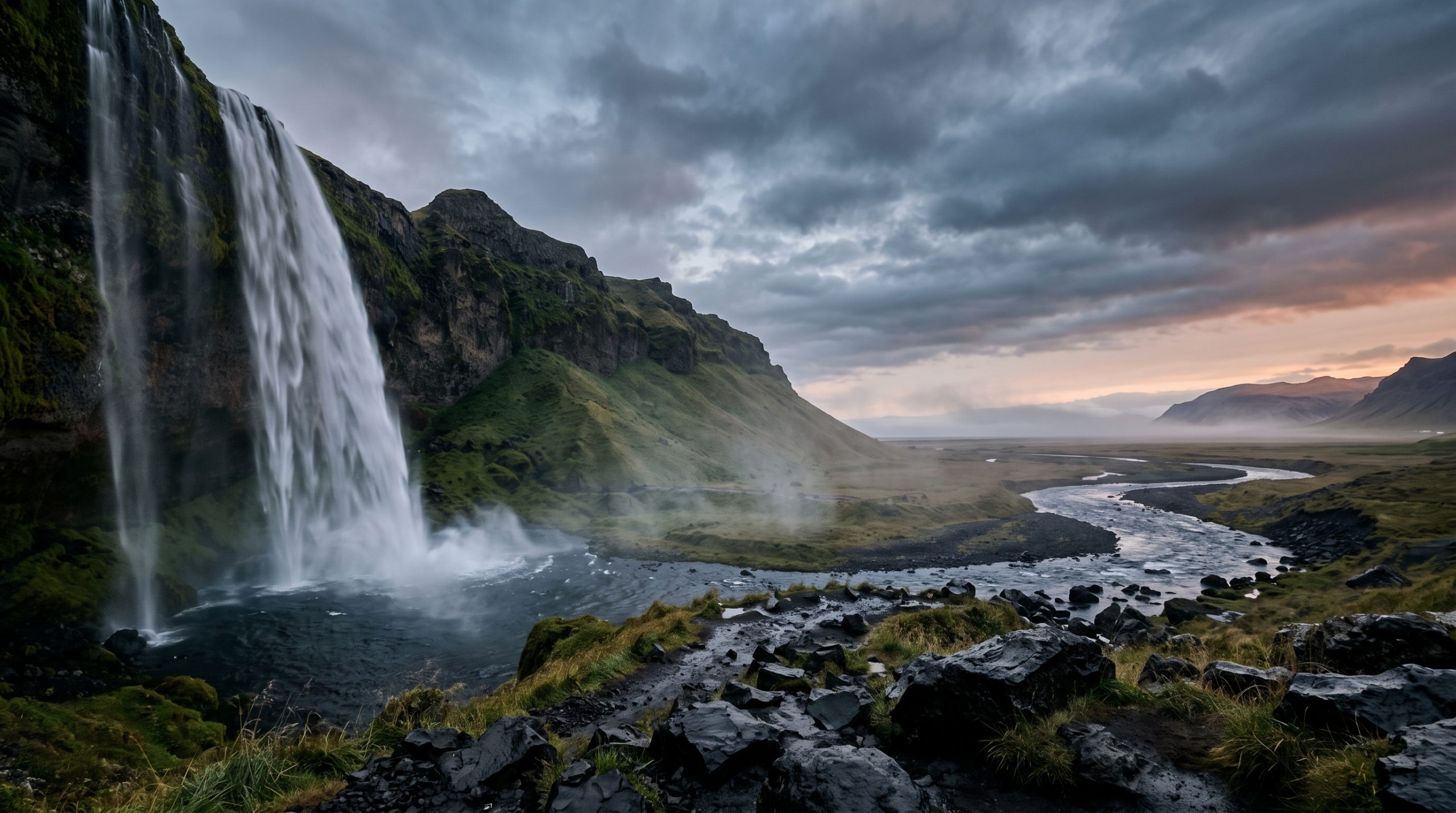
In the last week of June the sun clears the horizon in Reykjavík a few minutes before three in the morning and does not set again until just after midnight. That is more than twenty-one hours of daylight, and for about three of the hours that are left the sun sits just under the horizon and the sky never goes properly dark. Iceland in summer does not really have a golden hour. It has a golden half-night, and almost nobody is out in it.
Six months later the same city gets roughly four hours of daylight at the December solstice, and sunset arrives before four in the afternoon every single day of that month. The sun stays so low that noon behaves like evening light does everywhere else. Neither version of Iceland is a problem to be solved. Each one is a different plan, and the plan is the reason a day here works or falls apart.
Nearly every couple who elopes in Iceland hires a photographer. Far fewer hire anyone to film it, and this is the country where that gap is loudest. The roar under Skógafoss. Ice knocking against ice as the tide shifts it along black sand. Wind pulling at the page someone is reading vows from, and the pause while they wait for it to drop. Photographs hold the shape of all of that. Film is the only thing that keeps the sound.
Iceland elopements, photographed and filmed by the same eight people
We are an eight-person photography and film team, and in Iceland photo, film and planning are a single service: location design, a timeline built around the real light, permit research, then the shooting itself. Coverage runs a full day with a dedicated photographer or filmmaker, or with both working the same timeline together. Team travel to Iceland is included.
Building the day around a sun that barely sets, or barely rises
Every Iceland timeline we write starts from two numbers: the hour the sun is low, and the hour the coaches arrive. The second is more predictable than the weather. The visitor centre at Þingvellir opens at nine in the morning from April through October and the Golden Circle traffic builds behind it, while the south coast car parks fill from mid-morning as the day tours come east out of Reykjavík. Almost every location worth standing in has two good hours that nobody competes for, and they are rarely the hours a couple would pick on their own.
| When | Daylight in Reykjavík | Where the vows sit | What we plan around |
|---|---|---|---|
| Late June | Sun up just before 3am, down just after midnight | Late evening, often 10pm | Empty car parks and hours of low, warm light |
| Late December | About four hours, sunset before 4pm | Middle of the day, near 12:30pm | Office hours for a civil ceremony, aurora chance after dark |
| Spring and autumn | Changing by several minutes a day | Early morning or late afternoon | Two regions inside one drive, whichever side the wind is on |
June and July: the hours nobody else is using
In midsummer you do not have to trade light for solitude, which is the trade almost everywhere else in the world forces on you. A day we like: everyone eats properly at seven in the evening, dresses at eight, and we drive out at nine while the sun is still well up. Vows at ten, on ground chosen that afternoon for the wind direction rather than for the view alone. Then the long part. From about ten until one in the morning the sun grazes along the horizon, and a waterfall that had four hundred people in front of it at noon has you, us, and a fulmar. Seljalandsfoss and Skógafoss both charge for parking now, currently 1,000 ISK, and at midnight you will be sharing those car parks with two campervans and nobody else.
The path behind Seljalandsfoss soaks anyone who takes it, so we shoot it at the start of a block or at the very end, never in the middle. Small decisions like that are what a timeline actually is: not a list of pretty names, but an order of operations that keeps you dry, warm and unhurried.
November to February: four hours, and a sun that never climbs
Winter days here are short and unusually generous. Because the sun barely gets above the ridgelines, the light between eleven and three has the angle other countries only get at dusk. There is no rush to a sunset hour because the whole day is the sunset hour. We build these days tight and close to a single base, with a two-hour drive as the absolute ceiling and usually far less than that.
One legal detail shapes the December timeline more than the weather does. A civil ceremony with a district commissioner normally takes place at the office during office hours, and holding it elsewhere or outside those hours is a request made in advance that depends on the individual office and carries an extra fee. In a month when the light is gone by four, that request is the difference between vows in daylight and vows by headlamp, so it goes near the front of the planning, alongside the rest of the paperwork sequence we walk couples through.
The morning the plan moves
The single thing couples worry about here, ahead of cost and ahead of legalities, is weather. It is a reasonable worry and the answer is not reassurance, it is structure. We read the Icelandic Met Office forecast rather than a phone icon, and we read wind direction and cloud base before we read rainfall, because wind direction is what decides which side of a headland is workable and rain rarely cancels anything. Every timeline we send has a second location written against each block, picked so the alternative is a sensible drive and not an hour of hopeful searching.
In practice, moving usually means starting three hours earlier than planned, or driving ninety minutes west into a different weather system, or swapping an exposed clifftop for a river gorge that is sheltered from the same wind. We make that decision the evening before and confirm it in the morning. What does not move is the date. We have yet to meet an Icelandic forecast so uniform that there was nothing worth driving an hour for.
If you have one month in mind, or two you cannot choose between, send them over and we will write back with what those weeks actually give you here in daylight, weather and access. Check Your Date
Iceland is loud, and only one of the two cameras keeps that
Stand on the black sand below Jökulsárlón at first light and you will hear the ice before you see it. Blocks the size of a car grinding against each other in the surf, meltwater running under them, the low boom when a swell drops one back onto the sand. A photograph of that is beautiful and completely silent. It cannot tell you that you had to raise your voice to be heard, or that your vows had a nine-second gap in them while a gust went through.
That is the argument for film in Iceland, and it is a different argument than it would be in Tuscany. Here the sound is half the place. So on an Expedition day the filmmaker runs professional audio on the vows wherever conditions allow, and the vow position gets chosen for the microphones as much as for the frame. Often that means standing two hundred metres from the most photographed rock on the beach, in its lee, with the wind coming over your shoulder instead of into your face. We walk out to the famous view afterwards for the wider stills, when nobody has to speak.
This is where hiring a photographer and separately hiring a videographer quietly costs you. The two of them meet at seven in the morning in a car park, having never planned anything together. One needs you to hold still and look at each other. The other needs you walking, twice, at the same pace. Neither has any authority over the timeline, so the couple absorbs the conflict and does everything twice. On our days that conflict is settled weeks earlier in one document: film takes the approaches and the walking, photography takes the stopping points, audio takes the sheltered minutes, and the drone takes whatever legal window we have.
Aerials are their own piece of planning here. Þingvellir and Vatnajökull issue their own permits, which the national Nature Conservation Agency does not process, and Vatnajökull carries area by area restrictions, including hours of the day in some places. So we confirm the permission and the hour before we design a sequence that needs an aerial, rather than arriving with a shot list and hoping. Where flying is legal, safe and appropriate, it is included in what we do.
Eight of us also means there is always a second camera on the ground and a colleague in reserve, which matters more on an island where a single road closure changes everyone’s morning. If you want to see what the two crafts look like when they were planned together instead of introduced on the day, the Iceland work in our stories and films is the honest version: wind in the frame, real weather, and the sound left in.
What travels with us, and when the files land
Every experience we run in Iceland includes the same foundation. The difference between them is how many of us are on the ground and for how many days, not how much planning you get.
- Destination and location design for the regions your dates actually suit.
- A custom timeline built around light, tide, opening hours and real driving times, not optimistic ones.
- Permit research and logistics guidance, including which of your locations need permission and from whom.
- Weather alternatives and backup planning written into the timeline before you arrive.
- Drone footage where it is legal, safe and appropriate.
- Professional audio for vows and meaningful moments where conditions allow, on Expedition days.
- Team travel worldwide: flights, accommodation and ordinary travel for the assigned team, with no long-haul surcharge for Iceland or anywhere else.
- Highlights delivered within 5 days. The full gallery or film within 3 weeks.
Guest count does not change our fee. Bring two friends or eleven relatives and the number is the same. What changes is access, permits, transport and the shape of the timeline, all of which we would rather know about in March than on the morning.
Where Iceland coverage starts, and the local costs beside it
The Adventure covers one full day with either a dedicated photographer or a dedicated filmmaker, and starts at $4,900. The Expedition covers one full day with a dedicated photographer and filmmaker working together, plus audio for the vows, and starts at $7,900. The Odyssey runs from two to seven days across one or several regions, photography and film, quoted as a custom proposal once we know your route. All three include team travel to Iceland. The full breakdown sits on our coverage and pricing page.
What you pay locally, on top of coverage, is worth seeing plainly. Iceland is not an expensive country to elope in on the permit side. Most of the days we plan need no permit fee at all.
- A civil ceremony with a district commissioner has a published minimum fee, currently 15,400 ISK, with an additional charge for a ceremony held off site or outside office hours.
- Where a film location sits inside a protected area managed by the Nature Conservation Agency, that agency charges a processing fee for cinematography and photography applications, currently 83,200 ISK. Þingvellir and Vatnajökull handle their own permissions separately.
- Car parks at the busiest sites are now paid: currently 1,000 ISK at Þingvellir for a car with up to five seats, valid all day across the main lots, and 1,000 ISK each at Seljalandsfoss and Skógafoss.
- Some of the best coastal ground is private land with a gate fee per person, Stokksnes below Vestrahorn being the one most couples ask about.
- Accommodation, your celebrant, and anything unusual on wheels or rotors: a 4×4 charter for a highland track, a glacier guide, a helicopter.
The króna has recently traded near 140 to the US dollar, which puts a 1,000 ISK car park at about seven dollars. We quote the rest in krónur because that is the number on the machine and on the invoice.
How an Iceland film date moves from enquiry to held date
Six steps, and Dates are currently open across our 2027, 2028 and 2029 Iceland seasons.
- You send the inquiry form with your dates, the region you are drawn to, and what you want the day to feel like.
- We reply within 24 hours with an initial brochure and our honest read on those dates.
- We write a tailored proposal: coverage, who from the team, and the shape the day would take in that month.
- You sign the contract and pay a 30% retainer. The remaining schedule is set out in the proposal.
- Planning begins in earnest: locations, timeline, permit research, weather alternatives, logistics.
- We shoot the day. Highlights reach you within 5 days, the full gallery or film within 3 weeks.
Who Iceland is generous to, and which month to ask for
Iceland rewards a specific kind of willingness. Couples who will be dressed and outside at half past two in the morning in June get an island to themselves. Couples who are steady on uneven ground, wet basalt, loose black sand, a soaked path behind a waterfall, get to stand in places that a careful walk protects. Couples who can hear “we are going west instead, and leaving two hours earlier” at nine at night and say fine tend to get the best day of the season.
If that is not your idea of a good morning, say so in the first message and we will build a different shape rather than a compromise. There is a version of an Iceland day that never starts before eight, stays within forty minutes of one hotel, and still gets a waterfall, a coastline and a glacier tongue into the same afternoon. If what you want is a warm, still, predictable sunset hour, we will tell you honestly which weeks here come closest and which region gives you the calmest air, and if the answer for your dates is Snæfellsnes rather than the south coast, we will say that too.
Guests change the geometry more than most couples expect. Two witnesses fit anywhere. Twelve people need a track a minibus can use and a place to stand out of the wind, and that is a planning question we are happy to solve, not a reason to shrink the day.
Common questions
Do we need a permit to have our elopement filmed in Iceland?
It depends entirely on the location. Many places need nothing. Where a location sits inside a protected area managed by the Nature Conservation Agency, there is a processing fee for cinematography and photography applications, currently 83,200 ISK, and Þingvellir and Vatnajökull national parks issue their own permissions instead. We do the research and tell you which of your locations need what. Where a fee applies, you pay it directly.
Can we get legally married in Iceland if we are American?
Yes. A district commissioner can perform a civil ceremony, with a published minimum fee, currently 15,400 ISK, and the ceremony must take place within 30 days of the certificate confirming there is no impediment to the marriage. Ceremonies away from the office or outside office hours are requested in advance, subject to the office and an extra fee. We map the sequence into your timeline so the paperwork and the light line up.
Is one full day enough, or should we plan more than one?
One day is enough for a single region done properly. It is not enough for the south coast and the east fjords together, because Jökulsárlón alone is around five hours of driving from Reykjavík. If you want two or three landscapes that do not sit near each other, the multi-day Odyssey exists for exactly that, and we would rather tell you the honest driving time in March than have you find it out at 6am.
Which month gives the best light for a film?
Late June for length, because you can film for four hours in low sun and never touch harsh light. Late December for atmosphere, because four hours of daylight all behave like dusk and the dark hours can add an aurora sequence. Spring and autumn sit in between, with a normal-shaped day, faster-changing weather and stronger colour on the ground.
Will the wind ruin our vows on the film?
Not if the vow position is chosen for it. We pick the ceremony spot by wind direction and shelter, use professional audio on Expedition days, and keep the exposed, spectacular ground for the parts where nobody has to speak. Wind you can hear is part of Iceland, and there is a large difference between hearing it and losing words to it.
Can you fly a drone at Thingvellir or over the glacier lagoon?
Sometimes, and only with the right permission at the right hour. Both Þingvellir and Vatnajökull set their own drone rules and issue their own permits, and Vatnajökull restricts flying area by area, including by hour of the day in places. We confirm both before an aerial goes into the plan, so the film never depends on a shot we might not be allowed to take.
How much does an Iceland elopement with photo and film cost?
Coverage starts with a single-day experience and rises with the number of days and whether both a photographer and a filmmaker are on the ground. Team travel to Iceland is included in every figure, so there is no long-haul supplement to discover later. Current starting points for each experience are on our pricing page.
How soon do we see the photos and the film?
Highlights land within 5 days, which is usually while you are still in the country or just home. The full gallery or the finished film follows within 3 weeks.
Send us the dates you are holding
We keep every planning decision in writing, from your first message to the final timeline, so you can read it, sit with it, and answer at whatever hour suits the two of you. Send your dates and the region you keep coming back to, and within 24 hours you will have our brochure and a straight answer about what that week in Iceland actually offers, including the parts we would change. Tell Us Your Story