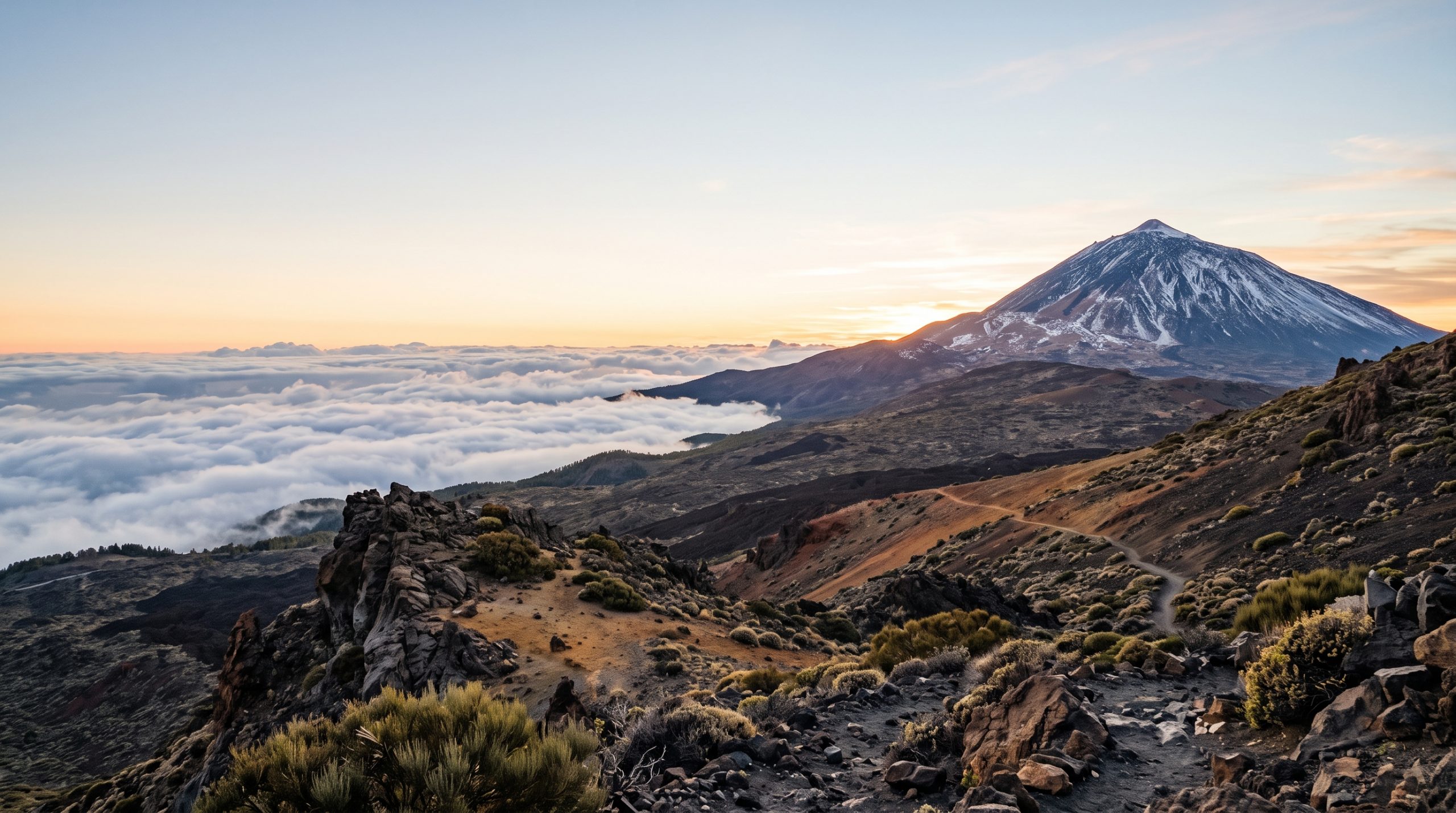
Tenerife sits at the western edge of its time zone, and that single geographic quirk shapes every elopement day we plan here. The sun does not clear the horizon before about 07:00 on any date of the year. In mid-June it rises at roughly 07:09 and sets at 21:05, and the latest sunset of the year lands just past 21:08 in the first days of July. Nobody has to be awake at three in the morning to stand on a volcano at first light.
The other thing that governs the day is vertical. From the coast to the floor of the Teide caldera is about an hour of switchbacks and roughly two thousand metres of climb, and the trade cloud that stacks against the north of the island usually sits below the top of that road. You drive up through grey and come out above it, onto pumice flats with a cloud sea below and the cone catching the first light.
Then there is the paperwork, which is the part almost nobody writes down. Teide National Park is the most visited national park in Spain, with around four million visits a year, and since late 2027 a new management plan has governed professional photography and filming inside its boundary. Planning a Tenerife day is mostly a matter of deciding which hours belong inside the park, and which belong to the laurel forest, the black-sand coves and the western cliffs.
One team for the volcano, the forest and the west coast
We are a team of eight, four photographers and four filmmakers, and we cover Tenerife elopements as one service: destination and location design, planning, permit research, then the photography and the film on the day itself. Coverage starts at $4,900 for one full day with one dedicated photographer or one dedicated filmmaker.
The package-holiday reputation, and the island behind it
The resort strip on the south coast is exactly what people picture, and we will not pretend otherwise. It is also a thin strip along one edge of a much bigger island, and almost none of the terrain couples come here for is anywhere near it.
The honest problem is not the resorts. It is the middle of the day inside the park. The Roques de García viewpoint at eleven in the morning is a car park with a view, and the photographs that made you want to come here were made about three hours earlier, from ground that had six people standing on it. That gap between what the place looks like at dawn and what it looks like when the coaches finish the climb up the TF-21 is the whole reason we build the timeline the way we do.
Away from the caldera, two other regions carry a Tenerife day. Anaga in the north east is ridge road and laurel forest, dropping to black sand at Benijo and Roque de las Bodegas. The west is the Teno massif: switchbacks, terraces, the cliffs at Los Gigantes going gold late. Masca village sits in the middle of that, and it is worth knowing the difference between the two things that share its name, because plenty of planning lists confuse them. Visiting the village itself is free and needs no reservation, though the parking is limited enough that we treat arrival time as part of the plan. The ravine below it is a regulated hiking route, booked ahead, capped at 275 people a day in groups of 25 every half hour, with a boat ticket out at the bottom. One of those is a stop on an elopement day. The other is a full day’s commitment and belongs in a different conversation, which is the sort of thing our destination guides exist to sort out before you book flights.
A 05:40 start, the cloud sea, and light until 21:08
Tenerife’s clock is generous at the front of the day and long at the back. Times below are for the island’s own clock, which runs an hour behind mainland Spain, and they shift by a few minutes from year to year.
| Month | First light | Sunrise | Sunset | What that does to the day |
|---|---|---|---|---|
| Mid-January | 07:34 | 07:59 | 18:36 | A 06:15 departure is plenty. Evening ends early, so vows sit mid-afternoon and stars are available by eight. |
| Mid-April | 07:18 | 07:42 | 20:32 | The most balanced shape of the year: dawn on the plateau, a long gap, a full evening on the west coast. |
| Mid-June | 06:42 | 07:09 | 21:05 | A 05:40 start, then a genuinely long day. We build a real break into the middle of it. |
| Mid-October | 07:46 | 08:10 | 19:32 | About as late as sunrise ever gets here, 08:12 at the extreme. You can sleep until half six and still make first light. |
Here is a June day, which is the tightest version. We leave the coast at 05:40 with coffee in a thermos, because nothing is open. By about 06:20 we are through the pine belt with the cloud below us, and on the caldera floor by 06:45, walking ten minutes off the road while the ridge behind Teide starts to colour. Sunrise at 07:09 gives roughly forty minutes of raking low light across the lava, and that is the hour the whole day is built to protect.
Vows usually sit straight after, somewhere between eight and nine, either up on the flats or lower toward the Llano de Ucanca while it is still empty. The cable car opens at 09:00 every day of the year, and that is also roughly when the first coaches reach the Roques de García, so by then we are already moving downhill. Breakfast happens late, in a village, with a change of clothes and dust in everyone’s shoes.
Then we stop. High sun at this latitude is unkind and we do not fight it. The middle of the day is for eating properly and driving west, which is a real hour and a half from the caldera, not a hop. Late afternoon picks up again on the Teno side, on the ridge road above Masca or out toward the cliffs, and the last light before 21:05 goes long and orange across the water. Civil twilight holds another twenty-five minutes after that, which is the quietest and often the best part of the film.
If you want stars, we plan the night around the moon rather than around the clock. There are professional telescopes on a ridge east of the summit for a reason, and the cable car base station runs guided stargazing with Starlight guides after normal hours, so a night frame is a decision to make early rather than an afterthought at midnight.
A January day inverts all of it. Sunset at 18:36 means the west coast hour is over before seven, and the sky is dark enough for the Milky Way while you are still eating dinner. It is the only month shape where one evening can hold both.
If you already know roughly when you want to be here, send us the month and where you are thinking of staying, and we will tell you what the light does on those dates. Check Your Date.
Scale, wind, and a film made without a drone
The caldera does something specific to human beings: it makes them tiny. The photograph that works here usually has the two of you very small and a great deal of lava, while the film wants either that same wide frame held long enough for the cloud to move through it, or a slow walk with a long lens compressing the cone behind you. Those are two different jobs in the same forty minutes of low sun, and one person switching bodies does both of them at half strength.
That is the practical argument for our Expedition, where a dedicated photographer and a dedicated filmmaker work the same hour together. The photographer moves in close for hands, faces and the moment your veil goes horizontal. The filmmaker holds position at distance and lets you walk into a frame that already has the mountain in it. Neither is waiting for the other, and neither is compromising the shot to cover the other’s job.
Tenerife adds two conditions that make the pairing matter more than it does in gentler places. The first is that there is no aerial vocabulary available inside the national park, where drones are not permitted except for heritage documentary work. So the film has to earn its movement on the ground, with foreground lava, walking frames and the cloud sea doing the moving instead. Where we do fly, outside the park boundary and clear of the protected zones, it runs on AESA registration and the official airspace map for that day, checked before we plan a single shot around it.
The second is wind. On the caldera rim and along the western cliffs, wind is the loudest thing in a film and the reason so much destination footage ends up with music laid over silence. The Expedition includes professional audio for vows, so we choose the lee side of a formation, mic close, and record your words rather than the gust. You can see how that combination of photographs and film comes out of a day like this in our stories, which is the best answer we can give to what the finished work actually looks like.
There is one more reason the same-team arrangement matters here specifically. The park treats professional photography and filming as an activity requiring written authorization, applied for at least a month ahead, and it caps how many productions it authorizes in a given period. A photographer and a videographer hired from two different companies are two sets of paperwork, two insurance certificates and two people meeting for the first time in a dark car park at six in the morning. We are one application, one team, and eight people deep, so there is always a colleague in reserve.
Everything included, and what Tenerife charges on top
Every experience we offer includes the planning, not just the shooting:
- Destination and location design for your dates, built around what the light does that week
- A custom timeline using real driving times between the caldera, the north and the west
- Permit research and logistics guidance, including the national park authorization process
- Weather alternatives and backup planning, which on this island means an alternative at a different altitude rather than a different day
- Drone footage where it is legal, safe and appropriate
- Professional audio for vows and meaningful moments on the Expedition, where conditions allow
Delivery is fixed and we hold to it. Highlights land within 5 days, so you have something real to send your family before you have unpacked. The full gallery or film follows within 3 weeks.
The Expedition, with a photographer and a filmmaker working together for one full day, starts at $7,900. Team travel is included worldwide, which means our flights, accommodation and ordinary travel to Tenerife are already inside that figure and there is no long-haul surcharge to discover later. Guest count does not change the fee either. Bringing six people affects access, permits, transport and the shape of the timeline, not the price. Two to seven days across the island, or Tenerife plus a second destination, is an Odyssey and gets a custom proposal. Full detail on all three sits on the coverage and pricing page.
Paid locally, in euros
- Government, venue and landowner permit fees. The national park may also set a deposit against an authorization, somewhere between 300 and 6,000 euros depending on the activity, refunded after the day. The research and the application are ours; the fee itself is yours
- Cable car tickets if we use them, currently 23.50 euros one way for a non-resident adult, plus the free timed permit for the cone above the upper station at 3,555 metres
- Accommodation, your celebrant, flowers, dinner and anything else on the island
- Unusual transport only if the plan needs it, such as a boat out of Los Gigantes or a 4×4 for a track we cannot legally drive a hire car down
Six steps from your first message to a planned day
- You send the inquiry form with your dates, or the month you are circling.
- We reply within 24 hours with an initial brochure and our honest read on those dates.
- We build a tailored proposal around the shape of day you actually want.
- You sign the contract and pay a 30% retainer. The rest of the schedule is set out in the proposal.
- Planning begins: locations, the permit route, the hour-by-hour timeline, the weather alternatives.
- We shoot the day. Highlights reach you in 5 days, everything else within 3 weeks.
Who Tenerife suits, and which month suits which couple
This island rewards couples who are relaxed about altitude. You will go from sea level to the caldera floor in an hour, it will be genuinely cold up there before the sun is properly up even in July, and the ground is loose pumice that eats shoes. If that sounds like a good morning rather than an ordeal, Tenerife will give you more landscape per day than almost anywhere we work.
It also suits couples who want two completely different films out of one trip. Dawn on a volcano and dusk on an Atlantic cliff are not variations on a theme. They are separate places that happen to share a postcode.
If early mornings are honestly not your thing, say so in your first message. We can build the whole day backwards from a long evening on the west coast, which in June and early July means usable light until well after nine, and treat the mountain as an optional second morning. If you want the north green and dramatic rather than volcanic and bare, that points at Anaga and at the wetter half of the year, and we will tell you which weeks give you the best chance of it. If you want the ceremony itself somewhere warm and sheltered with no climbing involved, that exists here too and we will find it. What we will not do is sell you a 05:40 alarm you do not want. Tell us what your ideal morning looks like and we will shape the day around it, or tell you plainly which month or which side of the island fits it better. The planning fundamentals are a good place to start if you are still deciding what kind of day you are after.
Common questions
Can you photograph and film inside Teide National Park?
Yes, with authorization from the park, which has to be applied for in writing at least a month before the date and is granted for designated areas of the park. The park limits how many productions it authorizes in a given period, so this is the first thing we start on after you book, and it is the main reason early dates are easier than late ones.
Do we really have to get up before dawn?
Only if you want the plateau at first light. Because Tenerife sits at the western edge of its time zone, sunrise is never earlier than about 07:00, so even the June version means a 05:40 start rather than the 03:00 alarms other volcanic destinations demand. In October, first light is not until 07:46.
Can we get legally married on Tenerife?
Spanish civil registries take marriage applications where at least one of the couple resides, so visiting couples almost always complete the legal side at home and hold the ceremony here with a celebrant, in the language and the words they want. It changes nothing about the day itself, and it removes months of document work from your planning.
Is the cable car worth building into the day?
Sometimes, as a mid-morning addition rather than the centre of the day. It opens at 09:00 all year, which is after the good light, and the upper station sits at 3,555 metres with a separate free timed permit needed for the cone above it. We will tell you honestly whether your dates make it worth the queue.
What happens if cloud sits on the coast all day?
We drive through it. The cloud that greys out the north coast normally lives below the top of the mountain road, so a coastal morning that looks hopeless from your window is often brilliant a thousand metres higher. Our backup plan on this island is usually a change of altitude, not a change of date.
Can you fly a drone for our film?
Not inside the national park, where drone flights are not permitted except for heritage documentary work. Outside the park and away from the protected zones we fly where it is legal, registered with AESA and checked against the official airspace map for that specific day and location.
How many of you actually come to Tenerife?
One dedicated photographer or one dedicated filmmaker on the Adventure, and both together on the Expedition. We are a team of eight, so there is always a second camera on the ground and a colleague in reserve, and travel for whoever is assigned is already included.
How long until we see the photographs and the film?
Highlights within 5 days and the full gallery or film within 3 weeks, from every destination, including this one.
What to send us first for a Tenerife date
We handle the planning in writing so nothing depends on matching time zones, which suits planning across time zones and means you can answer at midnight with a photograph of the exact ridge you have been staring at. Send us your dates or the month you are considering, where you are flying from, and one line about the kind of morning you want. We reply within 24 hours with a brochure and a straight assessment of what those dates will actually give you. We currently have Tenerife elopement dates available through 2027–2029.
Tell Us Your Story, and we will start with the light.