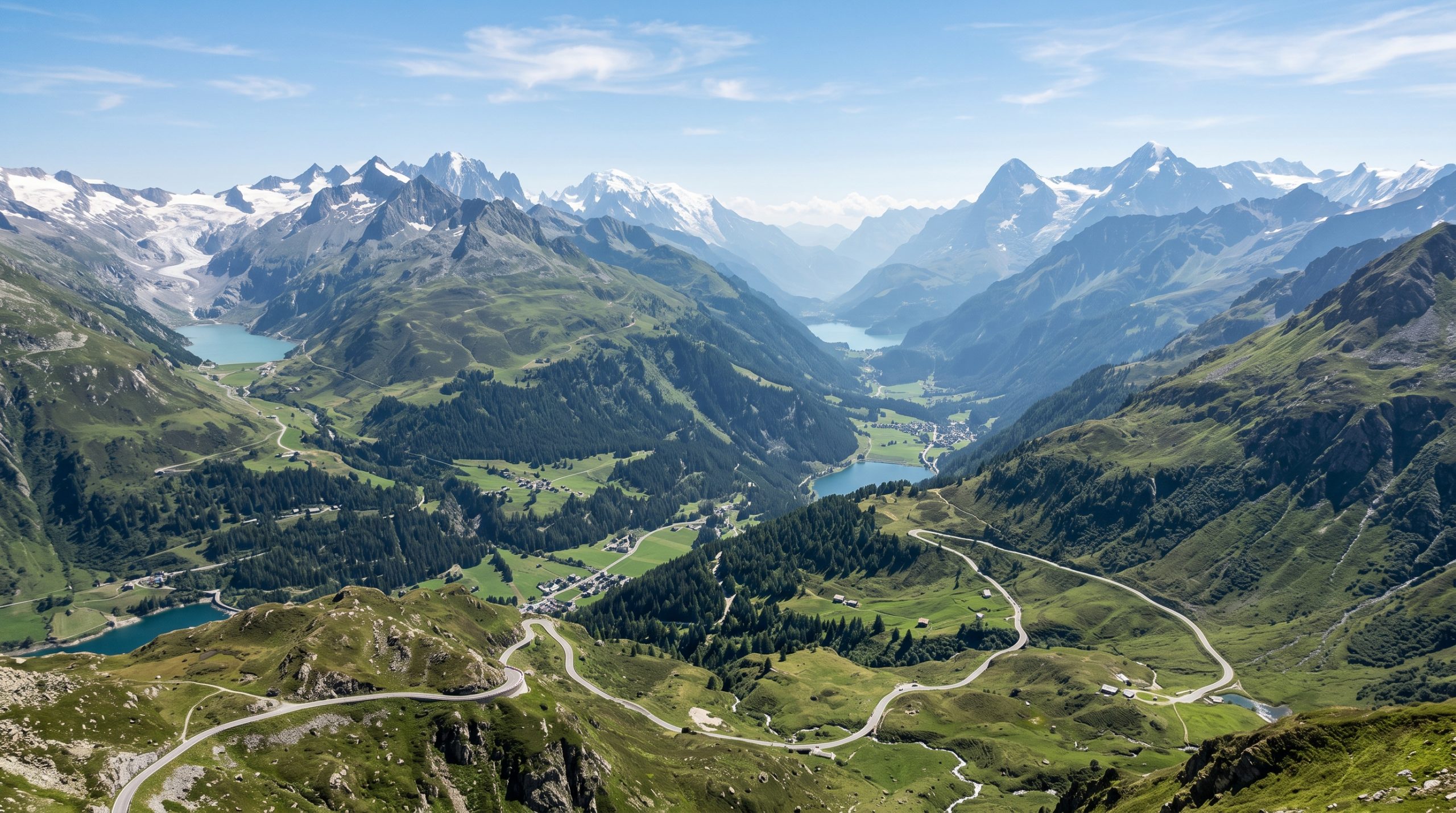
In late June the sun comes up over the Bernese Oberland at about 5:35 in the morning. The first cable cars in the Jungfrau region do not start running until around eight. That gap is the most important fact about eloping in Switzerland, and it is the one almost nobody notices while booking hotels.
It decides where you sleep. From the Lauterbrunnen valley floor, at 796 metres with a wall of rock standing between you and the east, the sky pales for a long time before anything happens on the ground, while the sun is already on the snow of the Jungfrau at 4,158 metres. From Mürren, on the terrace at roughly 1,650 metres, you open a door and walk straight into it. Same morning, two entirely different films.
We are eight people: four photographers and four filmmakers who plan Swiss days and then shoot them ourselves. Photography, film and planning come from one team and one brief, not from a photographer and a separately hired videographer who see each other for the first time in the Stechelberg car park at four in the morning. Our planning calendar for Switzerland currently covers 2027, 2028 and 2029, and our planning fundamentals are worth twenty minutes before you start fixing dates.
One day, or a week across three valleys
We plan, photograph and film Swiss elopements as a single team. The shortest shape is one full day in one valley with a dedicated photographer or a dedicated filmmaker. The fullest is a route of two to seven days across several valleys with both. Team travel to Switzerland is included, and highlights reach you five days later.
The three hours before the first cable car
Civil twilight in the Lauterbrunnen valley starts around 4:55 in late June, forty minutes before official sunrise. Those times assume a level horizon, and Switzerland does not have one. The real sun arrives over a ridge, which on the wrong side of a valley can be an hour later or more. We plan from the ridge line, not from the almanac.
04:10. Coffee in Mürren, which has no through road. The only sounds are water somewhere below and the first birds. Dressing takes longer than couples expect when the air is still cold enough for a jacket over the dress.
04:55. We walk out. Ten minutes on the path toward Gimmelwald puts you clear of the last chalet, with 850 metres of empty air between you and the valley floor. Nobody else is out. This is the hour that makes people choose Switzerland, and it costs nothing but the alarm.
05:35. Sunrise on paper. In practice the Jungfrau, Mönch and Eiger take the light first and hold it alone for several minutes while everything below stays cold blue. That contrast is the single best frame the day will give you, and it does not last.
06:40. Vows, on the terrace path, with the light now warm and low across the meadows rather than blasting down from overhead. Cowbells start up somewhere above Gimmelwald. We keep this part unhurried, because there is no reason to hurry: the first visitor will not reach this path for another two hours.
07:45. Breakfast, a change of shoes, and a move to the second location while the terrace is still ours.
08:00 to 08:30. The region wakes up. Most cableways in the Jungfrau valleys start running in this window in summer, and the first cars arrive full. Kleine Scheidegg at eleven in the morning is a busy railway platform with a view, and the light there is flat and hard. We are honest about that, and we are somewhere else.
Late morning. Down to the valley floor, where Staubbach drops roughly 300 metres past the church and the wind turns the bottom third of it into drifting mist. The valley advertises 72 waterfalls, and the floor is still in shadow while everything above it is lit, which flatters the cliff faces rather than fighting them.
Early afternoon. In summer, cumulus builds over the Eiger from about one o’clock. We either use that sky or we rest through it and put the energy into the evening, which is a planning decision made the night before rather than a disappointment discovered at the time.
17:00 to 18:00. The last downward cars leave. In late June the sun does not set until 21:25, and civil twilight runs to about 22:05. If you want a ridge at nine in the evening, you sleep on the mountain. That is one line in a proposal and it changes the entire shape of your day.
| Month | Sunrise, level horizon | Sunset | What it does to the morning |
|---|---|---|---|
| Mid-May | 05:55 | 20:55 | Green low down, snow still on the high paths, and individual lines shut for spring maintenance before the summer season opens |
| Late June | 05:35 | 21:25 | Wildflowers on the Mürren terrace, longest light of the year, and a genuine four o’clock alarm |
| Mid-September | 07:12 | 19:31 | Sunrise sits close to the first departures, air is cleaner, ridges are cold and sharp |
| Mid-October | 07:38 | 18:52 | Larch colour in the eastern valleys, early sunsets you can actually stay out for, autumn maintenance windows on some lines |
When the Eiger is under cloud
This is the thing couples actually lie awake about, and it deserves a straight answer rather than reassurance. Switzerland hides its mountains regularly. A forecast icon will not tell you whether you can see them, because the number that decides your morning is the cloud base, not the chance of rain.
So that is what we plan against. If the base sits at 2,000 metres, the summits are gone and the terrace villages are under a grey lid, and we go low: waterfalls, wet rock, forest, the Lauterbrunnen floor, where soft light is an advantage and the cliffs read better without hard shadow. If the base is at 2,800 metres, we go up and above it, and the day becomes ridges and cloud seas. On a föhn morning the air turns unusually warm and clear with wild lens-shaped cloud over the ridges, and the wind is the thing to plan around rather than the visibility.
Every Swiss proposal we write has a version of the day at three altitudes: valley floor, terrace, high station. We choose between them the evening before, and we are allowed to change our minds again when we look outside at four. Nothing in the timeline breaks when that happens, because all three versions were built with the same travel times, the same permits and the same team. A couple who takes two to seven days gets something better still, which is a second and third morning to spend the good weather on.
A second camera on the Mürren terrace
The argument for photo and film from one team is abstract in most places. In the Alps it is arithmetic. First light on the Jungfrau lasts a few minutes, the terrace path is a metre and a half wide in places, and there is exactly one good position for it. A photographer and a videographer who were hired separately and met that morning will both want that position, and one of them will get it.
Our two people settle that the night before, over a map and a sunrise time. The filmmaker takes the wide, motion-led angle from the path; the photographer works closer and against the light. Nobody is stepping into anybody’s frame, and nobody spends the best four minutes of the morning negotiating.
Wind is the other reason. The Mürren terrace and any ridge above it carry a steady breeze most mornings, which is fine for a still photograph and ruinous for vows recorded badly. On the Expedition, our filmmaker brings professional audio for vows and the other moments that matter, so we position you where the microphone works as well as the frame does, and the photographer plans to that spot rather than fighting it. Cowbells, the wind through the grass and the water below the cliff all end up in the film on purpose.
Logistics run the same way. One group, one departure, one set of mountain transport tickets, one gear plan that has to fit through a cable car door at eight in the morning. Two vendors from two companies means two arrival times and two people asking you where to stand. And because there are eight of us, there is always a second camera on the ground and a colleague in reserve.
Aerials are planned, not improvised. The Jungfrau region’s own guidance rules out drone flights over Lauterbrunnen, in the Rosenlaui valley and on the Jungfraujoch, and nature reserves need a special licence, so the aerial part of a Swiss film is designed around the valleys and ridges where flying is legal and safe. If you want to see what all of this looks like when it is finished, our galleries and films are the honest version: the same weather, the same hours, the same paths.
Everything we bring, and where coverage starts
- Destination and location design, and a timeline built on real light and real travel time, including the walk from the top station to the place we actually stand.
- Permit research and logistics guidance for the cantons, communes, landowners and railway companies your locations sit under. The permit fees themselves are paid by you.
- Weather alternatives and backup planning at three altitudes, decided the night before and revisited in the morning.
- Drone footage where it is legal, safe and appropriate.
- Professional audio for vows and meaningful moments on the Expedition, where conditions allow.
- Team travel worldwide, included: flights, accommodation and ordinary travel for the assigned team, with no European or long-haul distinction.
- Highlights delivered in 5 days. The full gallery or film in 3 weeks.
- No half-day option, and no change in our fee if you bring guests. Guests affect access, permits, transport and the timeline, not the price.
Where coverage starts
| Experience | On the ground | Shape | From |
|---|---|---|---|
| The Adventure | One dedicated photographer or one dedicated filmmaker | One full day, one valley | $4,900 |
| The Expedition | A dedicated photographer and filmmaker working together | One full day, photo and film | $7,900 |
| The Odyssey | Photography and film across the whole route | Two to seven days, one or several destinations | Custom proposal |
The full breakdown lives on our pricing page, and it does not change because the destination is Switzerland. Our travel to the Alps is inside the figure above.
What Switzerland bills you in francs
Everything on the Swiss side of the ledger is paid locally, in Swiss francs, and it is worth knowing which items exist before you build a budget. Mountain transport is ticketed per person, per line, and a summit return is the biggest of them. Accommodation is yours, and if the plan needs a first-light start, that means a night in Mürren, Wengen, Kleine Scheidegg or another car-free village above the valley rather than a cheaper bed on the floor. Add your celebrant, the register office’s own fees for a civil marriage, and any permit fee a commune, landowner or railway operator charges for the locations we choose. Unusual transport is separate too: a helicopter, a private boat on one of the lakes, a 4×4 charter or a mountain guide if the day needs one. We tell you which of these apply to your specific locations before you commit to them, in writing, with the amounts in francs.
When you have a month in mind and a rough shape for the day, that is the right time to send us a message. Two dates and a paragraph about the kind of morning you want is enough to start.
How a Swiss package moves from first message to hold
- You send the inquiry form with your dates, your valley if you have one, and how many people will be there.
- We reply within 24 hours with an initial brochure and our first questions about light, access and how early you are willing to be awake.
- We write a tailored proposal: locations, the hour-by-hour timeline, the alternatives at other altitudes, and what the Swiss third-party costs will be.
- You sign the contract and pay a 30% retainer. The remaining payments are set out in the proposal.
- Planning begins in earnest: permit research, transport, accommodation guidance for sleeping high, and the timeline sharpened as the season’s sunrise times firm up.
- The day happens. Highlights arrive in 5 days, the full gallery or film in 3 weeks.
Who the four o’clock alarm suits, and what we do when it does not
Switzerland rewards a specific kind of couple. You are happy to be dressed before dawn, on a path, in a jacket you take off for ten minutes at a time. You can walk thirty or forty minutes on uneven ground without it ruining your mood or your shoes. You would rather have an hour alone on a terrace at 1,650 metres than a mid-morning frame at a viewpoint with fifty other people in it. And you are relaxed about a plan that moves at four in the morning, because the plan moving is the reason the pictures work.
If the pre-dawn version is not you, say so, and we will build a different day rather than a worse one. Mid-September gives you a 7:12 sunrise, which sits close to the first departures and turns a first-light morning into a civilised one. If long walks are hard, the terrace paths above Mürren and Wengen are level and short, and the Lauterbrunnen floor is flat. If you want the mountains without the crowds around them entirely, we will point you at the Engadin in larch season or the green ridges of Appenzell instead of the famous valleys, or at Zermatt, which is car-free, reached by train, and puts the Matterhorn’s 4,478 metres above a village you can walk out of at five in the morning. Tell us the truth about the morning you want, and we will tell you honestly which month and which valley fits it.
Common questions
Can we legally get married in Switzerland as Americans, or should we do the paperwork at home?
Both work. A Swiss civil marriage runs through a mandatory preparatory procedure, handled by the register office where the ceremony will take place if you both live abroad, and you both have to appear in person. Original documents must not be older than six months. Once the licence is issued it is valid for three months and allows you to marry anywhere in Switzerland, and two witnesses over 18 must attend. Plenty of couples handle the legal step at home and keep the Swiss morning for the vows they wrote themselves. Tell us which route you are taking early, because who signs a register changes the shape of the day.
How early is sunrise in the Swiss Alps in summer?
Late June is the extreme: civil twilight from about 4:55 and sunrise around 5:35 over Lauterbrunnen, on a level horizon. Mid-September moves sunrise to 7:12 and mid-October to 7:38. The ridge above you delays the real thing, sometimes by an hour, which is why we plan each morning from its actual skyline.
What happens if the mountains are in cloud on our date?
We work from the cloud base rather than the forecast icon. A low base sends us to the valley floor, where waterfalls and cliffs look better in soft light anyway. A high base sends us above it. Your proposal contains a version of the day at three altitudes, all built on the same travel times and permits, and we choose between them the evening before and again at first light.
Can you fly a drone over Lauterbrunnen?
No. The Jungfrau region’s guidance rules out drone flights over Lauterbrunnen, in the Rosenlaui valley and on the Jungfraujoch, and nature reserves require a special licence. We plan the aerial part of a Swiss film around the valleys and ridges where flying is permitted, confirm the zone before it enters the timeline, and tell you at the proposal stage whether your locations support aerials at all.
Do we have to sleep on the mountain to get sunrise?
In summer, effectively yes. With the first cableways starting around eight and sunrise before six, a first-light start means a night above the valley in Mürren, Wengen, Kleine Scheidegg or their equivalents above Zermatt. In September and October the maths softens and a valley-floor stay can still catch good early light.
Is June or September better for a Swiss elopement?
June brings wildflowers on the terraces and the longest light of the year, along with a four o’clock alarm and cumulus building over the peaks by early afternoon. September gives you cleaner air, cold sharp ridges and a sunrise that sits close to the first departures. Spring and autumn both carry maintenance windows that close individual cable car lines for days at a time, which we check against your date before anything is confirmed.
Is travel to Switzerland charged on top of the coverage?
No. Team travel is included worldwide, which means flights, accommodation and ordinary travel for the assigned team, with no European or long-haul distinction and no surcharge for the Alps. What you pay in Switzerland is third-party: mountain transport, your own accommodation, the celebrant, register office fees, permit fees where they apply. Everything about our own coverage sits on the pricing page.
Can we combine Zermatt and the Jungfrau region in one trip?
Yes, and that is exactly what the two-to-seven-day shape is for. They are a train journey apart rather than a flight, so we build the transfer as a travel day instead of trying to shoot both ends of it. Two valleys also means two chances at clear summits, which in the Alps is worth more than any single location on a list.
Your valley, your date, and how we work from here
Everything between your first message and the morning itself happens in writing. You send dates, we send questions, a brochure, then a proposal with real sunrise times and real walking distances in it. You read all of it at your own pace and in your own time zone, and nothing in the process needs you to be free at a particular hour.
If you have a month in mind for 2027, 2028 or 2029, tell us the valley, the light you keep imagining, and how early you are honestly willing to get up. We will tell you what that morning looks like in practice, and what it looks like from the other side of the ridge. Check Your Date.