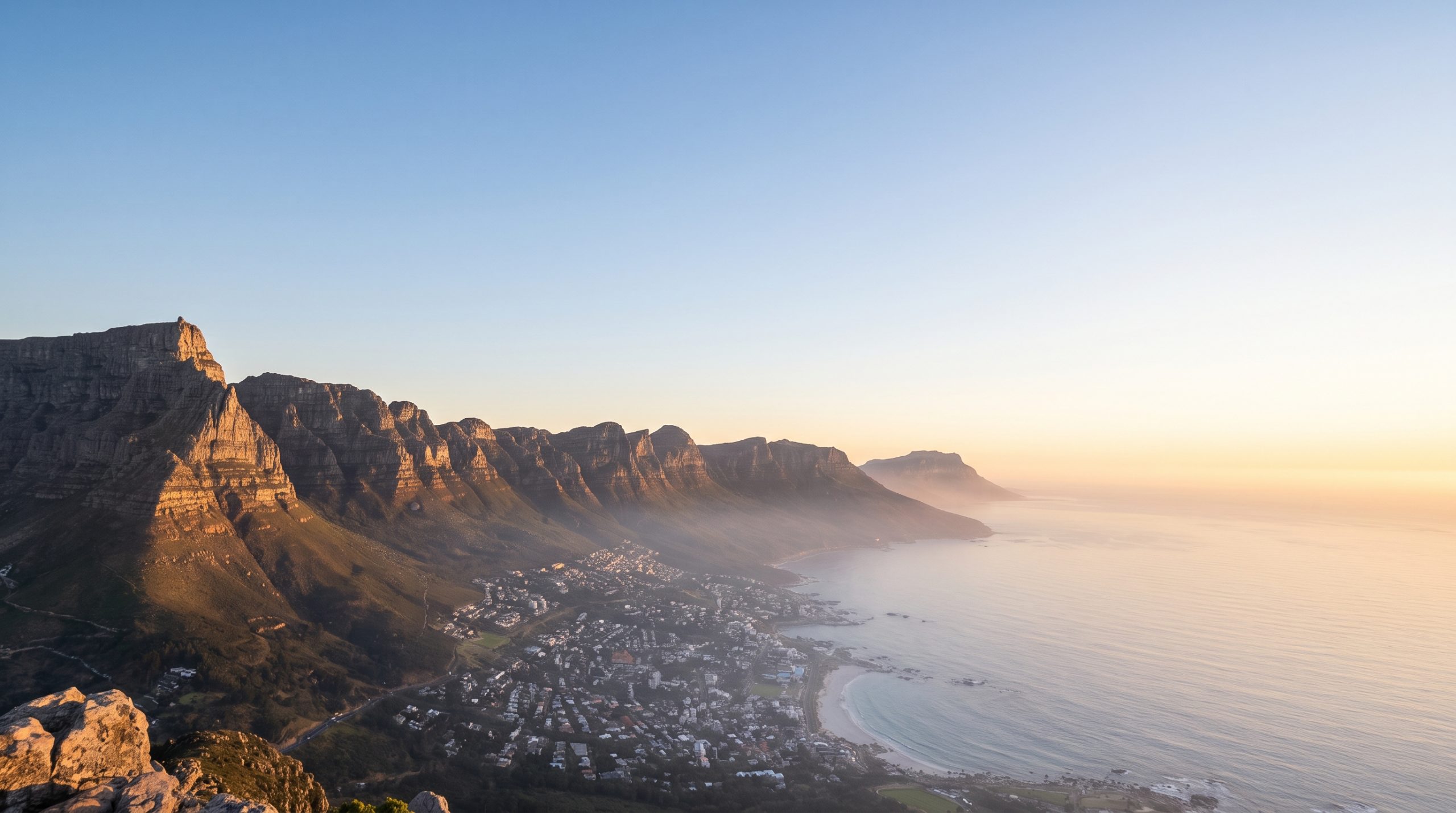
On 20 November the sky over the City Bowl begins to lift at 05:04, and the sun clears the Hottentots Holland at 05:32. If you want to be standing on the summit of Lion’s Head when it does, you are walking up from the Signal Hill Road car park in the dark, roughly two and a half kilometres of path with chains and ladders in the last stretch, and you are out of bed by half past three.
The rest of Cape Town’s decisive numbers are administrative. Table Mountain National Park runs its own permit office, and SANParks does not issue filming, photography or event permits anywhere in the park between 15 December and 15 January, dates that can shift slightly from year to year. Lion’s Head, Silvermine, Oudekraal and Cape Point all sit inside that boundary. The Clifton coves and Llandudno do not, because those beaches belong to the City of Cape Town and its film permit office. A day that uses both sides of the line needs two applications, prepared by someone who knows which is which.
We are eight photographers and filmmakers, and we plan Cape Town the way we plan every destination in our elopement guides, around light, wind direction and drive time rather than around a list of viewpoints. One honest thing before anything else: Signal Hill at sunset is a car park with a food truck and a line of idling cars. It is a fine place to watch the light go down over Robben Island, and a poor place to be married.
Photography, film and planning on the Cape Peninsula
We plan, photograph and film Cape Town elopements as one team on one contract, with a timeline built around Peninsula light and real drive times. A full day with a dedicated photographer or filmmaker starts at $4,900. Team travel to South Africa is included, and your highlights land five days after the day itself.
A November day, 05:04 to 20:00
Late spring gives you a little under fifteen hours between first light and last, and June takes five of them back. That single number shapes your day more than any location list, because it decides whether sunrise and sunset are two separate expeditions or one long, easy afternoon.
| Date | First light | Sunrise | Sunset | Last light |
|---|---|---|---|---|
| 20 November | 05:04 | 05:32 | 19:32 | 20:00 |
| 21 December | 05:03 | 05:32 | 19:57 | 20:26 |
| 21 March | 06:25 | 06:50 | 18:57 | 19:22 |
| 21 June | 07:23 | 07:51 | 17:45 | 18:13 |
The December row is in there for the light rather than as a suggestion, because the park’s permit window closes on 15 December. Here is how the November version of that day tends to run.
03:40. Headlamps at the Signal Hill Road car park. Most couples take an hour to ninety minutes to the top, and the last section is scrambling rather than walking, so the shoes matter more than the dress does. Two of us walk with you, one ahead of you on the path and one behind.
05:04. The sky goes grey, then peach, and the city below is still fully lit. This is the fifteen minutes people forget to plan for. It is also the quietest the summit will be all day.
05:32. The sun comes up over the mountains behind False Bay, side on to you rather than behind you, which is the whole reason we point couples east up here instead of west. By 07:00 the path belongs to trail runners and dog walkers, and that is fine, because we are already going down.
09:30. The signing. South Africa’s Marriage Act names a church or building used for religious service, a public office, or a private dwelling-house with open doors, in the presence of both of you and at least two competent witnesses. It also says a marriage officer is not obliged to work outside the hours of eight in the morning and four in the afternoon. So the legal half of the morning usually happens inside the villa you have rented, over coffee, with the doors open to the garden, and the vows you actually wrote stay up on the ridge where you said them.
11:00 to 15:30. Cape Town’s hard hours. The sun is high, the shadows are short and unkind, and we do not fight it. This is when we drive. Cape Point is about seventy kilometres from the city and, with summer traffic through Simon’s Town, closer to ninety minutes than an hour. It is also a SANParks pay point, so there is a conservation fee at the gate. Or you eat lunch somewhere with a view, change clothes, and do nothing at all.
16:30. Across to the Atlantic side. Chapman’s Peak, the long beach at Noordhoek, or the granite at Llandudno, which is ten minutes past Camps Bay and holds a fraction of the people.
19:32. Sunset into the Atlantic, then a half hour of afterglow that most timelines throw away. We do not. The best frames of a Cape Town evening usually happen at 19:50 with everyone else already at dinner.
The winter shape, 07:51 to 17:45
June and July run on a completely different clock. Sunrise at 07:51 means no night walk, sunset at 17:45 means dinner at a civilised hour, and the light between them is softer and lower all day. Winter also brings the Cableway’s annual maintenance shutdown, which in 2028 runs from 27 July to 9 August, so the summit is not part of a plan in those weeks. We build winter days low, green and coastal instead, and they photograph beautifully.
If you already have a month in mind, or two months you are deciding between, tell us and we will map both against the light. Check Your Date.
The south-easter is a direction, not a verdict
Cape Town Tourism is straightforward about it: between October and March a south-easterly blows through the city, and it is what draws the famous tablecloth of cloud over the mountain. Most couples read something like that a week before they write to us, and wind is the one thing they arrive worried about.
Here is how we actually handle it. The summit is never the anchor of your day, because the tablecloth can sit on Table Mountain while Camps Bay is in full sun, and a plan that depends on the top of the mountain is a plan with one point of failure. Every location in your timeline is paired with an alternative on the other coast, and the two coasts are rarely more than half an hour apart by car. When the south-easter is running, we move west and low, into the coves under Lion’s Head and the Twelve Apostles that sit in the lee of the ridge. When a winter north-wester comes through instead, we cross to the False Bay side, where the water goes flat and the light off the sand is completely different.
We decide the evening before and confirm it when we wake, reading wind direction rather than hoping. If you are planning a long veil or a light silk dress, say so early and we will place the ceremony itself in shelter and save the exposed ground for the walking frames, where moving fabric is an asset instead of a problem.
Two cameras on one permit
Table Mountain National Park is unusually explicit about this, and it is worth knowing before you hire anybody. An event permit there covers one photographer at no extra charge. Any additional photographer is billed against the park’s photography tariff, and filming sits in its own category again. Your second camera is a line on a permit application weeks before it is a line in your timeline, which is exactly the point where a photographer and a separately hired videographer start emailing each other about who is submitting what.
We submit one application, with both names on it, for the same day and the same locations. Then the same two people who wrote the timeline are the ones standing on the ridge at 05:04.
What that buys you in this specific landscape is coverage of the same thirty seconds from two distances. On a narrow summit in a stiff breeze, one person cannot be twenty metres back for the wide frame and two metres in for the vow. With a photographer and a filmmaker working together, the still and the moving image are not competing for the same square metre of rock. The Expedition also brings professional audio for vows and the moments around them, which on this peninsula is a real decision rather than a checkbox, because wind is what determines whether your voices survive the recording. We place the ceremony accordingly.
Aerials follow the same logic. Commercial drone work in South Africa runs under Part 101 of the Civil Aviation Regulations, which means a licensed remote pilot, an operator certificate, a ceiling of 120 metres above ground, and permission from whoever manages the land underneath. Where those line up, the coastline here is as good as aerial work gets. Where they do not, we plan the film without it rather than improvise on the morning. You can see how both halves come together in our published galleries and films, which is the most useful hour you can spend before writing to anyone, including us.
The other quiet advantage of a team of eight is depth. There is always a second camera on the ground and a colleague in reserve, and the person who wrote your timeline is never the only person who knows it.
Planning, delivery windows and where coverage starts
Every experience includes the planning, not just the shooting.
- Destination and location design for the Peninsula, the Winelands and the coast beyond them
- A custom timeline built around light, tide, wind and honest travel times
- Permit research and logistics guidance, including which authority governs which piece of ground
- Weather alternatives and backup planning, paired coast to coast
- Drone footage where it is legal, safe and appropriate
- Professional audio for vows and meaningful moments on the Expedition, where conditions allow
- Team travel worldwide, flights and accommodation included, with no long-haul surcharge for South Africa
- Highlights delivered in 5 days, and your full gallery or film in 3 weeks
The Expedition, with a dedicated photographer and a dedicated filmmaker working the same day, starts at $7,900. The Odyssey runs two to seven days across one or several destinations, photography and film together, and is quoted as a custom proposal. Everything is set out on our pricing page, and the figure does not move with your guest count. Guests change access, permits, transport and the shape of the timeline, not the fee.
What Cape Town adds on top, paid by you directly and all of it in rand: the park permit fee itself, quoted from the SANParks tariff sheet; a City of Cape Town film permit where your day touches a municipal beach; an Environmental Control Officer or baboon monitors where the park requires them for your location; the daily conservation fee at gates such as Cape Point, which is a few hundred rand per adult for international visitors and is reset each 1 November; Cableway tickets if we go up; and then your marriage officer, accommodation and car hire. We tell you which of these apply to your specific locations before you sign anything.
How a Cape Town enquiry moves from first message to planning
- You send the inquiry form with your dates, a rough idea, and anything you already know you want.
- We reply within 24 hours with an initial brochure.
- We build a tailored proposal around your date, your locations and the light on that date.
- You sign the contract and pay a 30% retainer. The remaining payments are set out in the proposal.
- Planning begins in earnest: locations, timeline, permit applications, the paired weather alternatives, and the practical reading in our guide to planning an elopement.
- You elope. Highlights reach you five days after the day, and the full gallery or film within three weeks.
The couples this peninsula rewards
Cape Town is generous to people who are willing to be awake at 03:40, who are comfortable on uneven granite, and who can hear at 05:00 that we are crossing to the other coast and treat that as part of the adventure rather than a broken promise. It rewards couples who will spend the flat middle of the day driving and eating instead of insisting on frames the light will not give them.
If the night walk up Lion’s Head is not your idea of a good morning, that is genuinely fine and worth saying in your first message. The road runs to the top of Signal Hill, so there is a version of sunrise that starts at the car door. A mid-May date puts sunrise at 07:31 and sunset at 17:54, a whole day of usable light with no alarm before dawn. The Winelands an hour east of the city are flat, warm and slow. Tell us the morning you actually want and we will build the day around it, or tell you honestly which month on this coast fits it better.
Common questions
Do we need a permit to photograph our elopement on Table Mountain?
Commercial photography, filming and events inside Table Mountain National Park run on a permit from the park’s own permit office, and that is separate from a conservation fee at a gate or a Wild Card. We research and prepare the application; the permit fee itself is paid to the park. If your day is on a beach like Clifton or Llandudno, the City of Cape Town film permit office governs it instead.
Can two Americans legally marry in South Africa?
Yes. Civil marriage is administered by the Department of Home Affairs, and foreign nationals marry on valid passports. The US Embassy in South Africa notes that South African law asks foreign citizens for a letter of no impediment to marry, and that US citizens may execute an affidavit before a US consular officer in place of one. Your marriage officer confirms the exact document set for your date, and we build the timeline around it.
Can we say our vows outside, on a beach or a ridge?
The Marriage Act names a church or other building used for religious service, a public office, or a private dwelling-house with open doors, in the presence of both parties and at least two competent witnesses. In practice most couples here sign indoors, often in the house they have rented, and keep the words they wrote for the mountain or the sand. Both halves are real. Only one of them is paperwork.
What happens if the south-easter is blowing on our date?
We move rather than cancel. Every location in your timeline is paired with a sheltered alternative on the opposite coast, usually less than half an hour away, and the summit is never the single point the day depends on. We decide off wind direction the evening before, then confirm it at first light.
Can we elope in Cape Town between Christmas and mid-January?
You can marry, but plan it differently. SANParks does not issue filming, photography or event permits inside Table Mountain National Park between 15 December and 15 January, and those dates can vary slightly each year. For that window we build the day on private land, in the Winelands, and on coastline outside the park boundary, which is a better use of that week anyway because the Peninsula is at its busiest.
Does the price change if we bring six guests?
No. Our fee is the same with two people present or twelve. What guests change is access, permit scope, transport and how much time gets absorbed between locations, all of which we plan for once we know the number.
Can we add the Winelands, or a second day somewhere else?
Yes. That is the Odyssey: two to seven days of photography and film across one or several destinations, quoted as a custom proposal. Franschhoek is roughly an hour east of the city, and a second day there looks nothing like a day on the Atlantic coast, which is exactly the argument for it.
When do we get our photos and film?
Highlights arrive 5 days after your day. The full gallery or film follows within 3 weeks.
Your date, in writing, from wherever you are
Everything between your first message and the morning on the mountain happens in writing. You write when it suits you, we answer within 24 hours, and nothing about planning your day depends on two people being awake at the same time six or seven hours apart. Our planning calendar for Cape Town currently covers 2027, 2028 and 2029, and the useful first message is short: your rough dates, the shape of morning you want, and whether anyone is coming with you. Tell Us Your Story.