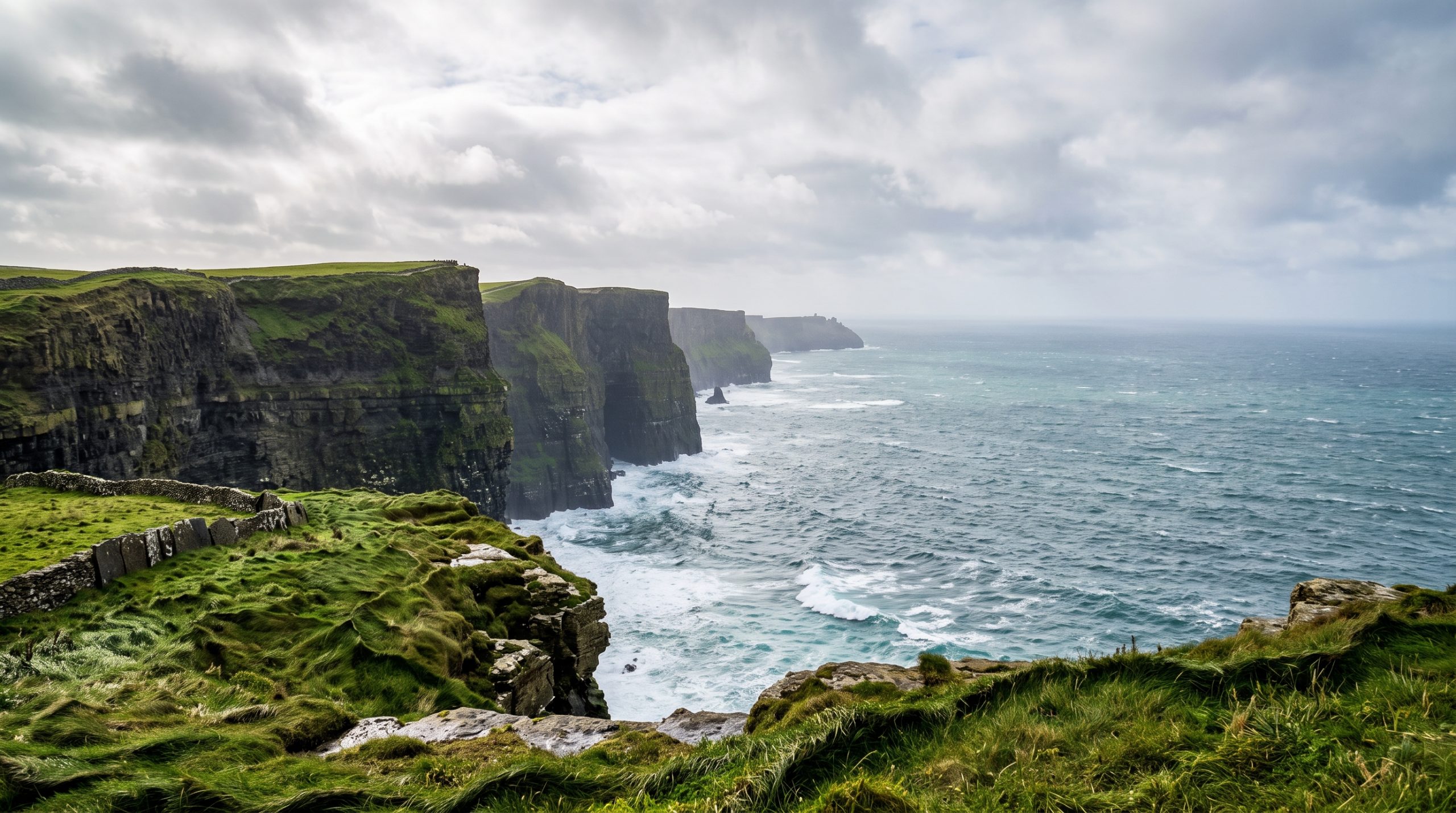
In the third week of June the sun clears the ridge behind Slea Head at 5:21 in the morning and does not go down until 22:06. Civil dusk holds until almost eleven at night. Move two hundred kilometres up the coast to Keem Bay on Achill Island and the same day runs from 5:08 to 22:17, with usable light in the sky until 23:11. That is the number that decides everything about how an Irish elopement day gets built, and almost nobody puts it in writing before you book.
The second number is a calendar one. Ireland requires a minimum of three months notice of your intention to marry, given to a Registrar at a Civil Registration Service, and both of you have to attend that appointment in person. The state fee for it is currently 200 euro and it is not refundable. Everything else about eloping here is flexible. That appointment is not.
We are eight people who photograph, film and plan elopements along this coast and elsewhere: photographers Serg, Alex, Alex and Viktoria, and filmmakers Lara, Mike, Anthony and Stas. Photo, film and planning are one service from one team, which is why this page can tell you what happens at 4:20am on a Connemara headland rather than just what a package contains.
What we cover on Ireland’s west coast
We photograph, film and plan elopements across Ireland, most often on the Wild Atlantic Way between Kerry and Donegal. One team handles location design, the timeline, permit research and both cameras. Coverage runs as a single full day or across several days, and the starting figures are set out on our pricing page. Team travel to Ireland is included.
Two ends of one long Atlantic day
An Irish summer day is too long to shoot end to end. Sixteen hours of continuous coverage is not a plan, it is an endurance event, and the pictures from hour eleven show it. So we split the day, and where we split it depends entirely on the month you choose.
Late May to July: the day that runs at both ends
Take the summer solstice on the Dingle Peninsula. Civil dawn at 4:32, sunrise at 5:21, and for the first ninety minutes Slea Head Drive belongs to you and the sheep. The loop is driven clockwise and the tour coaches follow the same direction from mid-morning, so a 5am start at Ventry means you are always an hour ahead of them rather than an hour behind. We use that window for the ceremony itself when a couple wants absolute quiet, then break at nine, and come back for a second block from about 21:10 when the light drops into the last hour before sunset. On Achill that final golden stretch runs a full fifty-nine minutes, followed by another fifty-five minutes of blue light over the water.
The honest part: it means eating dinner near midnight and getting up again the following morning. Some couples love that and say so in their first message. Others read the timeline and realise they want their vows at four in the afternoon with a bottle open by seven, which is a completely reasonable way to get married and points us straight to September instead.
September and October: the day that simply fits
Mid-September at the Cliffs of Moher gives sunrise at 7:11 and sunset at 19:54. By the tenth of October in Connemara it is 7:57 and 18:56. Both ends of the day are civilised, the whole thing fits inside a single continuous stretch of coverage, and the grass on the headlands is still green rather than the bleached gold of August. Twilight is shorter than in June, thirty-five minutes rather than nearly an hour, so the evening block is tighter and we plan the drive between the ceremony spot and the last location down to the minute.
This is the season we quietly push people towards. Autumn swell puts real weight into the water under the cliffs, the low sun sits at a workable angle for most of the afternoon rather than sitting overhead, and the coach traffic on Slea Head and at Moher has thinned out.
Winter: seven and a half hours, all of it good
On the shortest day at Slea Head the sun rises at 8:48 and sets at 16:32. That sounds impossible until you look at what the light does in between. On Achill at the solstice the sun sits below six degrees for seventy minutes before it sets, and it never climbs high enough to go harsh at all. A December day is short, it is entirely low-angle, and the coast is empty. We build those days tight, usually within a twenty-minute radius, with an indoor room held for the vows and the cliff hour treated as the bonus rather than the spine.
The rain question, answered with a plan
This is what couples actually write to us about. Rain is measured on roughly 225 days a year in the wettest western districts against about 150 in the east, so planning an Irish elopement on the assumption of a dry day is planning for the exception. We do the opposite. Every Irish timeline we build carries a second version: a sheltered ceremony location inside fifteen minutes of the first, an interior with a window that works when the sky goes flat white, and a reordering of the day that moves the coastal hour to whichever end of the day the front is not sitting on. Atlantic weather moves fast, which cuts both ways. A morning that looks unusable at seven often opens into forty minutes of extraordinary broken light at nine, and knowing which of those to wait for is most of the job. Our planning fundamentals for eloping go further into how a movable timeline is actually written.
If you already have a month circled, send it over and we will tell you exactly what the light is doing on those dates. Check Your Date
Wind, sound and moving light: both cameras on one plan
Here is what having a photographer and a filmmaker from the same team changes on this specific coast, and it has nothing to do with convenience.
Sound. The wind on an exposed Clare or Mayo headland will destroy vows recorded on a camera microphone, and there is no fixing it afterwards. On The Expedition our filmmaker runs professional audio for the vows and the moments that matter, so the words survive. That is only possible because the person recording sound was in the planning conversation weeks earlier, arguing for the ceremony to sit in the lee of a rock rather than on the exposed nose of the headland twenty metres further out. A videographer hired separately arrives on the morning and gets whatever spot the photographer already picked.
Light that changes every four minutes. Irish cloud does not hold still. When a gap opens over the water, a photographer wants the couple facing into it and a filmmaker wants to move, and both of those decisions have to happen in the same ten seconds. Working as one team means the movement the filmmaker asks for is the same movement that gives the photographer their frame, rather than two people quietly competing for the same thirty seconds of sun.
Scale. The Cliffs of Moher stand around 214 metres at their highest, and the Slieve League cliffs in Donegal rise to close to 600 metres. Stills flatten that. Film, and especially drone footage where it is legal and safe to fly, is what makes a viewer feel the drop. Photographs are what you frame. You want both from a single day, planned as one thing. Our published galleries and films are the honest test of that, and Atlantic days are well represented in them.
Eight people also means something practical. There is always a second camera on the ground and a colleague in reserve, so a coastal day thirty kilometres from the nearest town is not resting on one person and one bag of equipment.
Everything that travels with the team
Every experience, from a single day to a multi-day route, includes the same foundation:
- Destination and location design for your specific dates, not a list of the same six viewpoints everyone shoots
- Full planning support and a custom timeline built around real light times and real Irish driving times, which are longer than any mapping app tells you on the Beara and Dingle peninsulas
- Permit research and logistics guidance, including which landowner, council or state body actually governs the spot you want
- Weather alternatives and backup planning written into the timeline before you arrive
- Drone footage where it is legal, safe and appropriate
- Team travel worldwide, flights and accommodation included, with no European or long-haul distinction
- Professional audio for vows and meaningful moments on The Expedition, where conditions allow
Delivery is fixed. Highlights reach you within 5 days. The full gallery or film arrives within 3 weeks. Guest count does not change the fee, because guests change access, permits, transport and the timeline rather than the work itself. Bring two witnesses or bring fourteen people, and the number on the proposal is the same.
Where coverage starts, and what Ireland adds
The Adventure covers one full day with either a dedicated photographer or a dedicated filmmaker, from $4,900. The Expedition covers one full day with a dedicated photographer and filmmaker working together, from $7,900. The Odyssey runs from two to seven days across one or several destinations with photography and film, quoted as a custom proposal. There is no half-day option. Full detail sits on the pricing page.
Our flights and accommodation to Ireland are inside that figure. What you pay separately is local and specific:
| Cost | Who pays | Notes for Ireland |
|---|---|---|
| Marriage notification fee | You | Currently 200 euro, paid to the Civil Registration Service at your appointment, non-refundable |
| Solemniser | You | Must appear on the state Register of Solemnisers |
| Permit and access fees | You | Council, state body or private landowner charges where they apply. The research and applications are ours |
| Site admission | You | Some managed sites use pre-booked timed entry, which we build into the timeline |
| Ferries and unusual transport | You | Aran Islands sailings, private boats, helicopters, 4×4 charters, mountain guides |
| Accommodation, car hire, vendors | You | Booked by you, advised by us |
How an Ireland enquiry becomes a held date
- You send the inquiry form with your dates, or the month you are circling, and what you want the day to feel like.
- We reply within 24 hours with our initial brochure.
- We talk through the shape of the day in writing and put a tailored proposal together for your dates and locations.
- You sign the contract and pay a 30% retainer.
- Planning begins, and the remaining payment schedule is set out in your proposal.
- We build the timeline, the permit list and the weather alternatives, and keep refining all three until the week you arrive.
Who this coast rewards
Ireland suits couples who are relaxed about a plan that changes on the morning. If a fixed itinerary printed a month out is what makes you feel safe, the west coast will test that, and it is better to tell us so at the inquiry stage than to discover it at breakfast.
It rewards people who will walk. Most of the best ground here is a fifteen to forty minute walk from the nearest place you can park, often on wet grass and uneven farm tracks, sometimes through a gate you need permission to open. If long walks on rough ground are not what you want from your wedding day, say it in your first message. There are headlands in Clare and Mayo with a two-minute walk from the car and no compromise on the view, and there are working timelines built entirely around short approaches.
It rewards early risers in summer and everyone else in autumn. A 4:20am start in late June is genuinely wonderful and genuinely brutal. If it does not appeal, tell us and we will build you a mid-September day where the same quality of light arrives at seven in the morning and again at half past seven in the evening. Our destination elopement guides are a useful way to compare regions before you commit to one.
One more thing worth saying plainly. The main viewing platform at the Cliffs of Moher, at eleven in the morning in July, is shoulder to shoulder and the light is flat. It is a remarkable place and that is not the hour or the spot for it. The frames people remember from Clare come from the Hag’s Head end of the walk at dawn, or from the Aran Islands, and we would rather tell you that now than on the day.
Common questions
Do we have to come to Ireland three months before the wedding?
You have to give at least three months notice to a Registrar, and both of you attend that appointment. If you live abroad you can ask a Registrar for permission to make that notification by post, and you still meet a Registrar in person before the ceremony. Most couples we work with time a short scouting trip around it, or arrange the postal route early. Sorting this out is part of the planning we do with you.
Can we legally get married on a cliff or a beach in Ireland?
Yes, with the right solemniser. All marriages in Ireland must take place at a venue open to the public, which an accessible headland or strand can satisfy. A state registrar can only perform a civil ceremony in a registry office or an approved venue, Monday to Friday, so outdoor vows mean a registered religious or secular solemniser instead. Accredited humanist celebrants can marry you at any hour, any day of the week.
How long is our Marriage Registration Form valid?
If the marriage does not take place within six months of the date given on the form, you need a new one and you repeat the notification process. After a religious or secular ceremony, the signed form goes back to a Civil Registration Service within a month so the marriage can be registered. Two witnesses aged 18 or over sign it with you.
Which month has the best light on the Wild Atlantic Way?
September and early October, for most couples. Sunrise around 7:11 and sunset around 19:54 in mid-September means the entire day fits one continuous block of coverage, the sea has autumn weight in it, and the light is workable for far more of the afternoon than it is in high summer.
What actually happens if it rains for our whole elopement day?
We shoot it. Every Irish timeline we write carries a sheltered ceremony option within fifteen minutes, an interior that works in flat light, and the flexibility to move the coastal hour to the other end of the day. Atlantic fronts move quickly, and the forty minutes of broken light after a squall is often the best light of the day.
Can you fly a drone at the Cliffs of Moher or in Killarney National Park?
Aerials in Ireland run on two things: operator registration with the Irish Aviation Authority and permission from whoever manages the ground. National park land and managed cliff sites each have their own process. We confirm both in writing before any part of the film depends on a drone shot, and we always plan a version of the day that stands up without one.
Can we combine the Republic and Northern Ireland in one trip?
Yes, and we do it as an Odyssey across several days. Northern Ireland is a separate legal jurisdiction with its own notice period and paperwork, so the ceremony sits on one side of the border and the rest of the route can cross freely. Donegal to Antrim is a natural pairing.
How far ahead should we book Ireland?
We currently have Ireland elopement dates available through 2027–2029. Because the three month notice requirement sits between you and the ceremony date, the couples who have the easiest time of it write to us six to twelve months out, which gives the paperwork and the solemniser plenty of room.
Start with your month, not your venue
Tell us the month you are thinking about, how you feel about being awake at four in the morning, and how far you are willing to walk. We will come back with an honest read on which stretch of coast fits that, and where in Ireland the light will be doing the most interesting thing on your dates. From the first reply onward, the whole process stays in writing, so you can read a proposal at your own pace in your own time zone and nothing arrives unannounced. Our first reply and initial brochure come back within 24 hours. Tell Us Your Story