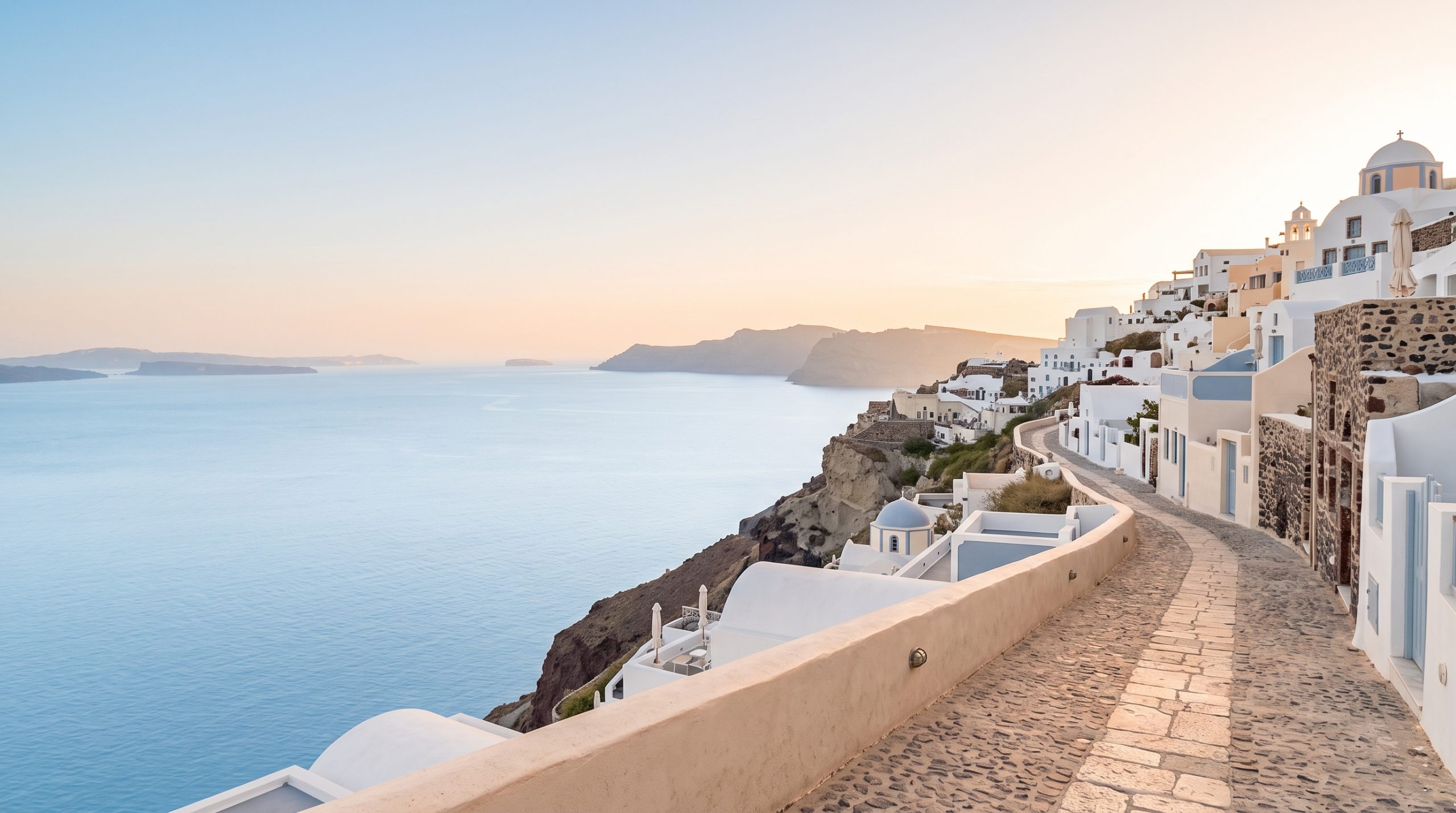
At six in the morning in late June, the rim path between Imerovigli and Oia belongs to about four people, one of whom is watering bougainvillea. On 21 June the sun clears the horizon at 06:01. By half past nine the first coaches are parked above Fira, and the lane you had to yourselves is a slow-moving line of shoulders and phones.
That gap is the whole planning problem on Santorini. The island is small enough to drive end to end in under an hour, and busy enough that the eleven kilometres between Fira and Oia can take three times what your phone promises. Add a marriage licence that the Municipality of Thira issues on its own calendar, plus a caldera sitting inside airspace that has to be checked before a drone leaves the case, and the order you plan things in starts to matter more than the list itself.
So we will take it in that order: paperwork first, because it has the longest lead time, then light, then the roads everyone underestimates.
Santorini in one paragraph: days, light and paperwork
Fly into Thira (JTR), almost always through Athens, and give yourselves five nights on the island. Build the ceremony around sunrise on the caldera rim rather than sunset. Greek authorities generally issue the marriage licence eight days after the application is submitted, so the paperwork sets your calendar long before the day itself does.
The paperwork calendar, counted backward from the ceremony
For a legal civil ceremony on the island, the licence comes from the municipality where the marriage takes place, which for Santorini means the Municipality of Thira. According to U.S. Embassy guidance for Americans marrying in Greece, authorities generally issue that licence eight days after the application goes in, and the mayor’s office waits a week from the date of application for any objection from a third party. The licence then stays valid for six months, which is the detail that makes early paperwork painless rather than tight.
Documents are the slow part. A full birth certificate needs an apostille from the issuing state and an official translation into Greek. American couples also sign an affidavit of no impediment, notarized in person in front of a consular officer at the U.S. Embassy in Athens, at fifty dollars each. That document then goes to the Greek Ministry of Foreign Affairs validation department in Athens, where the public fee voucher is 30 euros. The Embassy’s own guidance is to allow at least two days in Athens for this, which is one good reason the Athens leg belongs at the front of the trip rather than the back.
Two witnesses attend the ceremony, and one of them needs to interpret between Greek and English. Afterward the marriage is recorded at the Vital Statistics Office, the Lixiarcheio, within 40 days of the ceremony.
| Step | Where it happens | When to deal with it |
|---|---|---|
| Apostilled birth certificate | Your home state | Months ahead, before anything else |
| Greek translation of documents | Certified translator | Once the apostilles are in hand |
| Affidavit of no impediment | U.S. Embassy, Athens | On the Athens leg, before the island |
| Validation of the affidavit | Ministry of Foreign Affairs, Athens | Same Athens leg, 30 euro voucher |
| Marriage licence application | Municipality of Thira | At least eight days before the ceremony |
| Registering the marriage | Lixiarcheio, Thira | Within 40 days after |
Plenty of couples skip that chain and handle the legal registration at home, then treat the island day as the ceremony that matters to them. It removes eight days, two Athens mornings and a translator from the plan. Both routes work, and the choice changes the trip more than it changes the day, which is why we ask early. Our guide to how eloping actually works covers the difference in plain terms.
Sunrise beats sunset here, and the almanac explains why
Stand on the rim at first light and the sun is behind you. Everything you are looking at, the caldera wall, Thirassia across the water, the stacked white cubes of Imerovigli, is lit from the front in warm low light. Stand in the same spot twelve hours later and the sun is in your lens, the white walls go grey in their own shadow, and several hundred people are standing where you want to be. Oia’s castle at sunset is the most photographed spot on the island and also one of the flattest to work in.
| Date | First light | Sunrise | Sunset | Sunset direction |
|---|---|---|---|---|
| 15 May | 05:43 | 06:12 | 20:18 | WNW, 294 degrees |
| 21 June | 05:30 | 06:01 | 20:40 | WNW, 300 degrees |
| 15 August | 06:08 | 06:36 | 20:10 | WNW, 288 degrees |
| 15 September | 06:35 | 07:01 | 19:27 | W, 274 degrees |
| 10 October | 06:55 | 07:21 | 18:50 | W, 262 degrees |
All of those are island clock times in summer hours. Two things in that table change how we build a day. The first is the swing in sunset direction: nearly forty degrees between late June and mid-October. In high summer the sun drops to the northwest, out over open water beyond the Oia headland, so from Fira and Imerovigli it sets past the end of the island rather than into the caldera. By the second week of October it has come around to almost due west and goes down behind Thirassia, which is a completely different frame from the same balcony.
The second is that the almanac time and the useful time are not the same. Santorini’s own ridge rises to the east and southeast of the rim villages, so the first warm light on the caldera face arrives a few minutes after the printed sunrise. We plan the ceremony hour from the light we can actually see, not from the table, which in practice means being in position during first light and letting the sun find you. You can see how those two hours read on the island in our published elopement films and galleries, where the difference between 06:15 and 19:15 on the same rim is obvious in a single scroll.
Crowds follow the same clock. August is the island’s busiest month, with especially heavy demand around 15 August, and the public lanes and viewpoints in Oia are dense from late afternoon until the sun is down. May, early June, September and the first half of October are the months that give you the light and the room at once. If your only workable window is August, say so and we will build around a dawn ceremony and an inland or south-coast afternoon instead of fighting the rim at six in the evening.
What a twenty-minute drive really costs on the caldera rim
Route planners treat Santorini like flat ground. It is a crescent of cliff with one main artery, village lanes built for donkeys, and traffic that arrives in waves rather than a steady flow. Here is the gap between the estimate and the plan.
- Fira to Oia, about 11 km. Twenty minutes on an empty road early. Between five in the afternoon and sunset in July and August, plan on 35 to 45 minutes, and more if a cruise day has filled Fira.
- Airport (JTR) to the rim villages. Fifteen minutes at a quiet hour, double it when two or three flights land together and the Fira junction absorbs everything at once.
- Athinios port to Fira. Ten switchbacked kilometres. The number matters less than the timing: a ferry unloads hundreds of vehicles in one push, so we never place anything time-critical inside the hour after a big arrival.
- Oia to the Akrotiri lighthouse, end to end. Forty to forty-five minutes on a clear road, and one of the few long drives here worth making, because the light at the southwestern tip has nothing white in it and reads like a different island.
Then there is the part no map shows at all. No vehicle reaches the middle of Oia, Imerovigli or Firostefani. Cars stop at the edge of the village and the last few hundred metres are on foot, on steps, often in a single-file lane between walls. A ten-minute transfer on paper is ten minutes of driving plus twelve of walking with gear, a dress and whatever the wind is doing. That single miscalculation is the most common reason a Santorini timeline collapses by mid-morning.
Ammoudi Bay, at the foot of the stepped path below Oia, earns the descent for the red rock and the water at eye level. Going down is quick. Coming back up in July heat is a slow twenty minutes at best, so nothing time-critical goes after it. Two routes we generally talk couples out of: driving up from the south coast to Oia for sunset in high season, and fitting a rim ceremony and a black-sand beach hour into the same two-hour block. Both look fine on a map and run thin in practice.
Where to base yourselves
Where you sleep decides how much of the good light you spend in a car. The rim villages sit within a few kilometres of each other and feel much further apart in season.
| Base | On the doorstep | Trade-off |
|---|---|---|
| Oia | Ammoudi, the castle, the northern rim | Busiest lanes on the island from mid-afternoon |
| Imerovigli | Skaros Rock, the highest stretch of rim | Steps everywhere, and cars park above the village |
| Firostefani or Fira | Rim path, and the shortest drive to anywhere | Fira itself is the island’s traffic knot |
| Pyrgos | Inland alleys, rooftops, vineyards | No caldera edge, so a drive for rim light |
| Vlychada or Akrotiri | Pale carved cliffs, dark sand, the lighthouse | Forty minutes from the northern rim |
Couples who want the postcard and the quiet usually land on Imerovigli or Firostefani, close enough to Oia for a dawn hour and far enough out of it to have dinner in peace. Our destination guides go further into which corners of each village hold light late.
Aerials over the caldera: what we confirm before we plan the film
Greece follows the European framework, and the Hellenic Civil Aviation Authority is the office that governs where a drone may fly. Before any flight it is mandatory to check restrictions on DAGR, the Drone Aware Greece platform, which shows which areas are open without prior approval and which sit in the yellow and magenta zones. Airports and archaeological sites fall in those coloured zones, where flights are either permitted under specific conditions or not at all, and prior approval is required in most cases. Flights in airport areas go through an authorisation request to the authority.
That matters here because Santorini’s national airport sits in the middle of a very narrow island, so the map, not the mood on the morning, decides where aerials are possible. Our filmmakers work as registered operators inside the open category limits, within visual line of sight and below 120 metres, and we confirm the zone and the permission before a single shot is planned around a drone. We also plan the film so it stands on its own if the wind says no, because the summer meltemi builds through the afternoon and the calm window on the rim is usually the one at dawn.
How the schedule absorbs all of it
Every constraint above turns into a decision in the timeline we write for you. Start times sit before the coaches. Nothing important lands inside the hour after a ferry arrival. Every location has a second option in reserve within ten minutes, usually one on the sheltered side of a wall for the days the north wind is up. Walking time between the car and the ceremony spot is written in as its own line, with a number next to it.
The logistics of the team matter too. On an Expedition day the photographer and filmmaker arrive as one crew rather than two suppliers meeting at breakfast, which on an island of one-lane villages usually means two vehicles. One of us can be down at Ammoudi or parked at the Akrotiri end, checking where the light has moved and where a coach has just unloaded, while the other stays with you and keeps the morning calm. A second set of gear on the ground is not a luxury when a day runs from first light to blue hour and back up several hundred steps. What each experience covers, and what it starts from, is set out on our experiences and pricing page.
Tell us the week you are looking at and what you actually want the morning to feel like, and we will send back the version of the day that fits it, or tell you honestly which month on this island fits it better. Send Us a Message with your dates and we will take it from there.
Common questions
How many days do we need on Santorini for a legal elopement?
Five nights on the island is the comfortable shape, with two days in Athens in front of it if you are doing the paperwork in Greece. That gives you a settling day, the ceremony day, a weather alternative day and a day that is nobody’s schedule but yours.
Do we have to go to Athens first?
If you want the legal ceremony on the island, yes, in practice. The affidavit of no impediment is notarized at the U.S. Embassy in Athens and validated at the Ministry of Foreign Affairs there, and the Embassy suggests allowing at least two days for it. Couples who register at home instead fly straight through to Thira.
Can we have drone footage over Oia and the caldera?
Often yes, and it depends entirely on the zone. The Hellenic Civil Aviation Authority’s DAGR platform shows which areas are open and which need prior approval, with airports and archaeological sites in the restricted colours. We check the specific location and secure permission where it is needed before the film is planned around aerials.
Is Oia at sunset worth building the ceremony around?
Honestly, no. From late afternoon until the sun is down, the lanes and viewpoints in Oia are packed, and you are shooting into the light. The same rim at first light is empty, frontlit and cool enough to walk in. We move the vows to dawn and keep the evening for dinner and a slower walk.
Should we stay in Oia or Imerovigli?
Imerovigli if you want the rim and the quiet, Oia if the northern tip and Ammoudi are the reason you chose the island. From Imerovigli you can be in position in Oia for first light in a short early drive, and you get your evenings back.
How far ahead should we book a Santorini date?
We are currently taking 2027, 2028 and 2029 dates, and the May, September and October weeks go first. Planning begins once the contract is signed and a 30 percent retainer is paid, and hotel availability on the rim for those months tends to be the real deadline.
Picking your week on the island
If we could choose for you, it would be the last week of September or the first ten days of October, when sunset has swung around behind Thirassia, the sea is still warm and the rim path at seven in the morning is yours. May runs a close second, with longer evenings and greener terraces.
Send us your dates and the two or three things you care about most, and you will have a reply and our first brochure within 24 hours. Everything with us runs in writing, so you can read, think and answer on your own time, from your own time zone. Check Your Date and we will tell you what the light is doing that week.