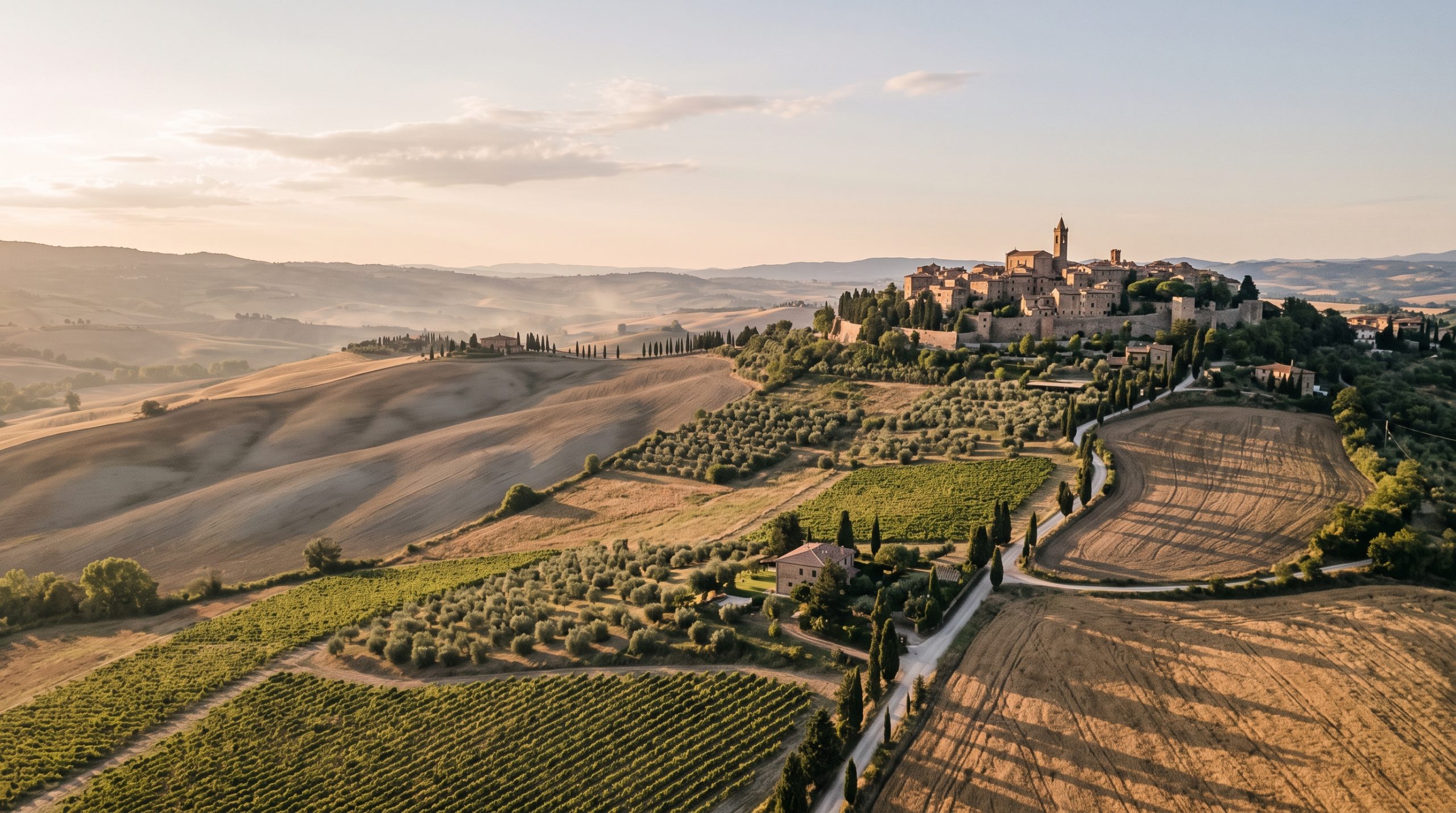
In the third week of June the sun rises over the Val d’Orcia at 5:34, and civil twilight opens just before five. Neither number tells you when the light actually arrives. This is a valley with hills on both sides, so the ridge above Pienza goes warm while the wheat in the bottoms is still gray, and that gap is the reason we ask couples to be dressed and standing on gravel in the dark.
The other thing nobody writes down is how much walking these places take. The Vitaleta chapel sits off a dirt road between San Quirico d’Orcia and Pienza, with a small free parking area and roughly 700 meters on foot from there. The chapel is private and stays locked, so what you get is a facade and two cypresses against the valley, not a room you can stand inside. Pienza’s historic center is a limited traffic zone, which means the car stops outside the walls and the dress walks in. None of that is hard. It only has to be in the timeline rather than discovered at 5:20 in the morning.
The Val d’Orcia went onto the UNESCO World Heritage List in 2004 as a cultural landscape: a farmed valley whose cypress lines, hilltop farmhouses and white roads were laid out with Sienese money in the fourteenth and fifteenth centuries, then painted by Sienese artists until the rest of the world decided this was what Italy looked like. It photographs the way it does because it was designed to be looked at. Working here well is less about finding the view than about choosing which twelve minutes of the day you want to be standing in it.
Two shapes of day, and where each one starts
We photograph, film and plan elopements across the Val d’Orcia and the wider Tuscan hills, one team for all three. A full day with a dedicated photographer or filmmaker starts at $4,900. A day with both working side by side starts at $7,900. Two to seven days across several regions is a custom proposal.
Dawn on the Pienza road, hour by hour
A June day here starts with a 4:20 alarm and coffee made in the room, because civil twilight opens just before five and the drive between most Orcia locations is ten to twenty minutes on roads that are half gravel. We want you in position while the valley is still blue. Nobody else is out there yet, the SP146 is empty, and the first ten minutes of real color lands on the ridges rather than in the fields, which is why we choose a high position first and drop into the valley afterwards.
Now the honest part. The roadside pull-offs above the best-known farmhouse views collect landscape photographers and tripods from first light through most of September and October, and standing in that line is not a private ceremony. We take two or three frames from the famous angles when they are worth it, then walk you somewhere with room. The Val d’Orcia has hundreds of unnamed crests that read exactly like the postcard, and half of them belong to an agriturismo that will say yes if you ask properly and in advance.
Vows tend to sit in the hour after direct sun, roughly 6:00 to 7:00 in June, when the light has warmth but the shadows are still long enough to give the hills their shape. Then Pienza, on foot, while the streets belong to people buying bread rather than to coach parties. Espresso standing at a bar. A walk along the outer wall where the whole valley opens up on your left.
The middle of a Tuscan day is flat and hot and we tell couples so rather than filling it with movement. Between about eleven and five, we break. You eat a long lunch, sleep, swim if there is a pool. We use that window to scout the evening in current conditions and to move anything the weather has changed. Late afternoon brings the second half: the thermal basin in the square at Bagno Vignoni, a Brunello estate above Montalcino, or the road out towards Sant’Antimo. In June the sun does not set until a few minutes before nine, and the hills hold color for another half hour after that.
If your marriage is being registered in Italy, the civil rite has to sit inside the working hours of a town hall, which is the one fixed point in an otherwise light-led day. Pienza holds its ceremonies in the Sala Consiliare of the Palazzo Comunale. So the shape becomes two ceremonies in one day: paperwork and a registrar in town, private vows on a hill at either end.
| Month | Sunrise | Sunset | What the hills are doing |
|---|---|---|---|
| Late April | 6:24 am | 8:01 pm | Wheat green, poppies on the verges, cool mornings |
| Mid-May | 5:50 am | 8:29 pm | Green turning, longest comfortable working day |
| Mid-June | 5:34 am | 8:54 pm | Gold before the harvest, warm middle hours |
| Early September | 6:41 am | 7:42 pm | Turned earth, heavy vines, softer light all day |
| Mid-October | 7:20 am | 6:40 pm | Second green after the rains, olives coming in |
| Late October | 6:46 am | 5:07 pm | Clocks back, short day, mist sitting in the valleys |
Those times are for the valley around Pienza, and the clocks go back on the last Sunday of October, which is why the late-October row looks so different from the one above it. Add fifteen to twenty-five minutes to sunrise for direct light to clear the eastern hills, depending on where you are standing. That correction is most of what separates a timeline that works from one built off an app.
What the second camera catches in an Orcia dawn
The whole argument for photography and film from one team lives in those twelve minutes. A single photographer standing on a crest at 5:50 has to choose: the wide still frame with you small in the landscape, or the moving one where you walk the cypress line and the light changes across your faces. One of those gets made and the other becomes a story you tell later. With a dedicated photographer and a dedicated filmmaker on the same plan, both get made, from positions we agreed the night before rather than negotiated in the field.
Sound is the other half of it, and Tuscany is unusually generous with it. At 5:30 the valley is genuinely silent except for gravel underfoot and bells carrying from a town two hills away. By noon the cicadas are loud enough to bury a vow spoken at normal volume. Our Expedition coverage adds professional audio for vows and the moments that matter, which is why a whispered exchange on a stubble field in July still arrives as something you can hear.
Aerials matter here more than in most places, because this landscape was composed from the ground but reads from above: the cypress rows mark roads and property lines, and a farmhouse on a hilltop only shows its geometry when you lift. Drone work runs on operator registration, pilot certification and a check of the flight zone over the ground you are standing on, so we confirm all three before we plan a single shot around it. Where any of that does not line up, the film is built without it and you will not feel the absence.
Because there are eight of us, there is always a second camera on the ground and a colleague in reserve. And because the same people who wrote your timeline are the ones carrying the cameras, nothing gets lost between the plan and the morning. Our published elopement galleries and films are the clearest way to see what that produces in this kind of light.
The Atto Notorio question, and how we plan around it
This is the thing American couples worry about most, and it is worth being precise. To marry legally in Italy, US citizens obtain an Atto Notorio, make a sworn declaration once they are in the country, then present their documents in person at the marriage office of the comune where the ceremony will take place and make the Declaration of Intention to Marry. Afterwards the marriage certificate is issued and an Apostille is obtained so it is recognized at home.
That chain is administrative rather than difficult, and it has two consequences for the day. The first is that the legal ceremony happens in a civic room during office hours, not on a hilltop at 6:00 in the morning. The second is that the comune, not us, sets the rules and the tariff for it.
So we build most Tuscany days one of two ways. Either the registrar’s ceremony sits mid-morning in town and the private vows happen at dawn and again at last light, or the couple signs at home before flying and Italy is kept entirely for the vows, which removes the document chain and buys back three hours. Permit research and logistics guidance for either version is part of every experience, including the letters to landowners for private fields and the confirmations for the towns. Our guide to planning an elopement covers the wider mechanics, and the proposal we send you names the specific offices involved in your date.
Check Your Date and tell us which of those two shapes sounds like yours.
Where our fee stops and Italy’s tariffs begin
Every experience, in every destination, includes the following.
- Destination and location design, and the planning behind it
- A custom timeline built around light and real travel time, not round numbers
- Permit research and logistics guidance
- Weather alternatives and backup planning, decided before the morning you need them
- Drone footage where it is legal, safe and appropriate
- Professional audio for vows and meaningful moments on the Expedition, where conditions allow
- Team travel worldwide: flights, accommodation and ordinary travel for the assigned team, Tuscany included
- Highlights in 5 days, and the full gallery or film in 3 weeks
Our fee does not change with guest count. Bringing six guests rather than two affects access, permits, transport and the timeline, not the number on the proposal. You can see how coverage is structured on our pricing page.
What Tuscany adds on top is paid locally and directly, in euro. A civil ceremony in a Val d’Orcia town hall carries a tariff set by each comune and revised by council resolution: Pienza’s fee for the Sala Consiliare has stood at 750 euro, and we confirm the current figure with the office before a date is fixed. Beyond that, expect landowner or estate permission for private fields and vineyards, parking outside the walls of the hill towns, your accommodation, a celebrant if you want a symbolic ceremony as well, flowers, and dinner. Anything unusual on wheels or in the air belongs to you too: a vintage car for the Orcia roads, a 4×4 up a farm track, a balloon flight over the valley at dawn.
From inquiry to retainer, in six steps
- You send the inquiry form with your dates, or your rough window if the dates are still moving.
- We reply within 24 hours with an initial brochure.
- We send a tailored proposal: locations, the shape of the day, the permits your version needs.
- You sign the contract and pay a 30% retainer. The remaining payments are set out in the proposal.
- Planning begins, and runs until your timeline is fixed to the hour and your weather alternatives exist on paper.
- Your assigned photographer and filmmaker travel to Tuscany and shoot the day we planned together.
Which couples the Orcia hills reward
This valley pays back couples who will get up in the dark, walk 700 meters over uneven ground in good shoes carried in a bag, and let a plan move on the morning when the mist sits lower than forecast. If that sounds like the two of you, June and September will give you the most dramatic light of the year.
If a 4:20 alarm is not your idea of a beautiful morning, say so in your first message, because the answer is a month rather than a compromise. Late October puts sunrise at 6:46 and sunset at 5:07 in the afternoon, so an entire day of coverage fits inside eleven hours and nobody is standing in a field before breakfast. If green hills matter more than long light, April and May are the months to ask about, and they are also quieter on the roads. Our destination elopement guides are a good place to compare regions before you decide.
Tell us what your ideal morning actually looks like, in plain words, and we will tell you honestly which month and which corner of Tuscany fits it best.
Common questions
Is there a half-day Tuscany elopement option?
No, and it is deliberate. The Val d’Orcia gives its two best hours at opposite ends of the day, and half-day coverage forces you to pick one and lose the other. Our shortest coverage is one full day, which holds dawn, the town, the rest hours and last light.
Can we be legally married in the Val d’Orcia, or does it have to be symbolic?
Both are possible. A legally registered marriage means an Atto Notorio, a sworn declaration made in Italy, the Declaration of Intention to Marry presented at the comune, and an Apostille on the certificate afterwards. Many couples instead sign at home and keep Italy for private vows with a celebrant.
Do we need permission to be at the Vitaleta chapel or the San Quirico cypresses?
The public approaches are open and free, and the walk to Vitaleta is around 700 meters from a small parking area. The chapel itself is private and locked, and the famous cypress groves stand on farmland, so anything beyond a roadside frame means asking the landowner first. We handle the research and the asking; any fee is paid by you.
Can you fly a drone over the Val d’Orcia?
Often, and it suits this landscape better than most. Italian aerial work requires operator registration, pilot certification and a check of the specific flight zone, so we confirm those for your locations before the film is planned around a drone shot.
How far ahead do couples book a Tuscany date?
Our current Tuscany availability runs across 2027–2029. Twelve to eighteen months is comfortable for a June or September date; shorter notice is often workable, especially in April, May and late October.
Do we pay for your flights and hotels in Italy?
No. Team travel is included worldwide, which covers flights, accommodation and ordinary travel for your assigned team, with no separate charge for Tuscany.
When do the photos and the film arrive?
Highlights reach you in 5 days, while you are probably still in Italy. The full gallery or the finished film follows within 3 weeks.
Can we add the coast or the Dolomites to the same trip?
Yes. Our Odyssey coverage runs from two to seven days across one or several destinations, so the Orcia hills and the Maremma coast, or Tuscany and the Dolomites, can sit inside one plan with the driving built into the timeline.
Sending us the first message
The full planning trail stays written and easy to revisit, in your own time and across whatever time zone you are in. You send dates and a sentence about the day you picture, we reply within 24 hours, and the conversation continues by email until the plan is yours. There is nothing to sit through and nothing to arrange before you can ask us a question.
If the Val d’Orcia at 5:34 in the morning sounds like the start of your marriage, Tell Us Your Story and we will start shaping the day.