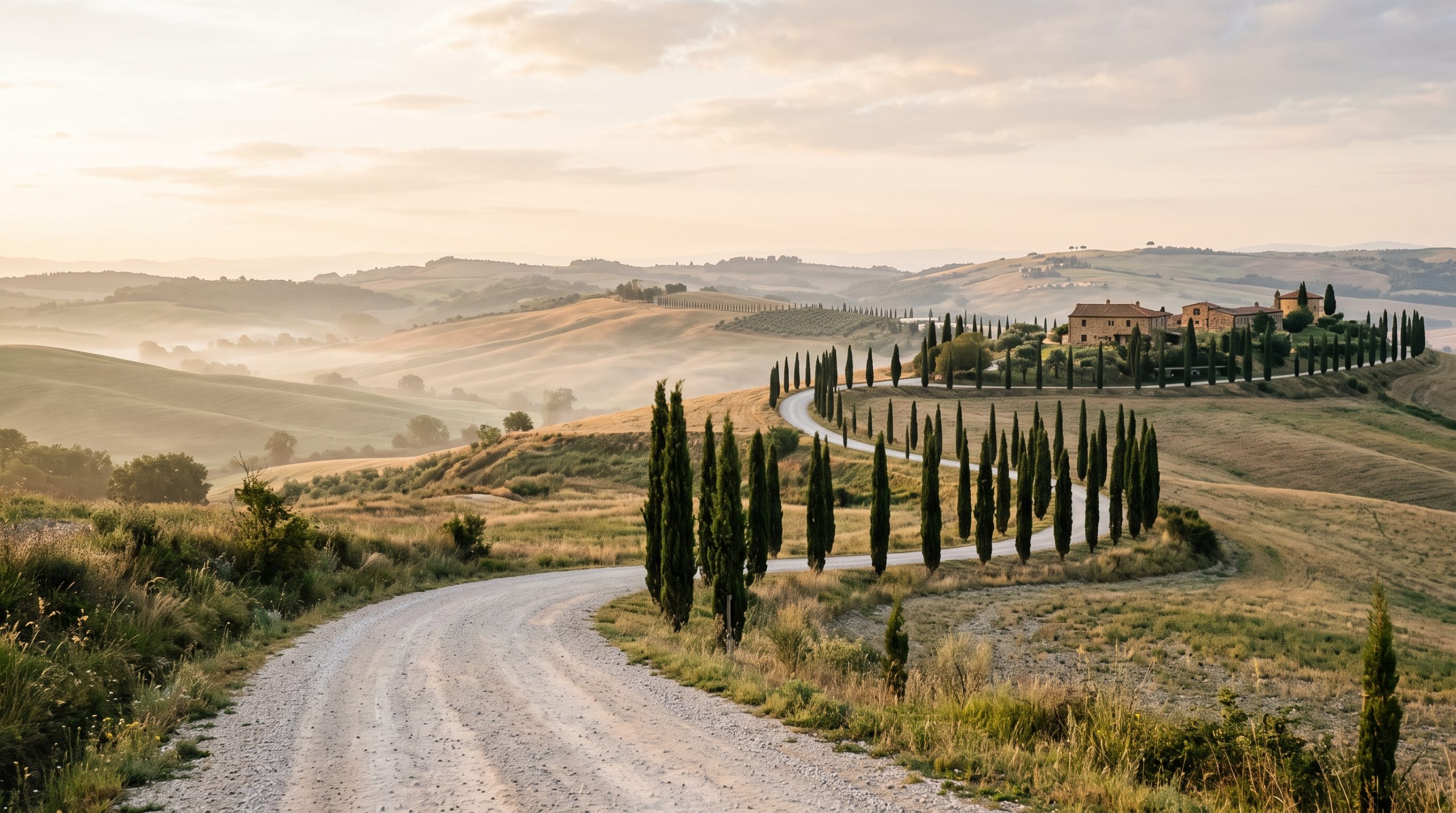
The Val d’Orcia runs on a clock that has nothing to do with opening hours. In mid-June the sun clears the ridge east of Pienza just after 5:30am, and by 7:30 the lay-by above the Vitaleta chapel holds a dozen cars and a row of tripods pointed the same way. In mid-October that sunrise arrives around 7:20, often through fog lying in the valley floor like water in a bath, and the pull-off is empty.
Almost every decision here comes back to that gap. Where you sleep decides whether you are on the ridge for first light or still on the SR2. Which comune you file your papers in decides which days of the week the registrar’s counter is open to you.
This is the operational version: the airports that serve the valley, the documents in the order Italy wants them, the drives that run longer than the route planner claims, and the light you are buying when you pick a month.
The plan in one paragraph: airport, car, comune, light
Fly into Florence, Pisa or Rome, connecting through a European hub, then drive roughly two hours to a base near Pienza or San Quirico d’Orcia. Allow several working days in Italy for the paperwork if you are marrying legally here. Plan the ceremony around sunrise or the last ninety minutes of light. Four nights is the working minimum.
Flying in: Pisa, Florence, or Rome and a longer drive
Neither Tuscan airport takes a nonstop flight from the United States. Florence Amerigo Vespucci (FLR) and Pisa Galileo Galilei (PSA) sit about 80 km apart on the Arno valley, and both are European-connection airports, so you will change planes in Rome, Milan, Paris, Amsterdam or London whichever you choose. Pisa is the larger of the two and carries most of the low-cost European traffic. Florence is smaller, closer to the city it serves, and has one useful trick: the T2 tram leaves the terminal for the edge of the historic center in about twenty minutes, which makes a first night in Florence painless before you head south.
Price Rome Fiumicino as well. The run north on the A1, leaving the motorway at Chiusi-Chianciano Terme, drops you into the southern Val d’Orcia in about the same time as the drive down from Florence, and the transatlantic fare is often better. If you would rather not drive the first leg, high-speed trains link Rome and Florence in about an hour and a half, and Chiusi-Chianciano Terme is the closest station to the valley.
| Arrival airport | Distance to Pienza | Route planner says | Plan on |
|---|---|---|---|
| Florence (FLR) | about 150 km | 1h50 | 2h20, more on a Friday |
| Pisa (PSA) | about 185 km | 2h20 | 2h50 |
| Rome Fiumicino (FCO) | about 215 km | 2h20 | 2h45 to 3h |
Collect the rental car at the airport, never in a city center, and take the smallest one you can live with; roads inside the valley were built for carts and are still used by tractors. Then sleep in the valley rather than in a city you commute from. San Quirico d’Orcia, Pienza, Montalcino and Bagno Vignoni all sit within fifteen or twenty minutes of the cypress country, which is what makes a 5am start survivable. Siena adds an hour each way. Florence adds two, each way, every day.
Paperwork in the order Italy wants it
There are two honest routes. Marry legally at home and hold the ceremony in the valley, which removes every deadline from this section. Or marry legally in Italy, which is very doable and asks for a short stack of documents in a specific order. Our guide to how eloping actually works covers both shapes; here is the Italian sequence for American couples.
- Atto Notorio. An affidavit stating that nothing under US law prevents your marriage. The straightforward version is sworn at an Italian consulate in the United States before you travel; it can also be done in Italy before a court, with witnesses.
- Dichiarazione Giurata. The sworn declaration made in front of a US consular officer in Italy. For Tuscany that is the Consulate General on Lungarno Vespucci in Florence.
- Legalization at a Prefettura. That declaration is then legalized at a Prefettura office inside the same consular district, which for the Val d’Orcia means the office on Piazza del Duomo in Siena. Buy a 16 euro revenue stamp, a marca da bollo, at any tabacchi and hand it over at the counter.
- Declaration of Intention to Marry. Made in person at the marriage office of the comune where you marry. In Florence that office sits inside Palazzo Vecchio and opens to the public on two weekdays. In San Quirico d’Orcia the registrar is in Palazzo Chigi Zondadari.
- Apostille. After the ceremony, get the apostille on your Italian marriage certificate so it is recognized at home.
Two things about this list matter more than the list itself. The US Embassy in Italy states plainly that waiting lists at town halls are not uncommon, particularly in May, June and September, the exact three months most couples want. And every comune is its own small authority: each publishes its own tariff for civil ceremonies and its own regulation listing which rooms and outdoor areas may be used, so the answer to “can we marry on that terrace” is a document held in one town hall and nowhere else. Rates differ between the council chamber and an approved outdoor site.
Build your arrival around that. Landing three or four working days ahead gives the counters room to be closed on the day you first try them, which happens, and still leaves the paperwork finished early.
Where the map lies: gravel roads, toll gates, ZTL cameras
Route planners here are optimistic in three specific places, and knowing where saves a morning.
The strade bianche. The white gravel roads are the reason you came, and they are also unpaved farm tracks connecting one village to the next. The Pienza to Monticchiello loop is 14 km of them. A planner treats them as roads; drive them at about two thirds of the speed you expect, more slowly after rain, and allow a minute for the dust to settle before anyone stands in it. Most are fine in a normal sedan if you pick the right ones, and we do pick the right ones.
The SP146 and the SR2. The famous stretch between San Quirico d’Orcia and Pienza is 10 km of two-lane road with no shoulder and the occasional lay-by where everybody stops. In April and May it carries groups of cyclists; in late June, harvest traffic. Siena to Pienza is about 55 km and shows as just over an hour, honest in daylight and optimistic at 5am in October when fog sits on the SR2 south of Buonconvento. Plan an hour twenty.
The A1 toll plazas. The motorway is fast and the exits are the slow part. The Valdichiana and Chiusi-Chianciano gates back up on summer Fridays and Sunday evenings. Ten minutes, not two.
Then there is the thing the map encourages you to get wrong. Florence’s historic center is a ZTL, a limited traffic zone read by cameras at every entrance, currently closed to unpermitted vehicles on weekdays from 7:30am to 8:00pm and Saturdays from 7:30am to 4:00pm, with extra late-night closures on summer weekends. Sundays and public holidays are open. A hotel inside the zone can register your plate, so hand it over at check-in; otherwise park outside the ring and walk, which is faster anyway. Siena and San Gimignano work the same way, and Pienza’s lots sit just outside the gate.
Two things we would tell you not to bother with. Florence portraits plus a Val d’Orcia sunset in one day is four hours in the car for two hours of light. And the run to the coast for a quick Tuscan beach hour is two hours each way from Pienza, on roads that are not scenic.
Light in the Val d’Orcia, month by month
This is a landscape of long shadows, so the difference between a good hour and a flat one is about twenty minutes. These are the numbers for the middle of the valley, near Pienza.
| Period | Sunrise | Sunset | What the ground looks like |
|---|---|---|---|
| Mid-April | about 6:20am | about 8:00pm | Green wheat, wildflowers, cyclists everywhere on weekends |
| Mid-May | about 5:50am | about 8:30pm | Deep green fields, poppies, the softest week of the year |
| Mid-June | about 5:30am | about 8:55pm | Gold, for roughly a fortnight, then harvest |
| Mid-July | about 5:45am | about 8:50pm | Cut stubble and plowed brown, hot by 10am |
| Mid-September | about 6:50am | about 7:25pm | Vines heavy in Montalcino, warm days, workable mornings |
| Mid-October | about 7:20am | about 6:25pm | Fog at dawn, olive harvest, short days and empty roads |
Read that table for what each month costs as much as what it gives. Mid-June buys fifteen hours of daylight and the gold fields, and asks you to be out of the door by 4:45am. Mid-October hands you a sunrise you can reach after coffee, a sunset before dinner, and fog that does more for a film than any amount of blue sky. If green fields are the reason you chose Tuscany, come in May; if the gold is, aim for the back half of June and accept that the harvest sets the date. Tell us which picture is in your head and we will say honestly which weeks hold it.
A real mid-September day in the valley, built on those numbers:
| Time | Where you are |
|---|---|
| 5:45am | Leaving the agriturismo, dressed, coffee in the car |
| 6:20am | On the ridge, first light, half an hour before the sun |
| 6:50am | Sunrise, and the fifteen minutes after it that matter most |
| 8:15am | Breakfast back at the farmhouse, then the morning off |
| 4:30pm | Second look, a short drive, one gravel track we scouted the day before |
| 5:45pm | Ceremony, an hour and forty minutes before sunset |
| 7:00pm | Last light on the cypress line, then the walk back |
| 8:00pm | Dinner in Pienza, cameras down |
Drones, comune ground rules and who says yes
Aerials in Italy run under the European open-category rules that ENAC administers, with operator registration and the official zone map on the D-Flight portal. The working limits are a 120 meter ceiling, the aircraft kept in sight, and no flying over crowds. What matters for your film is that the valley is not one uniform airspace: some ground is open, and some sits in a zone that needs permission first.
So we check the exact fields, not the region, before a shot is planned around aerials. Where a zone needs authorization we start early, and where the answer is no we say so before it reaches a timeline. Landowners are the other half of it. Most of the country you have seen photographed here is somebody’s working farm, including the ridge above the chapel, so access is a permission rather than a right of way.
How we build buffers into a Tuscan day
All of it turns into three habits. We hold a second location fifteen minutes from the first, because a tour van in your lay-by is a five-minute problem when you have somewhere else to go. We never put the ceremony hour next to a hard deadline. And we scout the actual track the day before, in the same light, so the morning itself is driving to a known place rather than looking for one.
The two-camera question is where the eight of us earn our keep. On a day with a photographer and a filmmaker together, that is two sets of gear and usually two vehicles: one of us can be up the road confirming that the harvest happened and the light is doing what it did yesterday, while the other stays with you and nothing stops. Two hours from the nearest airport, a second body carrying a second set of everything is also the reason a dead battery is a shrug. Team travel is included worldwide, so flights and accommodation for the team assigned to you are not a line you cover. What that looks like finished sits in our elopement stories and films; highlights reach you five days after the day itself, the full gallery or film inside three weeks.
Coverage runs from one full day with a photographer or a filmmaker, to one full day with both working together, to several days across more than one region, and the experiences page lays out what each includes. Permit research, the timeline, the weather alternatives and the location design are ours; permit fees, your celebrant, accommodation and anything unusual on wheels or rotors are yours. We are booking 2027, 2028 and 2029, so if you have a month in mind, Check Your Date and we will tell you what is open.
Common questions
How many days do we need in Italy before the ceremony if we marry legally there?
Plan on arriving three or four working days ahead. The declaration at the comune, the consular declaration and the Prefettura legalization all happen in person and on office hours, and the US Embassy notes that several days are often needed.
Can we legally marry in the Val d’Orcia itself, or only in a city?
In the valley itself. Small comuni such as San Quirico d’Orcia hold civil ceremonies and publish their own regulation for which rooms and outdoor areas can be used, plus their own tariff. The approved list is specific to each town hall, which is why we start there rather than with a view.
Do we really need a rental car, or can we use drivers?
A car is the honest answer for anything built around sunrise. Drivers work well for an evening ceremony and dinner, and for the Florence end of a trip where parking is the real problem. For a 5:45am start on a gravel track, your own keys are worth more than the comfort.
How far ahead should we lock a September date?
As early as you can. September is one of the three months the US Embassy flags for waiting lists at town halls, and the agriturismi worth staying in fill first. We are taking dates for 2027, 2028 and 2029.
Will the fields be green if we come in June?
Green is May. June is gold, for about two weeks, and then the harvest turns the same hills to stubble almost overnight. The exact week moves with the weather each year, so if the color matters to you, tell us and we will build the date around it.
Can you fly a drone over the Val d’Orcia and Pienza?
In many places yes, under the open-category rules ENAC administers, with the operator registered and the zone confirmed on the D-Flight map first. Over towns and inside restricted zones it needs permission, so we confirm the specific field before your film is planned around aerials.
What to send us when you are ready to fix a date
Three things get us moving: the month you are thinking about, whether the legal marriage happens in Italy or at home, and one image or line describing the morning you keep picturing. We reply with an initial brochure within 24 hours, then a tailored proposal, and once the contract and a 30 percent retainer are in place the planning starts properly. All of it happens in writing, on your own time zone. Our destination guides are a good place to keep reading while you decide.
The valley asks little of you beyond an early alarm and a willingness to let the light set the order of the day. Tell Us Your Story and we will start shaping it around you.