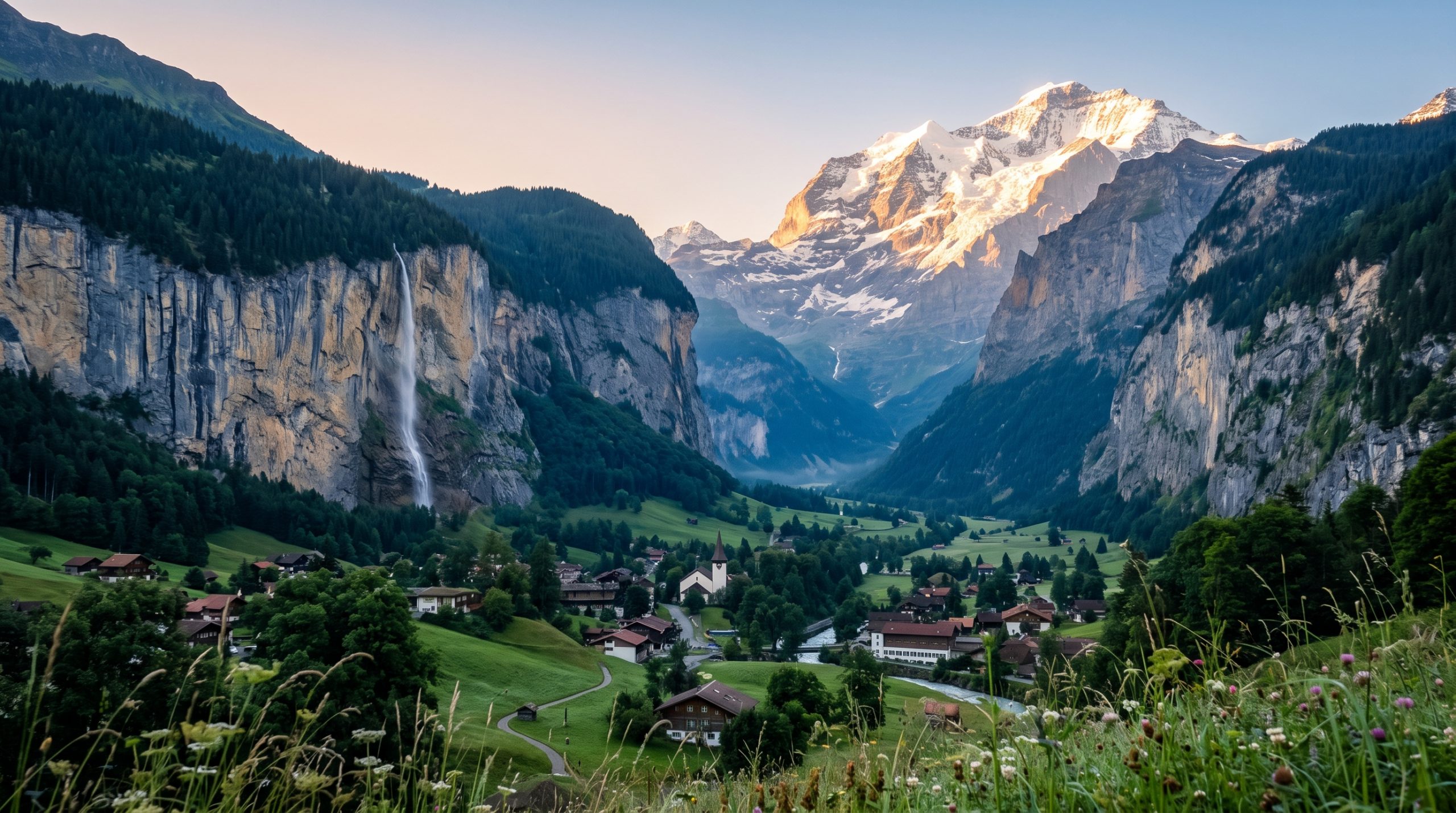
Official sunrise in the Lauterbrunnen valley and the moment the sun actually lands on the valley floor are two different times, and in midsummer they can be well over an hour apart. The tops go first. The Jungfrau, the Mönch and the Eiger hold colour while the meadows underneath are still grey and cold enough for a jacket over whatever you are wearing.
The other number worth knowing early: the first train from Kleine Scheidegg up to the Jungfraujoch does not leave until around half past eight. By then the best light of the day has already happened, more than a kilometre lower down. Switzerland’s high railways run on a visitor timetable rather than a photographer’s one, and planning a Swiss elopement is largely the work of deciding which places you can reach on your own two feet before the cableways start turning.
We are Unmapped Stories: eight photographers, filmmakers and planners working as one team. We design the day around light, altitude and the last departure down the mountain, and then we are the people who photograph and film it. We currently have Switzerland elopement dates available through 2027–2029.
One team for the photographs, the film and the timetable
We photograph, film and plan elopements across Switzerland, from the Bernese Oberland to the Gornergrat ridge above Zermatt. One dedicated photographer, or a photographer and filmmaker working together, for a full day or several. Team travel is included worldwide, and where coverage starts is set out on our coverage and starting figures page.
Hour by hour, from 4:40am in Mürren to the last light
In midsummer the alarm goes at four. That sounds severe until you are outside at 4:40 in Mürren, 1,638 metres up, with no road in from the valley and so no traffic, no coaches and nobody else awake. The path out of the village is level for the first ten minutes, which matters more than people expect when one of you is walking in a dress.
Between five and half past, colour arrives on the far wall of the valley while you are still standing in shade. That half hour cannot be moved, repeated or recovered later, so it gets protected ahead of everything else in the timeline. Then the sun reaches your side, and from roughly six to half past seven you have low, side-on light across the terraces above Mürren. It is the best light of the day for wide frames where the two of you are small and the valley does the talking. We work quickly through that window and we do not spend it walking somewhere.
By eight the first cableways are turning and the mountain starts to fill. Here is the honest part. The famous places in this country are famous, and by mid-morning the viewpoint below the Staubbach falls in Lauterbrunnen has a line of people waiting for the same frame you saw online. The answer is not a secret location, because in a valley this well travelled there aren’t any. The answer is an earlier alarm and a plan that moves vertically.
| Where | Height | How you get there | Why we use it |
|---|---|---|---|
| Mürren | 1,638 m | Cableway from Stechelberg or mountain railway via Grütschalp | Village terraces before the first visitors arrive, and a bed at altitude |
| Allmendhubel | 1,907 m | Short cable railway up from Mürren | Open meadow above the village with the Eiger, Mönch and Jungfrau in line |
| Birg | 2,677 m | Cableway from Mürren | The first rung above a low cloud base on a grey morning |
| Piz Gloria, Schilthorn | 2,970 m | Cableway from Birg | Rock and snow, and a horizon that stops looking Swiss and starts looking arctic |
| Gornergrat, Zermatt | 3,100 m | Cog railway from Zermatt, 1,484 vertical metres in 9,339 metres of track | The Matterhorn, the Gornergletscher and 29 four-thousand-metre peaks |
Ceremony timing is the one element we cannot bend. Marriage in Switzerland is a civil act, performed by a registrar, and the registrar’s office holds the calendar. In the canton of Bern the approved venues away from the registry buildings include the mountain restaurant on the Harder Kulm above Interlaken, where ceremonies are held on Friday afternoons. One line like that sets the shape of an entire week: a Friday signing in the valley, and the hours you actually came for either side of it.
Late morning through to mid-afternoon is the part of a Swiss day we are frank about. The light goes flat and hard, the valley floor is at its busiest, and in autumn the high walls start taking the sun off the meadows by the middle of the afternoon anyway. So that block belongs to you. Eat, change, sleep for an hour, ride a train because riding trains here is genuinely one of the pleasures. We use it to move the day’s second half into position.
Travel legs are not rounding errors in the Bernese Oberland. Lauterbrunnen to Kleine Scheidegg is 43 minutes on the Wengernalpbahn and Grindelwald to Kleine Scheidegg is 33, with departures around every half hour. A timeline that ignores those numbers falls apart by the third location. Late June gives you light until well after nine in the evening, which is room for a proper second act: vows on a quiet shoulder of the hill, then the long alpenglow, then blue hour. The last departure down to the valley is the real end of the mountain day, so either the closing sequence finishes with twenty minutes in hand, or you sleep up high and we stop watching the clock. We suggest the second one nearly every time.
Zermatt keeps a different clock. The Gornergrat railway has run year round since 1929, which is why a February morning at 3,100 metres is a plan rather than a hope. The line’s scheduled sunrise trip runs on summer Sundays: a departure in the dark, interior lights switched off, then a short path down from Rotenboden at about 2,800 metres to the Riffelsee, where the Matterhorn arrives on the surface of the water if the air is still. If your date is a Wednesday in June, that specific trip is not running and the morning takes another shape, which is the sort of thing worth telling us in your first message. Our destination guides go further into how the regions differ month by month.
Wind, waterfalls and moving cloud: what the film holds
Switzerland is the strongest argument we know for having the photographer and the filmmaker on the same ridge, working from the same plan. Half of what makes a Swiss morning is sound, and stills cannot carry it. Meltwater under the path. Cowbells two pastures away, arriving before you see the cows. The rack under a cog railway carriage. Wind through larch. A photograph of the Lauterbrunnen valley is a beautiful object; the film is the only place the water is loud.
Cloud behaves the same way. In the Alps it moves fast, and the moment a summit clears is over in seconds. A photographer freezes the instant the Eiger appears. The film shows the reveal, which is a different and often better piece of storytelling, and it only exists if someone was rolling before anyone knew it was coming. That is a coordination problem, not a talent problem, and it is why the two cameras belong to one team.
Wind is the practical reason too. On an exposed shoulder at 2,600 metres, ordinary in-camera audio is useless, so vows get planned into the lee of something, at an hour when the valley wind is usually quieter, with proper microphones on both of you. That professional audio for vows and the moments that matter comes with the Expedition, where a dedicated photographer and filmmaker work the same day together. Aerials run under Swiss federal aviation rules, with a registered operator, a 120 metre ceiling and geo-zone restrictions that change from valley to valley, so we confirm what is possible in your specific location before the film is designed around a drone shot rather than after.
Practically, one team also means nobody negotiates on a station platform. When a 43 minute train leg is the difference between catching the light and watching it go, the two people carrying cameras already know where they are going, who is shooting wide, and which of them has the ten minutes at the top. Eight of us means there is always a second camera on the ground and a colleague in reserve. If you want to see how it resolves, our galleries and films are where the same morning appears twice, once as photographs and once with the sound on.
The morning the peaks are in cloud
This is what couples actually write to us about, and the answer is a method rather than a reassurance. Alpine weather is layered, so the useful question on the morning is not whether it is clear but where the cloud base sits. If it is at 1,900 metres, the valley and the forest are working beautifully in soft light and the summits are a write-off. If it is at 1,200, we go up through it, which is what Birg at 2,677 metres and Piz Gloria at 2,970 metres are for. Two elevations are chosen for every key hour of your timeline, and the decision gets made at breakfast, not in the planning documents.
Weather alternatives and backup planning are part of every experience we run, not an upgrade. So is the discipline of never hanging the most important sequence of the film on a service that starts hours after sunrise. And if your date sits in a month with unsettled patterns, the Odyssey exists precisely for this: two to seven days of coverage means we take the best morning of three rather than the only morning you have. Send us the dates you are holding and we will tell you honestly what the odds look like and how we would build around them.
If part of your calendar is still flexible, say which part. That is often the most useful line in a first message. Check Your Date
What travels with us, and what Switzerland charges for
In every Swiss elopement we plan
- Destination and location design, from the region down to the specific meadow and the specific hour
- A custom timeline built around light and real travel time, including cableway and railway legs
- Permit research and logistics guidance for the locations and authorities involved
- Weather alternatives and backup planning at more than one elevation
- Drone footage where it is legal, safe and appropriate
- Professional audio for vows and meaningful moments on the Expedition, where conditions allow
- Team travel worldwide, including flights, accommodation and ordinary travel for the assigned team
- Highlights delivered in 5 days, and the full gallery or film in 3 weeks
Where coverage starts
The Adventure is one full day with one dedicated photographer or one dedicated filmmaker, from $4,900. The Expedition is one full day with a dedicated photographer and filmmaker working together, from $7,900. The Odyssey runs two to seven days across one or several destinations with photography and film throughout, and comes as a custom proposal. There is no half day, and the fee does not change with guest count. Guests affect access, permits, transport and timeline, not the price.
Costs on the Swiss side are quoted in francs and paid locally. The civil registry charges for the preparatory procedure and for the ceremony itself. Using an approved venue away from a registry building adds its own line: on the Harder Kulm, room rental is CHF 150 including VAT plus a CHF 150 supplement to the registry office, on top of those procedure and ceremony fees. Then there are cableway and railway tickets for everyone in your group, accommodation, a celebrant if you want a symbolic ceremony as well, and any unusual transport you decide you want, such as a helicopter, a private 4×4 or a mountain guide. Government, venue and landowner permit fees are yours; the research and the paperwork guidance are ours.
From first message to a held date: six steps
- You send the inquiry form with your dates, the region you are drawn to and how you picture the day.
- We reply within 24 hours with an initial brochure, in writing.
- We build a tailored proposal: coverage, the team assigned to you, and the shape of the timeline.
- You sign the contract.
- A 30% retainer holds your date, and the remaining payment schedule is set out in the proposal.
- Planning begins in earnest: locations, hours, permits, alternatives and the paperwork sequence.
If you are earlier than that and still working out the fundamentals, our guide on how to plan an elopement covers the groundwork before any of this matters.
The couples Switzerland rewards, and the month that fits
This country is generous to couples who will get up in the dark, who are comfortable on uneven ground for twenty minutes at a time, and who can hear a change of plan at 6am without it ruining the morning. You do not need to be a mountaineer. Almost everything we have described is reached by cableway, cog railway or a graded path, and the walking is measured in minutes rather than hours.
A four o’clock alarm is not for everyone, and that is fine to say out loud. Late June light runs past nine in the evening, which makes an evening-weighted day entirely legitimate: a late breakfast, a Friday ceremony, and the whole second half of the afternoon and evening on the mountain. If you would rather not ride cableways at all, there are valleys and lake shores where the day never leaves the ground. If you want deep snow and a low white sun, that is February and March at altitude, not October. Tell us which of those sounds like you, and we will either build it or tell you which month and which region delivers it better.
Guest lists change the logistics rather than the fee. Cantonal ceremony rooms have hard limits, and the room at the Oberland Ost registry office seats a maximum of 21 guests besides the couple and their witnesses, so a party of thirty is a different plan from a party of four. Both work. They are just not the same day.
Common questions
Can we legally get married in Switzerland if we both live in the United States?
Yes. Marriage in Switzerland is exclusively a civil act performed by a Swiss registrar, and a mandatory preparatory procedure comes first. Because you both live abroad, that procedure is handled by the registry office where the ceremony will take place, and you can start it through the Swiss embassy or consulate serving your state. Once it is complete, the ceremony can be held no earlier than ten days and no later than three months afterwards. You will need two witnesses, both over 18.
Can the legal ceremony happen on a mountain?
Only at a registry office or at a venue the canton has approved. In Bern that list includes the mountain restaurant on the Harder Kulm above Interlaken, which holds its ceremonies on Friday afternoons. Most couples we work with sign where the registrar can marry them and hold their vows where they actually want to stand, and we build the day so both feel like the same event rather than two errands.
What happens if the mountains are in cloud on our date?
We work from the cloud base rather than the forecast headline, and every key hour in your timeline has an alternative at a different elevation. Sometimes that means going above the cloud by cableway. Sometimes it means the waterfalls and forest in soft light, which photograph better on a grey morning than they ever do at noon in July.
Do you photograph and film, or do we hire a videographer separately?
Both come from us. The Expedition puts a dedicated photographer and a dedicated filmmaker on your day, from the same team, working from one plan we wrote together. The Adventure gives you one or the other. Nobody meets a stranger on the morning and negotiates who stands where.
How many guests can we bring, and does it change the price?
It does not change our fee. It changes access, permits, transport and the timeline, because cableway capacity and ceremony rooms have limits. The Oberland Ost registry room, for instance, seats a maximum of 21 guests besides the couple and their witnesses.
When do we get the photographs and the film?
Highlights arrive within 5 days, while you are still in the country or barely home. The full gallery or the finished film follows within 3 weeks.
How far ahead should we book a Swiss elopement?
We are taking 2027, 2028 and 2029 dates now. Worth knowing: canton Bern registry ceremony slots cannot be reserved more than a year in advance, so the usual order is to hold your date and your team with us first, then secure the official slot as soon as the window opens.
Dates for 2027, 2028 and 2029
The planning stays in writing from the first message onward, on your schedule and across whatever time zones are involved, starting with a reply and a brochure within 24 hours. Send us the dates you are considering, the region that keeps coming back to you, and whether a four o’clock alarm sounds like an adventure or a punishment. We will come back with the honest version of what that morning looks like in the Alps. Tell Us Your Story