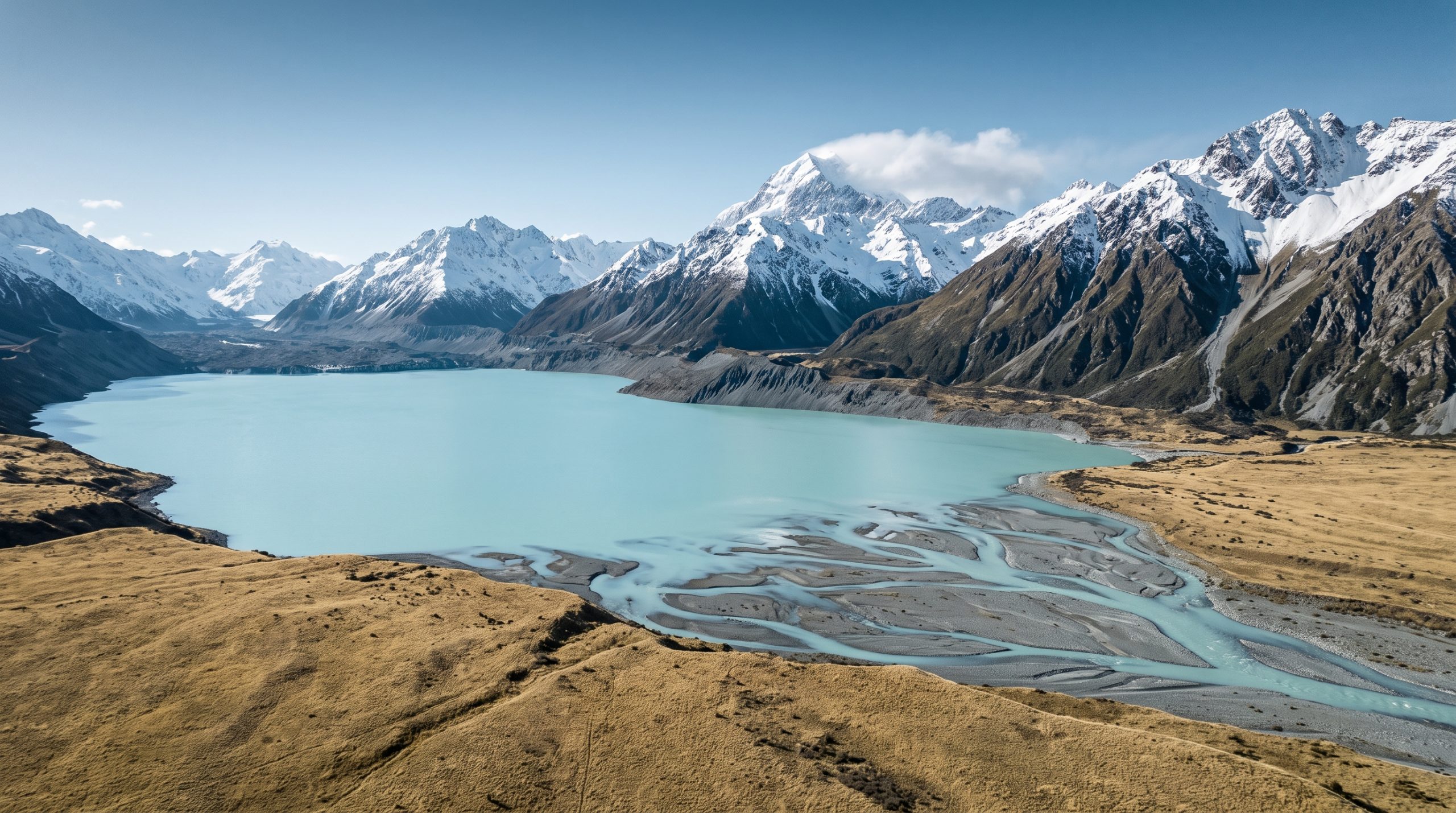
The almanac says the sun clears the horizon in Queenstown as early as 5:50 am in the second week of December. The ridge lines say otherwise. Every valley in the Southern Lakes holds its own shadow for a while after that, and the gap between standing in flat blue light and standing in the first warm light of the day usually comes down to which side of the lake you picked, and how high above it you are.
That is the kind of thing worth getting right before anyone books a flight. Mid-winter here gives you nearly seven hours less daylight than the December solstice: in late June the sun does not appear until 8:23 am, and mid-June sunsets come as early as 5:11 pm. A June elopement can start after breakfast and still hold good light all the way to the ceremony. A January one starts in the dark, in a car, with headlights on gravel.
We are Unmapped Stories, eight photographers and filmmakers who work worldwide. New Zealand is one of the countries we plan most carefully, because almost nothing here is more than a few hours from something completely different, and the weather across those few hours rarely agrees with itself.
Aoraki, Fiordland and Wānaka: what we cover here
We photograph, film and plan New Zealand elopements as one team, not a photographer plus a separately hired videographer. Coverage starts at $4,900 for a full day with one dedicated photographer or filmmaker, and a two-person photo and film crew is the step above that. Team travel to New Zealand is included, flights and accommodation for the crew.
Mountain shadow, not almanac time: how the hours get built
A New Zealand day is planned backwards from the moment light actually reaches the ground where you will be standing, which is rarely the time printed next to the word sunrise.
In December that means an alarm most couples would rather not think about. If the plan is a ridge above Lake Wānaka, the climb starts in the dark, because Roys Peak Track gains over 1.2 kilometers of vertical from a car park on Mount Aspiring Road, seven kilometers out of town. It also closes for lambing from 1 October to 10 November every year and reopens on the 11th, which is one of those dates that quietly decides a whole itinerary. The track crosses working farmland, so gates get left exactly as we found them.
The gentler shape of the same morning is the valley floor. On the Aoraki side of the Alps, the Hooker Valley Track runs 10 kilometers return and takes three to four hours at a walking pace, on gravel with the occasional set of steps, from the White Horse Hill car park to a glacial lake sitting directly under New Zealand’s highest mountain. The Department of Conservation charges for parking there, currently NZ$2.50 per half hour with a day rate of NZ$25, and anything under 20 minutes is free. That fee structure tells you everything about how most visitors use the valley. We pay the day rate and go slowly. In spring you get the Mount Cook buttercup along the track edges. The head of the valley holds Tōpuni status and is deeply significant to Ngāi Tahu, which shapes how we work there: quietly, on the track, without spreading out.
Late morning through mid-afternoon is when we drive, eat, change clothes and reposition. High sun in an alpine bowl is unkind to faces and to film, and pretending otherwise costs you the part of the day that matters. So the middle hours become the transit hours, and we say that plainly in the timeline rather than filling them with something for the sake of it.
Then December hands back what it took at 4 am. The evening light run is long, warm and slow, holding past 9 pm, and it is genuinely two hours of usable material rather than twenty minutes of scramble. Ceremonies often land in that window. In June the same window arrives before dinner, which is why winter couples get a completely different, much more civilized day for the same coverage.
When the forecast turns, which in Fiordland is standard
Milford Sound averages 6,813 millimeters of rain a year, spread across roughly 182 days. Up to 250 millimeters can arrive inside 24 hours, and the two wettest months are December and January, exactly when most couples want to be there. Rain in Fiordland is not the exception to the plan. It is the plan’s raw material, because the temporary waterfalls that make those cliffs famous only exist while it is falling.
What that means in practice is a set of decision points rather than a single hope. Access to the fiord is one road, State Highway 94, 119 kilometers from Te Anau with no turn-offs, so a Milford morning gets based in Te Anau rather than driven from Queenstown at 3 am. We check the road status the evening before and again at first light. Each hour of the timeline carries a second location that is closer, lower and more sheltered, and where permissions are needed we arrange them for more than one site so that moving is a choice rather than a problem. Couples who arrive expecting to shoot in rain, with dry clothes waiting in the car, get the version of Fiordland that people fly across the world to see.
If you already have a date in mind, or three possible weeks and no idea which one is right, tell us and we will map the light against them. Check Your Date.
One walk in, two cameras: how photo and film share a track
On a day where the good window might be 40 minutes long and the walk in takes 90, everything reduces to packing and timing decisions. That is where hiring photography and film separately starts to cost you something that has nothing to do with money.
Two vendors who met that morning bring two pack lists, two views on how early is early enough, and two ideas about who owns the wide shot. When the wind picks up on a ridge, they negotiate. Our photographer and filmmaker have planned the same timeline, driven the same road and agreed on the frame before the alarm went off. One decision gets made about turning back or pushing on, and it gets made by people who have made it together before. There are eight of us, so there is always a second camera on the ground and a colleague in reserve.
It changes the ceremony itself, too. You say your vows once. Nobody asks you to repeat them for a second angle, because the second angle was already covered from a position chosen with the filmmaker standing there. On the Expedition, professional audio runs at the same time, which matters more here than in most places: river noise at the head of the Hooker Valley and wind coming down a lake are both loud, and where microphones go is a decision made with the camera positions rather than after them.
Aerials are a permitted activity in New Zealand, not a spontaneous one. Drone use on public conservation land needs a permit from the Department of Conservation, which maps that land into green, orange and red zones, charges an activity fee, and expects operators to follow Civil Aviation Authority rules. Filming commercially on conservation land needs a concession of its own. We research and apply for what a location requires, and we build the film so that it never depends on getting airborne. If the wind rules out flying on the morning, the scale comes from the ground instead, from a second operator who is already there with a long lens on the other side of the river. Our published galleries and films sit in our collection of stories, and New Zealand is the clearest place to see what that dual coverage produces: the same hour, held as stills and as motion, with the sound of it.
Everything that travels with the team
Photo, film and planning are one service. The list below is what every experience carries, in New Zealand and everywhere else we work.
- Destination and location design, built around your date rather than a standard route.
- A custom timeline shaped by real light and real travel time, including the drive from Te Anau and the walk in from the car park.
- Permit research and logistics guidance for conservation land, councils and private landowners.
- Weather alternatives and backup planning for every hour of the day.
- Drone footage where it is legal, safe and appropriate.
- Professional audio for vows and meaningful moments on the Expedition, where conditions allow.
- Team travel worldwide: flights, accommodation and ordinary travel for the assigned team, with no long-haul surcharge for New Zealand.
- Highlights delivered in 5 days. The full gallery or film in 3 weeks.
Guest count does not change the fee. It changes access, permits, transport and the timeline, all of which we plan around, but the price is the price whether it is the two of you or twelve people on a lake shore.
Where coverage starts, and what you pay locally
One full day with a dedicated photographer and a dedicated filmmaker working together is the Expedition, from $7,900. One full day with one or the other is the Adventure. Two to seven days across one or several regions is the Odyssey, quoted as a custom proposal. There is no half-day version, in New Zealand or anywhere. Full detail sits on the coverage and pricing page.
Because team travel is included, the flights that get us to the South Island are not your problem. What sits outside our fee are the third-party costs New Zealand itself adds, and they are mostly small.
| Cost | Who pays it |
|---|---|
| Flights, accommodation and ground travel for the assigned team | Us, worldwide |
| Location design, timeline, permit research, weather planning | Us |
| Marriage licence from the New Zealand registrar, currently NZ$158 | You, direct |
| Your celebrant | You, direct |
| Conservation, council or landowner permit fees where a site requires them | You, direct |
| Trailhead parking, such as NZ$25 for a day at White Horse Hill | You, direct |
| Helicopter, boat or 4×4 charter, and mountain guides | You, direct |
| Your accommodation, vendors and activities | You, direct |
Six steps from first message to a planned day
- You send the inquiry form with your date, or the weeks you are considering.
- We reply within 24 hours with our initial brochure and first thoughts on regions and light.
- We build a tailored proposal around the day you actually want, not a package.
- You sign the contract and pay a 30% retainer. The remaining payments are set out in the proposal.
- Planning begins: locations, timeline, permits, celebrant coordination, weather alternatives.
- In the final weeks we lock the timeline, confirm permissions, and then confirm the morning against the forecast with you the evening before.
If you are earlier in the process than that, our guide to planning an elopement covers the fundamentals before any of this applies.
Gravel underfoot, plans that move: who this country fits
New Zealand rewards a particular kind of traveler. Couples who do well here are comfortable on uneven ground for a few hours, happy in a car for long stretches between very different landscapes, and relaxed about hearing at 8 pm that tomorrow now starts on the other side of a range. That last one is the real test. The couples who get the best days are the ones who treat the moving plan as part of the adventure rather than a failure of the original one.
It is also a country with genuinely different personalities by month and by region. If a 3 am start is not your idea of a good morning, say so, and we will build a June or July day where the light arrives at a sensible hour. If you want your odds of dry, still air as high as they go, we point you east of the main divide rather than into Fiordland, and toward late summer and autumn rather than the wettest weeks of December. If you want the fiord in full flood, we plan for water and dress for it. There is a shape of day here for all three, and the fastest way to find yours is to tell us in plain language what a good morning looks like to you. Our destination guides are a useful place to compare regions while you decide.
Common questions
Do we need a permit to elope in a New Zealand national park?
Filming commercially on public conservation land requires a concession from the Department of Conservation, and drone use on that land requires a separate permit. Exactly which permissions apply depends on the site, so we check each location in your plan during the planning stage and handle the applications. The fees themselves are paid by you, direct.
How far ahead do we apply for our New Zealand marriage licence?
You need to arrange it at least three working days before the date, and the registrar takes at least three working days to issue it, so we build a buffer rather than cutting it fine. Once issued, the licence stays valid for three months. We share our weather alternative for the ceremony site with your celebrant during planning so the paperwork and the plan match.
Can one team do both photography and film, or do we need a separate videographer?
One team. A dedicated photographer and a dedicated filmmaker from the same eight-person group plan the day together and shoot it together, which is why you never repeat your vows for a second camera. Choosing one discipline instead of two is also an option, and both shapes are listed on our pricing page.
What happens if it rains on our Milford Sound day?
We shoot. Milford gets rain on around 182 days a year and the waterfalls that make it extraordinary only run while it is raining. Every hour of the timeline carries a sheltered, lower alternative closer to Te Anau, and where permissions are needed we arrange them for more than one site so we can move without paperwork problems.
Can you fly a drone at Aoraki/Mount Cook?
Only with a permit. The Department of Conservation requires a permit for drone use on conservation land, sorts that land into zones, charges an activity fee, and expects Civil Aviation Authority rules to be followed. We apply where aerials are worth having, and we design the film so that it stands up completely without them.
How long is the drive from Queenstown to Milford Sound?
Around 288 kilometers and about four and a quarter hours each way, which is why we do not do it as a return day trip from Queenstown. From Te Anau it is 119 kilometers on State Highway 94 and worth allowing close to three hours with stops. Flying in from Queenstown takes roughly 40 minutes instead.
When do we get our photos and film?
Highlights land in 5 days, while you are still traveling. The full gallery or the finished film follows in 3 weeks.
Are you taking New Zealand bookings for 2027 and 2028?
Yes. Our planning calendar for New Zealand currently covers 2027, 2028 and 2029. A date is held once the contract is signed and the 30% retainer is paid, and we reply to every inquiry within 24 hours.
Choosing your month, and the first message
We handle the planning in writing so nothing depends on matching time zones, at whatever hour suits you: you write, we reply within a day, and the plan builds up over email while you get on with your life on the other side of the world. Tell us the date or the weeks you are weighing up, the kind of morning you actually want, and how far you are willing to walk before breakfast, and we will tell you honestly which region and which month give you that. Tell Us Your Story.