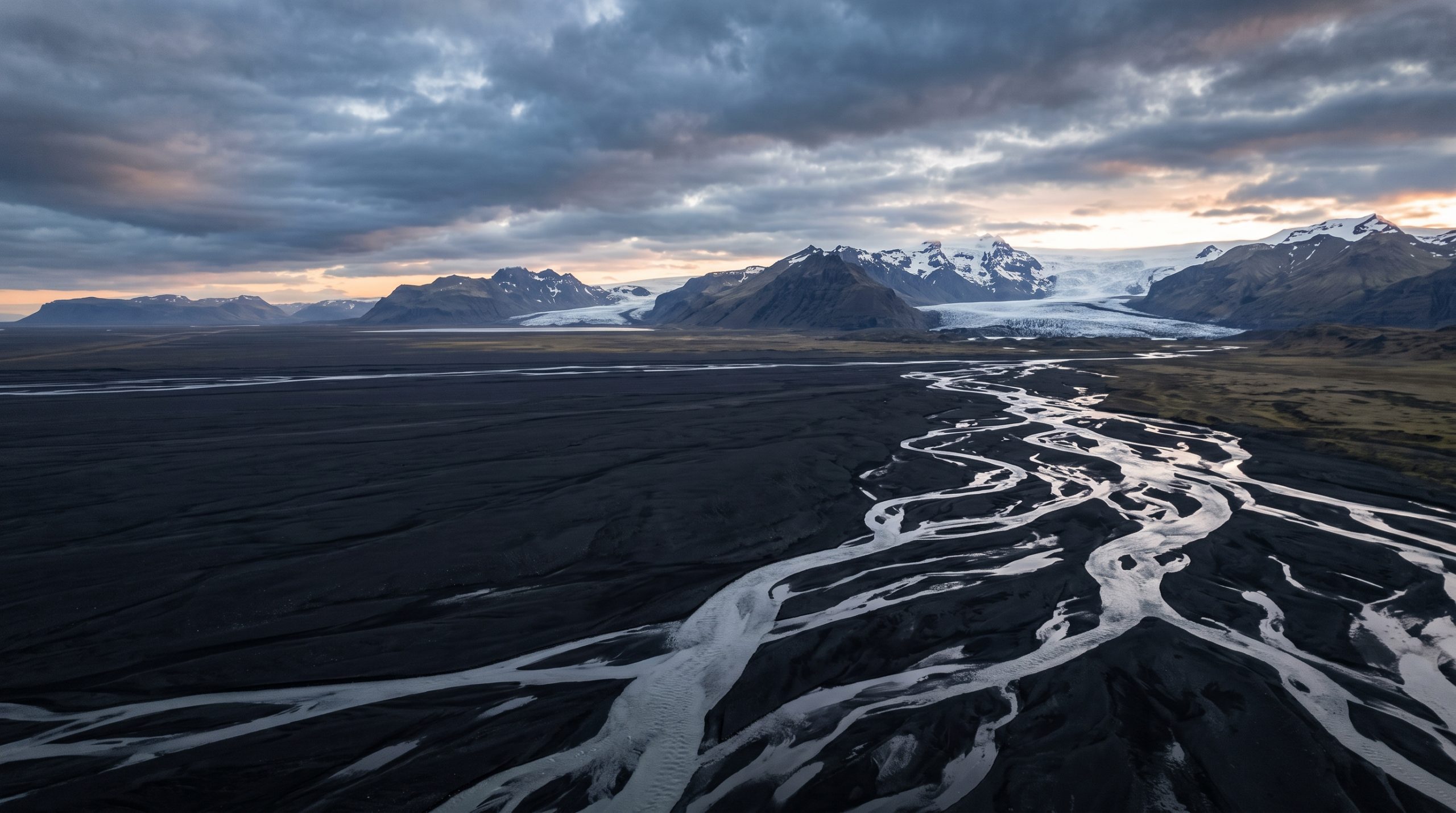
Iceland keeps GMT all year while sitting almost twenty-two degrees west of it, so the sun peaks over Reykjavík at about 13:21 in mid-September rather than at noon. That single quirk moves everything. The evening light you have seen in other people’s films is happening later than instinct suggests, the morning stays soft for longer than you expect, and both facts are the first things we work out when a couple asks what a day here costs. Cost in Iceland is really a question about hours and distance.
The second thing worth knowing early: an Iceland elopement arrives as two separate bills. One is what a photography and film team charges, which is a fixed figure you can read before you write to anyone. The other is what the country charges. The 1,000 ISK machine in the Þingvellir car park, which is under ten dollars at recent exchange rates. The landowner’s gate at Kerið. The certified guide who has to be alongside you for anything on glacier ice, and the 4×4 that reaches ground a rental car will not.
This page sets out the first bill in full and gives an honest account of the second, for couples planning 2027. If you are still choosing between the south coast, Snæfellsnes and the highlands, our destination guides go location by location.
Iceland elopement cost, in one paragraph
Photography, film and planning in Iceland come from one team of eight. A full day of coverage starts at $4,900, and team flights, accommodation and travel are included worldwide. You pay Iceland directly: permits and parking, accommodation, a celebrant, and any 4×4 or helicopter charter your chosen locations genuinely need.
A September day, from 06:00 blue light to 20:18
Late September is the month most couples land on once they see the numbers, so here is a real one. On 18 September 2027 the sun rises at Vík at 06:47 and sets at 19:31, with usable blue light from 06:00 in the morning and until 20:18 at night. That is 12 hours 45 minutes of daylight, and the country is shedding it at about six and a half minutes every twenty-four hours. The first of September gives you 14 hours 35 minutes. The thirtieth gives you 11 hours 28 minutes. Choosing a date three weeks apart in the same month changes the shape of your day more than the location does.
We put couples on the south coast the night before, usually within twenty minutes of the first location. Waking in Reykjavík and driving 180 kilometres east in the dark costs you the best hour of the day, and no timeline recovers it.
06:00. Blue light in the room. Rings, the letter one of you wrote at the kitchen table in March, boots by the door, weather app open on the bed. This is quiet work and it photographs beautifully in low light.
06:47. Sunrise on the black sand. The sun clears the horizon and then climbs at a lazy angle, staying under six degrees until 07:48. That is 61 minutes of light that makes everyone look like the best version of themselves. We work the upper beach here, planned around the tide table and the wind direction, with a sheltered alternative fifteen minutes inland if the swell is running big.
08:00 to 11:00. The light hardens, which is exactly when the canyons and the waterfalls become the right answer. Inside Gljúfrabúi the walls do the diffusing for you. At Skógafoss the spray catches a higher sun better than a low one. Rain jackets go on and off four times in this window and nobody minds.
11:30. Vows, if you want them in daylight and with guests present. Mid-morning suits a celebrant’s travel, gives your witnesses somewhere warm to stand, and leaves the whole afternoon open.
13:09. Solar noon on the south coast, with the sun at its highest for the year’s late season. We use the middle of the day for the drive, for a long lunch, for the glacier tongue if that is on your list, or for a hot spring. We put nothing precious against high sun.
18:30. The sun drops back under six degrees and the day gives you its second hour. Sea stacks, a headland, whatever the wind has left open.
19:31. Sunset. Then the part most timelines throw away: 47 minutes of blue light until 20:18, when the sky is still bright enough to hold a silhouette and the sea has gone silver.
Two other months rewrite this completely. On 21 June the sun rises at 02:55 in Reykjavík and sets at 00:03, and it sits below six degrees for six hours and forty-six minutes without interruption, from 22:06 straight through to 04:52. There is no golden hour in June because the whole night is one. On the winter solstice you get 4 hours 7 minutes of daylight and the sun never climbs higher than two and a half degrees above the horizon, which means every minute you have is low, raking and gold. Short is not the same as bad.
If you want a considered opinion on which of those three days suits the two of you, Check Your Date and tell us what your ideal morning looks like.
Two cameras, one plan, and 61 minutes of low sun
Here is the arithmetic that makes Iceland different from a soft continental morning. On that September day the sun is under six degrees for 61 minutes at dawn and about 61 again at dusk. Two good hours inside a twelve-hour day. If your photographer and your filmmaker met for the first time at breakfast, the first fifteen of those minutes go on negotiation: who stands where, who gets the walk-in, whether the drone goes up now or after the vows.
We do not run that risk, because photography, film and planning are one service from one team. The person who designed your timeline is the person holding the camera at 06:47. On The Expedition a dedicated photographer and a dedicated filmmaker work the same hour together, having already agreed the plan for it days earlier.
Wind is where this stops being theory. The Icelandic Met Office reports wind in metres per second and you learn to read it fast: 8 m/s is a good hair day, 18 m/s is a different plan on the same coast. In real wind the photographer and the filmmaker want opposite things. A veil reads best shot into the wind. Audio survives only with the wind at the back of the mic. A pair who have not worked together take turns and lose half the light; ours position the two of you once, so the vows are recorded clean and the frames still have movement in them. The Expedition includes professional audio for vows and meaningful moments where conditions allow, and that clause is doing real work in Iceland.
Eight of us means something practical too. There is always a second camera on the ground and a colleague in reserve. If you want to see what the pairing actually produces on Icelandic ground, the galleries and films on our stories page are the honest answer, wind and cloud and all.
The weather question, and the two-coast plan behind it
Nearly every couple asks this one, usually last, usually in the same words: what happens if the weather is bad. The answer is not reassurance, it is geography. From Reykjavík the south coast is 180 kilometres east, Snæfellsnes is about 180 kilometres north, and Reykjanes is forty minutes southwest. Those three sit in genuinely different weather. A wind that closes one side of a headland opens the other.
So we plan a primary region and a real alternative in a different wind shadow, then a second alternative inside twenty minutes of the first location so the timeline itself survives a change. We watch the Met Office forecast and the road administration’s conditions map, we send you our read the evening before, and we look again over coffee at 06:15. Unless a permit fixes the spot, the final decision on where you stand for your vows can wait until the morning itself.
Cloud is not the enemy anyone thinks it is. With a maximum sun altitude of 27.7 degrees in mid-September, a grey deck over the south coast gives you an enormous soft light source for the whole day. Rain travels here rather than settling, and a shower that looks final from the car park has usually moved on within half an hour. What we plan hardest around is not water, it is wind direction and the hour the coaches arrive at the well-known stops. Both are predictable. Both are solvable by being somewhere else at that hour.
What the fee covers, and where it starts
Nothing here is an add-on we hold back until the proposal. This is the standard shape of every experience we run, in Iceland and everywhere else.
In every experience
- Destination and location design, with the driving times checked rather than guessed.
- A custom timeline built around real light and real travel time, of the kind set out above.
- Permit research and logistics guidance, including which of your locations sit on private land.
- Weather alternatives and backup planning, in more than one region.
- Drone footage where it is legal, safe and appropriate. Aerials near the national parks run on a permission and a time window, so we confirm both before the film is designed around them.
- Professional audio for vows and meaningful moments where conditions allow, on The Expedition.
- Team travel worldwide. Flights, accommodation and ordinary travel for the assigned team, in Iceland exactly as in Patagonia, with no long-haul surcharge.
- Highlights delivered in 5 days. The full gallery or film in 3 weeks.
Where coverage starts
The Adventure is one full day with one dedicated photographer or one dedicated filmmaker, at the starting figure quoted near the top of this page. The Expedition is one full day with a dedicated photographer and filmmaker working together, from $7,900. The Odyssey runs from two to seven days across one or several destinations, photography and film, quoted as a custom proposal. There is no half-day option in Iceland, because a half day here is a bet on one weather window. Guest count does not change the fee. It changes access, permits, transport and timeline, which is a planning conversation rather than a pricing one. The coverage page lays all three side by side.
What Iceland charges directly
| Cost | Who charges it | How we handle it |
|---|---|---|
| Parking at the major sites | Park authorities and landowners | Most big south coast and Golden Circle stops now charge by the car for the day. At Þingvellir a single payment covers P1 at Hakið, P2 below Öxarárfoss and P5 beside the church, so we route the whole morning as one loop. |
| Entry at privately owned sites | Landowners, at the gate | Kerið is the obvious one. You get the list of which locations on your shortlist have a gate before the timeline is fixed. |
| Permit fees | Government, park, venue or landowner | The research, the application and the follow-up are ours. The fee is yours, and it is usually modest next to the car rental. |
| Celebrant and legal paperwork | Your celebrant, and the district commissioner for a civil marriage | Icelandic civil marriage runs through the sýslumaður’s office. We build the timeline around the hour your celebrant confirms. |
| Accommodation, car, food | Hotels, guesthouses, rental companies | We tell you which town to sleep in so the first hour of light is twenty minutes away instead of two hours. |
| Charters and specialist guides | Licensed operators | A super jeep for highland or beach-track ground, a certified glacier guide for anything on ice, a helicopter for a ridge, a private boat. Priced in krónur by the operator. We say plainly which ones your locations actually need and which ones the day does not miss. |
From first message to a planned day, in six steps
- You send the inquiry form with your dates, your rough region and anything you already know you want.
- We reply within 24 hours with our initial brochure.
- We put together a tailored proposal for your date and your locations, including what Iceland will and will not allow in that month.
- You sign the contract.
- You pay a 30% retainer. The remaining payment schedule is set out in the proposal.
- Planning begins in earnest: location design, the timeline, permit research, the alternatives.
Our current Iceland availability runs across 2027–2029. If you are earlier in the process than the inquiry form, our guide to how to plan an elopement covers the fundamentals first.
Who does well on an Icelandic day
The couples who love it here are the ones who are genuinely fine with a 05:45 alarm, uneven ground under good boots, and an hour of wind on the face in exchange for a beach nobody else is standing on. They arrive with a shortlist rather than a script. They accept, in advance, that the location for their vows might change at 06:15 and that this is the plan working, not the plan failing.
If a pre-dawn start on black sand is not your idea of a good morning, say so in your first message, because Iceland has other shapes. June hands you low light from 22:06 to 04:52 and a ceremony at 21:00 in full gold. Late December gives you four hours of daylight with the sun never higher than two and a half degrees, a slow start, and a real chance of aurora over the same landscape. February sits between them, with 8 hours 30 minutes of light on the fourteenth and a sun that never climbs past thirteen degrees. Tell us the day you actually want and we will either shape it around you or tell you honestly which month and which region fit it better.
Common questions
How much should we budget in total for eloping in Iceland?
Start with our coverage, which is a fixed figure and already contains the team’s flights and accommodation. Then add the Icelandic costs you pay directly: accommodation, a rental car, a celebrant and the civil paperwork, permit fees, parking at around 1,000 ISK a car per day at the ticketed sites, and any charter or specialist guide your locations require. Most couples find that second list smaller than they feared.
Do we have to pay for your flights and hotels to get to Iceland?
No. Team travel is included worldwide, with no European or long-haul distinction. Iceland is priced the same way as anywhere else we work.
Is a rental car enough, or do we need a super jeep?
For Route 1 and the south coast stops in summer, a normal car is fine. Winter conditions, beach tracks and anything beyond a marked road change the answer, and the highland F-roads open in stages with the dates published each spring rather than fixed in advance. Plan on them being shut through May and often into June. Where a super jeep genuinely opens up a location we will say so, and where it only adds a bill we will say that too.
Can we legally get married in Iceland as Americans?
Yes. Civil marriage runs through the district commissioner’s office, the sýslumaður, and your paperwork goes in ahead of the date. We guide the logistics and build the day around the hour your celebrant confirms. Plenty of couples we work with hold their ceremony on the ice or the sand and complete the legal signing at home, which is also a perfectly good plan.
What happens if the forecast turns the morning of our date?
We move inside the plan we already built. There is a primary region, an alternative in a different wind shadow, and a third option within twenty minutes of the first location. We send our read the evening before and confirm at 06:15. Nothing about the day gets cancelled for weather.
When do we get our photos and film?
Highlights reach you in 5 days, while you are quite possibly still in the country. The full gallery or the finished film follows within 3 weeks.
Is September or February the better month for an Iceland elopement?
September gives 12 hours 45 minutes of daylight in the middle of the month, an hour of low sun at each end, and enough true darkness for aurora. February gives 8 hours 30 minutes, with the sun under six degrees for the first eighty minutes and the last eighty, snow on the black sand, and quieter car parks. September is the safer bet on road access. February is the stronger look.
Can you fly a drone at the locations we have picked?
Often, and we include drone footage where it is legal, safe and appropriate. Around the national parks aerials need a permission and a time window, so we confirm both in the planning stage and design the film around what is actually cleared rather than what we hoped for.
Pick your month, then tell us the rest
The most useful first message is short: your rough dates, whether you want photography, film or both, and one sentence about the morning you keep imagining. From the first reply onward, the whole process stays in writing. The form, our reply and brochure within 24 hours, the proposal, the planning notes, the 06:15 forecast read on the day itself. You can read all of it at whatever hour suits you, from whichever time zone you are in.
We are holding dates across 2027 now, and the light on 18 September will do what it does whether or not anyone is standing in it. Tell Us Your Story and we will tell you exactly what your date makes possible.