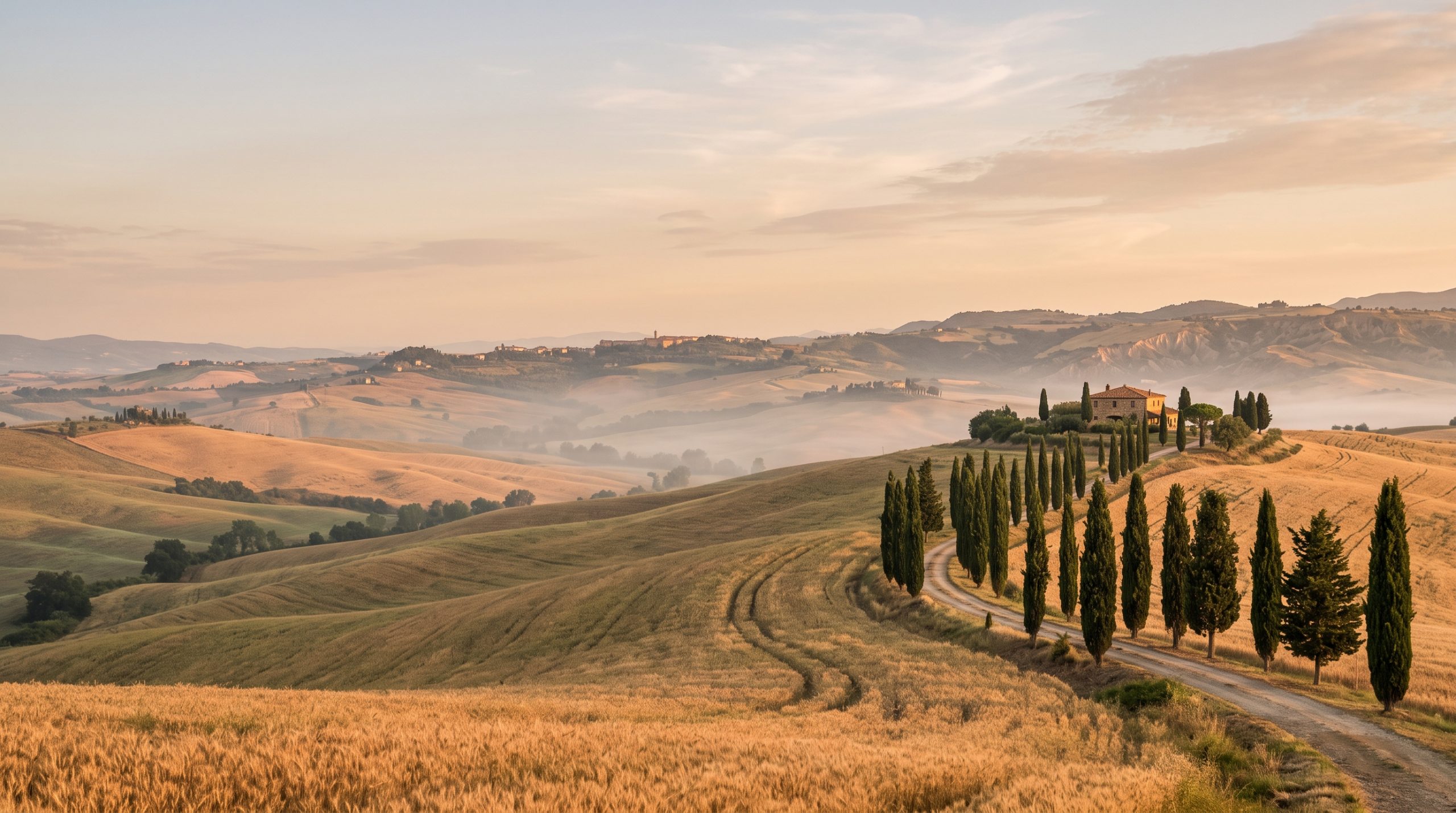
In mid-June the sun clears the horizon over Val d’Orcia at about 5:34, and for the next ninety minutes the SP146 between Pienza and San Quirico d’Orcia belongs to farm traffic, two or three photographers, and whoever set an alarm for four. By ten in the morning the same stretch of road has cars on both verges at the cypress cluster. This valley is not a secret and has never pretended to be.
What it still hands out for free is that first hour. Val d’Orcia has been a UNESCO World Heritage Site since 2004, and it was inscribed as a cultural landscape rather than as a view: chalk plains out of which rise almost conical hills, fortified villages on top, farmhouses, and the Roman Via Francigena running through the middle. That word cultural is a useful warning. These are working fields. Wheat that is green in early May is gold by mid-June and cut a few weeks after that, and the photograph you saved eighteen months ago was made in a crop rotation that has since moved to the next hill.
We are Unmapped Stories, eight people: four photographers and four filmmakers. We design the day, and then we are the ones who show up and shoot it. In this valley that matters more than it sounds, because the real work here is deciding which ninety minutes you spend on which ridge.
Photo, film and planning across Val d’Orcia and southern Tuscany
We photograph and film elopements across Val d’Orcia, the Crete Senesi and southern Tuscany, and the planning is ours too: locations, timeline, permit research, weather alternatives. One full day with a dedicated photographer or filmmaker, or with both working together, and team travel to Italy included. Coverage levels sit on our pricing page.
First light at five, last light at half past nine
Mid-June is the extreme version of a Tuscan day and the easiest one to explain. Civil twilight opens around five, sunrise lands at about 5:34, and the earliest sunrise of the year in this part of Tuscany falls on June 14 at 5:32. At the other end, the sun goes down close to 8:55 and the latest sunset of the year is June 26, at 8:59 pm. There is usable light until roughly half past nine. Two generous ends, and thirteen hours in between that need a completely different plan.
Here is how we normally build it. A 4:15 departure from wherever you are staying, because twelve kilometers of provincial road in the dark takes longer than any map suggests and nobody wants to arrive at a ridge already late. From five to half past, the valley goes from grey to blue to copper, and on a cool morning the low ground along the Orcia river holds mist while the hilltops sit clear above it. From 5:34 the light comes in almost horizontally, which is the only hour when the terraces below Pienza show their shape and the chapel roofline near San Quirico reads as a form rather than a building. That is your first working window, and it is about ninety minutes long.
By seven we are usually somewhere with stone instead of wheat. The thermal basin in the middle of Bagno Vignoni, the walls of Pienza and the empty length of Piazza Pio II, the lanes of Monticchiello. Pienza was rebuilt in the 15th century as a Renaissance ideal city on the instructions of Pope Pius II, and at seven in the morning you can walk the whole of it in fifteen minutes with the shutters still closed.
Then comes the part most timelines pretend does not exist. Between about eleven and half past five, Val d’Orcia in high summer is hot and flat. Visit Tuscany puts July and August temperatures between 27 and 40 degrees Celsius, and the light straight overhead flattens exactly the ridges you came for. So we plan against it: a civil or symbolic ceremony in the late morning while the air is still moving, a long lunch under a loggia, an actual rest, then hair and makeup back to itself before we go out again. If a comune ceremony slot is fixed for a particular hour, we build the rest of the day around that hour instead of arguing with it.
The evening window is longer and softer than the morning one. Out again by six, twenty-five kilometers toward Montalcino if the film wants a different valley, and the last hour before 8:55 is the one that makes people quiet. Silhouettes work until nine and dusk holds until half past.
The cypress trees everyone photographs
We should be straight about this, because it is the thing couples worry about and most sites skate over it. The roadside cypress cluster on the SP146, the view toward the little chapel between Pienza and San Quirico, the zigzag of trees in the Crete Senesi: all of them are photographed every single day of the season, and by nine in the morning there are cars, tripods and tour minibuses at the pull-ins. Mid-morning at the famous spots is crowded and, honestly, flat.
The planning answer is not to avoid them. It is to be there in the dark, to know which of them face the sunrise and which only work at sunset, and to have permission arranged in advance for private ground where the same shapes appear without a road in the frame. We do that research as part of the booking, we tell you which access needs a landowner’s yes, and we keep a second option fifteen minutes away for the morning the light does something else. Famous shapes are one element in your day. They are not the day.
If you already have dates in mind, send them over and we will tell you exactly what the light does that week: Check Your Date.
| Month | Sunrise | Sunset | What the ground actually looks like |
|---|---|---|---|
| Mid-May | 5:50 am | 8:30 pm | Green wheat, poppies on the verges, cool enough to walk uphill in a dress |
| Mid-June | 5:34 am | 8:55 pm | Wheat gold and full, harvest about to start, warm evenings |
| Mid-July | 5:47 am | 8:51 pm | Stubble and plowed brown, sunflowers wherever the rotation put them |
| Mid-September | 6:53 am | 7:23 pm | Grape harvest, heavy vines, mist in the low ground on cool mornings |
| Mid-October | 7:27 am | 6:31 pm | Bare chalk and olive picking, low sun most of the day |
Those times are for Pienza on Central European Summer Time, and they change the whole character of a booking. A September day starts at a civilized 6:53 and still ends with dinner at eight. By mid-October the sun never climbs high enough to hurt anything, so the day stops being two windows with a gap and becomes one continuous stretch of workable light.
Two cameras on the same ridge, one plan
This is the part of our work that is hardest to see from the outside, so here is what it changes on a Val d’Orcia ridge specifically.
The good morning light lasts about ninety minutes. With one person on the ground you spend those ninety minutes choosing: stills of you walking the crest, or the moving version of it. You cannot have both, and the compromise usually shows up as a photographer half-filming or a filmmaker half-shooting. With a dedicated photographer and a dedicated filmmaker in the same window, nothing has to be repeated for a second angle. Your vows happen once.
Wind is the other reason. These ridges are open chalk with nothing upwind of them, and a beautiful spot at 5:40 can have a steady breeze pushing across it. Audio has to be planned before you climb, not fixed afterward. Our Expedition includes professional audio for vows and the moments that matter, where conditions allow, which in practice means a filmmaker setting up sound while the photographer is already working, rather than one person apologizing and asking you to say it again.
Aerials are the third. The shot that makes a Val d’Orcia film feel like Val d’Orcia is the one that starts tight on the two of you and pulls back until the whole S-curve of cypresses is in frame. That needs you to keep walking for a continuous minute while somebody flies, and Italian aerial work runs under EASA and ENAC rules with a registered operator, an identification number on the aircraft and clearance for the specific ground you launch from. We include drone footage where it is legal, safe and appropriate, and we treat the flight as a planned block in the timeline with a second pair of hands still making photographs of the same walk.
Then there is the ordinary logistics of a valley where everything is close but nothing is quick. Pienza to San Quirico d’Orcia is around ten kilometers and twenty minutes with a dress in the back seat. Hilltop centers are limited-traffic zones, so the last few hundred meters are on foot. With two of us, one is scouting the next set-up and the exact patch of light while the other is still with you. You can see how the two halves come out of the same day in our published galleries and films, where the frames and the footage from a single morning sit side by side.
What travels with us to the valley
Every experience, from the single-day option upward, includes the following.
- Destination and location design, built around this valley’s light rather than a list of viewpoints.
- Full planning and a custom timeline based on real sunrise and sunset times and real driving times on the SP roads.
- Permit research and logistics guidance, including which comune, venue or landowner has to say yes.
- Weather alternatives and backup planning, because a Tuscan morning can arrive with cloud sitting on the hills.
- Drone footage where it is legal, safe and appropriate.
- Professional audio for vows and meaningful moments on the Expedition, where conditions allow.
- Team travel worldwide: flights, accommodation and ordinary travel for the assigned team.
- Highlights delivered in 5 days, and your full gallery or film in 3 weeks.
Your price does not change with guest count. Two of you or twelve of you, the fee is the same, and what guests actually change is access, permits, transport and the shape of the timeline. There is no half-day version of our work in Tuscany, because a half day here means giving up one of the two light windows.
Where coverage starts, and what Italy adds on top
The Adventure covers one full day with one dedicated photographer or one dedicated filmmaker, from $4,900. The Expedition covers one full day with a dedicated photographer and filmmaker working together, from $7,900. The Odyssey runs from two to seven days across one or several destinations and comes as a custom proposal. All three are set out in full on our pricing page.
Team travel is included, and it is included in Italy on exactly the same terms as anywhere else. Flights, accommodation and ordinary travel for the assigned team are ours. There is no European surcharge, no long-haul distinction and no travel line to negotiate.
What you pay separately in Tuscany, in euro, is worth knowing early:
- The comune tariff for a legal civil ceremony. Each municipality publishes its own annual rates, non-residents pay more than residents, and a room in the town hall costs less than a courtyard or an authorized off-site venue.
- Paperwork costs for American citizens. The US Embassy in Italy requires revenue stamps to apply for the Atto Notorio, currently two at 16 euro and one at 10.62 euro, plus the legalization of your sworn declaration at the Prefettura.
- An interpreter at the town hall if neither of you speaks Italian, and certified translations of documents.
- A celebrant, if you want a symbolic ceremony written for you rather than the registrar’s text.
- Accommodation, your agriturismo or villa, flowers, hair and makeup, dinner.
- Landowner or venue fees where private ground is involved. The research and the asking are ours; the fee is yours.
- Unusual transport only: a vintage car, a private driver, a 4×4 up a farm track.
How a Tuscany enquiry becomes a held date
- You send the inquiry form with your dates, or the month you are circling, and what you picture.
- We reply within 24 hours with our initial brochure and first thoughts on the light for those dates.
- We write a tailored proposal: the shape of the day, who from the team is assigned, the locations we would use and the paperwork Italy will want from you.
- You sign the contract and pay a 30% retainer.
- Planning begins in earnest: timeline, permit research, weather alternatives, and a calendar for the legal documents.
- The rest of the payment plan is written into your proposal, so there is nothing to guess at.
Who gets the most from a Val d’Orcia day
Val d’Orcia is generous to people who like mornings. If a 4:15 alarm in June sounds like an adventure rather than a punishment, you will get an hour on those ridges that almost nobody else sees, and it will be the hour your gallery is built on. You also want to be comfortable on uneven ground: chalk tracks, stubble, a short uphill walk with proper shoes in a bag and the good ones carried.
The other thing this place asks for is flexibility about the exact field. Farmers decide what grows where, and mist decides which morning it fills the valley. Couples who are happy to hear at 4am that we are going to the other side of the SP146 always end up with the better day.
If the June version does not sound like you, that is genuinely useful information and not a problem. Heat is the most common reason to move a date, and the fix is a month rather than a compromise: the last week of April and the first half of May give you green wheat and cool air, and the first half of October gives you low sun for most of the day, mist mornings and the olive harvest. If you want your ceremony inside a Renaissance town rather than out on a ridge, say so and we will plan around walls and stone instead. Tell us what your ideal morning looks like and we will either build it here or tell you honestly which month, or which corner of Tuscany, fits it better. Our destination guides are a good place to compare regions before you decide.
Common questions
How early do we actually have to get up for sunrise in Val d’Orcia?
In mid-June, sunrise is about 5:34 and we usually leave at 4:15 to be in position with time to spare. In mid-September that becomes a 6:53 sunrise and a 5:45 departure, and by mid-October you can leave around 6:15. If early mornings are not for you, we can build the whole day around the evening window instead.
Can two of you really cover both photography and film in one day?
Yes, and that is the Expedition: one dedicated photographer and one dedicated filmmaker, from the same team, working from one timeline we wrote. Nothing gets repeated for a second angle, sound is set up while stills are still being made, and the drone flies while the photographer keeps working.
What paperwork do Americans need to marry legally in Italy?
You need a sworn declaration from the US Embassy or your consulate in Italy, legalized at the Prefettura, plus an Atto Notorio, which can be sworn at an Italian consulate in the United States before you fly or in Italy after you arrive. The Atto Notorio needs two witnesses over 18 with photo ID and normally takes four to 10 working days, though an urgent version exists. We build those days into your timeline.
Can we just have a symbolic ceremony in a field instead?
Many couples do. A symbolic ceremony is not legally binding, so the legal marriage happens either at a comune or at home before or after the trip, and the ceremony itself can then happen wherever we have permission to stand. It removes the paperwork calendar from your Tuscan days entirely.
Will there be other photographers at the cypress trees while we are there?
At the well-known roadside spots from mid-morning onward, yes. At 5:15 in June, almost never. Our whole timeline is built to put you on the good ground before the pull-ins fill, and to use private access where the same landscape appears without a road in it.
Are drones allowed over Val d’Orcia?
Aerial work in Italy runs under EASA and ENAC rules, which means a registered operator, an identification number on the aircraft and permission for the ground you fly from. We confirm the airspace and the site before the film is planned around a flight, and we include drone footage wherever it is legal, safe and appropriate.
Which month has the gold fields we keep seeing in pictures?
Mid-June, usually, in the short stretch between the wheat ripening and the harvest. Green is late April into May, gold is June, and after the cut the same hills go stubble brown and then plowed chalk. Nobody can promise a specific field in a specific week, which is why we plan two or three alternatives inside twenty minutes of each other.
When do we see the photos and the film?
Highlights reach you within 5 days, while you are probably still in Italy or just home. Your full gallery or film follows within 3 weeks, edited by the people who were there on the ridge with you.
Write to us before you book the agriturismo
The single most useful thing you can do is tell us the month before the accommodation is locked, because in this valley the direction your window faces at 5:30 decides more than the pool does. The planning stays in writing from the first message onward, at whatever hour suits you: you send your dates and what you picture, and our reply and first brochure come back within 24 hours. Our Tuscany calendar is currently open across 2027, 2028 and 2029, and the earliest mornings are the ones worth planning first.
Tell us the week you have in mind and we will send back a real shape for the day, light times included. Tell Us Your Story.